Start free

Chatbase vs Decagon (2026): pricing, AI and features

By , founder of Rinhelp, which appears in this comparison · Facts checked

The short answer

Chatbase suits a small team that wants to sign up today for an AI agent trained on its website and documents, with a Helpdesk inbox where teammates take over and a printed monthly price. Decagon suits a large company with a busy chat, email and phone queue, a help desk it already runs such as Zendesk, Intercom or Salesforce, and an operations team to build the AI with Decagon’s engineers. A team of 5 pays $400 a month on Chatbase Business with annual billing, or $500 month to month, for 15,000 message credits. Decagon names a per-conversation or per-resolution rate only after a demo.

See Rinhelp on your own site. Enter your website and Rin builds your help desk from it: a chat widget, a help center and an inbox.

Free. No sign-up to look. Ready in a minute or two.

Is your help center somewhere else?

Rin will read . If your help articles or docs live at another address, like help. or a Notion page, Rin can read those too.

Where is your help center?

Rin reads it along with and turns it into your help center.

Chatbase vs Decagon at a glance

ToolBest forHow it billsFree plan3 people, 300 AI replies
ChatbaseTeams that want a chatbot on their website and messaging apps first, with a choice of models from OpenAI, Anthropic, Gemini and others, and a help desk second.Per plan, in message creditsNot on the pricing page: Basic and Business each start with a 7-day trial$120
DecagonEnterprises with a high-volume queue across chat, email and phone, and a support operations team to build and test the AI with Decagon’s engineers.Quoted by sales, per conversation or resolutionNo, buying starts with a demoQuote only
RinhelpSmall teams that want AI on every conversation at one flat price, and want their own AI agents working in the inbox.One price per workspaceYes: 3 teammates, 50 AI replies to try Rin$49

Key differences

Chatbase brings its own inbox, Decagon borrows yours

Basic and Business both include the Helpdesk, where a teammate takes over a live AI conversation and receives it as a ticket with an AI-written summary, so a team with no help desk gets an inbox without buying one. If you do keep one, its AI can file the ticket in Zendesk, Salesforce, Intercom, Freshdesk, Gorgias and others instead. Decagon isn’t a help desk at all: it answers through the Zendesk, Intercom, Salesforce, Gorgias, Kustomer or Gladly account your team already pays for, and escalates there.

A price list in credits against a rate set in negotiation

Chatbase prints its plans: Basic is $120 and Business $400 a month on annual billing, with 4,000 and 15,000 message credits, and each message on a recommended model spends 1 to 5 credits. When credits run out the chatbots go quiet until they reset, unless auto recharge buys more at $40 per 1,000. Decagon publishes no figure, only the shape of its deals: a fixed rate per incoming conversation or a higher one per resolution, cheaper at bigger volumes, and on the per-conversation option most customers pick, escalated conversations count too.

A 7-day trial against weeks with Decagon’s engineers

You can open a 7-day trial of Chatbase Basic or Business without a sales call and train the agent on your own website and documents. Decagon starts with “Get a demo” and offers no trial, and its rollouts run alongside Decagon’s own team, as its Rippling and 1-800-Flowers.com case studies describe. Duolingo went live a month after its first conversations with Decagon, a pace Decagon itself calls quick.

Phone on both, with 70+ languages on Decagon’s voice agent

Chatbase answers the phone from Basic, with 10 concurrent calls, or 20 on Business, and also covers WhatsApp, Messenger, Instagram, Slack and email beside your website. Decagon answers on web chat, SMS, WhatsApp, email and phone, and its voice agent speaks 70+ languages.

Your own AI can work Chatbase tickets; we found no official server for Decagon’s

On a paid Chatbase plan, Claude or ChatGPT can search conversations, reply to Helpdesk tickets or leave internal notes, and assign or close them through Chatbase’s official MCP server, though a trial signed up with a personal email gets an error. Decagon uses MCP the other way round: its AI calls MCP servers your company runs to look things up and take actions, and we found no official server for working inside Decagon.

Pricing at three sizes

What each tool costs a month in US dollars, with AI answering, and how each total adds up. Each AI reply counts as one resolved conversation.

Tool3 people, 300 AI replies5 people, 1,000 AI replies10 people, 3,000 AI replies
Chatbase$120Basic at $120 a month on annual billing ($150 monthly), the cheapest plan, with 3 members. Its 4,000 message credits cover 300 replies even at 5 credits each.$400Business at $400 a month on annual billing ($500 monthly), the first plan with 5 members. Its 15,000 credits cover 1,000 replies on any recommended model.$400 or moreBusiness at $400 a month on annual billing, whose 15,000 credits cover 3,000 replies at up to 5 credits each. It includes 5 members, and the other 5 need extra member slots, whose price the pricing page doesn’t show.
DecagonQuote onlyNo published rate: 300 conversations are priced per conversation or per resolution through Decagon’s sales team, and your help desk’s seats come on top.Quote only1,000 conversations are quoted after a demo, with no price on Decagon’s site, plus the seats of the help desk it escalates to.Quote onlyDecagon sets the rate for 3,000 conversations in a sales conversation, and the help desk your team works in is billed separately.
Rinhelp$49Pro for the whole workspace, using 300 of its 5,000 AI replies; Free covers your team if you don’t need AI replies.$49Pro for the whole workspace, using 1,000 of its 5,000 AI replies.$49Pro for the whole workspace, using 3,000 of its 5,000 AI replies.

Features compared

A check means the vendor’s own pages say a plan includes it.

ToolEmailLive chatWhatsAppVoiceHelp centerAI that answers customersShopifyStripeFree planSignup without a sales call
Chatbase
Decagon
Rinhelp

What your AI can do in each tool

Connect Claude, ChatGPT or your own AI agent through the vendor’s official MCP server, and this is what it can do of 11 everyday actions: search and read conversations, reply to a customer, add an internal note, assign, close or reopen, search the help center, write or update an article, publish an article, create a saved reply, look up an order, refund or cancel.

ToolThrough official MCPWhat it can doMoney moves wait for a teammate
Chatbase5 of 11Search and read conversations, reply to a customer, add an internal note, assign, close or reopenNo refunds or cancellations through MCP
Decagon0 of 11No official MCP server, or nothing from this listNo refunds or cancellations through MCP
Rinhelp11 of 11Search and read conversations, reply to a customer, add an internal note, assign, close or reopen, search the help center, write or update an article, publish an article, create a saved reply, look up an order, refund or cancelYes, a teammate approves first

More on each MCP server, and connectors from other companies, which don’t count:

  • Chatbase: The MCP server needs a paid plan, Basic or higher, and returns an error on a trial that signed up with a personal email address. Its tools cover chatbots, their sources, conversations and Helpdesk tickets, and a ticket message can be a reply the customer receives or an internal note only your team sees.
  • Decagon: Decagon’s AI calls MCP servers your company runs to look up data and take actions. We found no official MCP server that lets Claude or ChatGPT work in Decagon itself.

Chatbase

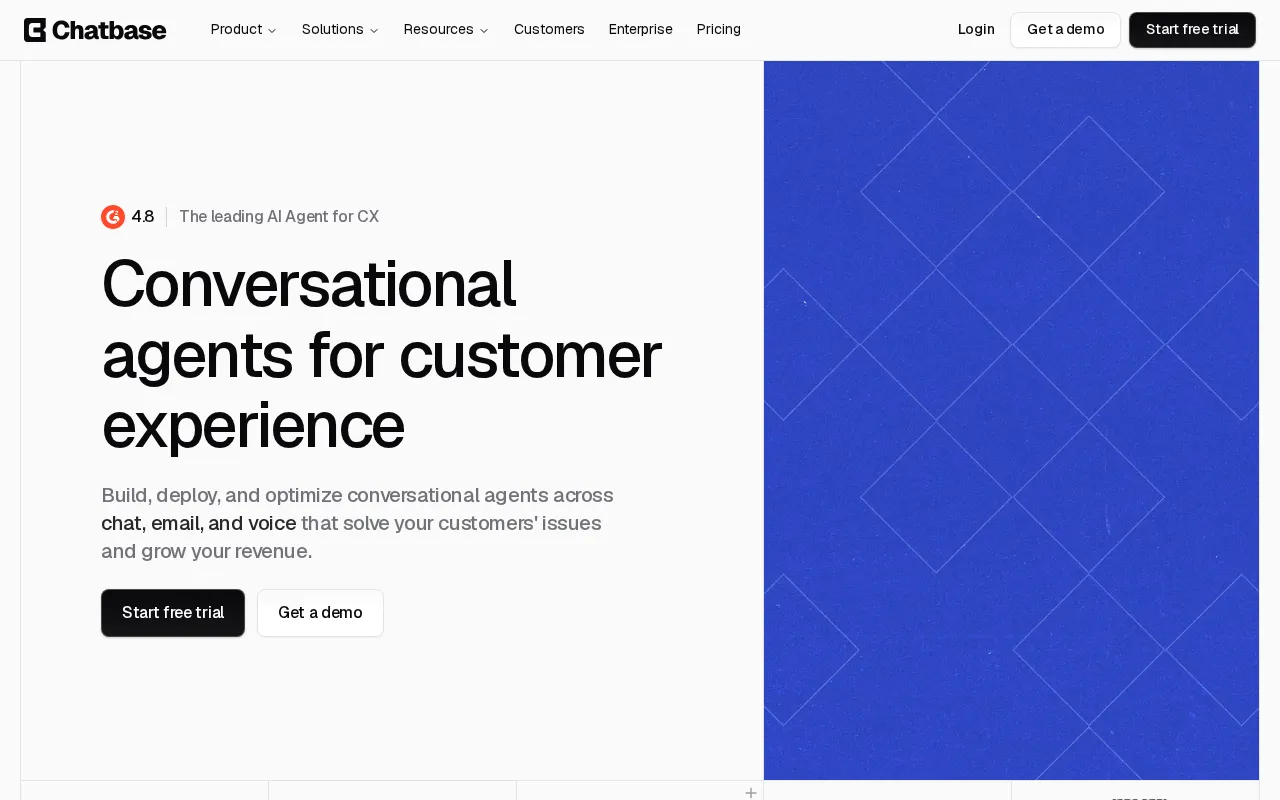
Chatbase homepage, November 2026

Chatbase builds an AI agent trained on your own content, such as your website and documents, and puts it on your site, WhatsApp, Messenger, Instagram, Slack, email and the phone. Its Helpdesk inbox, included from Basic, its cheapest plan, lets your team take over what the AI can’t solve.

Best for
Teams that want a chatbot on their website and messaging apps first, with a choice of models from OpenAI, Anthropic, Gemini and others, and a help desk second.
How it bills
Basic is $150 and Business $500 a month on monthly billing ($120 and $400 a month on annual billing), with 4,000 and 15,000 message credits and 3 and 5 members. The recommended models use 1 to 5 credits a message, unused credits don’t carry over, and auto recharge adds credits at $40 per 1,000.
Free plan
Not on the pricing page: Basic and Business each start with a 7-day trial
3 people, 300 AI replies
$120 a month: Basic at $120 a month on annual billing ($150 monthly), the cheapest plan, with 3 members. Its 4,000 message credits cover 300 replies even at 5 credits each.

Pros

  • Every plan includes advanced models from OpenAI, Anthropic, Gemini, DeepSeek, Mistral and others, so you choose the one each chatbot runs on.
  • The chatbot answers on your website, WhatsApp, Messenger, Instagram, Slack, email and the phone.
  • A teammate can take over a live AI conversation from the Helpdesk, which turns it into a ticket with an AI-written summary.
  • Its AI can escalate a conversation as a ticket to Zendesk, Salesforce, Intercom, Zoho Desk, Freshdesk, HubSpot, Help Scout, Gorgias or Odoo, with the customer’s details.
  • Its official MCP server lets Claude or ChatGPT search conversations, reply to Helpdesk tickets or leave internal notes on them, and assign or close them.

Cons

  • Members are capped by plan: 3 on Basic and 5 on Business.
  • When message credits run out, the chatbots stop responding until the credits reset, unless auto recharge buys more.
  • An action can make the chatbot send 2 or more requests to the model for one reply, and each one uses credits.
  • Removing “Powered By Chatbase” is a $99 a month add-on.

Already on Chatbase? See the best Chatbase alternatives.
Decagon

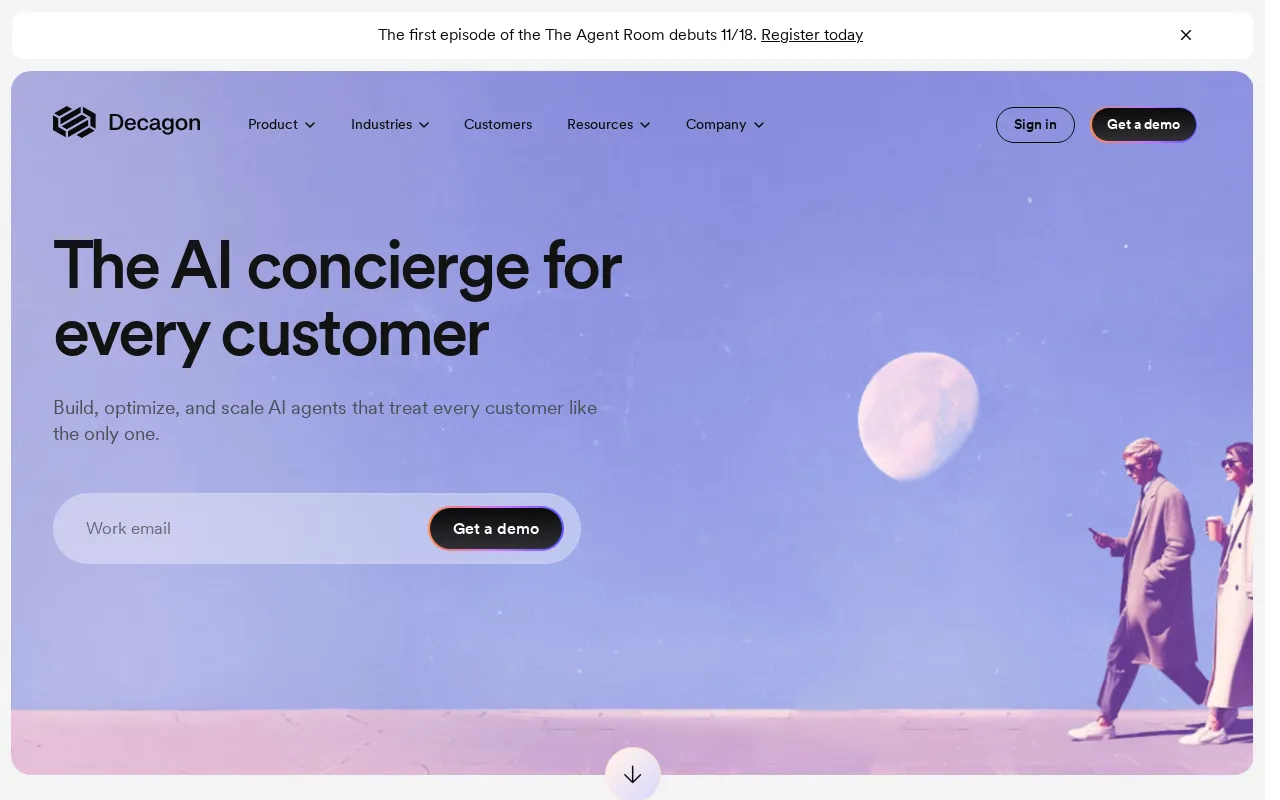
Decagon homepage, November 2026

Decagon is an AI agent platform for large companies that answers customers on chat, email and voice. It works through the help desk or CRM you already run, such as Zendesk, Intercom or Salesforce, and escalates what it can’t solve to your team there.

Best for
Enterprises with a high-volume queue across chat, email and phone, and a support operations team to build and test the AI with Decagon’s engineers.
How it bills
Decagon publishes no prices. Its own pricing post describes two options: a fixed rate for every incoming conversation, or a higher one for each fully resolved conversation, with lower rates for bigger volumes or commitments. Buying starts with “Get a demo”, and the help desk it answers in bills separately.
Free plan
No, buying starts with a demo
3 people, 300 AI replies
Quote only: No published rate: 300 conversations are priced per conversation or per resolution through Decagon’s sales team, and your help desk’s seats come on top.

Pros

  • One AI answers on web chat, SMS, WhatsApp, email and phone, and its voice agent speaks 70+ languages.
  • Your support team writes the AI’s workflows in plain language, as procedures Decagon calls AOPs, then tests and A/B tests changes before rolling them out.
  • Pre-built connections reach Zendesk, Intercom, Salesforce, Gorgias, Kustomer and Gladly, plus Shopify and Stripe Billing for orders and subscriptions.
  • Decagon’s own team works alongside yours during rollout, as its case studies with Rippling and 1-800-Flowers.com describe.

Cons

  • No published price, no free plan and no trial: every path to buying starts with “Get a demo”.
  • It answers inside your help desk, so Decagon is a second bill beside that help desk’s seats.
  • Going live takes weeks: Duolingo was live a month after its first conversations with Decagon, which Decagon calls a quick implementation.
  • On per-conversation pricing, which Decagon says most customers choose, conversations the AI escalates to your team are billed too.

Already on Decagon? See the best Decagon alternatives.

Pick Chatbase if

  • You don’t run a help desk yet and want the AI and the inbox your teammates take over in to arrive together.
  • You want to see the bill before you buy, and $120 or $400 a month on annual billing fits the budget.
  • 3 to 5 people will answer what the AI hands over, which fits the 3 and 5 members included on Basic and Business.
  • Customers reach you on Instagram, Messenger or Slack as well as on your website.
  • You want to decide which model each chatbot runs on, from OpenAI, Anthropic, Gemini, DeepSeek or Mistral.

Pick Decagon if

  • Your team works a high-volume queue in Zendesk, Intercom or Salesforce and isn’t moving out of it.
  • Callers ring in many languages, and the voice agent needs to cover 70+ of them.
  • Your support operations staff want to own the AI’s workflows, written in plain language as procedures Decagon calls AOPs, and A/B test workflow updates against real conversations.
  • You want Decagon’s engineers working beside your team while the AI is built and launched.
  • You’d rather negotiate a rate that falls with size or commitment than pay a list price.

When to consider Rinhelp instead

Consider Rinhelp if a few people answer your email and website chat and you want the help desk and the AI in one product, as on Chatbase, but with no cap on teammates: a sixth person needs an extra member slot on Chatbase Business, while Rinhelp Pro is $49 a month however many join, with 5,000 AI replies from Rin, our built-in AI. Free covers up to 3 teammates. Claude, ChatGPT or your own AI agent can work the inbox through MCP, and anything that moves money or can’t be undone waits for a teammate’s approval. Rinhelp isn’t the fit if calls, WhatsApp, Messenger, Instagram or Slack bring in your work, if you want to choose the model behind the AI, or if you need integrations beyond Shopify and Stripe, reports or routing rules; Chatbase covers those channels at a printed price. And a company with an enterprise queue, many languages on the phone and an operations team to tune the AI is shopping for what Decagon sells.

Start free

Questions about Chatbase vs Decagon

Can Chatbase work with the help desk we already use, as Decagon does?

Yes, though it doesn’t have to. Chatbase’s AI can escalate a conversation as a ticket into Zendesk, Salesforce, Intercom, Zoho Desk, Freshdesk, HubSpot, Help Scout, Gorgias or Odoo, carrying the customer’s details, and Business can learn from your tickets and Zendesk macros. Decagon only works that way, since it isn’t a help desk itself.

Does Chatbase have a plan for the kind of company Decagon sells to?

Chatbase Enterprise is quote only, like Decagon, and has unlimited members, adding SSO, audit logs, custom roles and permissions, white-labeling, HIPAA eligibility, SLAs and a success manager. Decagon builds the AI alongside you with its own engineers, and your operations staff test its procedures before customers see them.

How much say do we get over what each AI does?

On Chatbase you pick the model and give each agent actions and procedures, 8 and 4 on Basic or 12 and 6 on Business, with integrations such as Stripe, Shopify, HubSpot and Zapier. A reply that triggers an action uses the model at least twice, and every request spends credits. On Decagon your operations team writes the workflows in plain language as procedures called AOPs, then tests and A/B tests changes before rolling them out.

How we checked

We compared Chatbase and Decagon using the facts we keep on each, checked against the vendor’s own pages on the date shown beside its sources. Rinhelp is in every table because it is our product and we wrote this page, so check each figure against the vendor’s own page before you decide.

Costs are list prices in US dollars for three team sizes, on the cheapest plan that covers them, counting each AI reply as one resolved conversation. Features count only when the vendor’s own pages say a plan includes them. The AI column counts actions an official MCP server from the vendor can take, out of 11, and leaves third-party connectors out.

Try Rinhelp next to Chatbase or Decagon.

Start free with up to 3 teammates and 50 AI replies.

Start free