Start free

12 best Decagon alternatives (2026)

By , founder of Rinhelp · Facts checked

The short answer

Decagon is an enterprise AI agent built for large support teams, sold through a demo and rolled out over weeks, so the best Decagon alternative for a smaller team is Rinhelp, a help desk with AI built in at a published flat price that you can set up yourself in an afternoon. If you want another enterprise AI on top of the help desk you keep, look at Fin or Ada. Decagon publishes no price, and its own case studies count rollouts in weeks. Rinhelp is $49 a month for the whole team with 5,000 AI replies, free for 3 teammates, and you connect your email and chat widget yourself with no sales call. Pick Zendesk AI if your team stays on Zendesk, Kustomer or Gladly for a sales-led platform with phone support built in, and Gorgias for a Shopify store.

See Rinhelp on your own site. Enter your website and Rin builds your help desk from it: a chat widget, a help center and an inbox.

Free. No sign-up to look. Ready in a minute or two.

Is your help center somewhere else?

Rin will read . If your help articles or docs live at another address, like help. or a Notion page, Rin can read those too.

Where is your help center?

Rin reads it along with and turns it into your help center.

Decagon alternatives at a glance

ToolBest forHow it billsFree plan3 people, 300 AI replies
RinhelpSmall teams that answer mostly by email and live chat, want AI on every conversation without a buying process, and would rather run one tool than an AI on top of a help desk.One price per workspaceYes: 3 teammates, 50 AI replies to try Rin$49
FinTeams with a large queue on Zendesk, Salesforce, HubSpot or Freshdesk that want a strong AI answering customers without changing help desks.Per outcome, $49 a month minimumNo, 14-day trial$297 or more
AdaLarge companies with a contact center and an engineering team, that want an AI answering at volume on chat, email and phone and can buy through a sales process.Quoted by salesNo, demo through salesQuote only
Zendesk AITeams settled on Zendesk that want an AI answering inside it, beside the tickets, triggers and reports they already run.Per automated resolution, on top of Zendesk seatsNo, 14-day trial$428 or more
IntercomSoftware and app companies that want chat, email, phone, WhatsApp and SMS in one inbox, with Fin answering across them.Per seat, plus each Fin outcomeNo, 14-day trial$354
FreshdeskTeams that want a full ticketing help desk with SLAs, routing and a knowledge base, and chat and messaging for less per agent than Zendesk’s Suite Team.Per agent, plus each AI sessionNo, 14-day trial$204
KustomerMid-size and large consumer brands that want every order, conversation and channel on one customer timeline, and buy through a sales team.Quoted by sales, plus each AI conversationNo, and no self-serve trial$225 or more
GladlyLarge retail brands that want voice, messaging and an AI that sells and serves in one customer timeline.Per team member, plus each AI resolutionYes on Shopify: 1 seat, 100 AI interactions$810 or more
GorgiasShopify brands with a large team that answer on email, chat, SMS, WhatsApp, social and phone from one inbox.Per ticket, plus each AI interactionNo, 7-day trial$320 or more
SierraLarge brands with a contact center, many systems to connect, and a team ready to build and tune an AI agent with Sierra’s own deployment team over several weeks.Quoted by sales, per outcomeNo, buying starts with Sierra’s teamQuote only
Kore.aiLarge companies, often in banking, healthcare, retail or telecom, that want one platform for voice and digital AI agents across customer service and internal help, with builders to design and test them.Quoted by salesA free plan is listed, though the quick start opens sign-up only to approved domainsQuote only
LorikeetFintech, health tech and insurance companies with multi-step workflows to automate through their own APIs, a help desk they keep, and room for an annual plan from $2,100 a month.Annual plan plus a rate per resolutionNo, a 30-day free trial with a card at checkout$2,397 or more
Decagon, for comparisonEnterprises with a high-volume queue across chat, email and phone, and a support operations team to build and test the AI with Decagon’s engineers.Quoted by sales, per conversation or resolutionNo, buying starts with a demoQuote only

1. Rinhelp

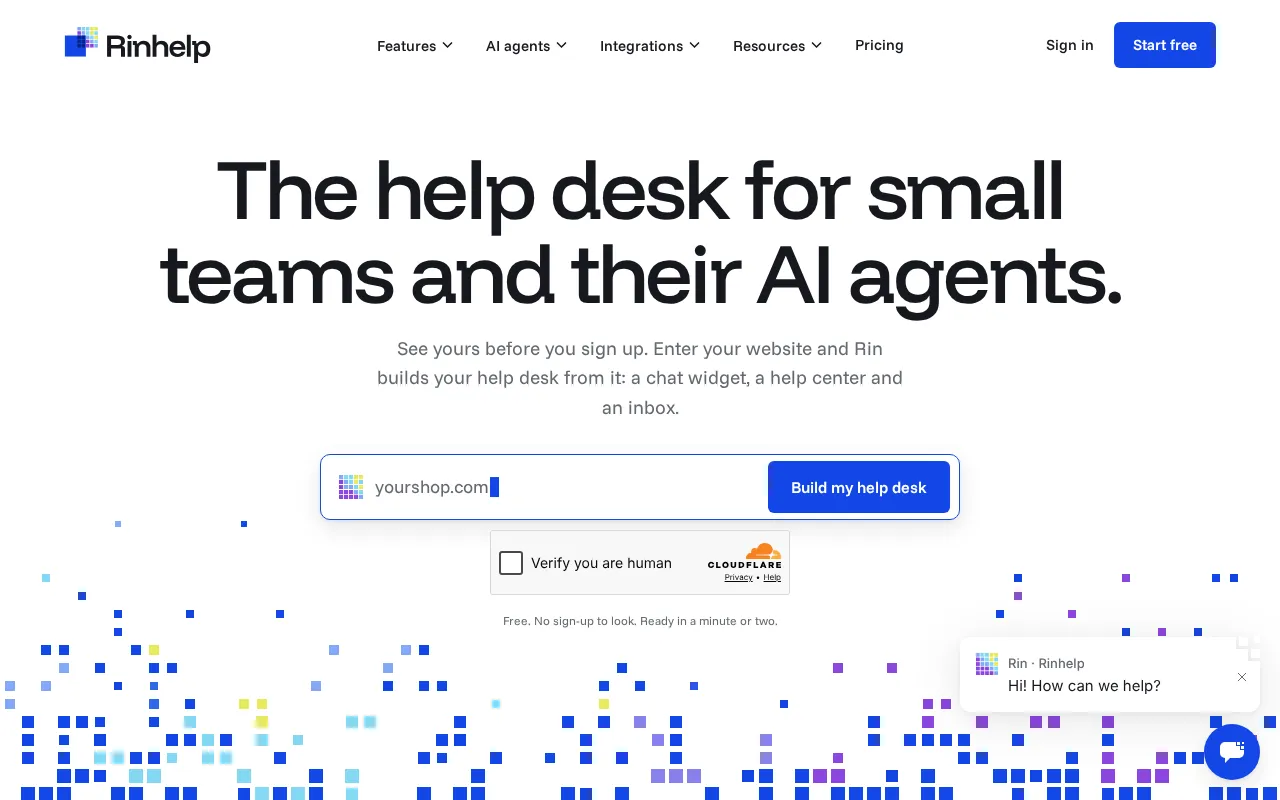
Rinhelp homepage, November 2026

Decagon is an AI layer for enterprises, bought through a demo and rolled out alongside its engineers. Rinhelp is the help desk itself, with Rin, our built-in AI, answering every new email and chat first from your help center and website. Its price sits on the pricing page, $49 a month for the whole team with 5,000 AI replies, and there is no rollout project: you sign up, forward your support address and paste the chat widget onto your site.

Best for
Small teams that answer mostly by email and live chat, want AI on every conversation without a buying process, and would rather run one tool than an AI on top of a help desk.
How it bills
Free for up to 3 teammates. Pro is $49 a month for the whole workspace, with 5,000 AI replies from Rin. No per-seat or per-resolution fees.
Free plan
Yes: 3 teammates, 50 AI replies to try Rin
3 people, 300 AI replies
$49 a month: Pro for the whole workspace, using 300 of its 5,000 AI replies; Free covers your team if you don’t need AI replies.

Pros

  • The price is public: $49 a month however many teammates you add, with 5,000 AI replies, where Decagon quotes each deal after a demo.
  • You set it up on your own, and Rin answers from the help center and website you already have, with no procedures to write first.
  • When the answer isn’t in your docs, Rin passes the conversation to a teammate with a short summary, and anything that moves money waits for a teammate’s approval.
  • Claude, ChatGPT or an agent you built works the same inbox through MCP: it can reply, assign, close, publish articles and look up an order.

Cons

  • Email and live chat only: there is no phone, WhatsApp, SMS or social inbox.
  • Shopify and Stripe are the only integrations.
  • No reports, SLA rules or routing rules: Rin hands a conversation to the teammate with the fewest open ones.
  • The free plan has no Rin beyond 50 AI replies to try it.
Start free

2. Fin

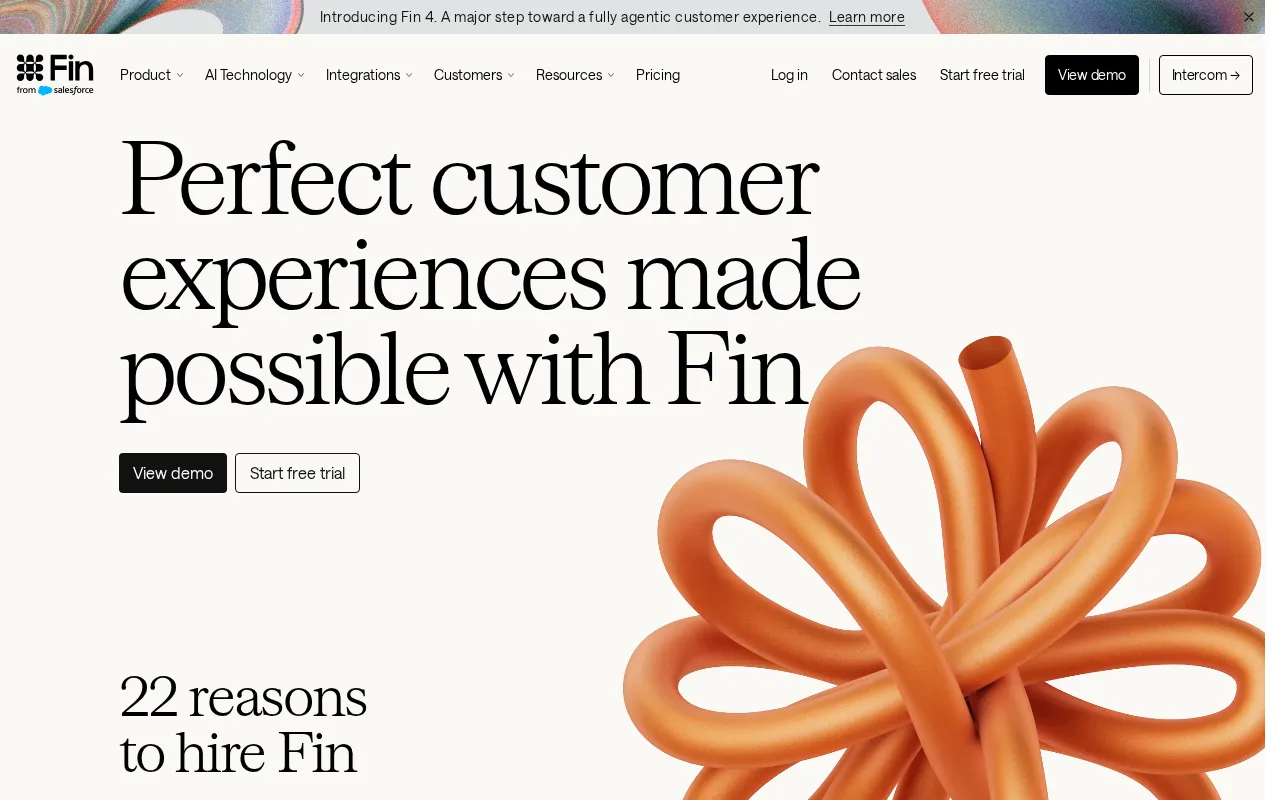
Fin homepage, November 2026

Fin is an AI that answers customers on chat, email, voice and social. It runs inside Intercom, or on top of a help desk you already use, such as Zendesk, Salesforce, HubSpot or Freshdesk, and hands your team what it can’t solve.

Best for
Teams with a large queue on Zendesk, Salesforce, HubSpot or Freshdesk that want a strong AI answering customers without changing help desks.
How it bills
A $49 base plan covers the first 50 outcomes a month, then each costs $0.99, charged at most once per conversation. Unused outcomes don’t carry over. Fin Voice is $1.99 a voice outcome through sales, and your help desk’s seats are billed separately.
Free plan
No, 14-day trial
3 people, 300 AI replies
$297 or more a month: 300 outcomes: $49 for the first 50, then 250 at $0.99. Your help desk’s seats come on top.

Pros

  • It works inside the help desk you already have, so your team keeps it as the system of record.
  • You pay at most once per conversation, and nothing when a customer asks for a person or a Procedure fails.
  • Procedures connect Fin to Stripe and Shopify, so it can check an order and refund it in the same conversation.
  • It answers on chat, email, voice, social and Slack, and on WhatsApp through Freshdesk, with spending limits you set.

Cons

  • Fin is an AI, not a help desk, so its outcomes come on top of your help desk’s seats.
  • An outcome counts when a customer stays silent for 24 hours after Fin’s answer, and when a Procedure ends in a handoff to your team.
  • A Procedure can refund on its own under a threshold you set, with no person approving it.
  • Buying Fin for another help desk starts with “Contact sales” on its pricing page.

Already on Fin? See the best Fin alternatives.

3. Ada

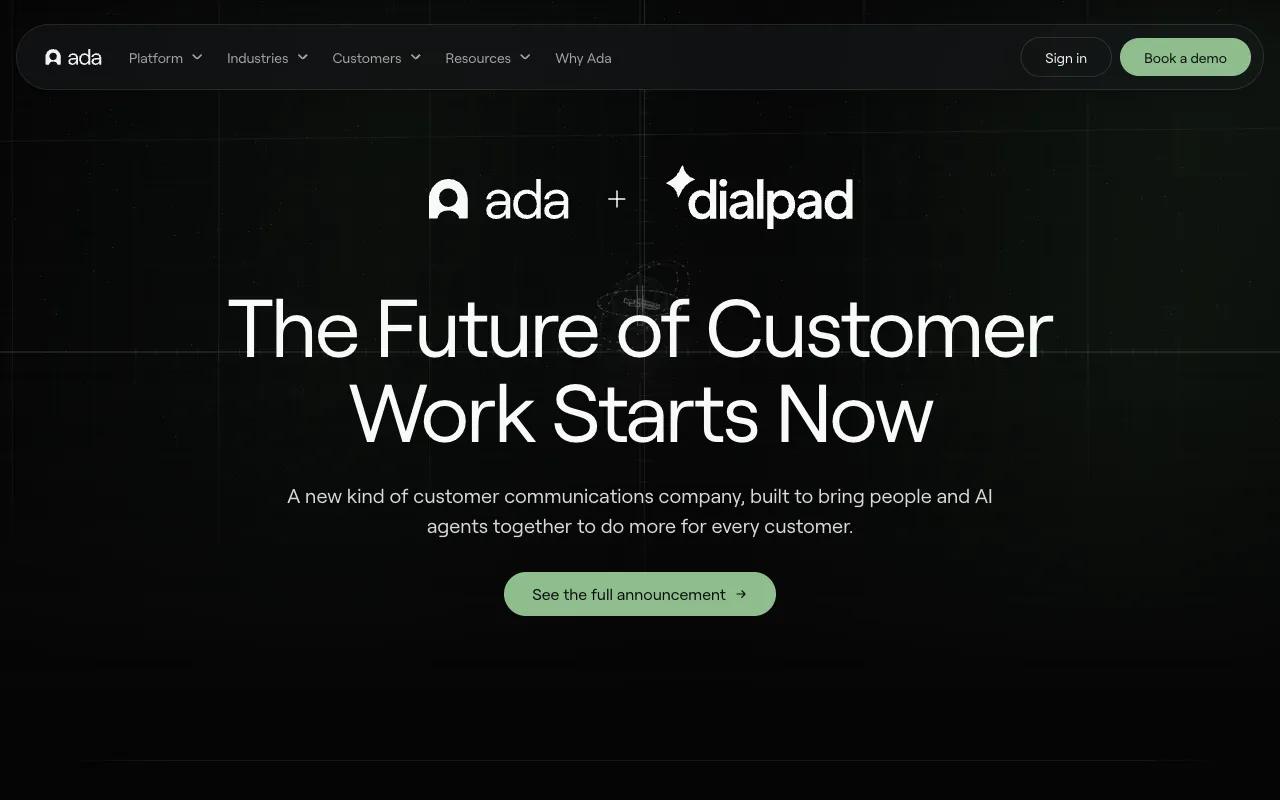
Ada homepage, November 2026

Ada is an AI agent for enterprise customer service that answers on chat, email, voice and social messaging. It keeps its own record of every conversation, and hands customers to people in a help desk or contact center such as Zendesk, Salesforce, Gorgias or Help Scout.

Best for
Large companies with a contact center and an engineering team, that want an AI answering at volume on chat, email and phone and can buy through a sales process.
How it bills
Ada publishes no prices or plans. Its pricing page books a 30-minute call for a custom demo and an ROI model based on your volume, and its docs say some features, such as the Data Export API, may not be in your package.
Free plan
No, demo through sales
3 people, 300 AI replies
Quote only: Ada publishes no price, so 300 conversations are quoted by sales, and the help desk your team takes handoffs in bills its own seats.

Pros

  • One AI agent answers on web and app chat, email, phone, WhatsApp, Messenger, Instagram and SMS.
  • Ready-made handoffs reach Zendesk, Salesforce, Gorgias, Help Scout and other help desks and contact centers, passing the context along.
  • It can call the MCP servers your company already runs to look up or change an order, a subscription or an account during a conversation.
  • Its own MCP server lets Claude or ChatGPT read transcripts and metrics, and stage changes to knowledge articles and Playbooks for review.

Cons

  • No published price, no free plan and no trial: buying starts with a demo call.
  • Ada hands conversations to people on “your preferred agent platform”, so your team still pays for a help desk or contact center to answer them.
  • Transcripts with personal data are deleted after two years, and the Data Export API only reaches the past year and may not be in your package.
  • Looking up or refunding an order is a tool your team builds or connects: an API tool, a code tool or an MCP server you run.

Already on Ada? See the best Ada alternatives.

4. Zendesk AI

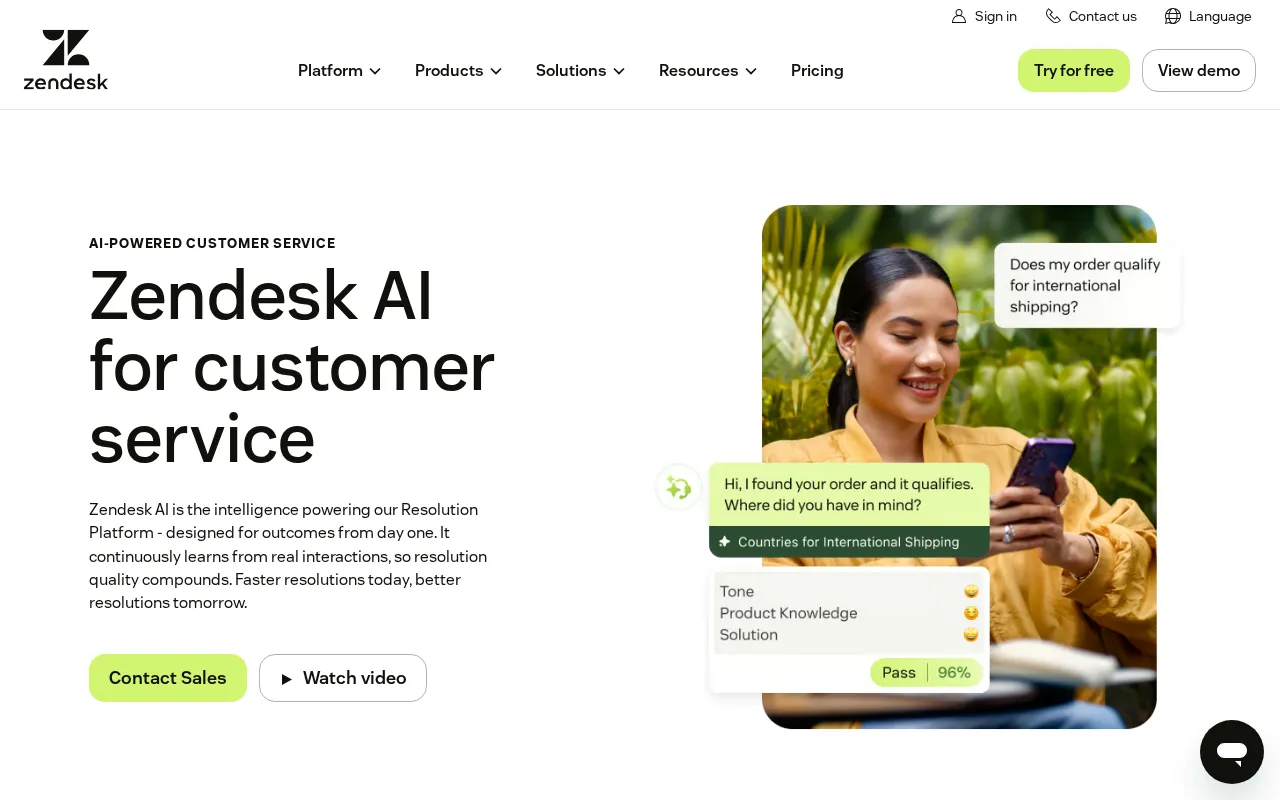
Zendesk AI homepage, November 2026

Zendesk AI is the AI built into Zendesk: AI agents that answer customers on messaging, email and voice, and Copilot, which helps your team. The AI agents come with a Zendesk plan and bill per automated resolution, while Forethought, which Zendesk bought, sells AI agents for other help desks through sales.

Best for
Teams settled on Zendesk that want an AI answering inside it, beside the tickets, triggers and reports they already run.
How it bills
AI agents come with every Zendesk plan, so each teammate needs a seat: $19 on Support Team or $55 on Suite Team, which adds messaging and voice, on annual billing. Each seat includes 5 automated resolutions a month on Team plans and 10 on Suite Professional, up to 10,000 a year, then each costs $1.50 committed or $2.00 pay as you go. Copilot is $50 more an agent.
Free plan
No, 14-day trial
3 people, 300 AI replies
$428 or more a month: 285 automated resolutions at $1.50 committed, past the 15 that 3 seats on a Team plan include. The seats come on top: $19 each on Support Team for email, or $55 on Suite Team for chat.

Pros

  • It answers inside the Zendesk you already run, so tickets, routing, triggers and reports stay where they are.
  • Escalations aren’t billed, and an LLM checks each conversation before it counts as a paid resolution.
  • AI agents answer from your help center, a web crawler or sources like Google Drive, on messaging, email and voice.
  • You can cap the bill by pausing AI agents at your limit, and through the MCP client they can use tools from Stripe’s and other MCP servers.

Cons

  • Zendesk’s own AI agents can’t be bought alone: every teammate needs a Zendesk seat, and resolutions come on top.
  • Accounts are moving to resolution tiers, paid from an allowance of $2 a seat a month on Team plans, up to $5,000 a year, and Zendesk gives tier prices through sales.
  • Each AI agent works on one kind of channel, and AI agents on Support Team need messaging for chat, which comes with Suite Team at $55 a seat.
  • AI agent tickets can’t be exported with Zendesk’s export tools, and it refunds no unused seats or time.

Already on Zendesk AI? See the best Zendesk AI alternatives.

5. Intercom

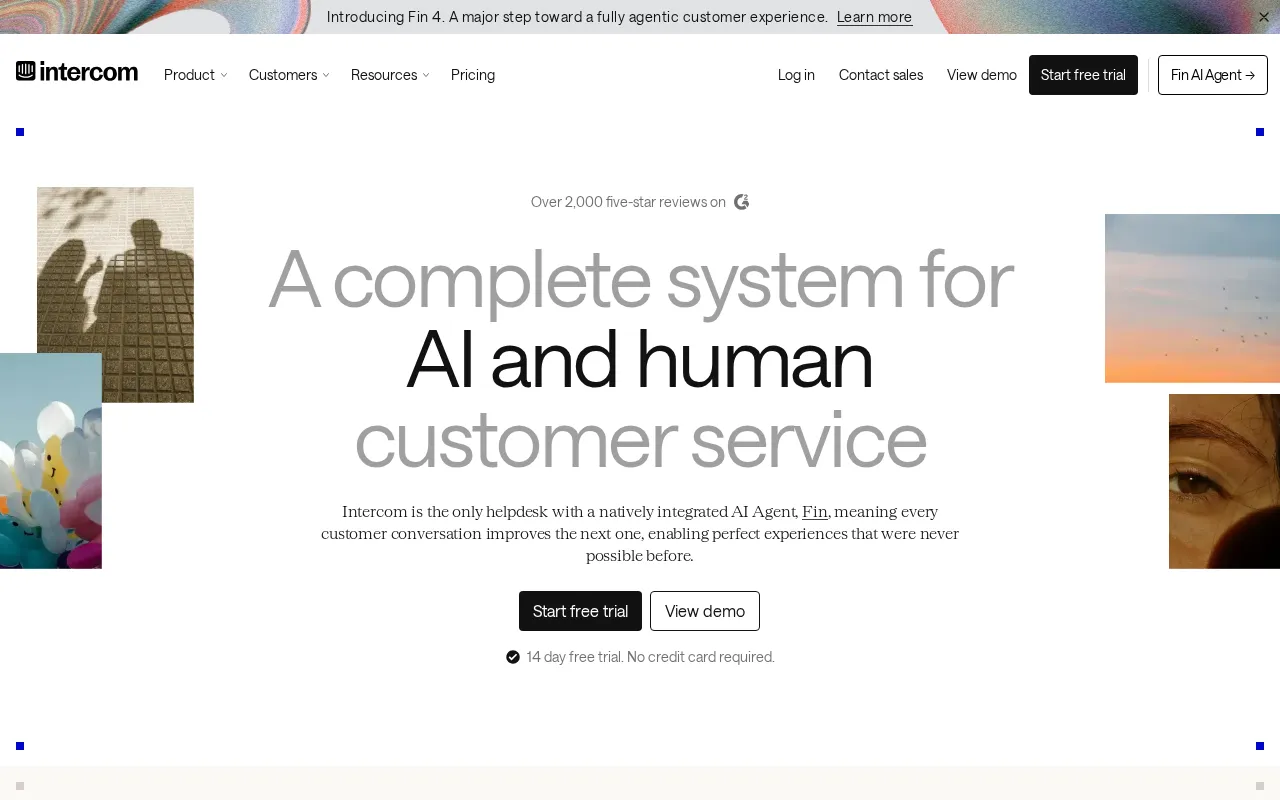
Intercom homepage, November 2026

Intercom is a customer service help desk with a chat Messenger, a shared inbox, a help center and Fin, its AI agent. Its company renamed itself Fin in May 2026, and Salesforce bought it that September.

Best for
Software and app companies that want chat, email, phone, WhatsApp and SMS in one inbox, with Fin answering across them.
How it bills
Per seat: Essential is $29, Advanced $85 and Expert $132 a seat a month on annual billing ($39, $99 and $139 monthly), and new customers pay $19 for Essential on annual billing. Fin costs $0.99 for each outcome, and WhatsApp, SMS and phone are billed by use.
Free plan
No, 14-day trial
3 people, 300 AI replies
$354 a month: 3 Essential seats at $19, the new-customer price on annual billing (list $29), plus 300 Fin outcomes at $0.99.

Pros

  • Chat, email, phone, WhatsApp, SMS, Slack, Facebook and Instagram all arrive in one inbox.
  • Fin answers on email, live chat and phone, and is charged once per conversation however many questions it answers.
  • Agents can refund or cancel a Shopify order from the inbox sidebar, and the Stripe app shows subscriptions mid-conversation.
  • Its official MCP server can add internal notes and write and publish help center articles, not only read.

Cons

  • Every teammate who replies needs a paid seat, and Fin adds $0.99 an outcome on top.
  • An outcome also counts when a customer simply stops asking after Fin’s answer, or when a Fin workflow hands the conversation to your team.
  • Its MCP server can’t reply to customers, assign or close conversations, and doesn’t serve workspaces hosted in Australia.
  • No free plan, and an annual plan cancelled early gets no prorated refund.

Already on Intercom? See the best Intercom alternatives.

6. Freshdesk

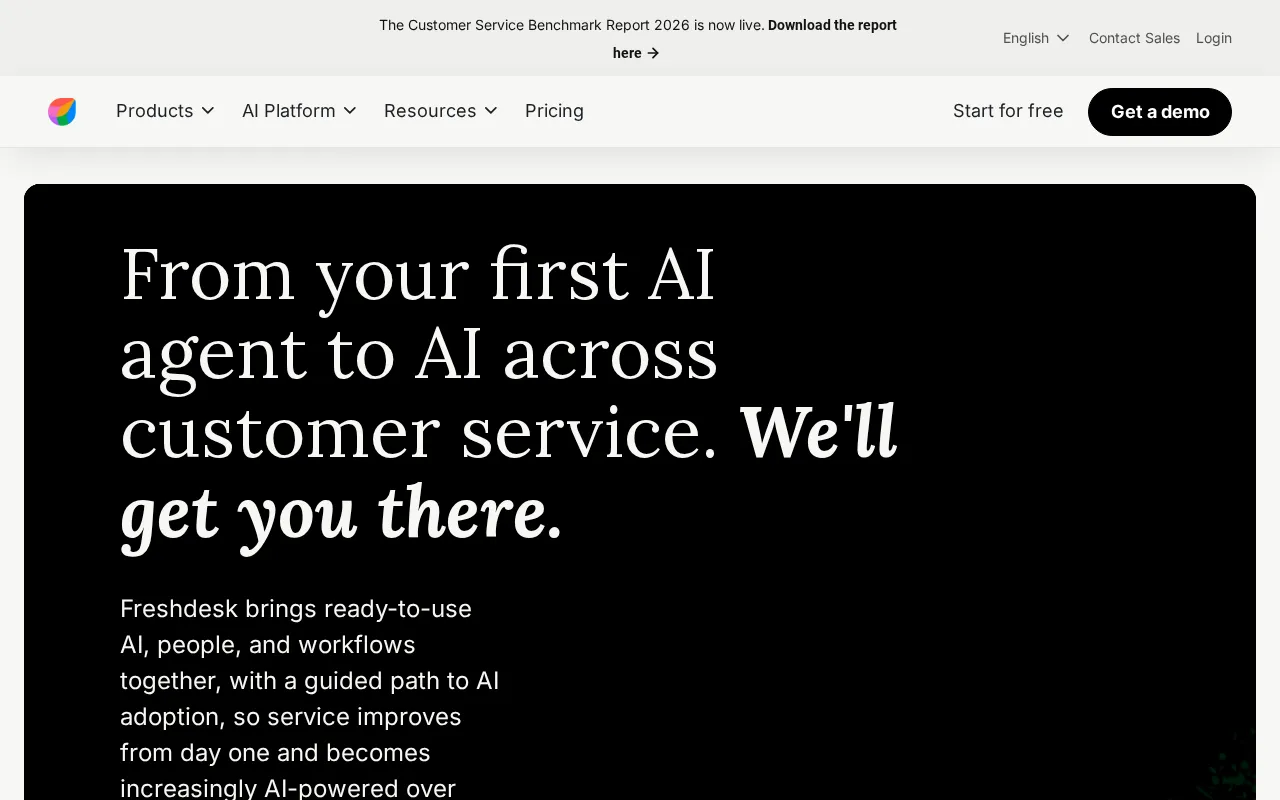
Freshdesk homepage, November 2026

Freshdesk is Freshworks’ help desk: email ticketing with a customer portal and knowledge base, with Freshdesk Omni adding chat, phone and messaging. Its Freddy AI agent answers customers and is billed per session.

Best for
Teams that want a full ticketing help desk with SLAs, routing and a knowledge base, and chat and messaging for less per agent than Zendesk’s Suite Team.
How it bills
Per agent on annual billing: Growth is $19, Pro $55 and Enterprise $89 a month, or $29, $79 and $119 on Freshdesk Omni with chat and messaging. Freddy AI agent sessions cost $49 per 100 after 500 free ones, once per account. Voice is $15 to $69 more an agent, and MCP actions $15 per 1,000.
Free plan
No, 14-day trial
3 people, 300 AI replies
$204 a month: 3 Growth agents at $19 on annual billing, plus 3 packs of 100 AI sessions at $49, on email only.

Pros

  • SLA policies, custom dashboards, skill-based routing and audit logs come on its higher plans, with skill-based routing at $89 an agent where Zendesk asks $115.
  • Freshdesk Omni adds chat, phone, WhatsApp, Messenger, Instagram and Line to the same tickets.
  • Day passes from $2 let occasional helpers answer without a full seat.
  • Its official MCP server can reply, add notes, update tickets and write knowledge base articles.

Cons

  • List prices rose early in 2026, from $15 to $19 an agent on Growth, and the free plan is gone.
  • Freddy AI agent costs 49 cents a session after the first 500, which never come back.
  • Every MCP call counts as an action, and Growth includes only 1,200 a year.
  • Fees are non-refundable, and a cancellation only takes effect at the end of your term.

Already on Freshdesk? See the best Freshdesk alternatives.

7. Kustomer

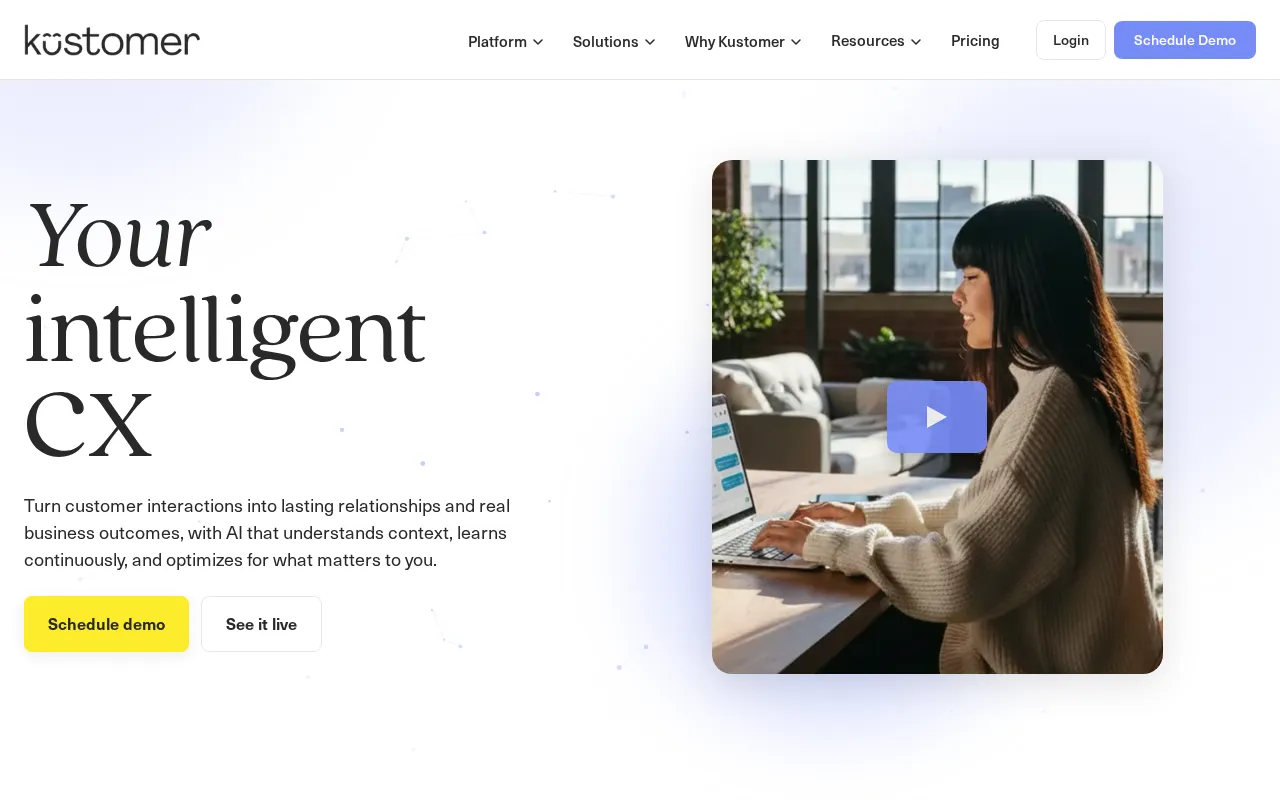
Kustomer homepage, November 2026

Kustomer is a customer service platform built around one timeline per customer, with chat, email, SMS, WhatsApp, voice and social in one place, and Concierge, an AI agent that answers customers.

Best for
Mid-size and large consumer brands that want every order, conversation and channel on one customer timeline, and buy through a sales team.
How it bills
Plan prices are quoted by sales: Enterprise and Ultimate today, with older seat-based and usage-based plans still listed. Published add-ons include Concierge at $0.75 per engaged conversation, Envoy at $50 a user a month, and voice from $0.02 a minute.
Free plan
No, and no self-serve trial
3 people, 300 AI replies
$225 or more a month: 300 Concierge conversations at $0.75, plus a platform price Kustomer quotes only on a sales call.

Pros

  • Chat, email, SMS, WhatsApp, voice, Facebook and Instagram share one timeline for each customer.
  • Concierge answers on chat, email, SMS, WhatsApp and voice, and you decide where it acts alone and where it hands off.
  • Agents can cancel or refund Shopify order items from the customer’s timeline.
  • Built to scale, with up to 300 brands and a 2,000-request-a-minute API on Ultimate.

Cons

  • No plan price is published: you fill in a two-minute assessment, then talk to sales.
  • No free plan and no self-serve trial.
  • Its official MCP server only reads, so your own AI can search conversations but can’t reply, add notes or close.
  • Contracts renew automatically unless you give written notice 30 days before the term ends, and fees are non-refundable.

Already on Kustomer? See the best Kustomer alternatives.

8. Gladly

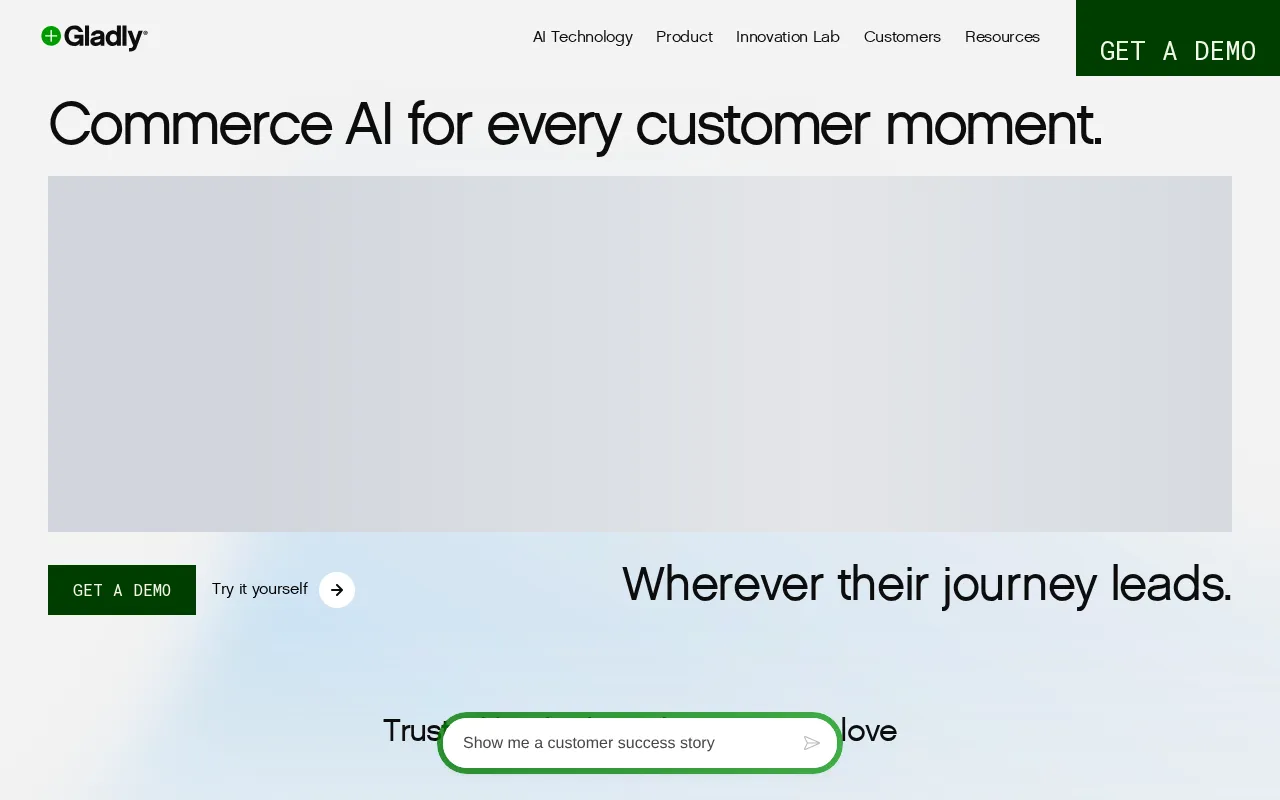
Gladly homepage, November 2026

Gladly is a customer service platform for retail brands that keeps one lifelong conversation per customer across voice, email, chat, SMS and social media. It now presents itself on gladly.ai as commerce AI, with an AI agent that also helps shoppers buy.

Best for
Large retail brands that want voice, messaging and an AI that sells and serves in one customer timeline.
How it bills
Gladly’s site publishes no prices and sends you to sales. Its Shopify app lists a free plan with 1 seat and 100 AI interactions, and a pay-as-you-go Starter cap plan shown at $250 a month: $120 a team member a month, plus $1.50 per AI Resolution and $0.25 per AI Assist, up to a monthly spending cap you set.
Free plan
Yes on Shopify: 1 seat, 100 AI interactions
3 people, 300 AI replies
$810 or more a month: 3 team members at $120 on the Shopify Starter cap plan, plus 300 AI Resolutions at $1.50. Direct contracts are quoted by sales.

Pros

  • Voice with IVR, SMS, WhatsApp, Instagram and Messenger sit in one customer timeline with email and chat.
  • Gladly AI can look up Shopify orders, change addresses, cancel orders and issue refunds, confirming the amount with the customer first.
  • Its AI also recommends products and lets shoppers check out in chat, before the sale as well as after.
  • A help center built from the same Answers your team and the AI use.

Cons

  • No prices on gladly.ai: direct contracts are quoted by sales, and only the Shopify app lists a price.
  • Each team member costs $120 a month on the Shopify plan, plus $1.50 for each AI resolution.
  • No official MCP server, so your own AI can’t work in Gladly without custom code.
  • The self-serve export covers only the last 7 days; older history needs Gladly Support.

Already on Gladly? See the best Gladly alternatives.

9. Gorgias

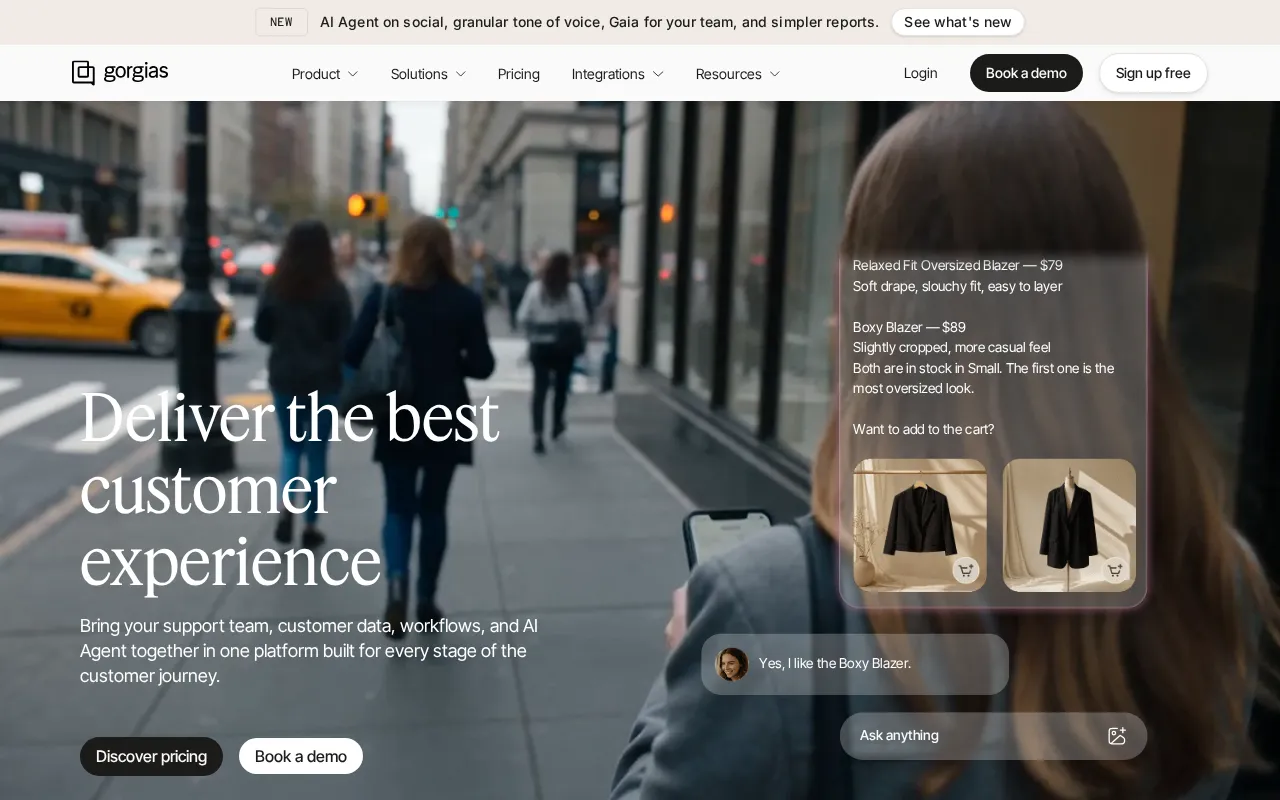
Gorgias homepage, November 2026

Gorgias is a help desk for ecommerce brands, built around Shopify, with an AI that answers shoppers and can cancel orders or edit addresses. It bills by tickets, not by agents.

Best for
Shopify brands with a large team that answer on email, chat, SMS, WhatsApp, social and phone from one inbox.
How it bills
By the ticket, never per agent: Starter is $10 a month for 50 tickets, and Basic $50 for 300, Pro $300 for 2,000 and Advanced $750 for 5,000 on annual billing ($60, $360 and $900 monthly). Gorgias AI Agent costs $0.90 per automated interaction on annual billing or $1.00 monthly, $1.50 past your tier, and each one also counts as a ticket.
Free plan
No, 7-day trial
3 people, 300 AI replies
$320 or more a month: Basic at $50 on annual billing for 300 tickets, plus 300 AI interactions at $0.90 with the AI limit raised to cover them, each also counted as a ticket and $1.50 past that limit.

Pros

  • Shopify orders, customers and products show inside every ticket, and Gorgias says 40% of Shopify brands use it.
  • Email, chat, SMS, WhatsApp, Instagram, Facebook and phone land in one inbox.
  • No seat price: Basic and above allow up to 500 users.
  • Its official MCP server lets Claude or ChatGPT reply, assign, close, write macros and publish help center articles on every Helpdesk plan.

Cons

  • A ticket the AI resolves on its own is billed twice, as a ticket and as an automated interaction.
  • Interactions past your AI tier cost $1.50 each, and tickets past your plan $0.36 to $0.40.
  • Cancelling takes written notice 30 days before the term ends, even on monthly billing, and fees aren’t refunded.
  • The MCP server is in open beta and has no tool to look up or refund an order.

Already on Gorgias? See the best Gorgias alternatives.

10. Sierra

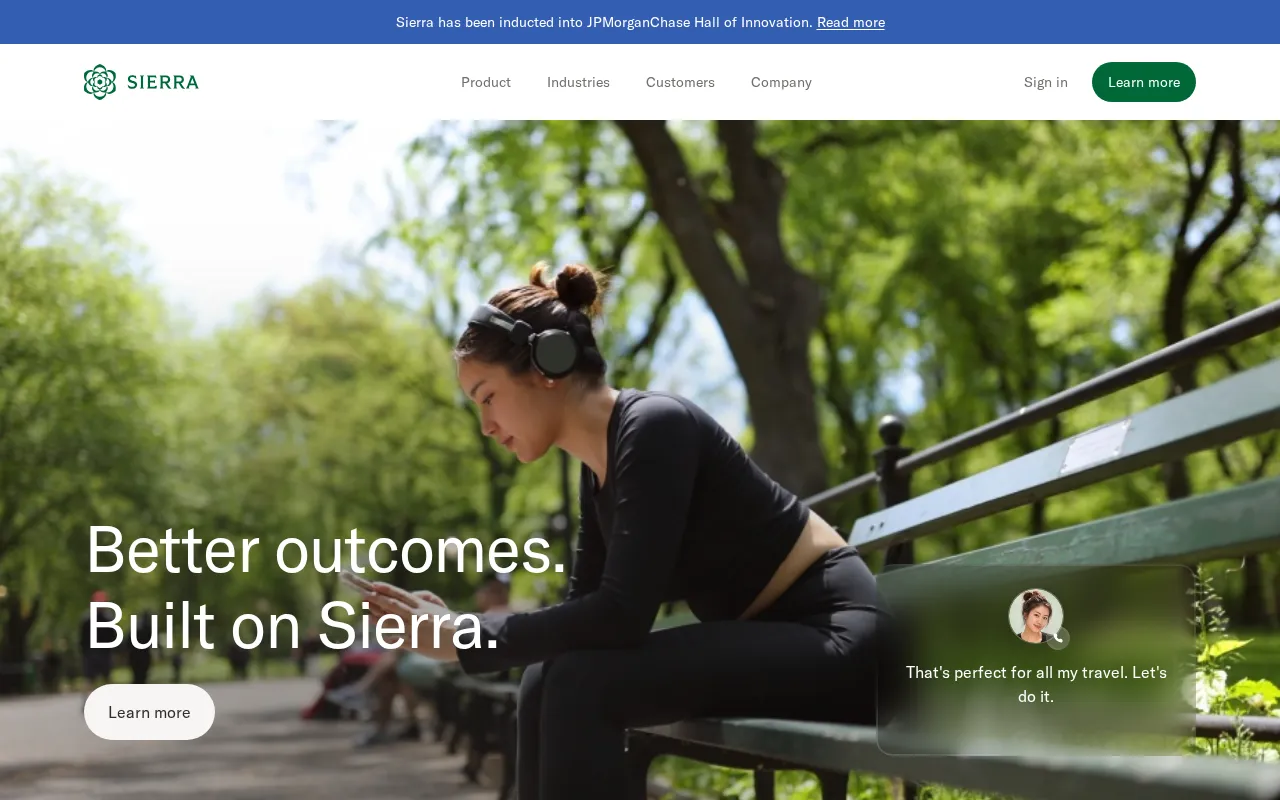
Sierra homepage, November 2026

Sierra is a conversational AI platform that large companies use to build their own branded AI agent for chat, SMS, WhatsApp, email, voice and ChatGPT. The agent connects to systems such as order management and CRM, and routes what it can’t handle to the company’s contact center with a summary.

Best for
Large brands with a contact center, many systems to connect, and a team ready to build and tune an AI agent with Sierra’s own deployment team over several weeks.
How it bills
Sierra lists no prices. It charges by outcome, such as a resolved conversation, a saved cancellation or a sale, against criteria agreed before launch, and says escalated conversations are usually free. Routing or greeter conversations can be billed per conversation instead, in a blended deal.
Free plan
No, buying starts with Sierra’s team
3 people, 300 AI replies
Quote only: Sierra prints no rate, so the outcomes in 300 conversations are priced in a deal with its team, and the contact center your people answer handoffs in costs extra.

Pros

  • One agent answers on chat, SMS, WhatsApp, email, voice and ChatGPT, and its voice agent speaks over 55 languages.
  • Support teams build without code in Sierra’s visual studio or by describing what they want to Ghostwriter, while developers can write journeys as code with its SDK.
  • You pay for outcomes, such as a resolved conversation or a saved cancellation, and escalations are usually not charged.
  • Its voice agent takes card payments during the call, and Sierra is listed in the Stripe App Marketplace.

Cons

  • No price, plan or trial on the site: every path leads to Sierra’s team.
  • Launch takes weeks: Sierra promises to deploy “in weeks”, and Airtable went live on chat after four.
  • Handoffs go to a contact center your team already runs, so that software is a second bill.
  • It is built for the largest companies, with 40% of the Fortune 50 as partners, and expects a team to keep improving the agent.

Already on Sierra? See the best Sierra alternatives.

11. Kore.ai

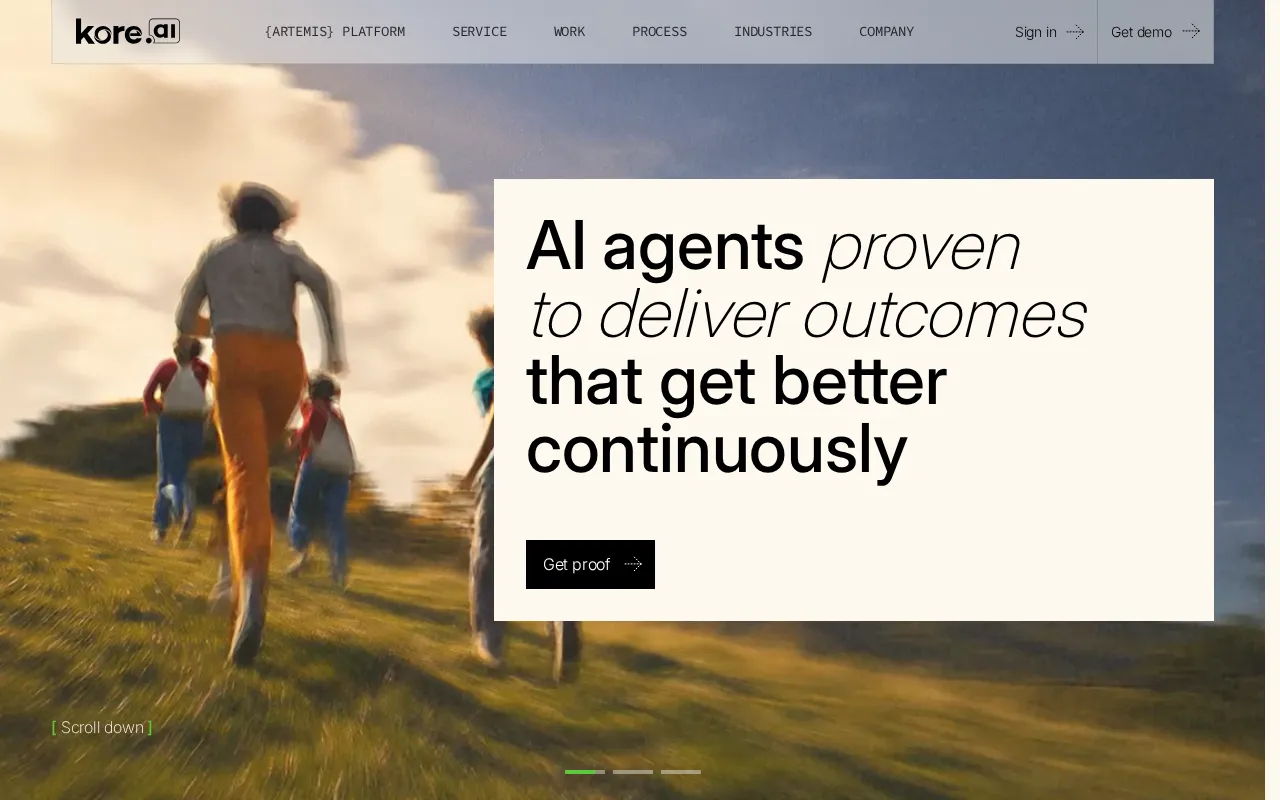
Kore.ai homepage, November 2026

Kore.ai is an enterprise platform for building AI agents, called {Artemis}, that serve customers on voice, chat, email and messaging apps, and employees in HR and IT. It keeps its own record of every session, and hands customers to people in a contact center such as Salesforce, ServiceNow, Genesys, Five9 or Amazon Connect.

Best for
Large companies, often in banking, healthcare, retail or telecom, that want one platform for voice and digital AI agents across customer service and internal help, with builders to design and test them.
How it bills
Kore.ai publishes no prices: its pricing page is gone, and its site offers a demo and a request for a quote. Its docs list Free, Team, Business and Enterprise plans, billed per seat, per seat plus tokens and messages, or by annual contract, and new sessions pause when a workspace passes its quota.
Free plan
A free plan is listed, though the quick start opens sign-up only to approved domains
3 people, 300 AI replies
Quote only: Kore.ai prints no rate, so 300 conversations are priced by its sales team, and the contact center your people answer handoffs in is a separate bill.

Pros

  • One agent definition answers on web and mobile chat, email, voice, WhatsApp, Messenger, Instagram, SMS, Slack and Teams.
  • Escalations reach people in Salesforce, ServiceNow, Genesys Cloud, Five9 or Amazon Connect, with the context you choose passed along.
  • Ready-made actions cover Shopify, Stripe, Zendesk and dozens of other systems, and its knowledge connectors index Zendesk, Intercom, Help Scout and Freshdesk content.
  • Its MCP server lets Claude Code or another assistant build, test and debug agents, and page through past sessions and traces.

Cons

  • No published price, and sign-up is limited to approved domains: access starts with Kore.ai’s team.
  • Setup has you register an LLM provider’s API key, such as OpenAI or Anthropic, before you build anything.
  • Kore.ai hands people conversations in a separate contact center, so your team still pays for one to answer them.
  • Agents are defined in ABL, a typed language of Kore.ai’s own, and its Forward Deployed Engineers take customers from proof to production in weeks.

Already on Kore.ai? See the best Kore.ai alternatives.

12. Lorikeet

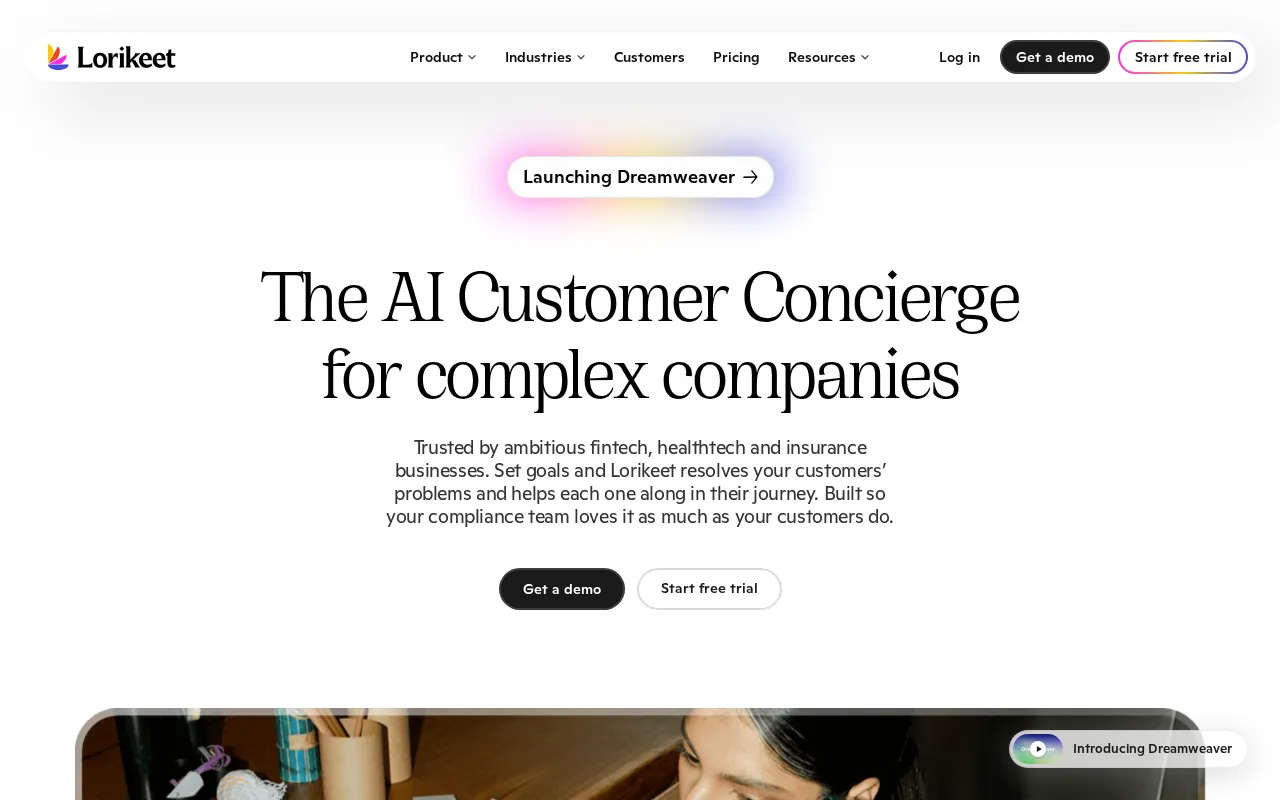
Lorikeet homepage, November 2026

Lorikeet is an AI customer support platform for complex and regulated businesses, such as fintech, health tech and insurance. Its Concierge agent resolves customers’ issues on chat, email, voice, SMS and WhatsApp by acting through your own systems, inside the help desk you already run, such as Zendesk, Intercom, Salesforce or HubSpot, and hands what it can’t solve to your team there.

Best for
Fintech, health tech and insurance companies with multi-step workflows to automate through their own APIs, a help desk they keep, and room for an annual plan from $2,100 a month.
How it bills
Start is $2,100 a month and Scale $5,100 a month, both paid annually, and each resolved chat, email or SMS ticket costs $0.99 or $0.90 on top, or $1.50 or $1.20 for a voice call. Escalations, unresolved tickets and tickets you mark bad aren’t charged, and there are no seat fees. Routing tags and automated QA cost $0.30 a ticket each on Start, Signature carries a $75K platform fee, and the help desk it answers in bills separately.
Free plan
No, a 30-day free trial with a card at checkout
3 people, 300 AI replies
$2,397 or more a month: Start at $2,100 a month, paid annually, plus 300 resolutions at $0.99. Your help desk’s seats come on top.

Pros

  • Concierge answers on chat, email, SMS, WhatsApp and voice, inbound and outbound, and workflows you train once run on every channel.
  • It runs multi-step workflows through your APIs, webhooks and MCP servers, from a Stripe refund to an account update, and escalates to your team with what it already tried.
  • Its prices are public, and you pay only for resolved tickets: never for escalations, failed attempts or tickets you mark bad, and never per seat.
  • It holds SOC 2 Type 2 and ISO 27001, signs a Business Associate Agreement for HIPAA, and never trains AI models on your data.

Cons

  • Start is $2,100 a month paid annually, or $25,200 a year, before the first resolution is billed.
  • It isn’t a help desk: it works inside Zendesk, Intercom, Salesforce, HubSpot or another you keep, so that help desk stays on your bill.
  • Time to the first live ticket averages under 29 days, while you build workflows and test them on your past tickets.
  • Its voice agent can’t take a card payment on a call, because Lorikeet doesn’t hold PCI DSS.

Already on Lorikeet? See the best Lorikeet alternatives.

Why people leave Decagon

No price before the demo

Decagon lists no plans or rates on its site. Its pricing post describes a fixed rate per incoming conversation or a higher one per resolved conversation, with lower rates for bigger volumes or commitments. Decagon: Pricing the AI agent economy, .

Escalated conversations still count

Most Decagon customers choose per-conversation pricing, by Decagon’s own account, and that bills every incoming conversation, including the ones its AI escalates to your team. Decagon: Pricing the AI agent economy, .

A rollout measured in weeks

Duolingo began talking with Decagon in August and was live on chat a month later, a timeline Decagon holds up as a quick implementation. Decagon and Duolingo, .

Built as an engineering partnership

Rippling’s rollout leaned on Decagon’s forward-deployed engineers to build custom API workflows and more than 75 routing tags, work a small team would have to staff. Decagon and Rippling, .

The help desk stays a separate bill

Decagon answers and routes email through Zendesk, Intercom or Salesforce, so the help desk your team takes escalations in remains its own contract. Decagon email, .

Features compared

A check means the vendor’s own pages say a plan includes it. Decagon is in the last row for comparison.

ToolEmailLive chatWhatsAppVoiceHelp centerAI that answers customersShopifyStripeFree planSignup without a sales call
Rinhelp
Fin
Ada
Zendesk AI
Intercom
Freshdesk
Kustomer
Gladly
Gorgias
Sierra
Kore.ai
Lorikeet
Decagon

What your AI can do in each tool

Connect Claude, ChatGPT or your own AI agent through the vendor’s official MCP server, and this is what it can do of 11 everyday actions: search and read conversations, reply to a customer, add an internal note, assign, close or reopen, search the help center, write or update an article, publish an article, create a saved reply, look up an order, refund or cancel.

ToolThrough official MCPWhat it can doMoney moves wait for a teammate
Rinhelp11 of 11Search and read conversations, reply to a customer, add an internal note, assign, close or reopen, search the help center, write or update an article, publish an article, create a saved reply, look up an order, refund or cancelYes, a teammate approves first
Fin0 of 11No official MCP server, or nothing from this listNo refunds or cancellations through MCP
Ada3 of 11Search and read conversations, search the help center, write or update an articleNo refunds or cancellations through MCP
Zendesk AI0 of 11No official MCP server, or nothing from this listNo refunds or cancellations through MCP
Intercom5 of 11Search and read conversations, add an internal note, search the help center, write or update an article, publish an articleNo refunds or cancellations through MCP
Freshdesk7 of 11Search and read conversations, reply to a customer, add an internal note, assign, close or reopen, write or update an article, publish an articleNo refunds or cancellations through MCP
Kustomer1 of 11Search and read conversationsNo refunds or cancellations through MCP
Gladly0 of 11No official MCP server, or nothing from this listNo refunds or cancellations through MCP
Gorgias9 of 11Search and read conversations, reply to a customer, add an internal note, assign, close or reopen, search the help center, write or update an article, publish an article, create a saved replyNo refunds or cancellations through MCP
Sierra0 of 11No official MCP server, or nothing from this listNo refunds or cancellations through MCP
Kore.ai1 of 11Search and read conversationsNo refunds or cancellations through MCP
Lorikeet0 of 11No official MCP server, or nothing from this listNo refunds or cancellations through MCP
Decagon0 of 11No official MCP server, or nothing from this listNo refunds or cancellations through MCP

More on each MCP server, and connectors from other companies, which don’t count:

  • Fin: Intercom’s MCP server reads Intercom data in US and EU workspaces. We found no official MCP server for Fin on another help desk.
  • Ada: Ada’s MCP server manages the AI rather than the queue: it reads transcripts and searches or stages knowledge articles, which feed Ada’s answers instead of a public help center. It can’t reply to customers, and write tools need an owner or admin.
  • Zendesk AI: Zendesk announced an MCP server for outside AI tools in May 2026, for early access that summer, and has published no docs for it. Its MCP client, generally available since August 10, 2026, works the other way, letting Zendesk’s AI agents call tools on other MCP servers.
  • Intercom: Workspaces with Fin Operator get five more MCP tools, which change Fin’s setup rather than conversations.
  • Freshdesk: Assigning, closing and publishing go through the general ticket and article tools, and there is no tool to search the knowledge base or read canned responses. Every call is metered.
  • Kustomer: kusty, a command-line tool Kustomer has previewed but not released, will run as a local MCP server that can also write.
  • Gladly: Third parties such as Truto sell Gladly connectors; Gladly itself has none.
  • Gorgias: The Gorgias MCP is in open beta. It can’t look up or refund an order, but its live tests of the AI run real order changes in your store.
  • Sierra: Sierra can publish your agent to ChatGPT as an app over MCP, so customers reach it there. We found no official MCP server that lets Claude or ChatGPT work in Sierra’s conversations for your team.
  • Kore.ai: Kore.ai’s MCP server is for building and debugging agents: it creates and deploys them, runs evaluations, and reads session history and traces. It has no tool to reply to a customer, assign or close, and its agents can also call MCP servers your company runs.
  • Lorikeet: Lorikeet’s AI connects to MCP servers you add, such as Notion or Linear, to read data and take actions in its workflows. We found no official MCP server that lets Claude or ChatGPT work in Lorikeet’s conversations for your team.
  • Decagon: Decagon’s AI calls MCP servers your company runs to look up data and take actions. We found no official MCP server that lets Claude or ChatGPT work in Decagon itself.

Pricing at three sizes

What each tool costs a month in US dollars, with AI answering, and how each total adds up. Each AI reply counts as one resolved conversation.

Tool3 people, 300 AI replies5 people, 1,000 AI replies10 people, 3,000 AI replies
Rinhelp$49Pro for the whole workspace, using 300 of its 5,000 AI replies; Free covers your team if you don’t need AI replies.$49Pro for the whole workspace, using 1,000 of its 5,000 AI replies.$49Pro for the whole workspace, using 3,000 of its 5,000 AI replies.
Fin$297 or more300 outcomes: $49 for the first 50, then 250 at $0.99. Your help desk’s seats come on top.$990 or more1,000 outcomes: $49 for the first 50, then 950 at $0.99, plus the seats your help desk charges.$2,970 or more3,000 outcomes: $49 for the first 50, then 2,950 at $0.99. The help desk Fin answers in bills its seats on top.
AdaQuote onlyAda publishes no price, so 300 conversations are quoted by sales, and the help desk your team takes handoffs in bills its own seats.Quote onlyPricing is through sales after a demo, with no published rate for 1,000 conversations, plus the seats of the help desk Ada hands off to.Quote onlyPricing for 3,000 conversations is through Ada’s sales team only, and your team’s help desk is a separate bill.
Zendesk AI$428 or more285 automated resolutions at $1.50 committed, past the 15 that 3 seats on a Team plan include. The seats come on top: $19 each on Support Team for email, or $55 on Suite Team for chat.$1,463 or more975 automated resolutions at $1.50 beyond the 25 included with 5 Team seats, which are billed on top.$4,425 or more2,950 automated resolutions at $1.50 beyond the 50 that 10 Team seats include. Seats are extra, from $19 an agent on annual billing.
Intercom$3543 Essential seats at $19, the new-customer price on annual billing (list $29), plus 300 Fin outcomes at $0.99.$1,0855 Essential seats at $19, the new-customer price on annual billing (list $29), plus 1,000 Fin outcomes at $0.99.$3,16010 Essential seats at $19, the new-customer price on annual billing (list $29), plus 3,000 Fin outcomes at $0.99.
Freshdesk$2043 Growth agents at $19 on annual billing, plus 3 packs of 100 AI sessions at $49, on email only.$5855 Growth agents at $19 on annual billing, plus 10 packs of 100 AI sessions at $49, on email only.$1,66010 Growth agents at $19 on annual billing, plus 30 packs of 100 AI sessions at $49, on email only.
Kustomer$225 or more300 Concierge conversations at $0.75, plus a platform price Kustomer quotes only on a sales call.$750 or more1,000 Concierge conversations at $0.75, plus the unpublished platform price.$2,250 or more3,000 Concierge conversations at $0.75, plus the unpublished platform price.
Gladly$810 or more3 team members at $120 on the Shopify Starter cap plan, plus 300 AI Resolutions at $1.50. Direct contracts are quoted by sales.$2,100 or more5 team members at $120 plus 1,000 AI Resolutions at $1.50, on the Shopify plan.$5,700 or more10 team members at $120 plus 3,000 AI Resolutions at $1.50, on the Shopify plan.
Gorgias$320 or moreBasic at $50 on annual billing for 300 tickets, plus 300 AI interactions at $0.90 with the AI limit raised to cover them, each also counted as a ticket and $1.50 past that limit.$1,200 or morePro at $300 on annual billing for 2,000 tickets, plus 1,000 AI interactions at $0.90 with the AI limit raised to cover them, each also counted as a ticket and $1.50 past that limit.$3,360 or morePro at $300 on annual billing for 2,000 tickets, 1,000 tickets past them at $0.36, plus 3,000 AI interactions at $0.90 with the AI limit raised to cover them, each also counted as a ticket and $1.50 past that limit.
SierraQuote onlySierra prints no rate, so the outcomes in 300 conversations are priced in a deal with its team, and the contact center your people answer handoffs in costs extra.Quote only1,000 conversations are billed per agreed outcome at a rate only Sierra’s team quotes, on top of the tools your care team uses for handoffs.Quote onlyFor 3,000 conversations Sierra sets the outcome rate in its sales process, and your contact center stays a bill of its own.
Kore.aiQuote onlyKore.ai prints no rate, so 300 conversations are priced by its sales team, and the contact center your people answer handoffs in is a separate bill.Quote onlyNo published price for 1,000 conversations: the quote comes after a demo, plus the seats of the desktop Kore.ai transfers customers to.Quote only3,000 conversations sit on a custom or annual contract that only Kore.ai quotes, with your contact center billed on top.
Lorikeet$2,397 or moreStart at $2,100 a month, paid annually, plus 300 resolutions at $0.99. Your help desk’s seats come on top.$3,090 or moreStart at $2,100 a month on an annual plan, plus 1,000 resolutions at $0.99, with the seats of the help desk it answers in on top.$5,070 or more3,000 resolutions at $0.99 on top of Start’s $2,100 a month, billed annually. The help desk Lorikeet works in bills separately.
DecagonQuote onlyNo published rate: 300 conversations are priced per conversation or per resolution through Decagon’s sales team, and your help desk’s seats come on top.Quote only1,000 conversations are quoted after a demo, with no price on Decagon’s site, plus the seats of the help desk it escalates to.Quote onlyDecagon sets the rate for 3,000 conversations in a sales conversation, and the help desk your team works in is billed separately.

The best Decagon alternative for each kind of team

Best Decagon alternative for a published price: Rinhelp

Decagon sets a rate per conversation or per resolution for each deal and shares it only through sales. Rinhelp costs $49 a month whether you have 3, 5 or 10 teammates, with 5,000 AI replies and no seat fee, so you can budget next year from the pricing page.

Best Decagon alternative for an AI with a list price: Fin

Fin also answers inside Zendesk, Salesforce, HubSpot or Freshdesk, but it prints its rate: a $49 base plan with 50 outcomes, then $0.99 for each. A 14-day trial replaces the demo.

Best Decagon alternative for a like-for-like enterprise AI: Ada

Ada is the closest swap: an AI for large contact centers on chat, email, phone and messaging, sold through a demo with no price on its site. Its own MCP server lets Claude or ChatGPT read transcripts and stage knowledge article changes for review.

Best Decagon alternative for teams staying on Zendesk: Zendesk AI

If Decagon answers inside your Zendesk today, Zendesk’s AI agents can take over from the same help desk without a separate vendor. Past the 5 resolutions a month each Team seat includes, every one the AI closes costs $1.50 on a commitment or $2.00 pay as you go.

Best Decagon alternative for software companies: Intercom

Intercom puts the help desk and Fin in one product, with phone, WhatsApp and SMS in the same inbox as chat and email. Its Essential plan lists $29 a seat billed yearly, $19 for new customers, plus $0.99 per Fin outcome.

Best Decagon alternative for AI built into the help desk: Freshdesk

Freddy AI agent is part of Freshdesk, so you drop the extra contract: the first 500 sessions are free, once per account, and then $49 buys 100 more. Growth seats are $19 a month on annual billing, and you can sign up without talking to sales.

Best Decagon alternative for one timeline per customer: Kustomer

Kustomer keeps chat, email, SMS, WhatsApp, voice and social on one timeline for each customer, and Concierge, its AI agent, costs $0.75 per engaged conversation. The platform price is quoted by sales, so expect a buying process much like Decagon’s.

Best Decagon alternative for large retailers with phone queues: Gladly

Gladly runs voice, SMS and social as one lifelong conversation per shopper, and its AI confirms the amount with the customer before refunding a Shopify order. Direct contracts go through sales, while its Shopify app lists $120 a team member plus $1.50 per AI resolution.

Best Decagon alternative for Shopify stores: Gorgias

Gorgias bills by the ticket rather than the seat and shows the Shopify order inside each one. Pro is $300 a month for 2,000 tickets on annual billing and its AI agent adds $0.90 per automated interaction, so a store can price it without a call.

When Decagon is still the right choice

Stay with Decagon ifSwitch if
You handle thousands of conversations a day, like the 9,000 a day Rituals sees at peak.Your queue is a few hundred conversations a month.
You have a team to write and test the AI’s procedures and work with Decagon’s engineers.Nobody on your team has time to run an AI project.
Phone calls are a big share of your support, and you want an AI answering them in many languages.Customers reach you by email or chat, not by phone.
Your help desk is staying, and you want a stronger AI working inside it.You’d rather run the inbox and the AI as one tool, on one bill.
You want the AI to issue refunds and store credit itself, against policy rules you set.You want anything that moves money, when Rin or an AI agent asks, to wait for a teammate’s approval.

Moving from Decagon to Rinhelp

Decagon answers inside your help desk, and your conversation history lives there, so you move it from that help desk.

Find your help desk’s move

Questions about Decagon and switching

How much does Decagon cost?

Decagon doesn’t publish a price. It quotes after a demo, either a fixed rate for every incoming conversation or a higher one for each resolved conversation, and says larger commitments lower the rate. The help desk it works in bills separately.

Who is Decagon for?

Large companies. Decagon names Avis Budget Group, Chime, Oura Health, 1-800-Flowers.com and Hunter Douglas among its customers, and Chime runs more than 1 million calls a month through it.

How long does Decagon take to set up?

Weeks, by its own case studies. Duolingo was live on chat a month after its first conversations, and Hunter Douglas was testing within weeks of its evaluation, both working with Decagon’s team. Rinhelp has no rollout: you sign up, forward your support address and add the chat widget.

Is there a free trial of Decagon?

Not one you can start yourself. Its site offers no free plan or trial, and buying starts with “Get a demo”.

Which help desks does Decagon work with?

Zendesk, Intercom and Salesforce for tickets and email, Gorgias, Kustomer and Gladly for retail case history, and Amazon Connect or RingCentral for calls. Your team picks up its escalations in whichever one you use.

Does Decagon answer phone calls?

Yes. Decagon Voice runs on Chord, its own speech model, supports 70+ languages and transfers calls to your team with a summary. Rinhelp doesn’t answer the phone, so if calls are a large part of your queue, Decagon, Ada or Kustomer will fit better.

Can I connect Claude or ChatGPT to Decagon?

Decagon connects outward: its AI calls MCP servers your company runs to look up orders or accounts. We found no official MCP server that lets your own AI agent read or answer Decagon conversations.

Where is my conversation history if I leave Decagon?

In your help desk, since Decagon answers and escalates inside Zendesk, Intercom, Salesforce or a tool like them. You bring conversations over from there.

What is the cheapest Decagon alternative?

Among AI agents with a public rate, Freddy on Freshdesk at $49 per 100 sessions after 500 free, or Gorgias at $0.90 an interaction for Shopify stores. To replace the help desk and the AI together, Rinhelp is free for 3 teammates and $49 a month with 5,000 AI replies.

Is Decagon a good fit for a small team?

Rarely. Its customers are large brands, its price comes after a demo, and its rollouts involve Decagon’s engineers. A team answering a few hundred conversations a month will usually be better served by a help desk with AI built in.

How we picked and checked

We listed the tools a team leaving Decagon weighs most often, and only tools we keep checked facts for. Rinhelp is first because it is our product and we wrote this page, so check each figure against the vendor’s own page before you decide.

Costs are list prices in US dollars for three team sizes, on the cheapest plan that covers them, counting each AI reply as one resolved conversation. Features count only when the vendor’s own pages say a plan includes them. The AI column counts actions an official MCP server from the vendor can take, out of 11, and leaves third-party connectors out.

We checked every source below on 9 November 2026 unless it shows another date.

Why people leave Decagon

Rinhelp

Checked

Fin

Checked

Ada

Zendesk AI

Checked

Intercom

Freshdesk

Kustomer

Checked

Gladly

Checked

Gorgias

Sierra

Kore.ai

Lorikeet

Decagon

Try Rinhelp next to Decagon.

Start free with up to 3 teammates and 50 AI replies. Keep Decagon running until you’re sure.

Start free