Start free

Decagon vs Fin (2026): pricing, AI and features

By , founder of Rinhelp, which appears in this comparison · Facts checked

The short answer

Pick Decagon if you are a large company with a heavy phone queue and a support operations team ready to build and test the AI alongside Decagon’s engineers. Pick Fin if you want an AI with a printed rate, answering inside Intercom, Zendesk, Salesforce, HubSpot or Freshdesk, with a 14-day trial on Intercom. When the AI settles 1,000 conversations a month for a team of 5, Fin costs about $990 or more, while Decagon names its rate only after a demo, and either one sits on top of the seats your help desk already bills.

See Rinhelp on your own site. Enter your website and Rin builds your help desk from it: a chat widget, a help center and an inbox.

Free. No sign-up to look. Ready in a minute or two.

Is your help center somewhere else?

Rin will read . If your help articles or docs live at another address, like help. or a Notion page, Rin can read those too.

Where is your help center?

Rin reads it along with and turns it into your help center.

Decagon vs Fin at a glance

ToolBest forHow it billsFree plan3 people, 300 AI replies
DecagonEnterprises with a high-volume queue across chat, email and phone, and a support operations team to build and test the AI with Decagon’s engineers.Quoted by sales, per conversation or resolutionNo, buying starts with a demoQuote only
FinTeams with a large queue on Zendesk, Salesforce, HubSpot or Freshdesk that want a strong AI answering customers without changing help desks.Per outcome, $49 a month minimumNo, 14-day trial$297 or more
RinhelpSmall teams that want AI on every conversation at one flat price, and want their own AI agents working in the inbox.One price per workspaceYes: 3 teammates, 50 AI replies to try Rin$49

Key differences

Fin prints its rate, Decagon quotes it

Fin’s help center lists a $49 monthly minimum that covers 50 outcomes, then $0.99 each, charged no more than once in a conversation. Decagon lists no rate at all. Its pricing post describes a fixed charge for every incoming conversation or a higher one for each fully resolved conversation, cheaper at larger volumes or commitments, and you learn the number after “Get a demo”.

A handoff to your team costs differently

Decagon says most of its customers pick per-conversation pricing, which bills the conversations its AI escalates as well as the ones it closes. Fin charges nothing when a customer asks for a person or a Procedure fails, but it does bill a conversation where the customer goes quiet for 24 hours after its answer, and a Procedure built to end with your team.

Decagon is rolled out with its engineers

Your team writes Decagon’s workflows in plain language as AOPs, tests them in simulated conversations before release, then A/B tests them against real ones, and Decagon’s engineers worked with Rippling on custom API workflows and more than 75 routing tags. Duolingo went live on chat a month after its first talks. Fin can be tried for 14 days with no credit card, though buying it for a help desk other than Intercom still begins with “Contact sales”.

Decagon has shown its voice agent at scale

Decagon Voice runs on Chord, Decagon’s own speech model, speaks 70+ languages and passes calls to your team with a summary, and Chime puts more than 1 million calls a month through it. Fin answers by voice too, but Fin Voice is sold through sales at $1.99 a voice outcome, about twice a chat or email outcome.

Each reaches a different set of help desks

Fin runs inside Intercom and also answers inside Zendesk, Salesforce, HubSpot and Freshdesk, reaching WhatsApp through Freshdesk. Decagon connects to Zendesk, Intercom and Salesforce for tickets, and to Gorgias, Kustomer and Gladly for retail case history. Both connect to Shopify and Stripe, so the AI can act on orders and payments while it answers.

Pricing at three sizes

What each tool costs a month in US dollars, with AI answering, and how each total adds up. Each AI reply counts as one resolved conversation.

Tool3 people, 300 AI replies5 people, 1,000 AI replies10 people, 3,000 AI replies
DecagonQuote onlyNo published rate: 300 conversations are priced per conversation or per resolution through Decagon’s sales team, and your help desk’s seats come on top.Quote only1,000 conversations are quoted after a demo, with no price on Decagon’s site, plus the seats of the help desk it escalates to.Quote onlyDecagon sets the rate for 3,000 conversations in a sales conversation, and the help desk your team works in is billed separately.
Fin$297 or more300 outcomes: $49 for the first 50, then 250 at $0.99. Your help desk’s seats come on top.$990 or more1,000 outcomes: $49 for the first 50, then 950 at $0.99, plus the seats your help desk charges.$2,970 or more3,000 outcomes: $49 for the first 50, then 2,950 at $0.99. The help desk Fin answers in bills its seats on top.
Rinhelp$49Pro for the whole workspace, using 300 of its 5,000 AI replies; Free covers your team if you don’t need AI replies.$49Pro for the whole workspace, using 1,000 of its 5,000 AI replies.$49Pro for the whole workspace, using 3,000 of its 5,000 AI replies.

Features compared

A check means the vendor’s own pages say a plan includes it.

ToolEmailLive chatWhatsAppVoiceHelp centerAI that answers customersShopifyStripeFree planSignup without a sales call
Decagon
Fin
Rinhelp

What your AI can do in each tool

Connect Claude, ChatGPT or your own AI agent through the vendor’s official MCP server, and this is what it can do of 11 everyday actions: search and read conversations, reply to a customer, add an internal note, assign, close or reopen, search the help center, write or update an article, publish an article, create a saved reply, look up an order, refund or cancel.

ToolThrough official MCPWhat it can doMoney moves wait for a teammate
Decagon0 of 11No official MCP server, or nothing from this listNo refunds or cancellations through MCP
Fin0 of 11No official MCP server, or nothing from this listNo refunds or cancellations through MCP
Rinhelp11 of 11Search and read conversations, reply to a customer, add an internal note, assign, close or reopen, search the help center, write or update an article, publish an article, create a saved reply, look up an order, refund or cancelYes, a teammate approves first

More on each MCP server, and connectors from other companies, which don’t count:

  • Decagon: Decagon’s AI calls MCP servers your company runs to look up data and take actions. We found no official MCP server that lets Claude or ChatGPT work in Decagon itself.
  • Fin: Intercom’s MCP server reads Intercom data in US and EU workspaces. We found no official MCP server for Fin on another help desk.

Decagon

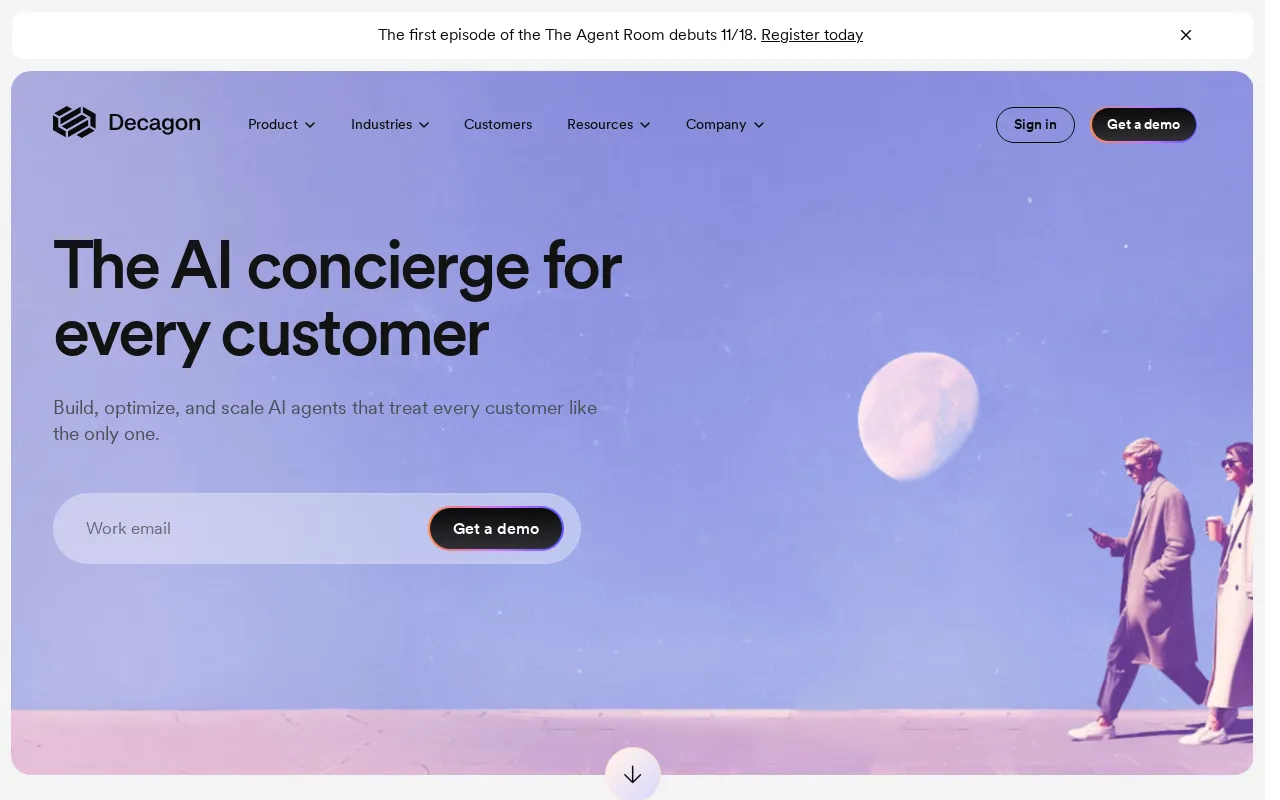
Decagon homepage, November 2026

Decagon is an AI agent platform for large companies that answers customers on chat, email and voice. It works through the help desk or CRM you already run, such as Zendesk, Intercom or Salesforce, and escalates what it can’t solve to your team there.

Best for
Enterprises with a high-volume queue across chat, email and phone, and a support operations team to build and test the AI with Decagon’s engineers.
How it bills
Decagon publishes no prices. Its own pricing post describes two options: a fixed rate for every incoming conversation, or a higher one for each fully resolved conversation, with lower rates for bigger volumes or commitments. Buying starts with “Get a demo”, and the help desk it answers in bills separately.
Free plan
No, buying starts with a demo
3 people, 300 AI replies
Quote only: No published rate: 300 conversations are priced per conversation or per resolution through Decagon’s sales team, and your help desk’s seats come on top.

Pros

  • One AI answers on web chat, SMS, WhatsApp, email and phone, and its voice agent speaks 70+ languages.
  • Your support team writes the AI’s workflows in plain language, as procedures Decagon calls AOPs, then tests and A/B tests changes before rolling them out.
  • Pre-built connections reach Zendesk, Intercom, Salesforce, Gorgias, Kustomer and Gladly, plus Shopify and Stripe Billing for orders and subscriptions.
  • Decagon’s own team works alongside yours during rollout, as its case studies with Rippling and 1-800-Flowers.com describe.

Cons

  • No published price, no free plan and no trial: every path to buying starts with “Get a demo”.
  • It answers inside your help desk, so Decagon is a second bill beside that help desk’s seats.
  • Going live takes weeks: Duolingo was live a month after its first conversations with Decagon, which Decagon calls a quick implementation.
  • On per-conversation pricing, which Decagon says most customers choose, conversations the AI escalates to your team are billed too.

Already on Decagon? See the best Decagon alternatives.
Fin

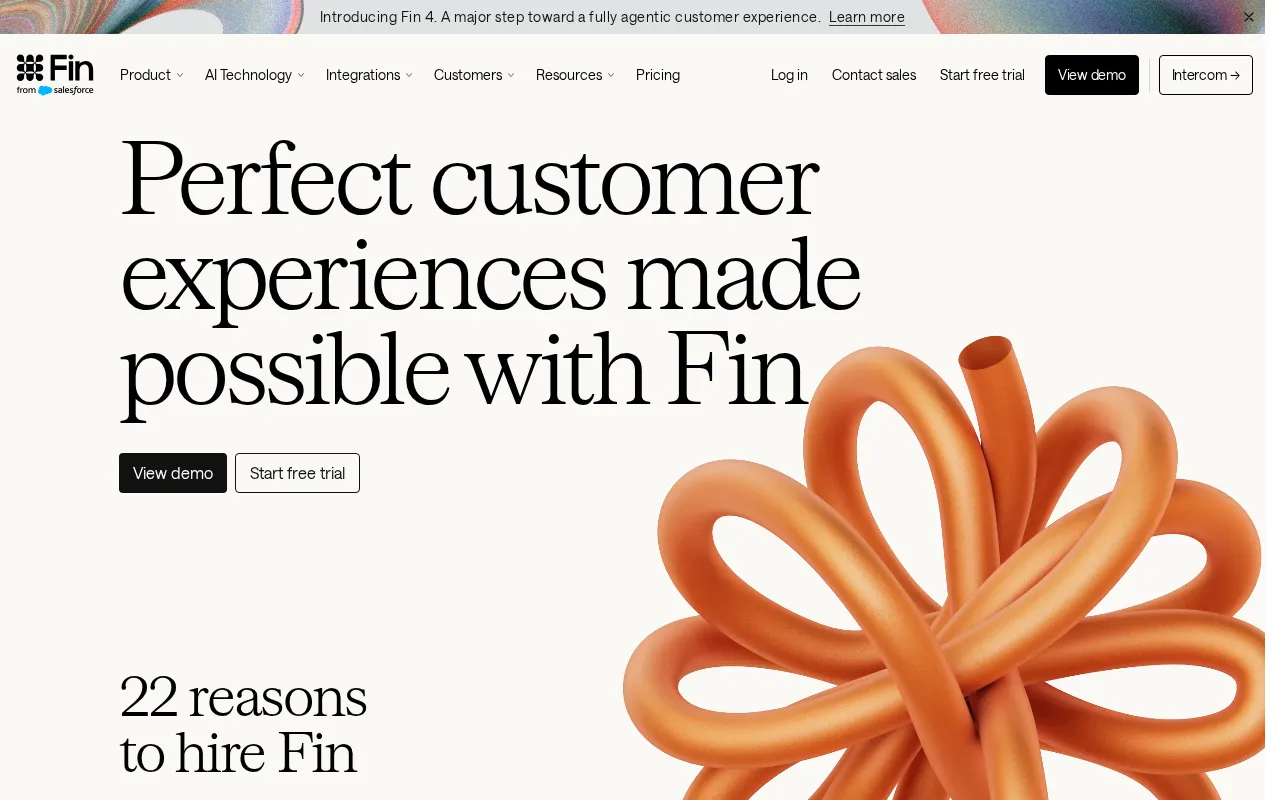
Fin homepage, November 2026

Fin is an AI that answers customers on chat, email, voice and social. It runs inside Intercom, or on top of a help desk you already use, such as Zendesk, Salesforce, HubSpot or Freshdesk, and hands your team what it can’t solve.

Best for
Teams with a large queue on Zendesk, Salesforce, HubSpot or Freshdesk that want a strong AI answering customers without changing help desks.
How it bills
A $49 base plan covers the first 50 outcomes a month, then each costs $0.99, charged at most once per conversation. Unused outcomes don’t carry over. Fin Voice is $1.99 a voice outcome through sales, and your help desk’s seats are billed separately.
Free plan
No, 14-day trial
3 people, 300 AI replies
$297 or more a month: 300 outcomes: $49 for the first 50, then 250 at $0.99. Your help desk’s seats come on top.

Pros

  • It works inside the help desk you already have, so your team keeps it as the system of record.
  • You pay at most once per conversation, and nothing when a customer asks for a person or a Procedure fails.
  • Procedures connect Fin to Stripe and Shopify, so it can check an order and refund it in the same conversation.
  • It answers on chat, email, voice, social and Slack, and on WhatsApp through Freshdesk, with spending limits you set.

Cons

  • Fin is an AI, not a help desk, so its outcomes come on top of your help desk’s seats.
  • An outcome counts when a customer stays silent for 24 hours after Fin’s answer, and when a Procedure ends in a handoff to your team.
  • A Procedure can refund on its own under a threshold you set, with no person approving it.
  • Buying Fin for another help desk starts with “Contact sales” on its pricing page.

Already on Fin? See the best Fin alternatives.

Pick Decagon if

  • Your queue runs to thousands of conversations a day, as Rituals’ does at a 9,000-a-day peak.
  • Callers make up a big share of your support, and they speak many of the 70+ languages Decagon Voice covers.
  • Your case history lives in Gorgias, Kustomer or Gladly, and the AI should read it.
  • A support operations team will write the AI’s procedures and A/B test changes against real conversations.
  • You want Decagon’s own engineers in the room while the rollout is built, as Rippling had.

Pick Fin if

  • You want to know the AI’s price before you talk to anyone: $49 a month, then $0.99 an outcome.
  • You’d like 14 days to try the AI inside Intercom before paying, without entering a card.
  • Your team works in HubSpot or Freshdesk, both on Fin’s list of help desks.
  • You want usage reminders and a hard limit on what the AI can spend in a month.
  • A customer who asks for a person straight away shouldn’t cost you anything.

When to consider Rinhelp instead

Consider Rinhelp if you are a small team answering email and live chat, and you’d rather run the help desk and the AI as one tool than pay for an AI layered on seats you already buy. Pro is $49 a month for the whole workspace with 5,000 AI replies, it’s free for up to 3 teammates, you set it up yourself with no demo, and anything that moves money waits for a teammate’s approval. It isn’t the fit if calls are a large part of your queue, you answer on WhatsApp, SMS or social, your team must stay in Zendesk or Salesforce, or you handle thousands of conversations a day with an operations team to tune the AI. Decagon or Fin covers those, and Fin is the one with a rate you can read before the first call.

Start free

Questions about Decagon vs Fin

Is Fin cheaper than Decagon?

Nobody can say from the outside, because Decagon keeps its rates for the sales conversation. What is public is the shape: Fin bills $0.99 for each outcome after its $49 minimum, and Decagon charges either for every incoming conversation or a higher rate only for resolved ones. If your AI escalates many conversations, Fin’s model skips the ones a customer hands to a person, while Decagon’s per-conversation option still counts them.

Can Decagon answer inside Intercom instead of Fin?

Yes. Intercom is among Decagon’s pre-built connections, and its AI escalates to your team there. On Intercom’s own help desk, Fin costs the same $0.99 an outcome, on top of Intercom’s seats.

Will either AI refund a customer without a person approving it?

Both can. A Fin Procedure refunds through Stripe on its own under a threshold you set and passes larger amounts to a person. Decagon issues refunds and store credit itself against policy rules you write.

Can Claude or ChatGPT work in Decagon or Fin?

Only partly. Intercom’s MCP server reads conversations, contacts and articles in a US or EU Intercom workspace, but we found no official one for Fin on another help desk. Decagon works the other way round: its AI calls MCP servers your company runs, and we found none that lets your own agent into Decagon.

Does Salesforce owning Fin change anything?

Salesforce completed its purchase of Fin on September 10, 2026, so a Fin contract signed now is with a Salesforce business. Fin still lists Zendesk, HubSpot and Freshdesk among the help desks it answers in, beside Salesforce and Intercom.

How we checked

We compared Decagon and Fin using the facts we keep on each, checked against the vendor’s own pages on the date shown beside its sources. Rinhelp is in every table because it is our product and we wrote this page, so check each figure against the vendor’s own page before you decide.

Costs are list prices in US dollars for three team sizes, on the cheapest plan that covers them, counting each AI reply as one resolved conversation. Features count only when the vendor’s own pages say a plan includes them. The AI column counts actions an official MCP server from the vendor can take, out of 11, and leaves third-party connectors out.

Try Rinhelp next to Decagon or Fin.

Start free with up to 3 teammates and 50 AI replies.

Start free