Start free

Decagon vs Lorikeet (2026): pricing, AI and features

By , founder of Rinhelp, which appears in this comparison · Facts checked

The short answer

Lorikeet suits a fintech, health tech or insurance company that wants its AI vendor to sign a BAA, print its prices and let it start a 30-day trial without a sales call. Decagon suits a large company with a busy phone line in many languages, agents in Gorgias, Kustomer or Gladly, and an operations team ready to write and A/B test the AI’s procedures with Decagon’s engineers. For a team of 5 whose AI resolves 1,000 conversations a month, Lorikeet comes to $3,090 a month or more on Start, while Decagon names its figure only after a demo, and on both the help desk your people work in is billed separately.

See Rinhelp on your own site. Enter your website and Rin builds your help desk from it: a chat widget, a help center and an inbox.

Free. No sign-up to look. Ready in a minute or two.

Is your help center somewhere else?

Rin will read . If your help articles or docs live at another address, like help. or a Notion page, Rin can read those too.

Where is your help center?

Rin reads it along with and turns it into your help center.

Decagon vs Lorikeet at a glance

ToolBest forHow it billsFree plan3 people, 300 AI replies
DecagonEnterprises with a high-volume queue across chat, email and phone, and a support operations team to build and test the AI with Decagon’s engineers.Quoted by sales, per conversation or resolutionNo, buying starts with a demoQuote only
LorikeetFintech, health tech and insurance companies with multi-step workflows to automate through their own APIs, a help desk they keep, and room for an annual plan from $2,100 a month.Annual plan plus a rate per resolutionNo, a 30-day free trial with a card at checkout$2,397 or more
RinhelpSmall teams that want AI on every conversation at one flat price, and want their own AI agents working in the inbox.One price per workspaceYes: 3 teammates, 50 AI replies to try Rin$49

Key differences

Lorikeet publishes a price list, Decagon doesn’t

Lorikeet’s pricing page shows three plans: Start at $2,100 a month paid annually, or $25,200 a year, Scale at $5,100 a month, and Signature by quote with a $75K platform fee. Each resolved chat, email or SMS ticket then adds $0.99 on Start or $0.90 on Scale, and a voice call $1.50 or $1.20. Decagon has no rate on its site at all: a blog post explains that you pay either per incoming conversation or a higher amount per resolved one, with a lower rate for a larger commitment, and the figure itself arrives after “Get a demo”.

Handoffs are free on Lorikeet, usually billed on Decagon

Lorikeet charges only for tickets its AI resolves: a handoff to your team, a failed attempt or a ticket you mark bad costs nothing, and there are no seat fees. Decagon says most of its customers choose the per-conversation rate, and under it a conversation the AI passes to a person counts just like one it closes.

A self-serve trial on Lorikeet, a demo first on Decagon

You can sign up for Lorikeet yourself and get 30 days free, with a card taken at checkout. Decagon offers no trial and no free plan, so buying begins with a demo. Going live usually takes weeks on either: Lorikeet puts the average time to a first live ticket at under 29 days, while you build workflows and test them on your past tickets, and Duolingo was live on Decagon a month after its first conversations with the company.

Lorikeet puts its compliance terms on the price list

Lorikeet holds SOC 2 Type 2 and ISO 27001 and signs a Data Processing Agreement or a Business Associate Agreement for HIPAA, and it says it never trains AI models on your data. Its Signature plan adds custom data residency. If you handle health or financial data, ask Decagon’s sales team for its certifications and a BAA before you compare the two.

How each one handles calls

Both answer on chat, email, SMS, WhatsApp and phone. Decagon’s voice agent speaks 70+ languages. Lorikeet’s calls run through Amazon Connect, Twilio, Vonage, Five9, AirCall or Dialpad on Start and Scale, or any platform that supports call forwarding on Signature, and its agent rings customers as well as answering them. It can’t take a card payment during a call, though, because Lorikeet doesn’t hold PCI DSS.

Pricing at three sizes

What each tool costs a month in US dollars, with AI answering, and how each total adds up. Each AI reply counts as one resolved conversation.

Tool3 people, 300 AI replies5 people, 1,000 AI replies10 people, 3,000 AI replies
DecagonQuote onlyNo published rate: 300 conversations are priced per conversation or per resolution through Decagon’s sales team, and your help desk’s seats come on top.Quote only1,000 conversations are quoted after a demo, with no price on Decagon’s site, plus the seats of the help desk it escalates to.Quote onlyDecagon sets the rate for 3,000 conversations in a sales conversation, and the help desk your team works in is billed separately.
Lorikeet$2,397 or moreStart at $2,100 a month, paid annually, plus 300 resolutions at $0.99. Your help desk’s seats come on top.$3,090 or moreStart at $2,100 a month on an annual plan, plus 1,000 resolutions at $0.99, with the seats of the help desk it answers in on top.$5,070 or more3,000 resolutions at $0.99 on top of Start’s $2,100 a month, billed annually. The help desk Lorikeet works in bills separately.
Rinhelp$49Pro for the whole workspace, using 300 of its 5,000 AI replies; Free covers your team if you don’t need AI replies.$49Pro for the whole workspace, using 1,000 of its 5,000 AI replies.$49Pro for the whole workspace, using 3,000 of its 5,000 AI replies.

Features compared

A check means the vendor’s own pages say a plan includes it.

ToolEmailLive chatWhatsAppVoiceHelp centerAI that answers customersShopifyStripeFree planSignup without a sales call
Decagon
Lorikeet
Rinhelp

What your AI can do in each tool

Connect Claude, ChatGPT or your own AI agent through the vendor’s official MCP server, and this is what it can do of 11 everyday actions: search and read conversations, reply to a customer, add an internal note, assign, close or reopen, search the help center, write or update an article, publish an article, create a saved reply, look up an order, refund or cancel.

ToolThrough official MCPWhat it can doMoney moves wait for a teammate
Decagon0 of 11No official MCP server, or nothing from this listNo refunds or cancellations through MCP
Lorikeet0 of 11No official MCP server, or nothing from this listNo refunds or cancellations through MCP
Rinhelp11 of 11Search and read conversations, reply to a customer, add an internal note, assign, close or reopen, search the help center, write or update an article, publish an article, create a saved reply, look up an order, refund or cancelYes, a teammate approves first

More on each MCP server, and connectors from other companies, which don’t count:

  • Decagon: Decagon’s AI calls MCP servers your company runs to look up data and take actions. We found no official MCP server that lets Claude or ChatGPT work in Decagon itself.
  • Lorikeet: Lorikeet’s AI connects to MCP servers you add, such as Notion or Linear, to read data and take actions in its workflows. We found no official MCP server that lets Claude or ChatGPT work in Lorikeet’s conversations for your team.

Decagon

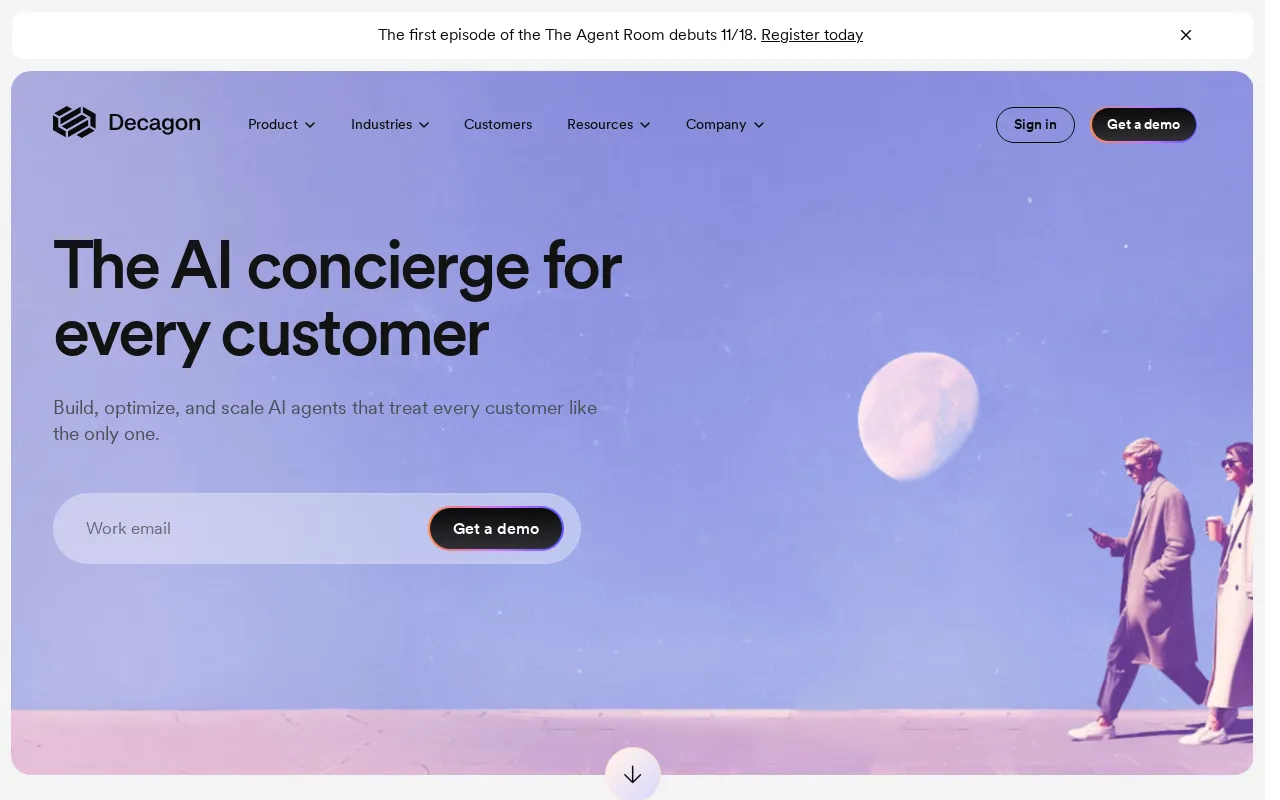
Decagon homepage, November 2026

Decagon is an AI agent platform for large companies that answers customers on chat, email and voice. It works through the help desk or CRM you already run, such as Zendesk, Intercom or Salesforce, and escalates what it can’t solve to your team there.

Best for
Enterprises with a high-volume queue across chat, email and phone, and a support operations team to build and test the AI with Decagon’s engineers.
How it bills
Decagon publishes no prices. Its own pricing post describes two options: a fixed rate for every incoming conversation, or a higher one for each fully resolved conversation, with lower rates for bigger volumes or commitments. Buying starts with “Get a demo”, and the help desk it answers in bills separately.
Free plan
No, buying starts with a demo
3 people, 300 AI replies
Quote only: No published rate: 300 conversations are priced per conversation or per resolution through Decagon’s sales team, and your help desk’s seats come on top.

Pros

  • One AI answers on web chat, SMS, WhatsApp, email and phone, and its voice agent speaks 70+ languages.
  • Your support team writes the AI’s workflows in plain language, as procedures Decagon calls AOPs, then tests and A/B tests changes before rolling them out.
  • Pre-built connections reach Zendesk, Intercom, Salesforce, Gorgias, Kustomer and Gladly, plus Shopify and Stripe Billing for orders and subscriptions.
  • Decagon’s own team works alongside yours during rollout, as its case studies with Rippling and 1-800-Flowers.com describe.

Cons

  • No published price, no free plan and no trial: every path to buying starts with “Get a demo”.
  • It answers inside your help desk, so Decagon is a second bill beside that help desk’s seats.
  • Going live takes weeks: Duolingo was live a month after its first conversations with Decagon, which Decagon calls a quick implementation.
  • On per-conversation pricing, which Decagon says most customers choose, conversations the AI escalates to your team are billed too.

Already on Decagon? See the best Decagon alternatives.
Lorikeet

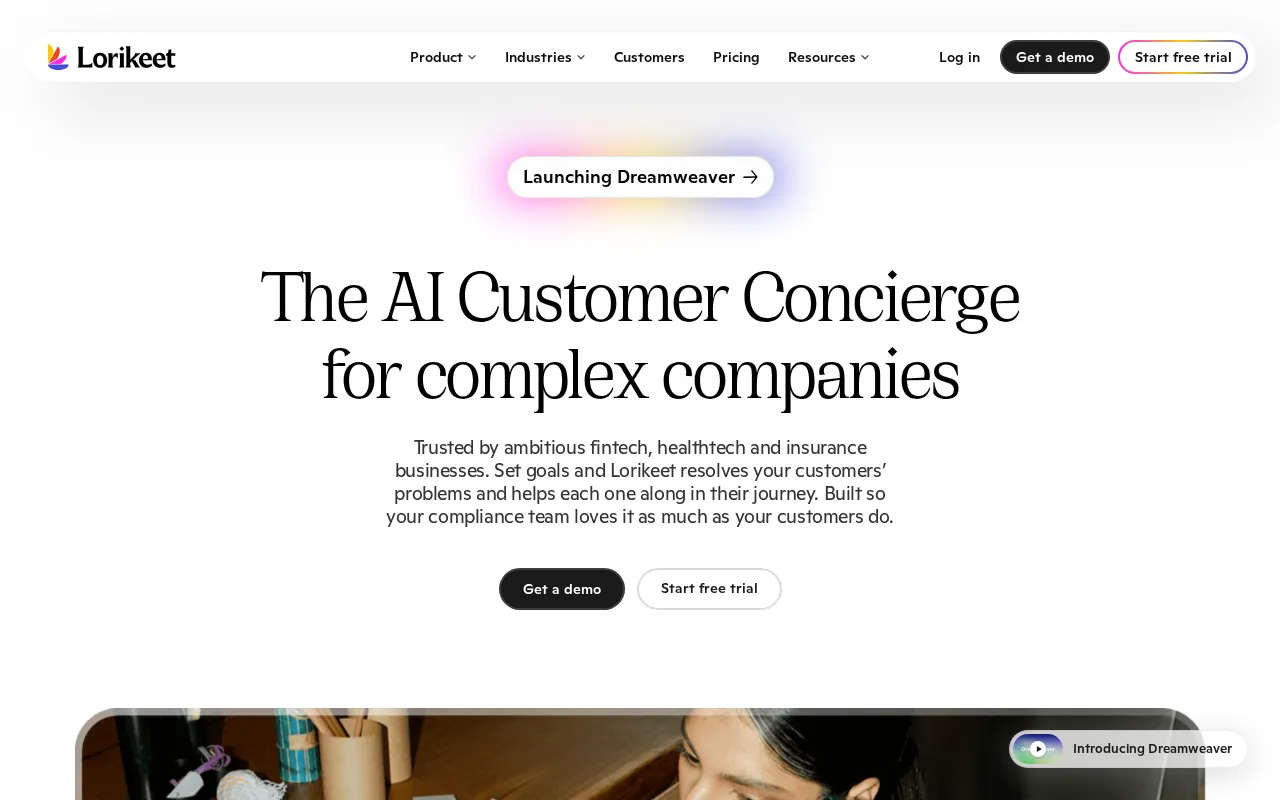
Lorikeet homepage, November 2026

Lorikeet is an AI customer support platform for complex and regulated businesses, such as fintech, health tech and insurance. Its Concierge agent resolves customers’ issues on chat, email, voice, SMS and WhatsApp by acting through your own systems, inside the help desk you already run, such as Zendesk, Intercom, Salesforce or HubSpot, and hands what it can’t solve to your team there.

Best for
Fintech, health tech and insurance companies with multi-step workflows to automate through their own APIs, a help desk they keep, and room for an annual plan from $2,100 a month.
How it bills
Start is $2,100 a month and Scale $5,100 a month, both paid annually, and each resolved chat, email or SMS ticket costs $0.99 or $0.90 on top, or $1.50 or $1.20 for a voice call. Escalations, unresolved tickets and tickets you mark bad aren’t charged, and there are no seat fees. Routing tags and automated QA cost $0.30 a ticket each on Start, Signature carries a $75K platform fee, and the help desk it answers in bills separately.
Free plan
No, a 30-day free trial with a card at checkout
3 people, 300 AI replies
$2,397 or more a month: Start at $2,100 a month, paid annually, plus 300 resolutions at $0.99. Your help desk’s seats come on top.

Pros

  • Concierge answers on chat, email, SMS, WhatsApp and voice, inbound and outbound, and workflows you train once run on every channel.
  • It runs multi-step workflows through your APIs, webhooks and MCP servers, from a Stripe refund to an account update, and escalates to your team with what it already tried.
  • Its prices are public, and you pay only for resolved tickets: never for escalations, failed attempts or tickets you mark bad, and never per seat.
  • It holds SOC 2 Type 2 and ISO 27001, signs a Business Associate Agreement for HIPAA, and never trains AI models on your data.

Cons

  • Start is $2,100 a month paid annually, or $25,200 a year, before the first resolution is billed.
  • It isn’t a help desk: it works inside Zendesk, Intercom, Salesforce, HubSpot or another you keep, so that help desk stays on your bill.
  • Time to the first live ticket averages under 29 days, while you build workflows and test them on your past tickets.
  • Its voice agent can’t take a card payment on a call, because Lorikeet doesn’t hold PCI DSS.

Already on Lorikeet? See the best Lorikeet alternatives.

Pick Decagon if

  • Callers reach you in many languages, and you want one voice agent that covers 70+ of them.
  • Your team answers in Gorgias, Kustomer or Gladly, all among Decagon’s pre-built connections.
  • Support operations staff want to write the AI’s procedures in plain language and A/B test changes before all customers see them.
  • You want Decagon’s own people working beside yours through the rollout, as Rippling and 1-800-Flowers.com had.

Pick Lorikeet if

  • You run a fintech, health tech or insurance business, and your AI vendor has to sign a BAA and show SOC 2 Type 2 and ISO 27001.
  • Finance wants the AI’s cost in writing before anyone books a call: $2,100 a month on Start, then $0.99 per resolved ticket.
  • You’d like 30 days to try it on your own, free, before you commit.
  • Your agents work in HubSpot, Front or Help Scout, or your calls come through Five9, Vonage, AirCall or Dialpad.
  • The AI must run multi-step jobs through your own APIs and webhooks, such as a Stripe refund or an account update, and hand over with a note of what it tried, with a person approving only the high-value actions you choose.

When to consider Rinhelp instead

Rinhelp fits a team of a few people whose customers write by email and website chat, and who would rather not sign a yearly AI contract on top of a help desk. It is the help desk and the AI in one: Rin, our built-in AI, answers each new conversation from your help center and website, then passes what it can’t solve to a teammate in the same inbox. Pro costs $49 a month for the whole workspace with 5,000 AI replies, the Free plan gives 3 teammates 50 AI replies to try Rin, and a refund or cancellation waits for a teammate to approve it. Skip Rinhelp if calls, SMS or WhatsApp carry much of your queue, if the AI must run long workflows through your own systems, or if you need integrations beyond Shopify and Stripe.

Start free

Questions about Decagon vs Lorikeet

Do I keep my help desk with Decagon or Lorikeet?

Yes, with either. Lorikeet says plainly it isn’t a help desk and works inside Zendesk, Intercom, Salesforce, HubSpot or another one you keep, and Decagon escalates into Zendesk, Intercom, Salesforce or a similar tool. Those seats stay on their own invoice beside the AI.

Can Claude or ChatGPT work in Decagon or Lorikeet?

Not as a teammate. Both use MCP in the other direction: Lorikeet’s AI calls servers you add, such as Notion or Linear, inside its workflows, and Decagon’s calls servers your company runs to look up data and act. We found no official MCP server on either that lets your own assistant read the queue or answer customers.

Is either one meant for a small team?

Not really. Lorikeet’s Start plan commits you to $25,200 a year before the first resolution is billed, and Decagon sells to enterprises through a demo, with case studies from companies such as Duolingo, Chime and Rituals.

How we checked

We compared Decagon and Lorikeet using the facts we keep on each, checked against the vendor’s own pages on the date shown beside its sources. Rinhelp is in every table because it is our product and we wrote this page, so check each figure against the vendor’s own page before you decide.

Costs are list prices in US dollars for three team sizes, on the cheapest plan that covers them, counting each AI reply as one resolved conversation. Features count only when the vendor’s own pages say a plan includes them. The AI column counts actions an official MCP server from the vendor can take, out of 11, and leaves third-party connectors out.

Try Rinhelp next to Decagon or Lorikeet.

Start free with up to 3 teammates and 50 AI replies.

Start free