1. Rinhelp
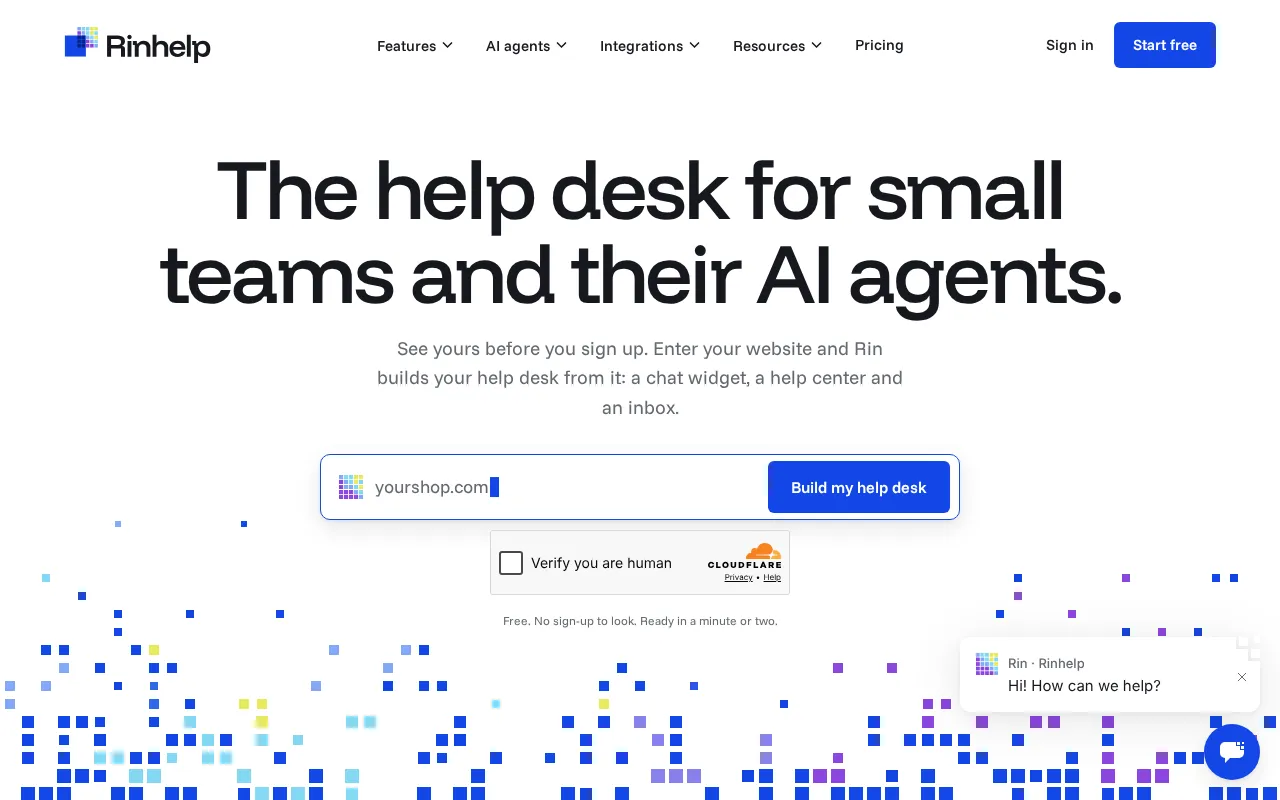
When a customer’s accounts payable team writes about an invoice, a teammate types the invoice number and Rinhelp finds that customer in Stripe, with their latest invoices showing number, total, status and date beside their subscriptions and payments. A teammate refunds a payment in full or in part, or cancels a subscription at the end of its period, from the conversation. When Rin, our built-in AI, or a teammate’s AI agent such as Claude asks for either, it becomes an approval that waits for a teammate. Rinhelp has no SSO, SLA rules, reports, CRM links or Slack channels, answers email and live chat only, and doesn’t create invoices, quotes or credit notes: those stay in Stripe. It’s $49 a month for the workspace with 5,000 AI replies, however far the team grows.
- Best for
- Series A SaaS teams that bill through Stripe, answer customers by email and chat, are hiring past their first few support people, and have no buyer yet who requires SSO.
- How it bills
- Free for up to 3 teammates. Pro is $49 a month for the whole workspace, with 5,000 AI replies from Rin. No per-seat or per-resolution fees.
- Free plan
- Yes: 3 teammates, 50 AI replies to try Rin
- 3 people, 300 AI replies
- $49 a month: Pro for the whole workspace, using 300 of its 5,000 AI replies; Free covers your team if you don’t need AI replies.
Pros
- One $49 workspace price with 5,000 AI replies, so going from 4 support hires to 10, or adding a solutions engineer to the inbox, adds nothing to the bill.
- Search by an invoice number, a receipt number, an email or a Stripe customer ID, and the customer’s latest invoices, subscriptions and payments open in the conversation.
- A refund or cancellation requested by Rin or a teammate’s AI agent waits until a teammate approves or rejects it, in the conversation or on the approval page.
- A cancellation lands at the end of the current period, so an account that paid for its term keeps what it paid for until then.
Cons
- Email and live chat only: there is no phone, WhatsApp, SMS or social inbox.
- Shopify and Stripe are the only integrations.
- No reports, SLA rules or routing rules: Rin hands a conversation to the teammate with the fewest open ones.
- The free plan has no Rin beyond 50 AI replies to try it.
2. Front
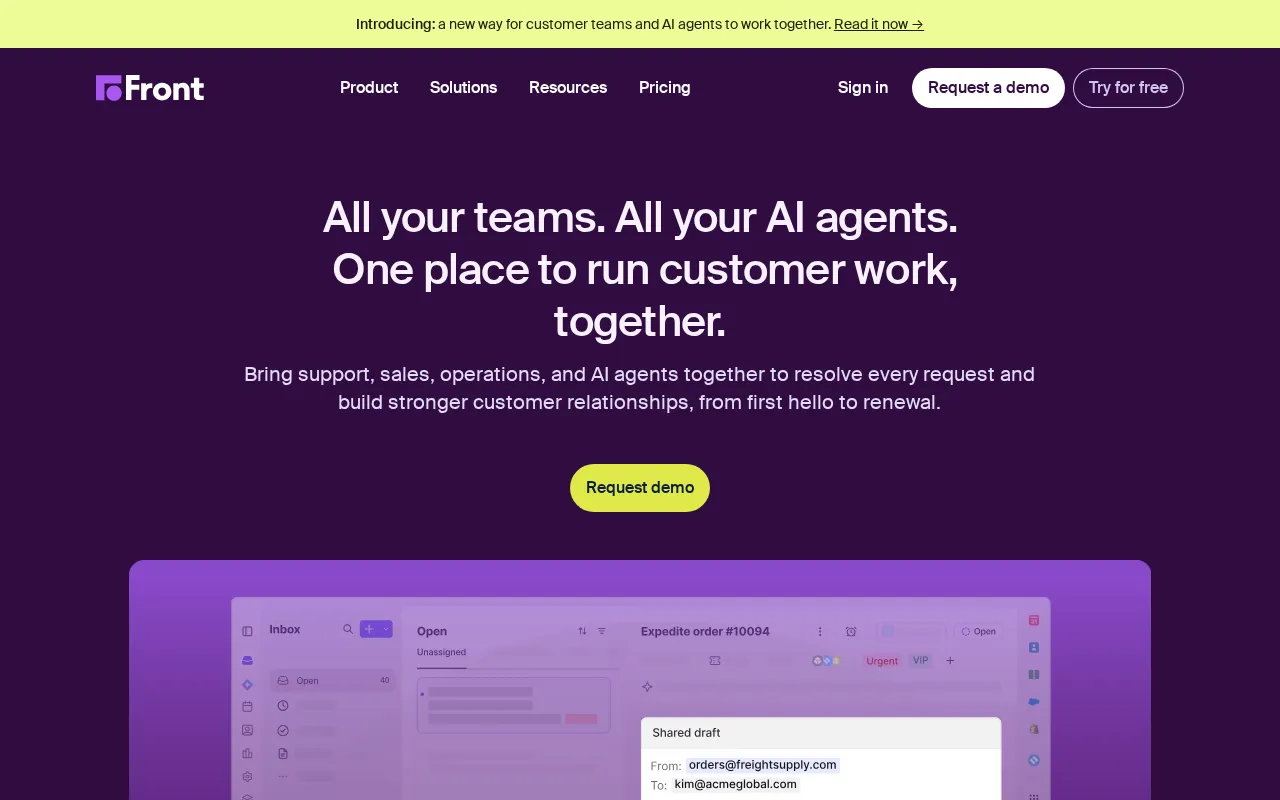
Front is a customer service platform built on shared inboxes, where support, sales and operations teams handle email, chat, SMS and social together. Autopilot, its AI agent, is billed by what it does in each conversation.
Professional at $65 a seat on annual billing adds SSO and SCIM for up to 50 seats, and you can sign up without a sales call. Account executives can join a conversation as guests and comment without a license of their own, and paid onboarding becomes required on contracts over $25,000.
- Best for
- Teams that run many shared addresses, bring in colleagues outside support, and want people and AI agents working one queue.
- How it bills
- Starter is $25 a seat a month for up to 10 seats, Professional $65 for up to 50 and Enterprise $105, on annual billing ($35 and $85 monthly; Enterprise is annual only). Autopilot charges $0.39 to hand off and $0.89 to resolve a conversation, and Copilot is $20 a seat.
- Free plan
- No, 14-day trial
- 3 people, 300 AI replies
- $342 a month: 3 Starter seats at $25 on annual billing, plus 300 Autopilot resolutions at $0.89.
Pros
- Its official MCP server can search, draft, send, comment, assign, tag and archive, with sending behind its own permission.
- Guest accounts let colleagues outside support comment on a conversation without a paid seat.
- Autopilot answers on email, chat, SMS, WhatsApp and Slack, and its 30-day trial covers up to 1,000 resolutions.
- Outside AI agents built with Claude, OpenAI or Sierra can be assigned conversations like a teammate, on every plan.
Cons
- Starter stops at 10 seats and one channel type, so an 11th seat or a second channel means Professional at $65 a seat.
- Autopilot charges for handoffs too, not only for conversations it resolves.
- There is no export you can run yourself: Support makes one, and it leaves out contacts, templates, tags and individual inboxes.
- Monthly and annual payments are nonrefundable, even if you cancel early.
Already on Front? See the best Front alternatives.
3. BoldDesk
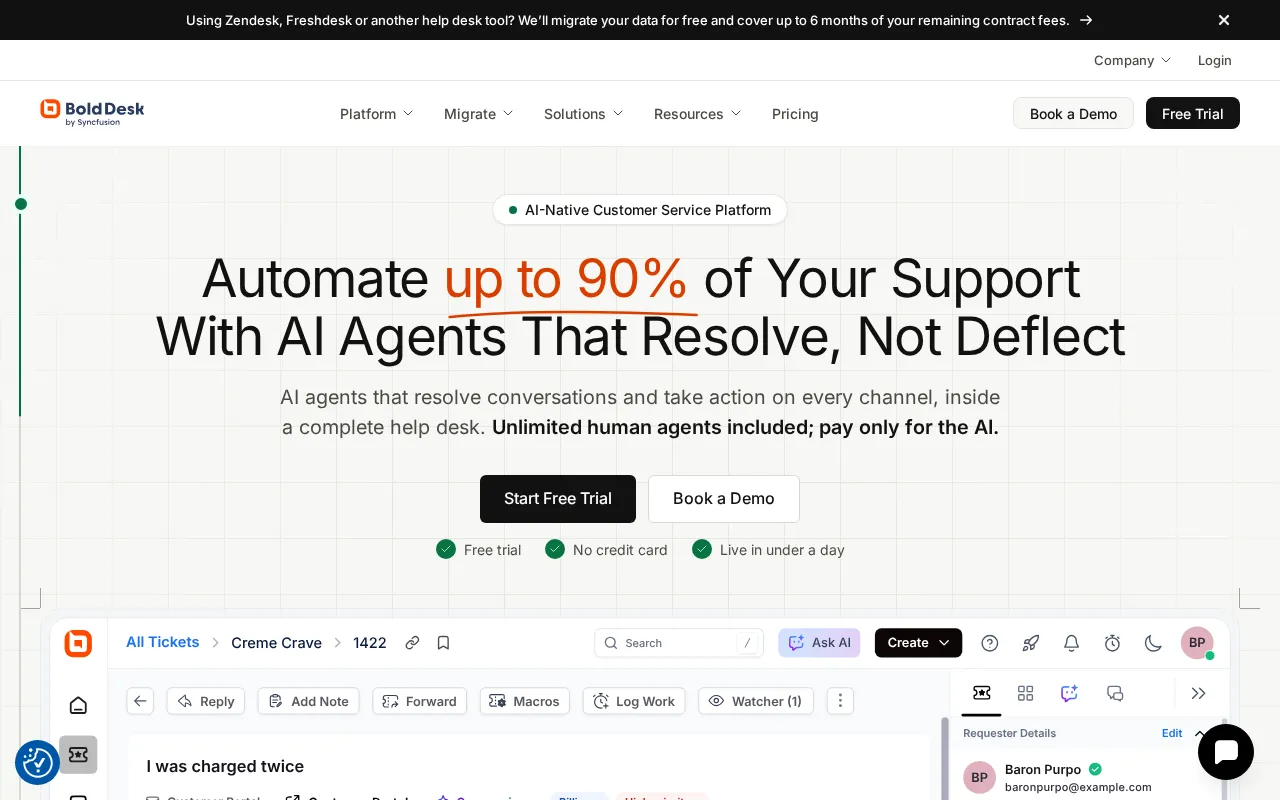
BoldDesk is a help desk and AI customer service platform from Syncfusion. Its AI agents answer on email, chat, WhatsApp, social media and SMS, and its AI plans include unlimited human agents.
Enterprise at $35 an agent on annual billing lists SSO, audit logs, roles and SOC 2, HIPAA and GDPR compliance, and agents refund or cancel Stripe subscriptions from the ticket. Its pricing page and plan articles disagree on whether that plan can have AI at all.
- Best for
- Large support teams, often running several brands, that want every agent in the help desk and to pay only for the work AI does.
- How it bills
- Enterprise is $35 an agent a month on annual billing ($40 monthly), with every help desk feature, live chat included. Its pricing page sells AI for it as an add-on, credits at $40 per 1,000 shared across every agent, while BoldDesk’s plan articles say Enterprise has no AI. AI plans instead include unlimited human agents and a monthly allowance of credits: Scale AI is $99 a month with 500, Momentum AI $499 with 1,000 and Enterprise AI $999 with 2,500, on annual billing ($116, $587 and $1,175 monthly). Bought credits never expire, while plan credits lapse at the end of each month.
- Free plan
- No, 15-day trial with no card
- 3 people, 300 AI replies
- $185 or more a month: 3 Enterprise agents at $35 on annual billing, plus 2 AI add-on credit packs of 1,000 at $40 for 300 AI answers at 5 credits each, the default in BoldDesk’s cost calculator, as its per-agent pricing page sells it. BoldDesk’s plan articles say Enterprise has no AI, which would leave Momentum AI at $499 as the first AI plan with chat.
Pros
- The AI plans include unlimited human agents, so on them adding a teammate never raises the bill.
- An official hosted MCP server lets Claude, ChatGPT or Copilot read tickets, reply, add notes, change status and assignee, and search or create knowledge base articles.
- Shopify order history and Stripe subscriptions show beside the ticket, and agents can issue Stripe refunds and cancellations from BoldDesk.
- Its own AI agent can call your APIs and MCP servers, with each action set to run on its own or wait for a person’s approval.
Cons
- On Enterprise every agent is $35 a month and AI credits come on top, and BoldDesk’s pricing page and plan articles disagree on whether that plan can have AI at all. The unlimited-agent plans with chat start at Momentum AI, $499 a month on annual billing, since Scale AI has no chat widget.
- Credits per answer vary with length and complexity, and BoldDesk says the cost of a response can’t be predicted or capped.
- Plan credits expire unused at the end of each cycle, and AI stops answering when the balance reaches zero.
- No free plan, and BoldDesk Voice is still launching soon, so phone calls come in through integrations such as Aircall.
Already on BoldDesk? See the best BoldDesk alternatives.
4. HappyFox
HappyFox Help Desk is a ticketing help desk with a knowledge base and support portal, used for customer support and for internal teams such as IT and HR. Live chat, AI, a chatbot and voice are separate HappyFox products that plug into it.
HappyFox puts SSO with Google, SAML or Azure, plus SLA management, on Basic at $24 an agent on annual billing. Basic stops at 5 agents and leaves out Stripe, so the sixth support hire moves everyone to Team at $49 an agent.
- Best for
- Teams that run customer, IT or HR requests through one ticket queue with SLAs, several brands and asset tracking, and want HappyFox to handle the move for them.
- How it bills
- Per agent: Basic is $24, Team $49 and Pro $99 a month on annual billing ($29, $69 and $119 monthly), and Basic stops at 5 agents. Live chat (HappyFox Messaging) starts at $19 an agent, HappyFox AI at $14 to $39 an agent, and the Chatbot at $0.33 per resolution. Unlimited-agent plans start at $1,999 a month on annual billing for 20,000 tickets a year, and Scale is $3,999 for 150,000.
- Free plan
- No, 14-day trial requested through the demo form
- 3 people, 300 AI replies
- $171 or more a month: 3 Basic agents at $24 on annual billing, plus 300 Chatbot resolutions at $0.33. HappyFox’s Chatbot page says each price is set in the order form.
Pros
- Free white-glove migration with any annual plan: HappyFox maps your tickets, rebuilds rules and SLAs, and helps for 30 days after launch.
- One account can serve customer support, IT, HR and facilities, with separate queues, SLAs and knowledge bases, and assets on Pro.
- Team runs up to 5 brands, each with its own support center and domain, and Pro up to 15.
- Large teams can skip per-agent pricing: Growth is $1,999 a month on annual billing for unlimited agents and 20,000 tickets a year.
Cons
- Live chat, AI, the Chatbot and voice are each sold separately, on top of the per-agent help desk.
- Basic stops at 5 agents and leaves out WhatsApp and Stripe, so a sixth agent moves everyone to Team at $49.
- No free plan, and even the trial starts from a demo form.
- No MCP server for the help desk, and API access can be switched off on new accounts until you email support.
- An annual plan ended early refunds no prepaid fees, and HappyFox may delete your data as soon as the subscription ends.
Already on HappyFox? See the best HappyFox alternatives.
5. Intercom
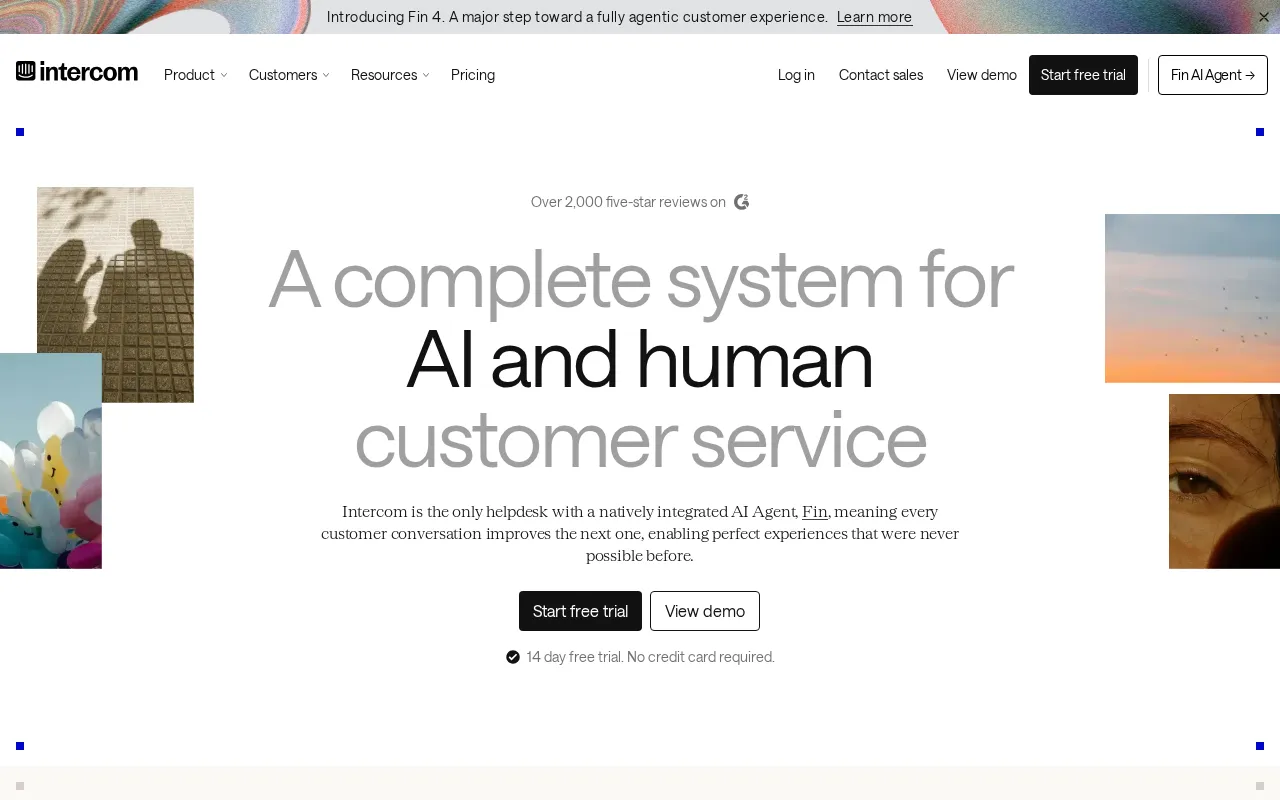
Intercom is a customer service help desk with a chat Messenger, a shared inbox, a help center and Fin, its AI agent. Its company renamed itself Fin in May 2026, and Salesforce bought it that September.
Expert at $132 a seat on annual billing brings SSO, identity management, HIPAA support and SLAs, with 50 free Lite seats for internal collaboration. Fin’s $0.99 an outcome comes on top of every seat.
- Best for
- Software and app companies that want chat, email, phone, WhatsApp and SMS in one inbox, with Fin answering across them.
- How it bills
- Per seat: Essential is $29, Advanced $85 and Expert $132 a seat a month on annual billing ($39, $99 and $139 monthly), and new customers pay $19 for Essential on annual billing. Fin costs $0.99 for each outcome, and WhatsApp, SMS and phone are billed by use.
- Free plan
- No, 14-day trial
- 3 people, 300 AI replies
- $354 a month: 3 Essential seats at $19, the new-customer price on annual billing (list $29), plus 300 Fin outcomes at $0.99.
Pros
- Chat, email, phone, WhatsApp, SMS, Slack, Facebook and Instagram all arrive in one inbox.
- Fin answers on email, live chat and phone, and is charged once per conversation however many questions it answers.
- Agents can refund or cancel a Shopify order from the inbox sidebar, and the Stripe app shows subscriptions mid-conversation.
- Its official MCP server can add internal notes and write and publish help center articles, not only read.
Cons
- Every teammate who replies needs a paid seat, and Fin adds $0.99 an outcome on top.
- An outcome also counts when a customer simply stops asking after Fin’s answer, or when a Fin workflow hands the conversation to your team.
- Its MCP server can’t reply to customers, assign or close conversations, and doesn’t serve workspaces hosted in Australia.
- No free plan, and an annual plan cancelled early gets no prorated refund.
Already on Intercom? See the best Intercom alternatives.
6. HubSpot
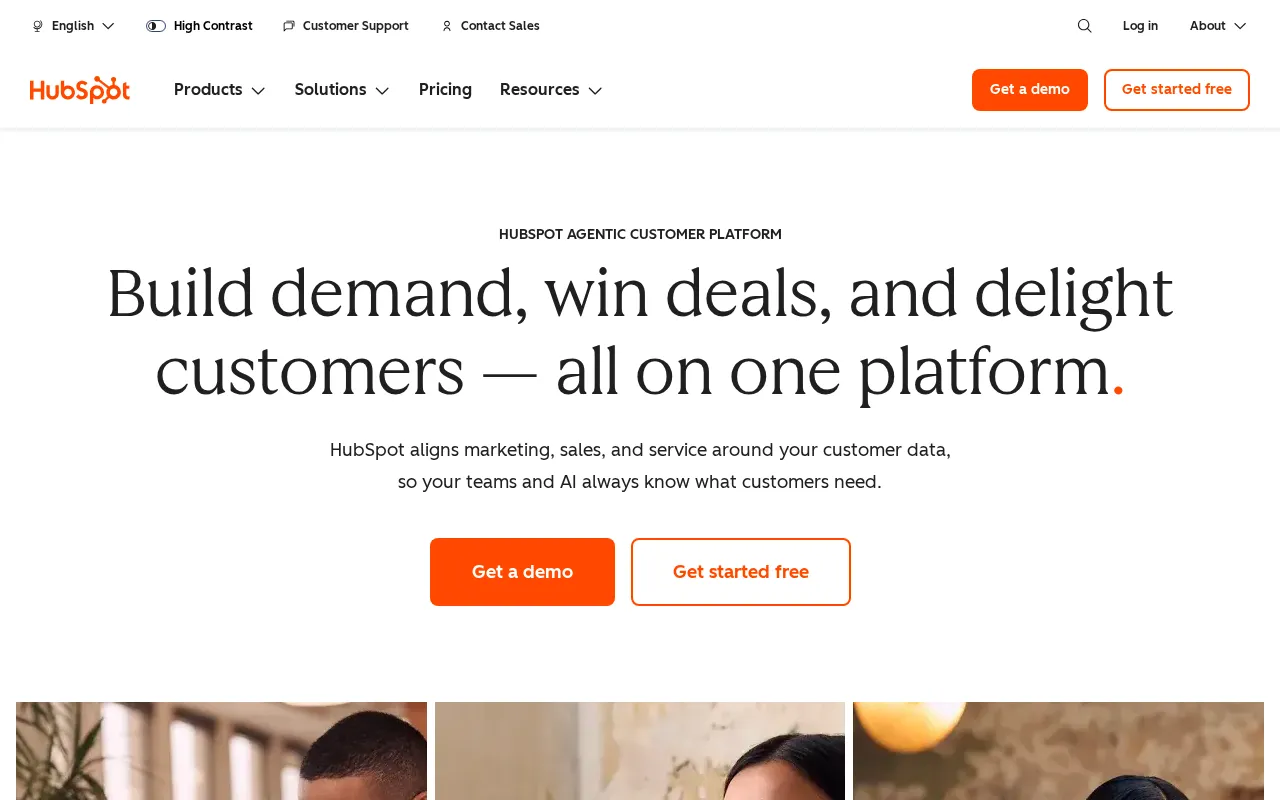
HubSpot Service Hub is the customer service part of HubSpot’s CRM: a help desk inbox for email, chat, WhatsApp and calls, a knowledge base, and the customer agent, an AI that answers customers.
Enterprise, from $150 a seat through sales, adds conditional SLAs, skill-based routing and a sandbox on the CRM where your account executives log deals. Professional carries a required $1,500 onboarding fee, and Enterprise $3,500.
- Best for
- Teams already running sales or marketing on HubSpot that want support on the same customer records.
- How it bills
- Per seat: Starter is $7 and Professional $90 a seat a month on annual billing ($10 and $100 paid monthly, with Professional still committed for a year), and Enterprise starts at $150. Starter’s prices are new-customer discounts on a $20 list price. Professional adds a required $1,500 onboarding fee, and Enterprise $3,500. The customer agent uses 50 credits, $0.50, per resolved conversation, after 3,000 credits a month included on Professional.
- Free plan
- Yes: 2 users, with HubSpot branding on chat and email
- 3 people, 300 AI replies
- $390 a month: 3 Professional seats at $90 on annual billing, plus 300 resolutions by the customer agent at 50 credits each, $120 after the 3,000 included credits. A one-time $1,500 onboarding fee comes on top.
Pros
- Support, sales and marketing share one CRM, so every ticket sits next to the customer’s deals and emails.
- The customer agent is billed only when it resolves a conversation, and a handoff to a person costs nothing.
- Professional puts calling, WhatsApp and Facebook Messenger in the same inbox as email and chat.
- The official MCP server reads inbox conversations and writes tickets, notes and contacts, asking you to confirm each change.
Cons
- The customer agent needs Professional at $90 a seat on annual billing, plus a required $1,500 onboarding fee.
- AI credits are shared with every other credit feature, and the customer agent stops taking new conversations when they run out.
- The MCP server can’t send a reply to a customer or reach the knowledge base.
- HubSpot’s examples of customer agent actions are password resets and booking meetings, with no refunds or order changes.
Already on HubSpot? See the best HubSpot alternatives.
7. Salesforce Service Cloud
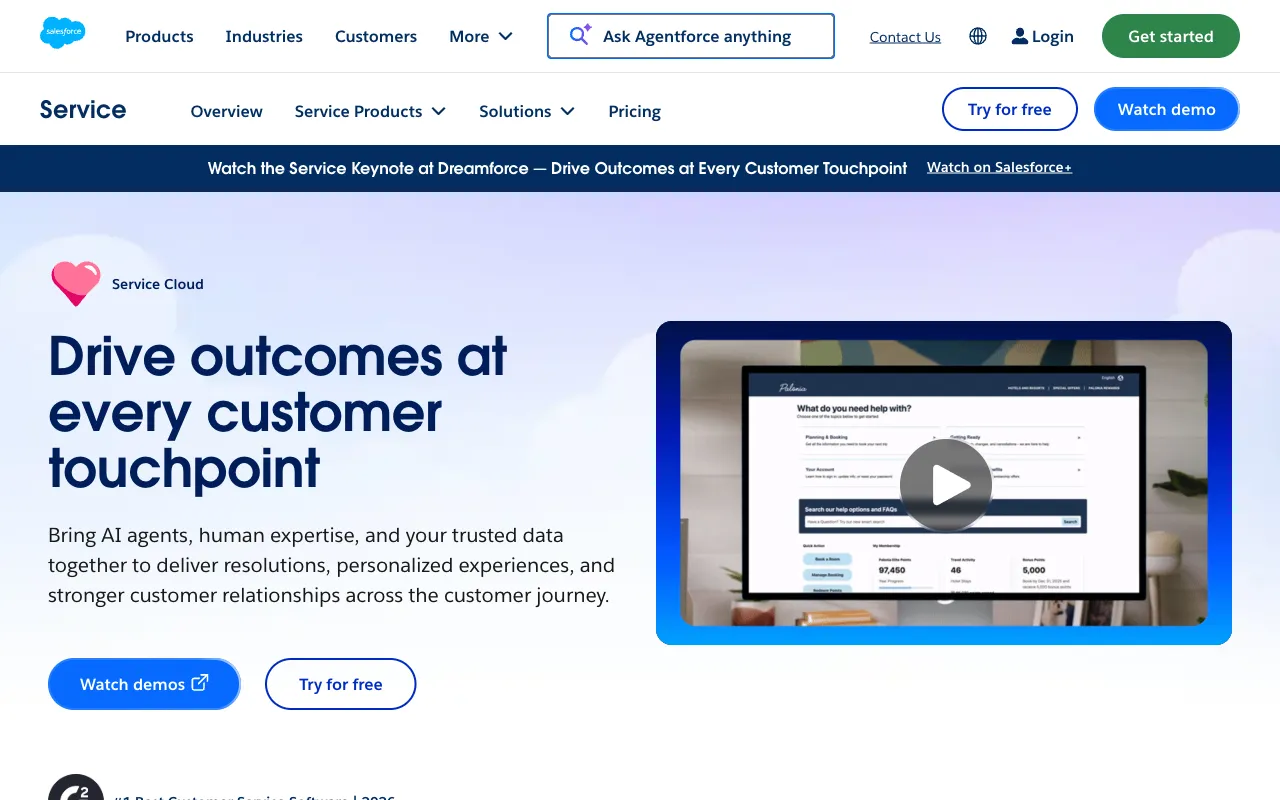
Salesforce Service Cloud is an enterprise customer service platform on the Salesforce CRM, with case management, a self-service help center, contact center add-ons, and Agentforce AI agents billed per resolution or conversation.
Pro Suite, from $100 a user on an annual contract, keeps sales quoting, service contracts and entitlements on the same records, which suits a sales-led company already in Salesforce. Core, the service edition, is $195 a user before any AI.
- Best for
- Large service teams already on Salesforce that need contact center seats, voice, routing and admins who customize the platform.
- How it bills
- Per user a month on annual billing: Core is $195, Advanced $395 and Max $550. Starter Suite at $25 and Pro Suite at $100 bundle sales, service and marketing, and transaction fees apply. Agentforce’s help agent costs $2 per resolution, Agentforce for Service $125 more a user, contact center seats $125 a user and voice from $50 a user. Agentforce can instead run on Flex Credits at $500 per 100,000.
- Free plan
- No, free trial
- 3 people, 300 AI replies
- $1,185 a month: 3 Core users at $195 on annual billing, plus 300 help agent resolutions at $2.
Pros
- Core brings case management and a self-service help center, and voice and contact center seats can be added on top.
- Agentforce’s help agent answers on web, portal, messaging and voice from your Salesforce knowledge base, and bills only when it resolves an issue on its own.
- Hosted MCP servers let Claude query, create and update cases, comments and articles, within the signed-in user’s permissions.
- AppExchange lists Stripe’s own app and Shopify sync apps tested with Service Cloud.
Cons
- Core starts at $195 a user a month, billed annually, before any AI.
- Salesforce’s help agent announcement lists voice, web, portal and messaging, but not email.
- Agentforce for your reps costs $125 more a user a month, and Enhanced Messaging $75.
- Unused Flex Credits don’t roll over, and an org can’t mix Flex Credits with per-conversation pricing.
Already on Salesforce Service Cloud? See the best Salesforce Service Cloud alternatives.
8. TeamSupport
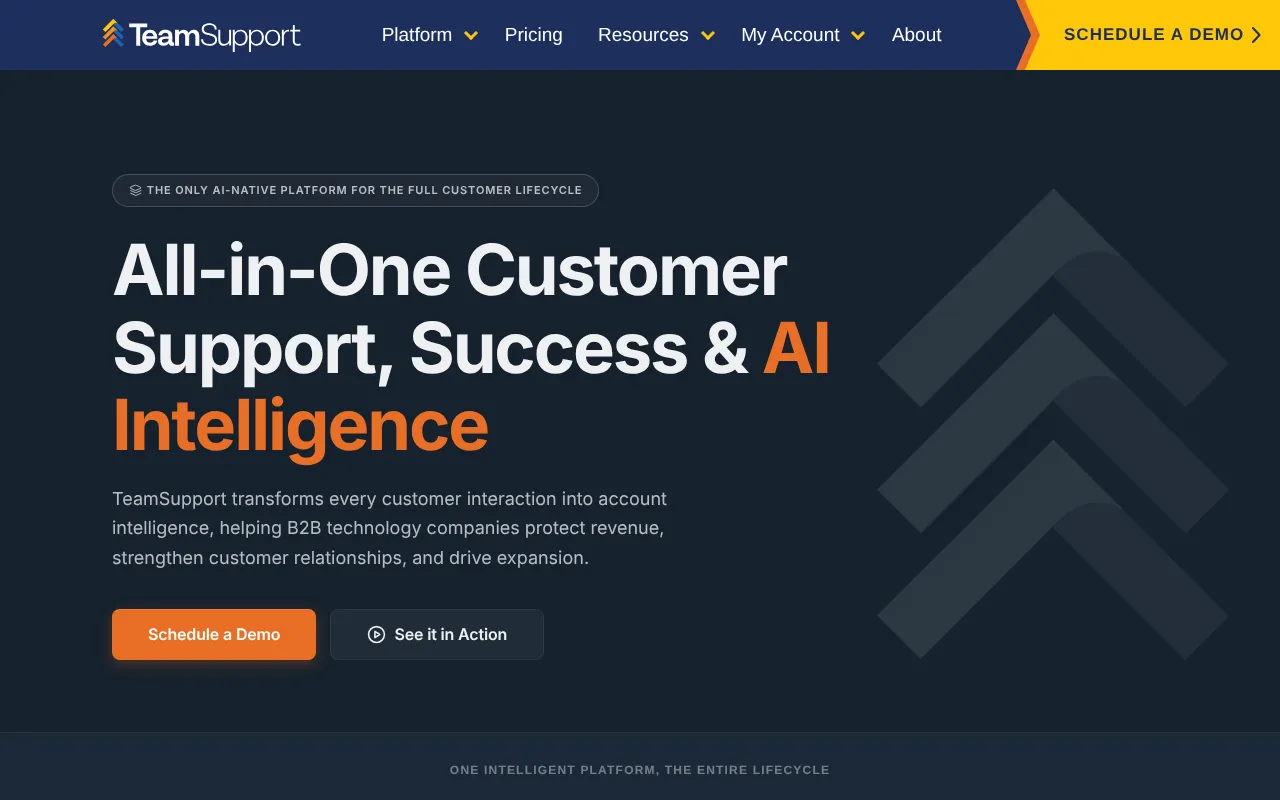
TeamSupport is a help desk for B2B software and technology companies, built around the customer account rather than the single ticket. Email becomes tickets beside the account’s ARR and renewal context, with Messaging & Live Chat, a Customer Hub with a knowledge base, and AI agents that answer chat.
TeamSupport shows each account’s ARR, product usage and health signals beside its tickets, so a renewal at risk surfaces in support. Every plan is quoted and billed yearly, and Starter stops at 5 users.
- Best for
- B2B software companies whose support and customer success teams track account health, ARR and renewals around every ticket.
- How it bills
- Per user a month, billed yearly: Starter is $45 for up to 5 users, Professional $65 and Scale $85, each bought through a quote. Messaging & live chat is $15 more an agent and includes Kevin at 3 chats a day per agent. On the chat price list, an additional AI agent with 200 chats a month is $125. Basic training is listed at $2,000 on Starter, $1,500 on Professional and $1,000 on Scale.
- Free plan
- No, trial requested through a form
- 3 people, 300 AI replies
- $180 or more a month: 3 users on Starter at $45, billed yearly, plus Messaging & live chat at $15 an agent with Kevin at 3 chats a day per agent. More Kevin chats have no listed price.
Pros
- Tickets roll up to the customer account, with ARR, product usage, renewal timelines and health signals beside them.
- AI agents answer chat visitors from your sites, files, knowledge base and Confluence, and create a TeamSupport ticket with the transcript when they hand off.
- Ask Kevin looks up, creates, updates and assigns tickets, and adds notes, from plain-language requests.
- Integrations with Salesforce, HubSpot, Jira, Azure DevOps, Slack and Microsoft Teams, plus a REST API.
Cons
- Every plan is bought through a quote, and even the trial starts from a request form.
- Starter stops at 5 users and has no knowledge base or customer portal, which start on Professional at $65.
- Live chat is $15 more an agent on every plan.
- No Shopify or Stripe integration, and no MCP server: TeamSupport’s own guide connects Claude through the REST API.
- Contracts renew themselves unless you give written notice 30 days before, and fees are nonrefundable.
Already on TeamSupport? See the best TeamSupport alternatives.
9. Freshdesk
Freshdesk is Freshworks’ help desk: email ticketing with a customer portal and knowledge base, with Freshdesk Omni adding chat, phone and messaging. Its Freddy AI agent answers customers and is billed per session.
Pro at $55 an agent on annual billing adds multiple SLA policies and intelligent routing, and Enterprise at $89 adds audit logs, allowed domains and IP whitelisting. Fees are non-refundable, and a cancellation waits for the end of the term.
- Best for
- Teams that want a full ticketing help desk with SLAs, routing and a knowledge base, and chat and messaging for less per agent than Zendesk’s Suite Team.
- How it bills
- Per agent on annual billing: Growth is $19, Pro $55 and Enterprise $89 a month, or $29, $79 and $119 on Freshdesk Omni with chat and messaging. Freddy AI agent sessions cost $49 per 100 after 500 free ones, once per account. Voice is $15 to $69 more an agent, and MCP actions $15 per 1,000.
- Free plan
- No, 14-day trial
- 3 people, 300 AI replies
- $204 a month: 3 Growth agents at $19 on annual billing, plus 3 packs of 100 AI sessions at $49, on email only.
Pros
- SLA policies, custom dashboards, skill-based routing and audit logs come on its higher plans, with skill-based routing at $89 an agent where Zendesk asks $115.
- Freshdesk Omni adds chat, phone, WhatsApp, Messenger, Instagram and Line to the same tickets.
- Day passes from $2 let occasional helpers answer without a full seat.
- Its official MCP server can reply, add notes, update tickets and write knowledge base articles.
Cons
- List prices rose early in 2026, from $15 to $19 an agent on Growth, and the free plan is gone.
- Freddy AI agent costs 49 cents a session after the first 500, which never come back.
- Every MCP call counts as an action, and Growth includes only 1,200 a year.
- Fees are non-refundable, and a cancellation only takes effect at the end of your term.
Already on Freshdesk? See the best Freshdesk alternatives.
10. Zendesk
Zendesk is a customer service suite for email, messaging, live chat, social and voice, with AI agents that answer customers and are billed per automated resolution.
Suite Professional at $115 an agent on annual billing brings skills-based routing and an IVR phone tree, and Suite Enterprise adds approval workflows, a sandbox and custom agent roles through a quote. Automated resolutions beyond the allowance each agent brings are billed at $1.50 to $2.00 apiece.
- Best for
- Growing and large teams that need voice, many channels, 1,800+ apps and integrations, and enterprise controls to grow into.
- How it bills
- Per agent: Support Team is $19, Suite Team $55 and Suite Professional $115 a month on annual billing ($25, $69 and $149 monthly). Each agent brings 5 automated resolutions a month (10 on Professional), then each costs $1.50 committed or $2.00 pay as you go. Copilot is $50 more an agent.
- Free plan
- No, 14-day trial
- 3 people, 300 AI replies
- $485 a month: 3 Support Team agents at $19 on annual billing, plus 285 automated resolutions at $1.50 committed beyond the 15 included, on email only.
Pros
- Email, messaging, live chat, WhatsApp, social and voice sit in one Suite, and AI agents can answer on email, messaging or voice.
- Its marketplace lists 1,800+ apps, partners and integrations.
- Agents refund and cancel Shopify orders inside a ticket, and an admin can connect Zendesk’s AI agents to Stripe’s MCP server.
- The 14-day trial opens every Suite Professional feature, Copilot included, and startups can get 6 months of Suite free for up to 50 agents.
Cons
- Every agent is a seat, and each automated resolution past the 5 per agent a plan includes costs $1.50 to $2.00.
- No official MCP server for outside AI tools yet: Zendesk announced one in May 2026 for early access and has published no tools for it.
- Data exports are off until the account owner asks support, and the export tools aren’t on Team plans.
- Zendesk gives no refunds or credits for unused seats or time.
Already on Zendesk? See the best Zendesk alternatives.
11. Plain
Plain is a support platform for B2B software companies. It answers customers in Slack, Microsoft Teams, Discord, email, chat and a help center, with an AI customer agent and a GraphQL API that does everything its app can.
Horizon at $99 a member seat, for 3 to 10 seats, adds SLAs, escalation paths, Microsoft Teams and sync with HubSpot, Attio and Salesforce. SSO, SCIM and custom contracting wait for Frontier, which is quote only.
- Best for
- B2B software teams that support customers in shared Slack or Teams channels and want engineers and AI agents building on its API.
- How it bills
- Per member seat: Foundation is $45 a month on annual billing ($55 monthly) for up to 5 seats with 1,000 credits, and Horizon $99 ($139 monthly) for 3 to 10 seats with 2,500 credits; Frontier is quoted. Each customer agent resolution uses 100 credits, extra credits are $10 per 1,000, and viewer seats are free.
- Free plan
- No, 7-day trial
- 3 people, 300 AI replies
- $425 a month: 3 Foundation seats at $45 on annual billing, plus 29,000 credits at $10 per 1,000 for 300 customer agent resolutions beyond the 1,000 credits included.
Pros
- Slack, Microsoft Teams and Discord work as support channels next to email, which suits B2B customers.
- Its official MCP server can reply, add notes, assign, close and write help center articles, signed in as your own user.
- A customer agent resolution is charged only after the thread stays done for 7 days with no teammate stepping in.
- Viewer seats are free and unlimited, and Linear, Jira, GitHub and incident.io link to threads.
Cons
- Its price list has changed four times since December 2025, most recently raising Foundation’s seat price and halving its included credits.
- No free plan, and the trial shrank from 14 days to 7 in 2026.
- No phone, WhatsApp, SMS, Shopify or Stripe.
- Foundation stops at 5 seats and 2 email addresses, so a sixth teammate means Horizon at $99 a seat.
Already on Plain? See the best Plain alternatives.
12. Help Scout
Help Scout is a help desk with shared inboxes, a Docs help center and Beacon, a widget for chat and help articles. Scout, its AI agent, answers chat from your help content and is billed per resolution.
Plus at $45 a user connects Salesforce, Jira and HubSpot and adds a secure customer portal, and agents refund Stripe payments from the sidebar. SSO/SAML waits for Pro at $75 a user, which needs 10 users and a demo.
- Best for
- Support teams that think in tickets and want a calm shared inbox, a help center and live chat, with a free plan to start on.
- How it bills
- Standard is $25, Plus $45 and Pro $75 a user a month on annual billing, which saves 16%. Pro needs at least 10 users and a demo. Scout costs $0.75 per resolution, free for a new account’s first 3 months.
- Free plan
- Yes: 5 users, 1 inbox, 100 contacts a month
- 3 people, 300 AI replies
- $300 a month: 3 Standard users at $25 on annual billing, plus 300 AI resolutions at $0.75.
Pros
- A free plan for up to 5 users, with 1 inbox, a Docs site and 100 contacts a month.
- Agents can refund, cancel or edit recent Shopify orders, and refund Stripe payments or cancel subscriptions, from the sidebar.
- Standard brings email, live chat, SMS, WhatsApp, Instagram and Messenger into one inbox.
- You can cap AI spending each month, and Scout switches off when it reaches the cap.
Cons
- Its official MCP server is read-only: your own AI can search conversations and Docs, but can’t reply, add notes or close.
- Scout answers website and in-app chat only, and lists email as “Coming Soon”.
- Scout can’t look up orders or act in other tools yet: its connection to payment processors and CRMs is still to come.
- Seats and AI are billed separately, so the bill grows with every user and every resolution.
Already on Help Scout? See the best Help Scout alternatives.
13. Hiver
Hiver is a help desk for teams that work from email. It sells two versions at the same prices: Hiver in Gmail, and Hiver Omni, a standalone app for email, live chat, WhatsApp, voice and Slack.
For a team that answers from Gmail or Outlook, Pro at $55 a user brings SLAs and HubSpot, Salesforce and NetSuite, and Elite at $85 adds SSO and SCIM. Approval is opt-in there: an AI agent stops for a person only on actions you have marked sensitive.
- Best for
- Teams that run support from Gmail or Outlook and want shared inboxes, SLAs and AI agents that Hiver’s engineers set up with them.
- How it bills
- Per user, from 2 seats: Growth is $25, Pro $55 and Elite $85 a user a month on annual billing ($35, $65 and $95 monthly). AI agents come on every plan with no published price, and voice is $30 a voice seat.
- Free plan
- No, 7-day trial of Elite
- 3 people, 300 AI replies
- $75 or more a month: 3 Growth users at $25 on annual billing. AI agents come with every plan, but Hiver doesn’t publish what their work costs.
Pros
- Hiver in Gmail keeps your team in the Gmail it knows, and Hiver Omni brings email, live chat, WhatsApp, voice and Slack into one app.
- Its AI agents look up orders, issue refunds and update records in other systems, and pause for approval on actions you mark sensitive.
- Hiver’s engineers build the agent’s integrations with your team, including tools that have no API.
- Elite adds AI quality scoring, skill-based routing, SSO and HIPAA compliance.
Cons
- Every user is a seat from 2 up, and Growth stops at 10 users and 2 shared inboxes.
- The API starts at Pro, at $55 a user a month on annual billing.
- Hiver doesn’t publish what its AI agents cost, saying only that you pay for work correctly delivered.
- Its official MCP can assign, close and add notes, but can’t send a reply, only save a draft.
Already on Hiver? See the best Hiver alternatives.
14. Zoho Desk
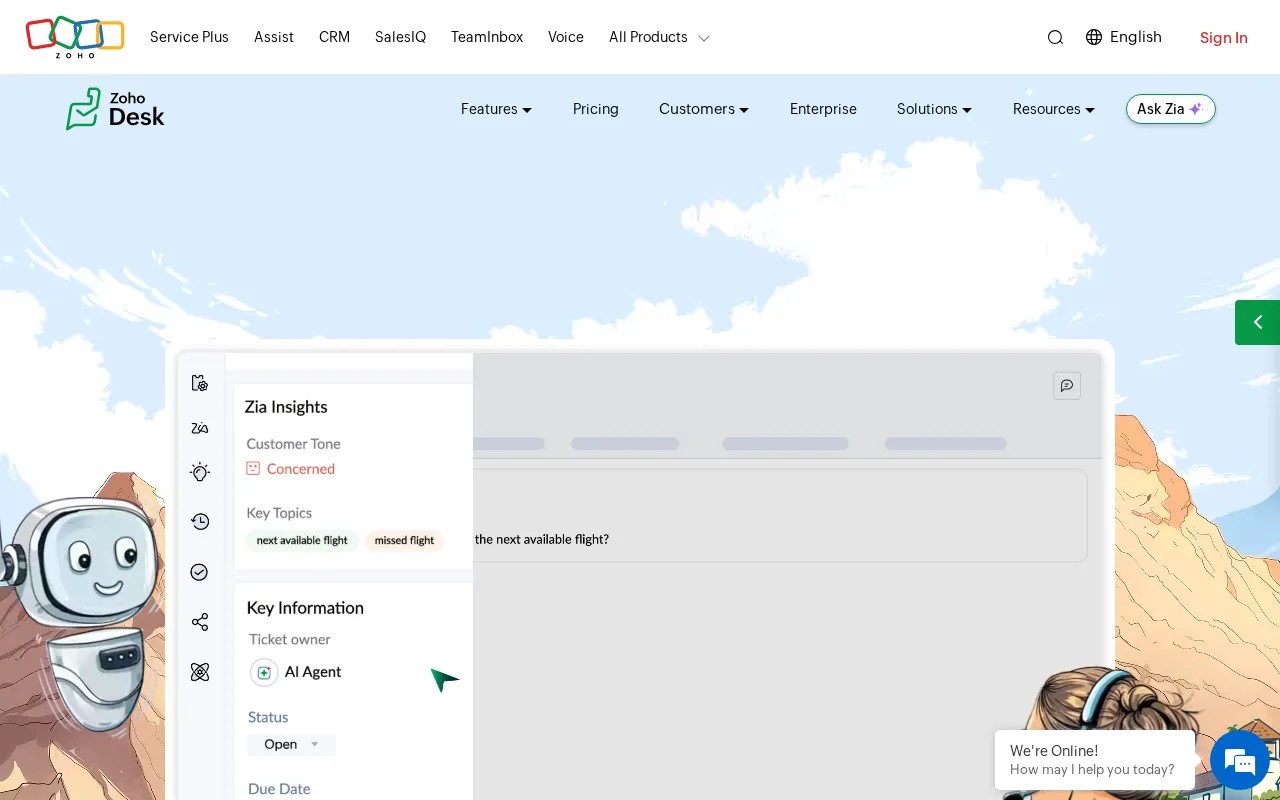
Zoho Desk is the help desk in Zoho’s suite of business apps, with tickets from email, social media, chat, WhatsApp and phone, a multilingual help center, and Zia, Zoho’s AI.
Standard at $14 a user on annual billing has no user limit and adds a knowledge base and custom reports, the budget step once Express’s 5-user cap is hit. Skill-based assignment and a sandbox wait for Enterprise at $40.
- Best for
- Budget-minded teams that want a full ticketing suite with workflows and SLAs, especially if they already use other Zoho apps.
- How it bills
- Per user: Express is $7, Standard $14, Professional $23 and Enterprise $40 a month on annual billing ($9, $20, $35 and $50 monthly), and light agents are $6 each. Express allows up to 5 users; Standard and above have no user limit. AI agents include up to 30 million free tokens a month. Other generative features run on a key you bring from an AI provider, and Professional and Enterprise add Zia’s own.
- Free plan
- Yes: 3 users, email only
- 3 people, 300 AI replies
- $42 a month: 3 Standard users at $14 on annual billing, the first plan with live chat and Answer Bot, which answers customers from your help center. Zoho publishes no per-answer fee.
Pros
- Low seat prices: Express is $7 a user and Standard $14 on annual billing, with a free plan for 3 users.
- Standard adds live chat, WhatsApp, Telegram and other messaging apps, and Professional adds phone support.
- Workflows, SLAs and several departments, with a help center you can publish in over 40 languages on Professional.
- Zoho’s official MCP server is free and can read tickets, send replies and add comments.
Cons
- Express stops at 5 users, so a sixth teammate moves everyone to Standard at $14.
- Zia’s full AI needs Professional, and the agent that answers email tickets is open only to selected accounts.
- The MCP server has no tools for help center articles or saved replies, and every call uses daily API credits.
- Express has no live chat, and the free plan covers email only.
Already on Zoho Desk? See the best Zoho Desk alternatives.
15. Jira Service Management
Jira Service Management is Atlassian’s service desk for IT, HR and other internal teams, sold in its Service Collection: requests by email, portal, widget, Slack and Microsoft Teams, with on-call schedules on every plan, assets on paid plans and change management from Premium, and an AI agent for customers billed per resolution.
Premium at $61.60 an agent brings the virtual service agent, a 99.9% uptime SLA and change management with approvals, beside the Jira projects engineering runs. SSO and SCIM come through Atlassian Guard, included in Enterprise, listed from $185,000 a year, or bought as a separate subscription.
- Best for
- IT and engineering teams already on Jira and Confluence that run incidents, changes, problems, assets and on-call in one place.
- How it bills
- Free for 3 agents. Up to 15 agents, Standard is $26.90 and Premium $61.60 an agent a month, or on annual billing Standard is $800 a year for 1 to 3 agents, $1,350 for 4 to 5 and $2,700 for 6 to 10. Enterprise is billed annually only, listed from 201 agents at $185,000 a year and bought through sales. The Customer Service AI Agent costs $1 per resolution from the first one, and Rovo credits past a plan’s allowance cost $0.01 each.
- Free plan
- Yes: 3 agents, no AI agent
- 3 people, 300 AI replies
- $367 a month: Standard for 1 to 3 agents at $800 a year on annual billing, plus 300 AI agent resolutions at $1.
Pros
- Incidents, problems, changes, assets and on-call sit next to Jira, where engineering already works.
- Free for 3 agents with unlimited customers, a portal, email, Slack and Microsoft Teams.
- The Customer Service AI Agent charges nothing when it fails to resolve a conversation.
- Its knowledge base runs on Confluence without buying Confluence.
Cons
- Live chat and the virtual service agent need Premium at $61.60 an agent.
- The Customer Service AI Agent bills $1 for every resolution, with none included.
- Extra Rovo credits and other usage are billed from December 3, 2026.
- There is no official Shopify app, and Stripe comes only through third-party Marketplace apps.
Already on Jira Service Management? See the best Jira Service Management alternatives.
16. Deskpro
Deskpro is a help desk from Deskpro Ltd in London for customer support, IT, HR and internal operations teams. It sells Deskpro Cloud, and Deskpro Private, which you host on-premise or in your own private cloud.
Enterprise lists security reviews, quarterly health checks and HIPAA-compliant hosting, at $99 an agent with at least 25 agents, and Deskpro Private runs the help desk on-premise or in your own private cloud. Even Team has a 5-agent minimum.
- Best for
- Organizations that run support for several departments and need the help desk, and its AI, inside their own infrastructure.
- How it bills
- Deskpro Cloud is per agent a month: Team is $39 with at least 5 agents, Professional $59 with at least 10, and Enterprise $99 with at least 25. AI features and the AI chatbot start on Professional, and the tokens they use are billed by OpenAI or your own AI provider, with no Deskpro markup. Deskpro Private is priced on request.
- Free plan
- No, 14-day trial with no card
- 3 people, 300 AI replies
- $592 or more a month: 10 Professional agents at $59, the plan’s minimum and the first with the AI chatbot, plus about $2 of AI tokens for 300 AI answers, which Deskpro estimates at $0.0067 each.
Pros
- Email, live chat, phone, WhatsApp, SMS, social media, Slack and Microsoft Teams come on every plan, Team included.
- Deskpro Private runs the same help desk on-premise or in your own private cloud, and its AI can use a model you host.
- AI is billed by the tokens it uses, never per resolution, and you can bring your own AI provider.
- Every plan’s help center has a knowledge base, guides, news and a community forum.
Cons
- Every plan has a seat minimum: a team of 3 pays for 5 agents on Team.
- The AI chatbot, AI drafts and summaries need Professional, at least $590 a month before tokens.
- No official MCP server for your own AI agent, and no Stripe app in its marketplace.
- Cancelling means emailing support, with no refund for unused time, and Deskpro then deletes your data.
Already on Deskpro? See the best Deskpro alternatives.
17. Chatwoot
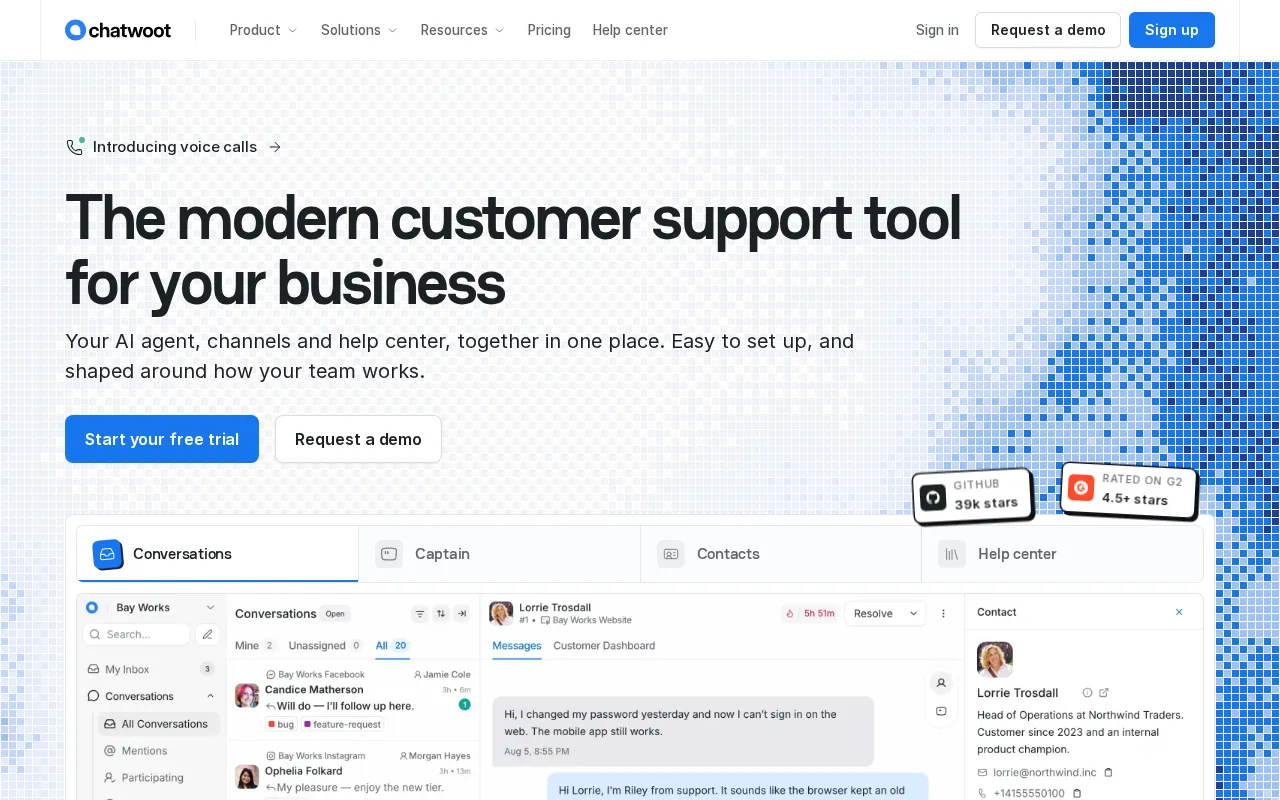
Chatwoot is open-source support software with one inbox for live chat, email, WhatsApp, social and voice, a help center, and Captain, its AI agent. You can use Chatwoot Cloud or host it yourself.
Startups at $19 an agent covers email, chat and WhatsApp while no buyer has asked for SSO yet, and Enterprise at $99 adds SSO and audit logs. Captain’s custom tools have no built-in approval step for refunds.
- Best for
- Teams that want many channels at a low seat price, or want to run their help desk on their own servers.
- How it bills
- Cloud is per agent a month: Startups $19, Business $39 and Enterprise $99, with 300, 500 or 800 Captain credits for the account. Each Captain reply uses a credit, extra credits are $20 per 1,000, and no annual price is published. Credits never top up by themselves: once they run out, new conversations go straight to your team with no Captain reply.
- Free plan
- Yes: 2 agents, live chat only, 500 conversations a month
- 3 people, 300 AI replies
- $57 a month: 3 Startups agents at $19, with the 300 included Captain credits covering 300 AI replies.
Pros
- Open source: the self-hosted Community Edition is free, and your data stays on your own servers.
- One inbox for live chat, email, WhatsApp, Instagram, Messenger, TikTok and, from Business, voice calls.
- Startups includes every channel but voice, plus a help center, at $19 an agent a month.
- An official CLI and agent skill let coding agents such as Claude Code work in Chatwoot.
Cons
- Startups has no automation rules or teams; those start on Business at $39 an agent.
- Captain uses a credit for every reply, and bought credits expire after 6 months and aren’t refunded.
- Since July 2026 the free Cloud plan has no API or webhook access.
- No official MCP server, and Captain’s custom tools have no built-in approval step for actions like refunds.
Already on Chatwoot? See the best Chatwoot alternatives.
18. Fin
Fin is an AI that answers customers on chat, email, voice and social. It runs inside Intercom, or on top of a help desk you already use, such as Zendesk, Salesforce, HubSpot or Freshdesk, and hands your team what it can’t solve.
Fin answers inside Zendesk, Salesforce, HubSpot or Freshdesk, so a company that chose one of those for SSO and SLAs can still add a strong AI. A Fin Procedure can refund under a threshold you set with no one approving, unless you add an approval step.
- Best for
- Teams with a large queue on Zendesk, Salesforce, HubSpot or Freshdesk that want a strong AI answering customers without changing help desks.
- How it bills
- A $49 base plan covers the first 50 outcomes a month, then each costs $0.99, charged at most once per conversation. Unused outcomes don’t carry over. Fin Voice is $1.99 a voice outcome through sales, and your help desk’s seats are billed separately.
- Free plan
- No, 14-day trial
- 3 people, 300 AI replies
- $297 or more a month: 300 outcomes: $49 for the first 50, then 250 at $0.99. Your help desk’s seats come on top.
Pros
- It works inside the help desk you already have, so your team keeps it as the system of record.
- You pay at most once per conversation, and nothing when a customer asks for a person or a Procedure fails.
- Procedures connect Fin to Stripe and Shopify, so it can check an order and refund it in the same conversation.
- It answers on chat, email, voice, social and Slack, and on WhatsApp through Freshdesk, with spending limits you set.
Cons
- Fin is an AI, not a help desk, so its outcomes come on top of your help desk’s seats.
- An outcome counts when a customer stays silent for 24 hours after Fin’s answer, and when a Procedure ends in a handoff to your team.
- A Procedure can refund on its own under a threshold you set, with no person approving it.
- Buying Fin for another help desk starts with “Contact sales” on its pricing page.
Already on Fin? See the best Fin alternatives.
19. Decagon
Decagon is an AI agent platform for large companies that answers customers on chat, email and voice. It works through the help desk or CRM you already run, such as Zendesk, Intercom or Salesforce, and escalates what it can’t solve to your team there.
Decagon is built for enterprises with a high-volume queue, so a Series A company should call only once chat, email and phone volume is large and someone in support operations can build and test the AI with Decagon’s engineers. It answers through the help desk you already run, reaches Stripe Billing for subscriptions, publishes no price, and going live takes weeks.
- Best for
- Enterprises with a high-volume queue across chat, email and phone, and a support operations team to build and test the AI with Decagon’s engineers.
- How it bills
- Decagon publishes no prices. Its own pricing post describes two options: a fixed rate for every incoming conversation, or a higher one for each fully resolved conversation, with lower rates for bigger volumes or commitments. Buying starts with “Get a demo”, and the help desk it answers in bills separately.
- Free plan
- No, buying starts with a demo
- 3 people, 300 AI replies
- Quote only: No published rate: 300 conversations are priced per conversation or per resolution through Decagon’s sales team, and your help desk’s seats come on top.
Pros
- One AI answers on web chat, SMS, WhatsApp, email and phone, and its voice agent speaks 70+ languages.
- Your support team writes the AI’s workflows in plain language, as procedures Decagon calls AOPs, then tests and A/B tests changes before rolling them out.
- Pre-built connections reach Zendesk, Intercom, Salesforce, Gorgias, Kustomer and Gladly, plus Shopify and Stripe Billing for orders and subscriptions.
- Decagon’s own team works alongside yours during rollout, as its case studies with Rippling and 1-800-Flowers.com describe.
Cons
- No published price, no free plan and no trial: every path to buying starts with “Get a demo”.
- It answers inside your help desk, so Decagon is a second bill beside that help desk’s seats.
- Going live takes weeks: Duolingo was live a month after its first conversations with Decagon, which Decagon calls a quick implementation.
- On per-conversation pricing, which Decagon says most customers choose, conversations the AI escalates to your team are billed too.
Already on Decagon? See the best Decagon alternatives.