1. Rinhelp
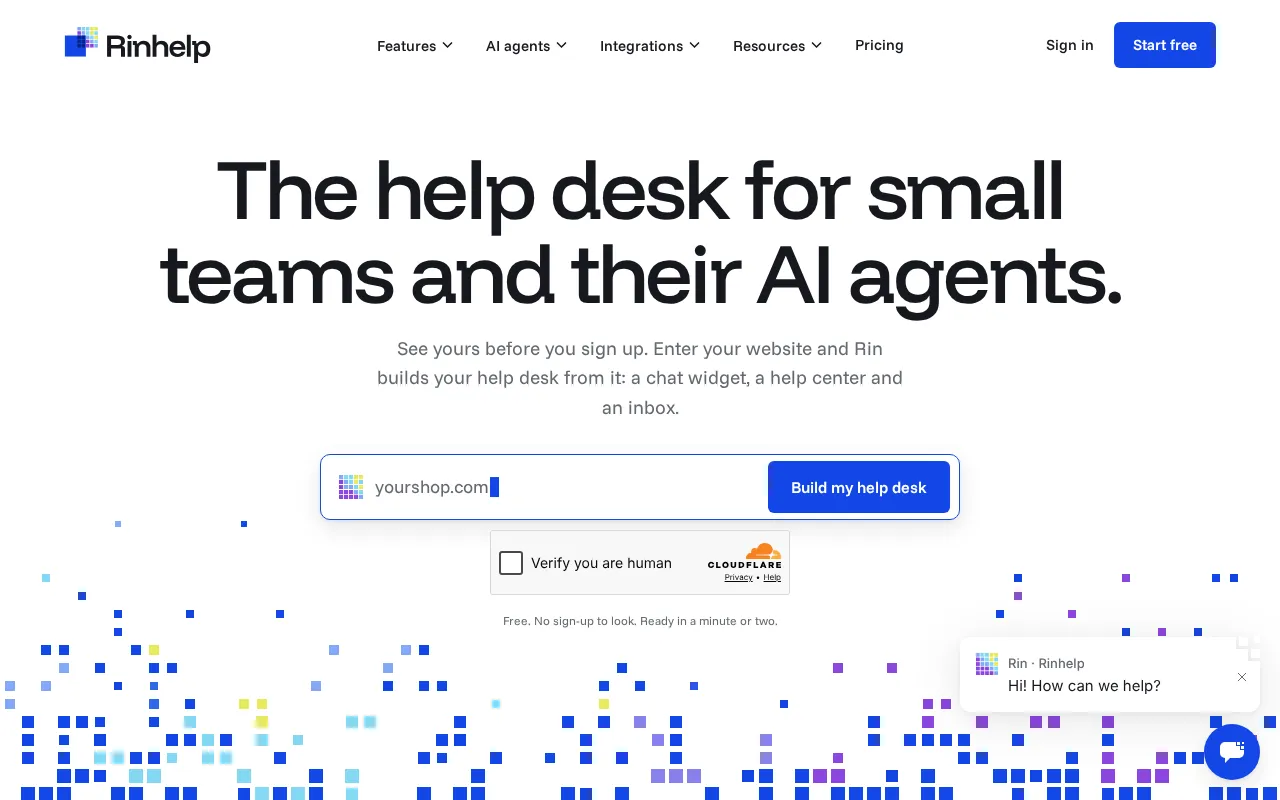
Rinhelp’s Free plan is $0 forever for up to 3 teammates, with live chat, email, a help center with no article limit and 50 AI replies to try Rin, our built-in AI. When the queue grows, Pro is $49 a month for the workspace with 5,000 AI replies, billed monthly, and a new teammate adds nothing. If you bill through Stripe, a customer’s payments show beside the conversation, and a refund Rin asks for waits for a teammate to approve. Every plan shows Rinhelp branding on chat, the help center and email replies until a Pro workspace pays $49 a month to remove it. Rinhelp answers email and live chat only, with no phone, reports or SLA rules.
- Best for
- Founding teams of 1 to 3 who answer customers themselves and want a price that doesn’t hinge on an application or a funding stage.
- How it bills
- Free for up to 3 teammates. Pro is $49 a month for the whole workspace, with 5,000 AI replies from Rin. No per-seat or per-resolution fees.
- Free plan
- Yes: 3 teammates, 50 AI replies to try Rin
- 3 people, 300 AI replies
- $49 a month: Pro for the whole workspace, using 300 of its 5,000 AI replies; Free covers your team if you don’t need AI replies.
Pros
- Free for up to 3 teammates, forever, with live chat, email and a help center, so the team can start before it has paying customers.
- Pro is $49 a month for the whole workspace, so the first support hire or a cofounder joining the inbox costs nothing more.
- When AI replies run out, Rin hands new conversations to your team, and nothing is charged on its own.
- Claude, ChatGPT or your own AI agent can work in the inbox through MCP, and refunds and cancellations wait for a teammate’s approval.
Cons
- Email and live chat only: there is no phone, WhatsApp, SMS or social inbox.
- Shopify and Stripe are the only integrations.
- No reports, SLA rules or routing rules: Rin hands a conversation to the teammate with the fewest open ones.
- The free plan has no Rin beyond 50 AI replies to try it.
2. Help Scout
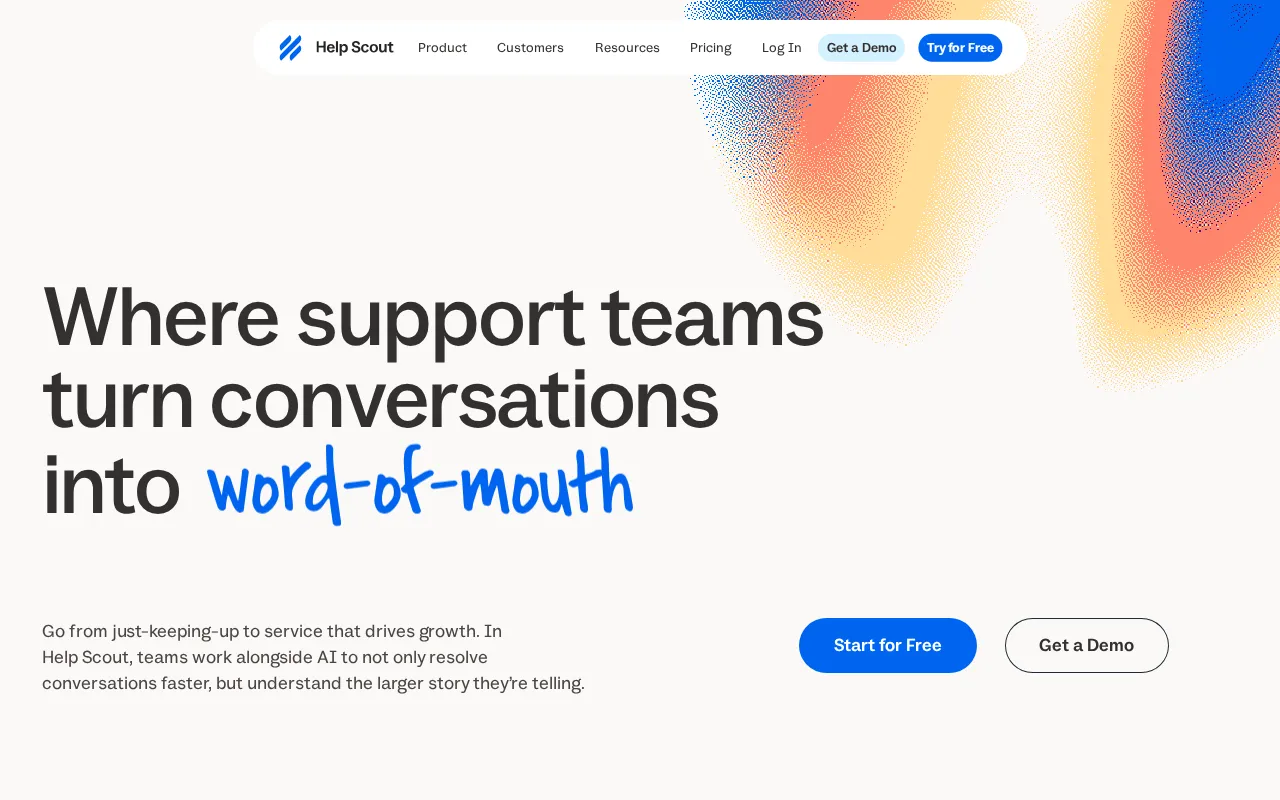
Help Scout is a help desk with shared inboxes, a Docs help center and Beacon, a widget for chat and help articles. Scout, its AI agent, answers chat from your help content and is billed per resolution.
Help Scout’s free plan covers 5 users with 1 inbox, a Docs site and 100 contacts a month, enough for founders still learning what customers ask. Scout’s resolutions are free for a new account’s first 3 months, then $0.75 each, and Standard is $25 a user on annual billing.
- Best for
- Support teams that think in tickets and want a calm shared inbox, a help center and live chat, with a free plan to start on.
- How it bills
- Standard is $25, Plus $45 and Pro $75 a user a month on annual billing, which saves 16%. Pro needs at least 10 users and a demo. Scout costs $0.75 per resolution, free for a new account’s first 3 months.
- Free plan
- Yes: 5 users, 1 inbox, 100 contacts a month
- 3 people, 300 AI replies
- $300 a month: 3 Standard users at $25 on annual billing, plus 300 AI resolutions at $0.75.
Pros
- A free plan for up to 5 users, with 1 inbox, a Docs site and 100 contacts a month.
- Agents can refund, cancel or edit recent Shopify orders, and refund Stripe payments or cancel subscriptions, from the sidebar.
- Standard brings email, live chat, SMS, WhatsApp, Instagram and Messenger into one inbox.
- You can cap AI spending each month, and Scout switches off when it reaches the cap.
Cons
- Its official MCP server is read-only: your own AI can search conversations and Docs, but can’t reply, add notes or close.
- Scout answers website and in-app chat only, and lists email as “Coming Soon”.
- Scout can’t look up orders or act in other tools yet: its connection to payment processors and CRMs is still to come.
- Seats and AI are billed separately, so the bill grows with every user and every resolution.
Already on Help Scout? See the best Help Scout alternatives.
3. Zendesk
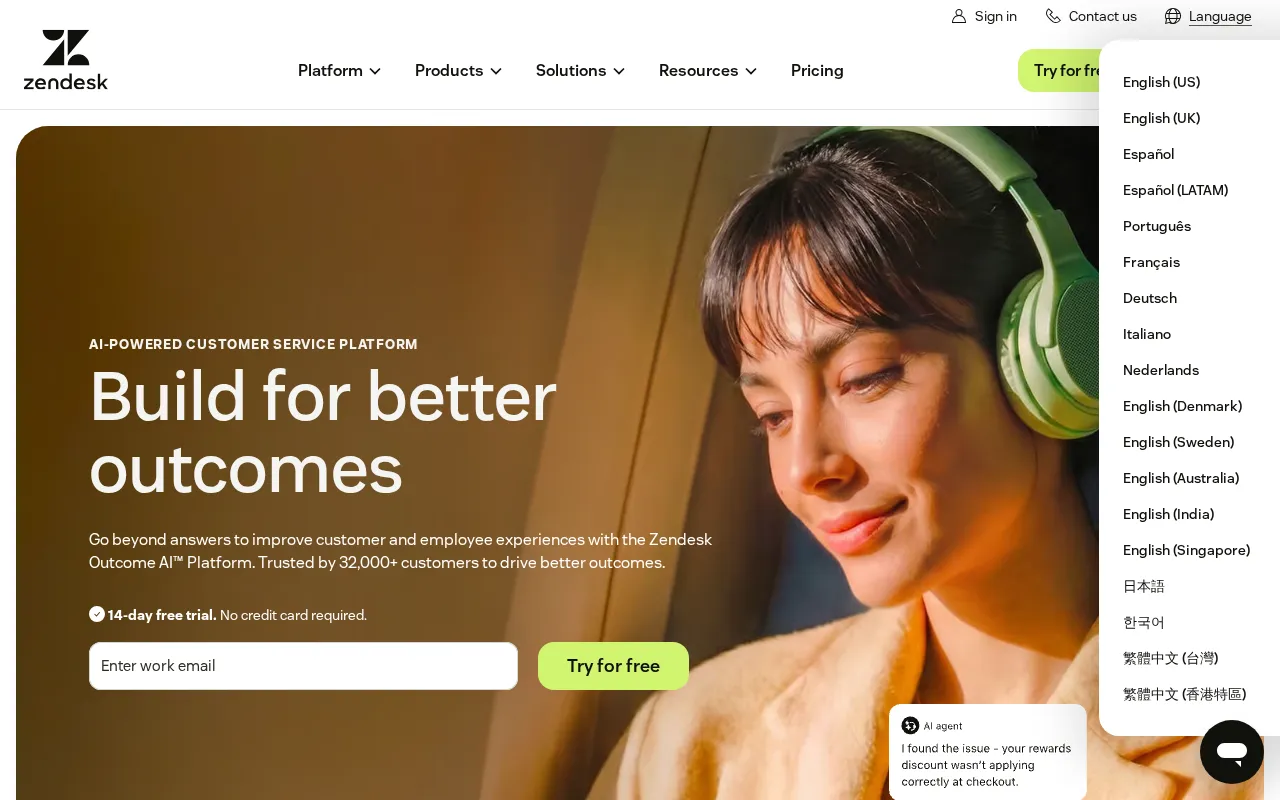
Zendesk is a customer service suite for email, messaging, live chat, social and voice, with AI agents that answer customers and are billed per automated resolution.
Startups can get 6 months of Zendesk Suite free for up to 50 agents, and the 14-day trial opens every Suite Professional feature. When the free months end, each agent is a seat, from $55 on Suite Team for messaging and AI agents, and Zendesk refunds no unused seats or time.
- Best for
- Growing and large teams that need voice, many channels, 1,800+ apps and integrations, and enterprise controls to grow into.
- How it bills
- Per agent: Support Team is $19, Suite Team $55 and Suite Professional $115 a month on annual billing ($25, $69 and $149 monthly). Each agent brings 5 automated resolutions a month (10 on Professional), then each costs $1.50 committed or $2.00 pay as you go. Copilot is $50 more an agent.
- Free plan
- No, 14-day trial
- 3 people, 300 AI replies
- $485 a month: 3 Support Team agents at $19 on annual billing, plus 285 automated resolutions at $1.50 committed beyond the 15 included, on email only.
Pros
- Email, messaging, live chat, WhatsApp, social and voice sit in one Suite, and AI agents can answer on email, messaging or voice.
- Its marketplace lists 1,800+ apps, partners and integrations.
- Agents refund and cancel Shopify orders inside a ticket, and an admin can connect Zendesk’s AI agents to Stripe’s MCP server.
- The 14-day trial opens every Suite Professional feature, Copilot included, and startups can get 6 months of Suite free for up to 50 agents.
Cons
- Every agent is a seat, and each automated resolution past the 5 per agent a plan includes costs $1.50 to $2.00.
- No official MCP server for outside AI tools yet: Zendesk announced one in May 2026 for early access and has published no tools for it.
- Data exports are off until the account owner asks support, and the export tools aren’t on Team plans.
- Zendesk gives no refunds or credits for unused seats or time.
Already on Zendesk? See the best Zendesk alternatives.
4. Intercom
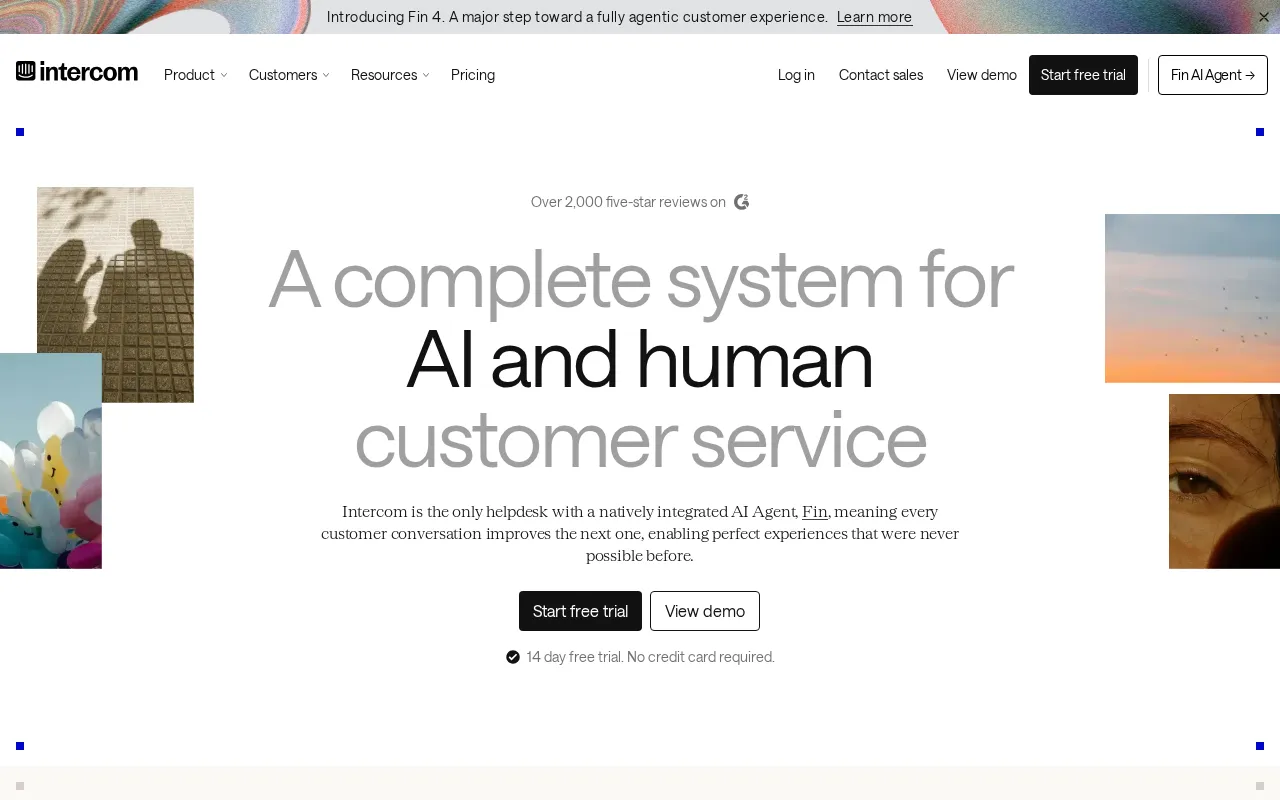
Intercom is a customer service help desk with a chat Messenger, a shared inbox, a help center and Fin, its AI agent. Its company renamed itself Fin in May 2026, and Salesforce bought it that September.
A team of fewer than 15 people with up to $10M raised can join Intercom’s Early Stage program, 93% off the first year with 300 Fin outcomes a month, while phone, SMS and WhatsApp stay at list price. Past the included outcomes Fin costs $0.99 each, and an annual plan cancelled early gets no prorated refund.
- Best for
- Software and app companies that want chat, email, phone, WhatsApp and SMS in one inbox, with Fin answering across them.
- How it bills
- Per seat: Essential is $29, Advanced $85 and Expert $132 a seat a month on annual billing ($39, $99 and $139 monthly), and new customers pay $19 for Essential on annual billing. Fin costs $0.99 for each outcome, and WhatsApp, SMS and phone are billed by use.
- Free plan
- No, 14-day trial
- 3 people, 300 AI replies
- $354 a month: 3 Essential seats at $19, the new-customer price on annual billing (list $29), plus 300 Fin outcomes at $0.99.
Pros
- Chat, email, phone, WhatsApp, SMS, Slack, Facebook and Instagram all arrive in one inbox.
- Fin answers on email, live chat and phone, and is charged once per conversation however many questions it answers.
- Agents can refund or cancel a Shopify order from the inbox sidebar, and the Stripe app shows subscriptions mid-conversation.
- Its official MCP server can add internal notes and write and publish help center articles, not only read.
Cons
- Every teammate who replies needs a paid seat, and Fin adds $0.99 an outcome on top.
- An outcome also counts when a customer simply stops asking after Fin’s answer, or when a Fin workflow hands the conversation to your team.
- Its MCP server can’t reply to customers, assign or close conversations, and doesn’t serve workspaces hosted in Australia.
- No free plan, and an annual plan cancelled early gets no prorated refund.
Already on Intercom? See the best Intercom alternatives.
5. HubSpot
HubSpot Service Hub is the customer service part of HubSpot’s CRM: a help desk inbox for email, chat, WhatsApp and calls, a knowledge base, and the customer agent, an AI that answers customers.
HubSpot’s free plan covers 2 users, with its branding on chat and email, and Starter’s $7 a seat is a new-customer discount on a $20 list price. For its customer agent, a founder pays for Professional at $90 a seat on annual billing and $1,500 for onboarding.
- Best for
- Teams already running sales or marketing on HubSpot that want support on the same customer records.
- How it bills
- Per seat: Starter is $7 and Professional $90 a seat a month on annual billing ($10 and $100 paid monthly, with Professional still committed for a year), and Enterprise starts at $150. Starter’s prices are new-customer discounts on a $20 list price. Professional adds a required $1,500 onboarding fee, and Enterprise $3,500. The customer agent uses 50 credits, $0.50, per resolved conversation, after 3,000 credits a month included on Professional.
- Free plan
- Yes: 2 users, with HubSpot branding on chat and email
- 3 people, 300 AI replies
- $390 a month: 3 Professional seats at $90 on annual billing, plus 300 resolutions by the customer agent at 50 credits each, $120 after the 3,000 included credits. A one-time $1,500 onboarding fee comes on top.
Pros
- Support, sales and marketing share one CRM, so every ticket sits next to the customer’s deals and emails.
- The customer agent is billed only when it resolves a conversation, and a handoff to a person costs nothing.
- Professional puts calling, WhatsApp and Facebook Messenger in the same inbox as email and chat.
- The official MCP server reads inbox conversations and writes tickets, notes and contacts, asking you to confirm each change.
Cons
- The customer agent needs Professional at $90 a seat on annual billing, plus a required $1,500 onboarding fee.
- AI credits are shared with every other credit feature, and the customer agent stops taking new conversations when they run out.
- The MCP server can’t send a reply to a customer or reach the knowledge base.
- HubSpot’s examples of customer agent actions are password resets and booking meetings, with no refunds or order changes.
Already on HubSpot? See the best HubSpot alternatives.
6. Crisp
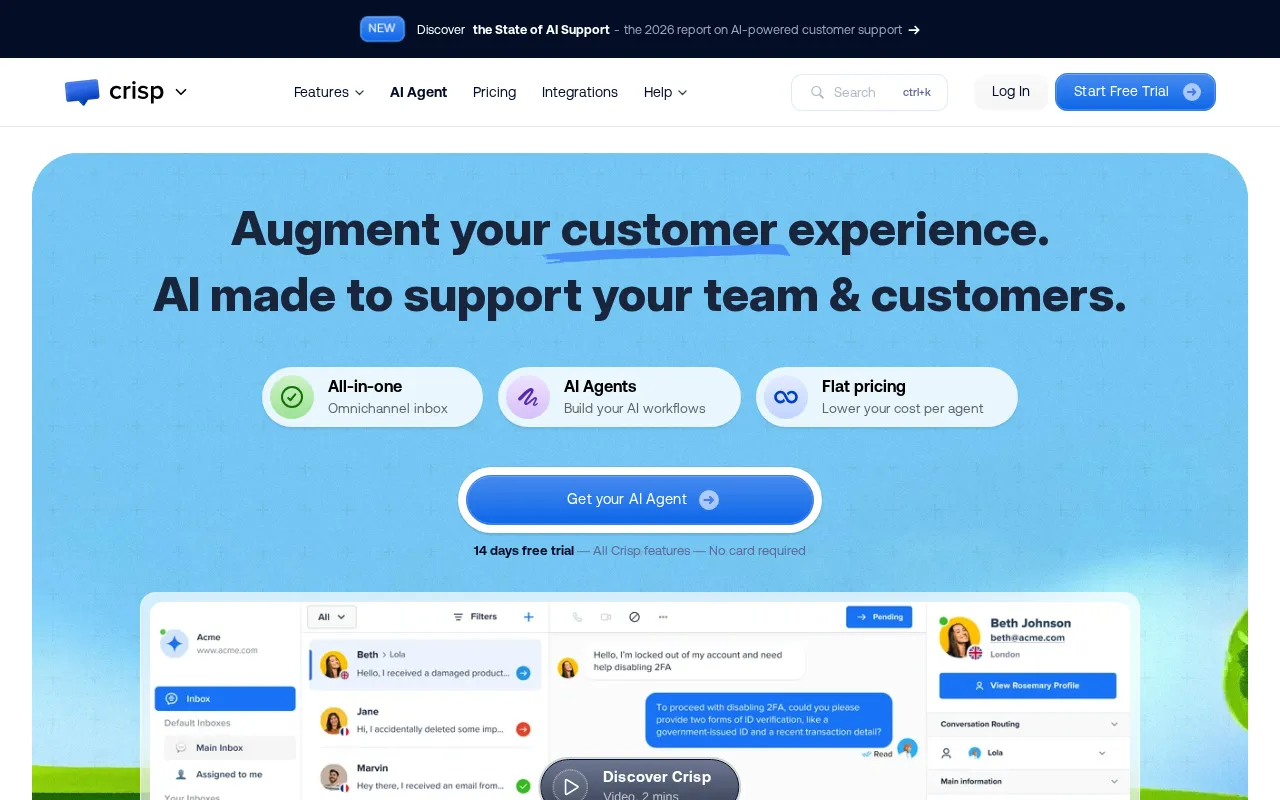
Crisp is a French customer support platform built around a website chat widget, with a shared inbox, many messaging channels and Hugo, its AI agent.
Crisp’s free plan gives 2 seats of website chat, with no email inbox and no AI. Mini is $45 a month for the workspace with 4 seats and $5 of Hugo credits, so a third founder adds no seat fee, but Crisp’s terms refund no fees, monthly or yearly.
- Best for
- Small teams that start with free website chat and want WhatsApp, Instagram, SMS and phone in the same inbox later.
- How it bills
- Per workspace a month: Mini is $45 with 4 seats, Essentials $95 with 10 and Plus $295 with 20, including $5, $25 and $75 of AI credits (about 90, 450 and 1,350 Hugo conversations). Extra seats are $10 each, sold on Plus only, and Hugo past the credits runs on Pay-As-You-Go at about $0.05 to $0.10 a conversation.
- Free plan
- Yes: 2 seats, chat only, no AI
- 3 people, 300 AI replies
- $66 or more a month: Mini at $45 for 4 seats with about 90 Hugo conversations in its credits, plus about 210 more at about $0.10 each.
Pros
- One price per workspace, with 10 seats on Essentials for $95 a month.
- WhatsApp, Instagram, Messenger, SMS, Telegram and phone sit in the same inbox from Essentials.
- Its official MCP server can read, reply, add notes, resolve and write help center articles.
- Hugo can look up orders and refund through Shopify, WooCommerce, PrestaShop and Stripe, after a one-time code checks the customer.
Cons
- The free plan has no email inbox and no AI, and Mini has no help center, WhatsApp or MCP server.
- Hugo stops answering when the month’s credits run out unless you turn on Pay-As-You-Go, whose rates aren’t published.
- Stripe data in the inbox comes only with Plus at $295 a month.
- Crisp’s terms refund no fees, monthly or yearly.
Already on Crisp? See the best Crisp alternatives.
7. tawk.to
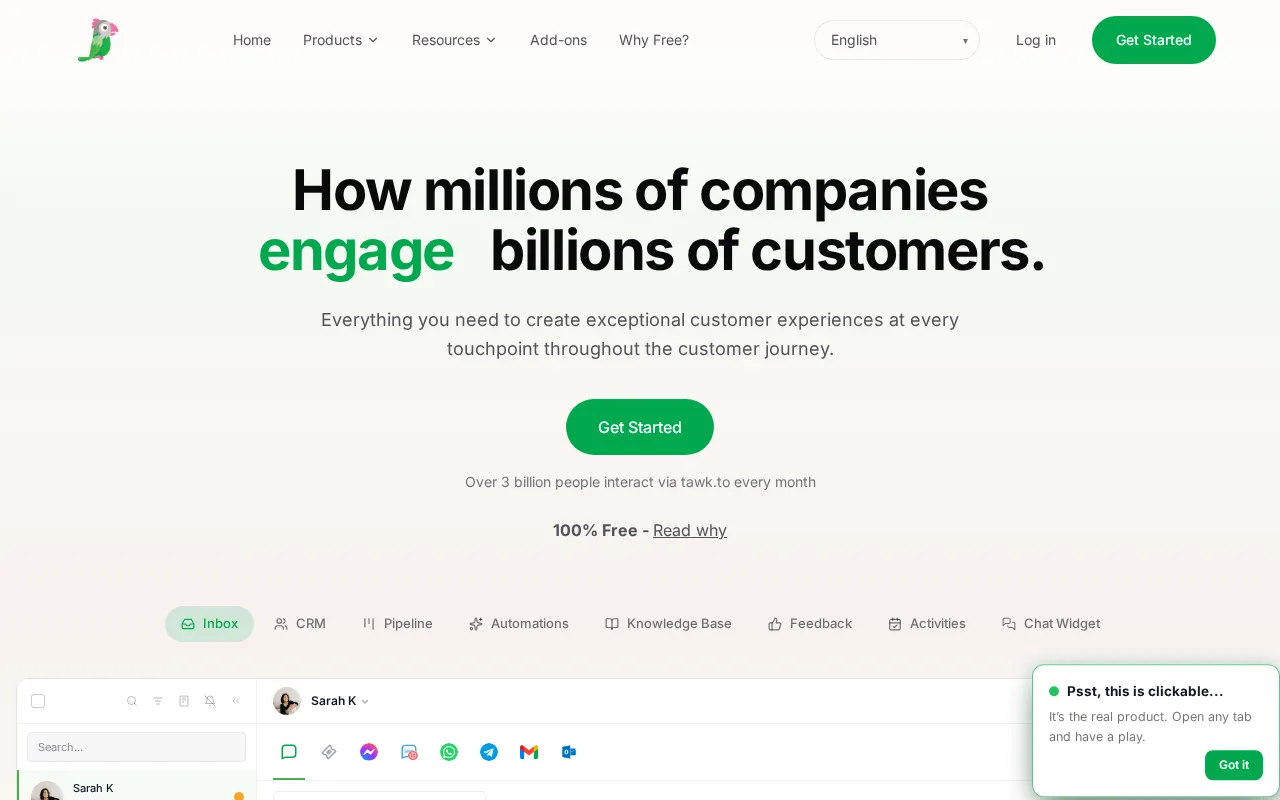
tawk.to is free live chat and ticketing software for websites, with a hosted knowledge base. It makes its money from paid add-ons, such as AI Assist, white label and hired chat agents, billed per website.
If the founders run a landing page and a product on separate sites, tawk.to puts chat, ticketing and a hosted knowledge base on both for free, with as many agents as they like. Its AI gives about 33 free replies a month and stops joining new conversations when credits run out, and the “Powered by tawk.to” badge stays unless you buy white label for each website.
- Best for
- Small businesses that want website chat for any number of agents at no cost, and don’t mind the tawk.to badge.
- How it bills
- Chat, ticketing and the knowledge base are free for any number of agents. AI Assist is free for 100 credits a month, then $29, $99 or $399 a month ($290, $990 or $3,990 a year) for 1,000, 5,000 or 20,000 credits, and a reply on the default Auto model uses 3.
- Free plan
- Yes: unlimited agents and chats, about 33 AI replies a month
- 3 people, 300 AI replies
- $24 a month: AI Assist Growth at $290 a year, whose 1,000 monthly credits cover 300 replies at 3 credits each on the Auto model. Seats are free.
Pros
- Free for any number of agents, chats and websites, with ticketing and a hosted knowledge base.
- WhatsApp, Messenger, SMS through Twilio and email share one inbox, and the AI answers on chat, WhatsApp, SMS and Messenger.
- Its Shopify app adds a tab where agents check orders, refund and cancel during a chat.
- Hired chat agents start at $1 an hour if you want someone else to answer.
Cons
- AI Assist charges per reply, and once credits run out it stops joining new conversations.
- The “Powered by tawk.to” badge stays unless you pay for white label, $39 a month or $348 a year for each website.
- No official MCP server, and REST API access must be requested and approved first.
- Add-ons are billed per website, so each extra site pays again.
Already on tawk.to? See the best tawk.to alternatives.
8. Zoho Desk
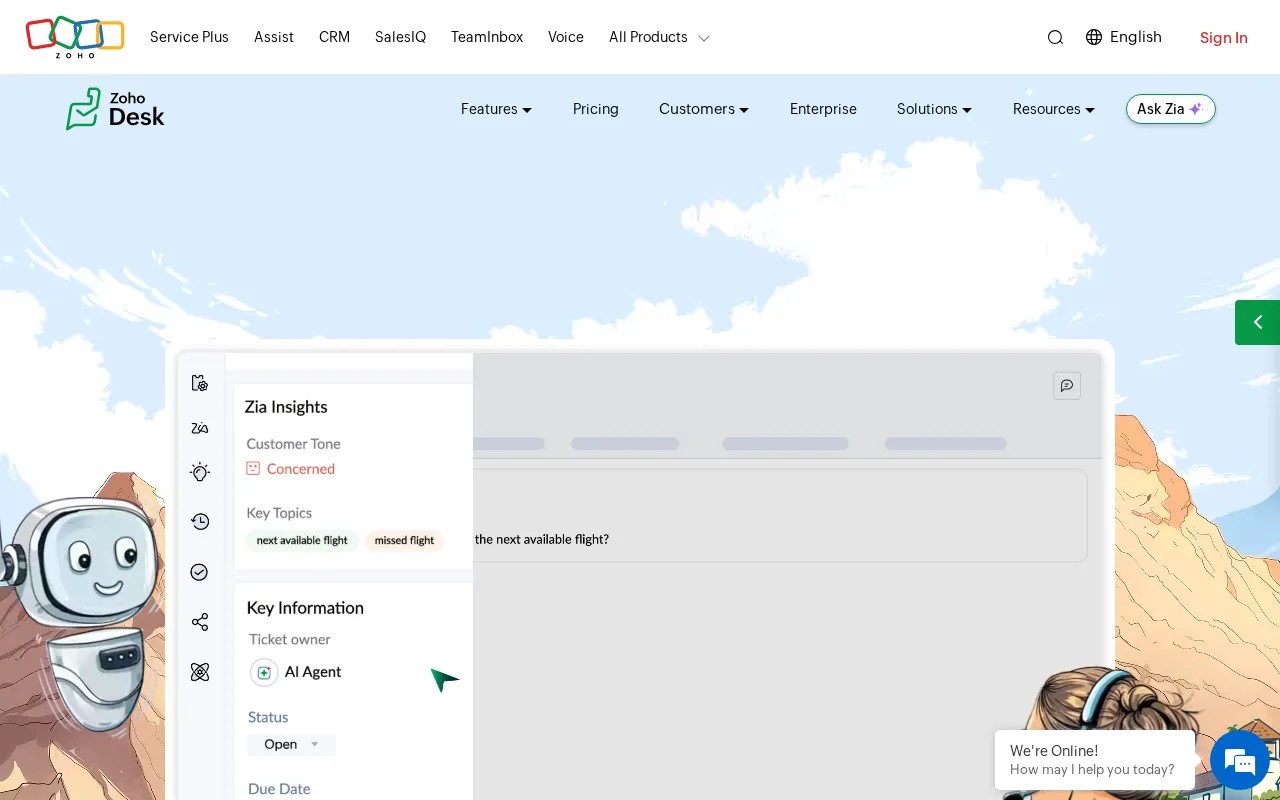
Zoho Desk is the help desk in Zoho’s suite of business apps, with tickets from email, social media, chat, WhatsApp and phone, a multilingual help center, and Zia, Zoho’s AI.
A founding team of 3 can share one support address and a web form on Zoho Desk’s free plan, with 2 macros for the answers they repeat. Express, $7 a user on annual billing for up to 5, adds AI agents, but live chat waits for Standard at $14.
- Best for
- Budget-minded teams that want a full ticketing suite with workflows and SLAs, especially if they already use other Zoho apps.
- How it bills
- Per user: Express is $7, Standard $14, Professional $23 and Enterprise $40 a month on annual billing ($9, $20, $35 and $50 monthly), and light agents are $6 each. Express allows up to 5 users; Standard and above have no user limit. AI agents include up to 30 million free tokens a month. Other generative features run on a key you bring from an AI provider, and Professional and Enterprise add Zia’s own.
- Free plan
- Yes: 3 users, email only
- 3 people, 300 AI replies
- $42 a month: 3 Standard users at $14 on annual billing, the first plan with live chat and Answer Bot, which answers customers from your help center. Zoho publishes no per-answer fee.
Pros
- Low seat prices: Express is $7 a user and Standard $14 on annual billing, with a free plan for 3 users.
- Standard adds live chat, WhatsApp, Telegram and other messaging apps, and Professional adds phone support.
- Workflows, SLAs and several departments, with a help center you can publish in over 40 languages on Professional.
- Zoho’s official MCP server is free and can read tickets, send replies and add comments.
Cons
- Express stops at 5 users, so a sixth teammate moves everyone to Standard at $14.
- Zia’s full AI needs Professional, and the agent that answers email tickets is open only to selected accounts.
- The MCP server has no tools for help center articles or saved replies, and every call uses daily API credits.
- Express has no live chat, and the free plan covers email only.
Already on Zoho Desk? See the best Zoho Desk alternatives.
9. Chatwoot
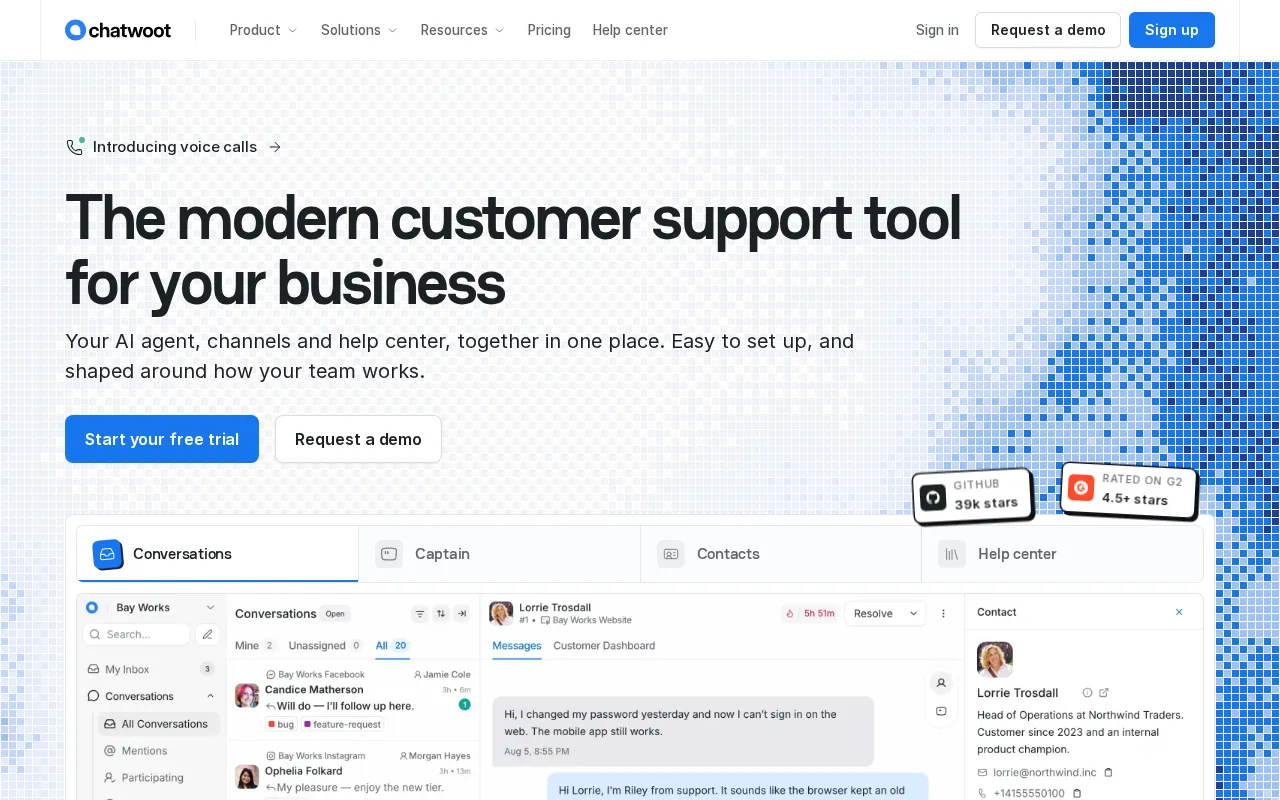
Chatwoot is open-source support software with one inbox for live chat, email, WhatsApp, social and voice, a help center, and Captain, its AI agent. You can use Chatwoot Cloud or host it yourself.
Chatwoot’s free Hacker plan covers 2 agents and 500 website chats a month, but since July 2026 it has no API or webhook access. Its paid plan, named Startups, is $19 an agent with email, WhatsApp, a help center and 300 Captain credits, and a technical founder can host the Community Edition for free.
- Best for
- Teams that want many channels at a low seat price, or want to run their help desk on their own servers.
- How it bills
- Cloud is per agent a month: Startups $19, Business $39 and Enterprise $99, with 300, 500 or 800 Captain credits for the account. Each Captain reply uses a credit, extra credits are $20 per 1,000, and no annual price is published. Credits never top up by themselves: once they run out, new conversations go straight to your team with no Captain reply.
- Free plan
- Yes: 2 agents, live chat only, 500 conversations a month
- 3 people, 300 AI replies
- $57 a month: 3 Startups agents at $19, with the 300 included Captain credits covering 300 AI replies.
Pros
- Open source: the self-hosted Community Edition is free, and your data stays on your own servers.
- One inbox for live chat, email, WhatsApp, Instagram, Messenger, TikTok and, from Business, voice calls.
- Startups includes every channel but voice, plus a help center, at $19 an agent a month.
- An official CLI and agent skill let coding agents such as Claude Code work in Chatwoot.
Cons
- Startups has no automation rules or teams; those start on Business at $39 an agent.
- Captain uses a credit for every reply, and bought credits expire after 6 months and aren’t refunded.
- Since July 2026 the free Cloud plan has no API or webhook access.
- No official MCP server, and Captain’s custom tools have no built-in approval step for actions like refunds.
Already on Chatwoot? See the best Chatwoot alternatives.
10. Jira Service Management
Jira Service Management is Atlassian’s service desk for IT, HR and other internal teams, sold in its Service Collection: requests by email, portal, widget, Slack and Microsoft Teams, with on-call schedules on every plan, assets on paid plans and change management from Premium, and an AI agent for customers billed per resolution.
When the founders already track bugs in Jira, Jira Service Management is free for 3 agents, with requests by email, portal, Slack and Microsoft Teams. The free plan has no AI agent, and live chat waits for Premium at $61.60 an agent.
- Best for
- IT and engineering teams already on Jira and Confluence that run incidents, changes, problems, assets and on-call in one place.
- How it bills
- Free for 3 agents. Up to 15 agents, Standard is $26.90 and Premium $61.60 an agent a month, or on annual billing Standard is $800 a year for 1 to 3 agents, $1,350 for 4 to 5 and $2,700 for 6 to 10. Enterprise is billed annually only, listed from 201 agents at $185,000 a year and bought through sales. The Customer Service AI Agent costs $1 per resolution from the first one, and Rovo credits past a plan’s allowance cost $0.01 each.
- Free plan
- Yes: 3 agents, no AI agent
- 3 people, 300 AI replies
- $367 a month: Standard for 1 to 3 agents at $800 a year on annual billing, plus 300 AI agent resolutions at $1.
Pros
- Incidents, problems, changes, assets and on-call sit next to Jira, where engineering already works.
- Free for 3 agents with unlimited customers, a portal, email, Slack and Microsoft Teams.
- The Customer Service AI Agent charges nothing when it fails to resolve a conversation.
- Its knowledge base runs on Confluence without buying Confluence.
Cons
- Live chat and the virtual service agent need Premium at $61.60 an agent.
- The Customer Service AI Agent bills $1 for every resolution, with none included.
- Extra Rovo credits and other usage are billed from December 3, 2026.
- There is no official Shopify app, and Stripe comes only through third-party Marketplace apps.
Already on Jira Service Management? See the best Jira Service Management alternatives.
11. Freshdesk
Freshdesk is Freshworks’ help desk: email ticketing with a customer portal and knowledge base, with Freshdesk Omni adding chat, phone and messaging. Its Freddy AI agent answers customers and is billed per session.
Freshdesk has no free plan, and Growth is $19 an agent on annual billing. Day passes from $2 let an advisor or contractor pick up the odd ticket, and Freddy AI agent sessions cost $49 per 100 after a one-time 500.
- Best for
- Teams that want a full ticketing help desk with SLAs, routing and a knowledge base, and chat and messaging for less per agent than Zendesk’s Suite Team.
- How it bills
- Per agent on annual billing: Growth is $19, Pro $55 and Enterprise $89 a month, or $29, $79 and $119 on Freshdesk Omni with chat and messaging. Freddy AI agent sessions cost $49 per 100 after 500 free ones, once per account. Voice is $15 to $69 more an agent, and MCP actions $15 per 1,000.
- Free plan
- No, 14-day trial
- 3 people, 300 AI replies
- $204 a month: 3 Growth agents at $19 on annual billing, plus 3 packs of 100 AI sessions at $49, on email only.
Pros
- SLA policies, custom dashboards, skill-based routing and audit logs come on its higher plans, with skill-based routing at $89 an agent where Zendesk asks $115.
- Freshdesk Omni adds chat, phone, WhatsApp, Messenger, Instagram and Line to the same tickets.
- Day passes from $2 let occasional helpers answer without a full seat.
- Its official MCP server can reply, add notes, update tickets and write knowledge base articles.
Cons
- List prices rose early in 2026, from $15 to $19 an agent on Growth, and the free plan is gone.
- Freddy AI agent costs 49 cents a session after the first 500, which never come back.
- Every MCP call counts as an action, and Growth includes only 1,200 a year.
- Fees are non-refundable, and a cancellation only takes effect at the end of your term.
Already on Freshdesk? See the best Freshdesk alternatives.
12. Tidio
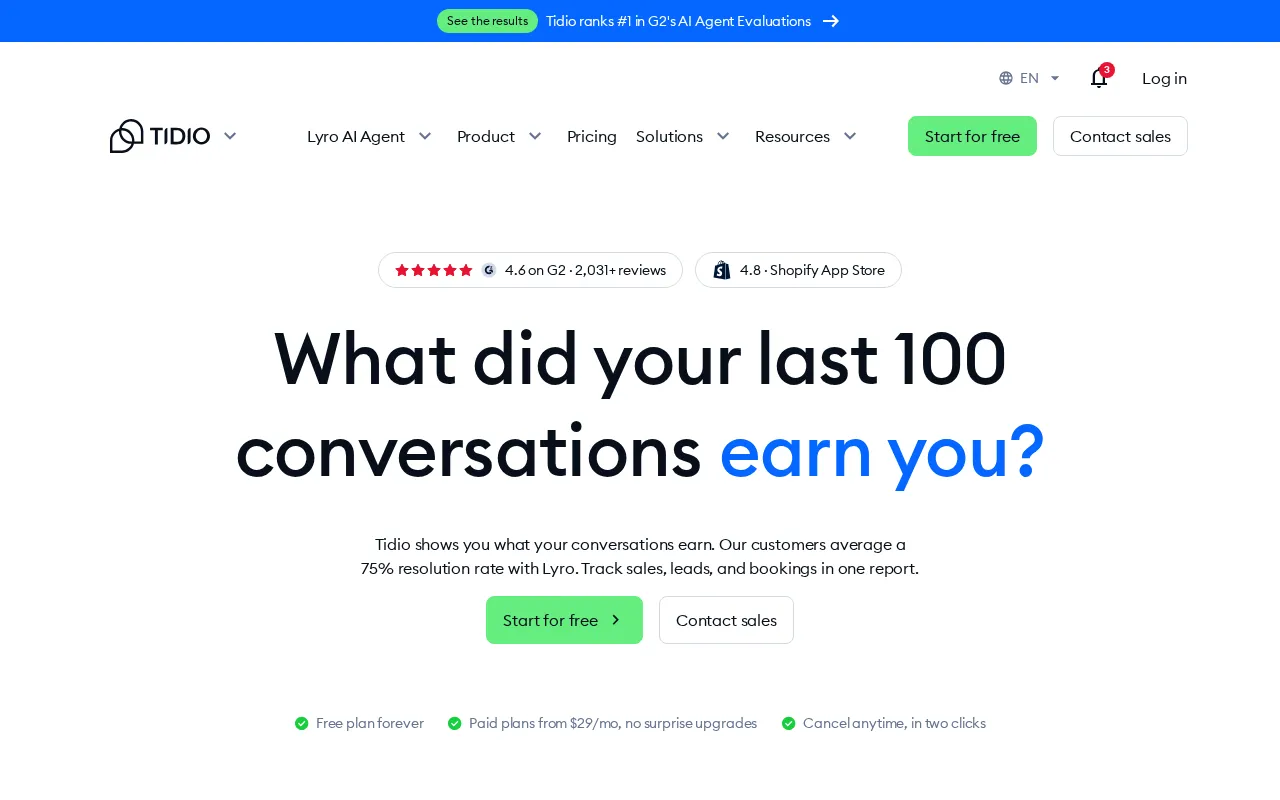
Tidio is a live chat and help desk tool built for online stores, especially Shopify, with Lyro, an AI agent sold as an add-on, and a help center since 2026.
All 10 seats on Tidio’s free plan cost nothing, so the whole founding team fits, with WhatsApp, Instagram and email inside a limit of 50 conversations a month. Lyro gets 50 AI conversations once and is a paid add-on after that, and the Stripe integration needs Plus from $300 a month.
- Best for
- Shopify and WooCommerce stores that want chat, WhatsApp and Instagram in one inbox and an AI that recommends products.
- How it bills
- Plans are priced by the conversations your team answers, with 10 seats: Starter is $24.17 a month on annual billing ($29 monthly) for 100, and Growth runs from $49.17 for 250 ($59 monthly) to $349 monthly for 2,000. Lyro is an add-on from $32.50 a month for 50 conversations to $583.33 for 1,000 on annual billing ($39 for 50, $210 for 300 and $700 for 1,000 monthly), and Plus starts at $300 a month plus usage.
- Free plan
- Yes: 10 seats, 50 conversations a month
- 3 people, 300 AI replies
- $199 or more a month: Starter at $24.17 on annual billing plus 300 Lyro conversations at $175. Starter covers 100 conversations your team answers, and more needs Growth.
Pros
- Up to 10 seats on Free, Starter and Growth, so the bill doesn’t grow as you add teammates.
- WhatsApp, Instagram, Messenger and email on every plan, including Free.
- Lyro recommends products and adds them to the cart on Shopify and WooCommerce.
- Lyro’s actions can check orders, cancel or change them and refund, and Lyro can call your own MCP servers.
Cons
- Lyro is a separate add-on billed per conversation, about $0.58 to $0.78 each by tier and billing, and over 1,000 a month is priced by sales.
- The API and Stripe integration need Plus, from $300 a month.
- Its official MCP server only reads analytics data, loaded once a day, so your own AI can’t reply or close.
- No refunds for time left after you cancel.
Already on Tidio? See the best Tidio alternatives.
13. Plain
Plain is a support platform for B2B software companies. It answers customers in Slack, Microsoft Teams, Discord, email, chat and a help center, with an AI customer agent and a GraphQL API that does everything its app can.
Plain fits a B2B startup whose first design partners want support in Slack, and viewer seats are free. There’s no free plan, and the trial is 7 days.
- Best for
- B2B software teams that support customers in shared Slack or Teams channels and want engineers and AI agents building on its API.
- How it bills
- Per member seat: Foundation is $45 a month on annual billing ($55 monthly) for up to 5 seats with 1,000 credits, and Horizon $99 ($139 monthly) for 3 to 10 seats with 2,500 credits; Frontier is quoted. Each customer agent resolution uses 100 credits, extra credits are $10 per 1,000, and viewer seats are free.
- Free plan
- No, 7-day trial
- 3 people, 300 AI replies
- $425 a month: 3 Foundation seats at $45 on annual billing, plus 29,000 credits at $10 per 1,000 for 300 customer agent resolutions beyond the 1,000 credits included.
Pros
- Slack, Microsoft Teams and Discord work as support channels next to email, which suits B2B customers.
- Its official MCP server can reply, add notes, assign, close and write help center articles, signed in as your own user.
- A customer agent resolution is charged only after the thread stays done for 7 days with no teammate stepping in.
- Viewer seats are free and unlimited, and Linear, Jira, GitHub and incident.io link to threads.
Cons
- Its price list has changed four times since December 2025, most recently raising Foundation’s seat price and halving its included credits.
- No free plan, and the trial shrank from 14 days to 7 in 2026.
- No phone, WhatsApp, SMS, Shopify or Stripe.
- Foundation stops at 5 seats and 2 email addresses, so a sixth teammate means Horizon at $99 a seat.
Already on Plain? See the best Plain alternatives.
14. Front
Front is a customer service platform built on shared inboxes, where support, sales and operations teams handle email, chat, SMS and social together. Autopilot, its AI agent, is billed by what it does in each conversation.
Guest accounts let an advisor or a sales cofounder comment on a conversation without a paid seat, and Starter is $25 a seat on annual billing. Starter allows one channel type, there’s no free plan, and payments are nonrefundable even after an early cancellation.
- Best for
- Teams that run many shared addresses, bring in colleagues outside support, and want people and AI agents working one queue.
- How it bills
- Starter is $25 a seat a month for up to 10 seats, Professional $65 for up to 50 and Enterprise $105, on annual billing ($35 and $85 monthly; Enterprise is annual only). Autopilot charges $0.39 to hand off and $0.89 to resolve a conversation, and Copilot is $20 a seat.
- Free plan
- No, 14-day trial
- 3 people, 300 AI replies
- $342 a month: 3 Starter seats at $25 on annual billing, plus 300 Autopilot resolutions at $0.89.
Pros
- Its official MCP server can search, draft, send, comment, assign, tag and archive, with sending behind its own permission.
- Guest accounts let colleagues outside support comment on a conversation without a paid seat.
- Autopilot answers on email, chat, SMS, WhatsApp and Slack, and its 30-day trial covers up to 1,000 resolutions.
- Outside AI agents built with Claude, OpenAI or Sierra can be assigned conversations like a teammate, on every plan.
Cons
- Starter stops at 10 seats and one channel type, so an 11th seat or a second channel means Professional at $65 a seat.
- Autopilot charges for handoffs too, not only for conversations it resolves.
- There is no export you can run yourself: Support makes one, and it leaves out contacts, templates, tags and individual inboxes.
- Monthly and annual payments are nonrefundable, even if you cancel early.
Already on Front? See the best Front alternatives.
15. Customerly
Customerly is customer support and marketing software: a live chat messenger, one inbox for chat, email, WhatsApp and Facebook Messenger, a help center, and Aura, its AI agent, alongside email campaigns, in-app surveys and NPS.
Customerly puts chat support beside onboarding emails, in-app surveys and NPS, handy when one founder covers support and activation. Core is $16 a seat on annual billing with 10 AI conversations a month, and cancelling deletes the project, its conversations and help center at once.
- Best for
- Software companies that want chat support, onboarding emails and NPS surveys in one tool, with an AI agent they pay for by the conversation.
- How it bills
- Per seat in US dollars: Core is $16 a seat a month, Growth $59 and Ultimate $84 on annual billing, which gives 2 months off, or $19, $69 and $99 paid monthly, with 10, 20 or 50 AI conversations a month. Each further conversation Aura handles is $0.45 bought in advance or $0.50 on demand. Interactions past a plan’s 500, 1,000 or 5,000 a month cost down to $0.99 per 1,000 at volume, and AI Companion, which drafts and summarizes for your team, is $19 an agent a month billed annually. Companies in Europe are billed in euros at the same figures, from €16 a seat, with extra interactions at €0.005 down to €0.00099 each. Every plan starts with a 14-day free trial.
- Free plan
- No, 14-day free trial; view-only Lite users are free
- 3 people, 300 AI replies
- $200 a month: 3 Core seats at €16 on annual billing, plus 290 AI conversations past the 10 included at €0.45 each: €178.50, about $200 at $1.12 to the euro.
Pros
- Aura answers from your help center and canned responses, lists the sources behind each reply, and hands a conversation to your team when it should.
- Live chat, email, WhatsApp and Facebook Messenger share one inbox, and Customerly adds no fee for WhatsApp.
- Its official MCP server lets Claude read conversations, reply and draft help center articles, with each resource set to no access, read only or full access.
- Email campaigns, workflows, in-app surveys and NPS sit beside support, and view-only Lite users are free.
Cons
- Each conversation Aura handles past the plan’s 10 to 50 a month costs $0.45 bought in advance or $0.50 on demand, and there is no setting to cap AI spending.
- Core keeps 30 days of conversation history and 2 canned responses; unlimited history starts on Growth at $59 a seat.
- AI drafts, summaries and article writing for your team need AI Companion at $19 a seat a month.
- Cancelling deletes the project, conversations and help center at once, and no fees are refunded.
Already on Customerly? See the best Customerly alternatives.
16. Gmail / Google Workspace
Google Workspace is Google’s business email and office suite. A support team answers from a shared Gmail address, a Google Group set up as a collaborative inbox, or delegated access to one mailbox.
If the founders already use Google Workspace, a Google Group set up as a collaborative inbox lets them take, assign and resolve support email at no extra cost. There’s no live chat or help center, and Gemini helps whoever is writing rather than answering customers.
- Best for
- Very small teams already on Google Workspace that answer a modest amount of email and need no live chat or help center.
- How it bills
- Per user: Business Starter is $7, Standard $14 and Plus $22 a user a month with a 1-year commitment, and Starter is $8.40 on the monthly “Flexible” plan. Gemini comes with every plan, and a Google Group costs nothing extra.
- Free plan
- No, 14-day trial
- 3 people, 300 AI replies
- $21 a month: 3 Business Starter users at $7 with a 1-year commitment. Gemini is included, but nothing in Gmail answers customers on its own.
Pros
- Most teams already pay for it, and $7 a user covers email, calendar, Meet, Drive and Gemini.
- A collaborative inbox lets members take, assign and resolve conversations at no extra cost.
- Google’s official Gmail MCP server lets an AI client search and read threads and save drafts.
- Since September 2026, Google Workspace Studio flows can act on new mail, including sending replies within a thread.
Cons
- Assigning and resolving happen in Google Groups, not in Gmail itself.
- There is no live chat, help center, Shopify or Stripe for support.
- Gemini helps the person writing, and delegates in a shared mailbox lose Gemini in Gmail.
- The Gmail MCP server is still in early access for developers and can’t send a reply.
Already on Gmail / Google Workspace? See the best Gmail / Google Workspace alternatives.
17. Zoho SalesIQ
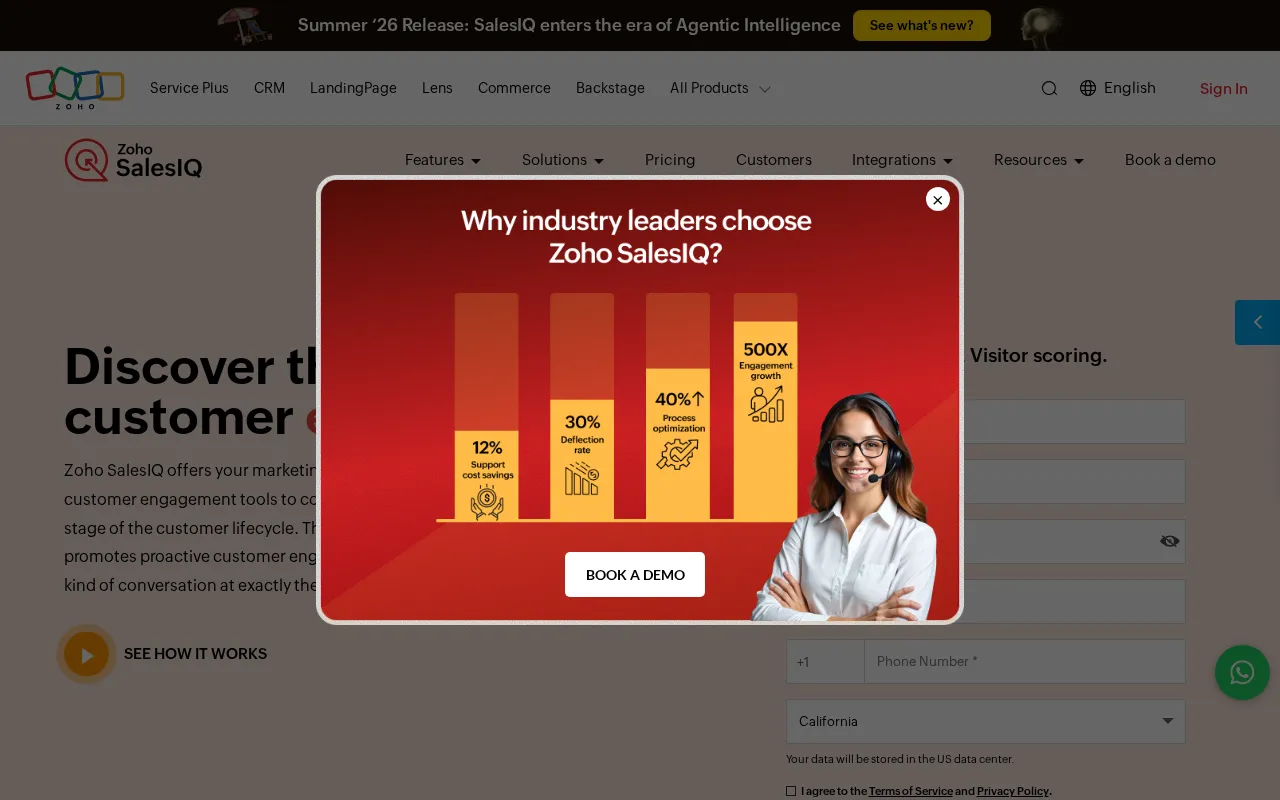
Zoho SalesIQ is Zoho’s live chat and visitor tracking app for marketing, sales and support teams, with chatbots, messaging apps, lead scoring and Zia agents, Zoho’s AI agents that can pick up chats.
Zoho SalesIQ’s free plan covers 3 operators and 100 operator chats a month, with visitor insights that show who is on your site so a founder can open the chat. It has no email inbox or public help center, and the free plan keeps 30 days of history with no AI.
- Best for
- Sales and marketing teams on Zoho CRM that want to see who is browsing, score leads and start the chat themselves.
- How it bills
- Per operator a month: Basic is $7, Professional $12.75 and Enterprise $20 on annual billing ($10, $17 and $25 monthly). Zia agents cost nothing to deploy, 1 on Basic, 3 on Professional and 10 on Enterprise, and on Zoho’s Standard hosted models the first 30 million tokens a month are free, then $1 per million. Answer Bot needs Enterprise. Add-ons on annual billing: another brand is $16, a chatbot $8, 5,000 more bot chats $8 and 100,000 more tracked visitors $90 a month.
- Free plan
- Yes: 3 operators, 100 operator chats a month, 30 days of history, no AI
- 3 people, 300 AI replies
- $21 or more a month: 3 Basic operators at $7 on annual billing, with 1 Zia agent answering on a Zoho-hosted model, plus any tokens past the 30 million free each month at $1 per million.
Pros
- Cheap seats: Basic is $7 an operator a month on annual billing, and the free plan covers 3 operators.
- Live visitor tracking, lead scoring and company scoring show who is on your site, and proactive triggers open the chat.
- WhatsApp, Instagram, Messenger, Telegram, LINE and WeChat from Basic, with audio calls, video calls and screen sharing in the chat window.
- Zia agents can pull records from Zoho CRM, Shopify or Stripe, and pass a chat to an operator with its context.
Cons
- No email inbox and no public help center: articles and FAQs open inside the chat window.
- Answer Bot, which answers from your articles with Zoho’s built-in AI, needs Enterprise at $20 an operator.
- Basic caps operator chats at 1,000 a month, and the free plan at 100 with 30 days of history.
- Zoho MCP lists SalesIQ but publishes no list of its SalesIQ tools.
Already on Zoho SalesIQ? See the best Zoho SalesIQ alternatives.
18. FreeScout
FreeScout is a free, open-source help desk and shared mailbox built with PHP and Laravel, which you install on your own server. Features beyond the core, from live chat to a knowledge base, come as modules sold once.
FreeScout is free and open source for unlimited agents when a technical founder runs the server, and live chat, a knowledge base and saved replies are each bought once as a module. No AI answers customers, and modules come with no trial and no refund.
- Best for
- Teams with someone to run a PHP server who want an email help desk for any number of agents without a monthly bill.
- How it bills
- FreeScout is free and open source for unlimited agents, tickets and mailboxes, and you host it yourself: FreeScout offers no cloud version of its own. Features such as live chat ($13), a knowledge base ($12), saved replies ($4.99), tags ($6.99), workflows ($14.99) and API & Webhooks ($12.99) are modules, each a one-time lifetime license for one FreeScout instance, with no trials and no refunds. The AI module is free and runs on your own AI provider.
- Free plan
- Yes: free and open source for unlimited agents, on your own server
- 3 people, 300 AI replies
- $0 or more a month: 3 agents on the free FreeScout app, on a server you run from $3.10 a month on PikaPods in FreeScout’s one-click list. Live chat ($13), knowledge base ($12) and saved replies ($4.99) are one-time modules, $29.99 together, and no AI answers customers.
Pros
- Free for unlimited agents, tickets and mailboxes, and every conversation stays on a server you control.
- Modules are paid once, with lifetime updates, and their source code is open under AGPL-3.0.
- The free AI module drafts and summarizes with OpenAI, Claude, Gemini or a local model through Ollama.
- Beside email, live chat, WhatsApp, Telegram, Facebook and SMS through Twilio can join the same inbox, each through a module.
Cons
- FreeScout sells no hosted version, so you run the server yourself or pay another company to host it.
- No AI answers customers: the AI module only drafts, summarizes and polishes replies for an agent.
- Saved replies, tags, workflows, live chat and the knowledge base are each a paid module, with no trial and no refund.
- Help with a module is limited to fixing confirmed bugs, and FreeScout points you to a developer for anything else.
Already on FreeScout? See the best FreeScout alternatives.