Start free

12 best Plain alternatives (2026)

By , founder of Rinhelp · Facts checked

The short answer

Plain keeps changing how it charges: five different price lists since December 2025, a trial cut from 14 days to 7, and Foundation’s included credits halved since September. If you are a small team that wants a price that stays put and AI answering email and live chat, pick Rinhelp, free for 3 teammates and $49 a month for the whole team. If your customers live in Slack, Intercom is the closest match you can buy online, and Pylon and Thena turn shared Slack channels into tickets but start with a demo; pick Help Scout for a calm shared inbox with a free plan, Front for shared email with many teammates, Zendesk for enterprise depth, HubSpot to keep support beside your CRM, and Chatwoot if you’d rather host it yourself.

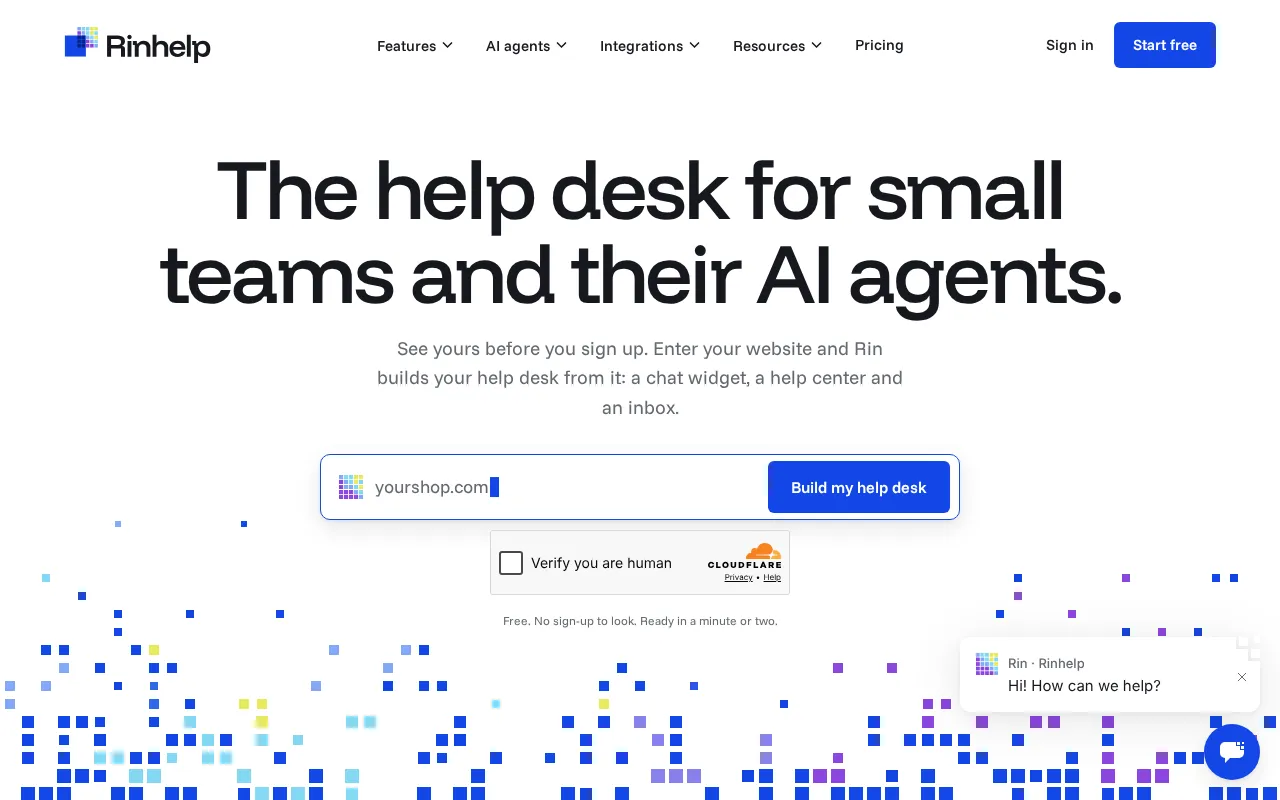
See Rinhelp on your own site. Enter your website and Rin builds your help desk from it: a chat widget, a help center and an inbox.

Free. No sign-up to look. Ready in a minute or two.

Is your help center somewhere else?

Rin will read . If your help articles or docs live at another address, like help. or a Notion page, Rin can read those too.

Where is your help center?

Rin reads it along with and turns it into your help center.

Plain alternatives at a glance

ToolBest forHow it billsFree plan3 people, 300 AI replies
RinhelpSmall teams whose customers write by email and website chat rather than Slack, and who want AI replies at a price that doesn’t move.One price per workspaceYes: 3 teammates, 50 AI replies to try Rin$49
IntercomSoftware and app companies that want chat, email, phone, WhatsApp and SMS in one inbox, with Fin answering across them.Per seat, plus each Fin outcomeNo, 14-day trial$354
Help ScoutSupport teams that think in tickets and want a calm shared inbox, a help center and live chat, with a free plan to start on.Per user, plus each AI resolutionYes: 5 users, 1 inbox, 100 contacts a month$300
FrontTeams that run many shared addresses, bring in colleagues outside support, and want people and AI agents working one queue.Per seat, plus each Autopilot conversationNo, 14-day trial$342
ZendeskGrowing and large teams that need voice, many channels, 1,800+ apps and integrations, and enterprise controls to grow into.Per agent, plus each automated resolutionNo, 14-day trial$485
HubSpotTeams already running sales or marketing on HubSpot that want support on the same customer records.Per seat, plus credits for each AI resolutionYes: 2 users, with HubSpot branding on chat and email$390
FreshdeskTeams that want a full ticketing help desk with SLAs, routing and a knowledge base, and chat and messaging for less per agent than Zendesk’s Suite Team.Per agent, plus each AI sessionNo, 14-day trial$204
MissiveSmall teams that answer email together and want internal chat and tasks beside their messages.Per user, plus AI creditsNo, 30-day trial$72 or more
ChatwootTeams that want many channels at a low seat price, or want to run their help desk on their own servers.Per agent, plus AI creditsYes: 2 agents, live chat only, 500 conversations a month$57
CrispSmall teams that start with free website chat and want WhatsApp, Instagram, SMS and phone in the same inbox later.Per workspace, plus AI usageYes: 2 seats, chat only, no AI$66 or more
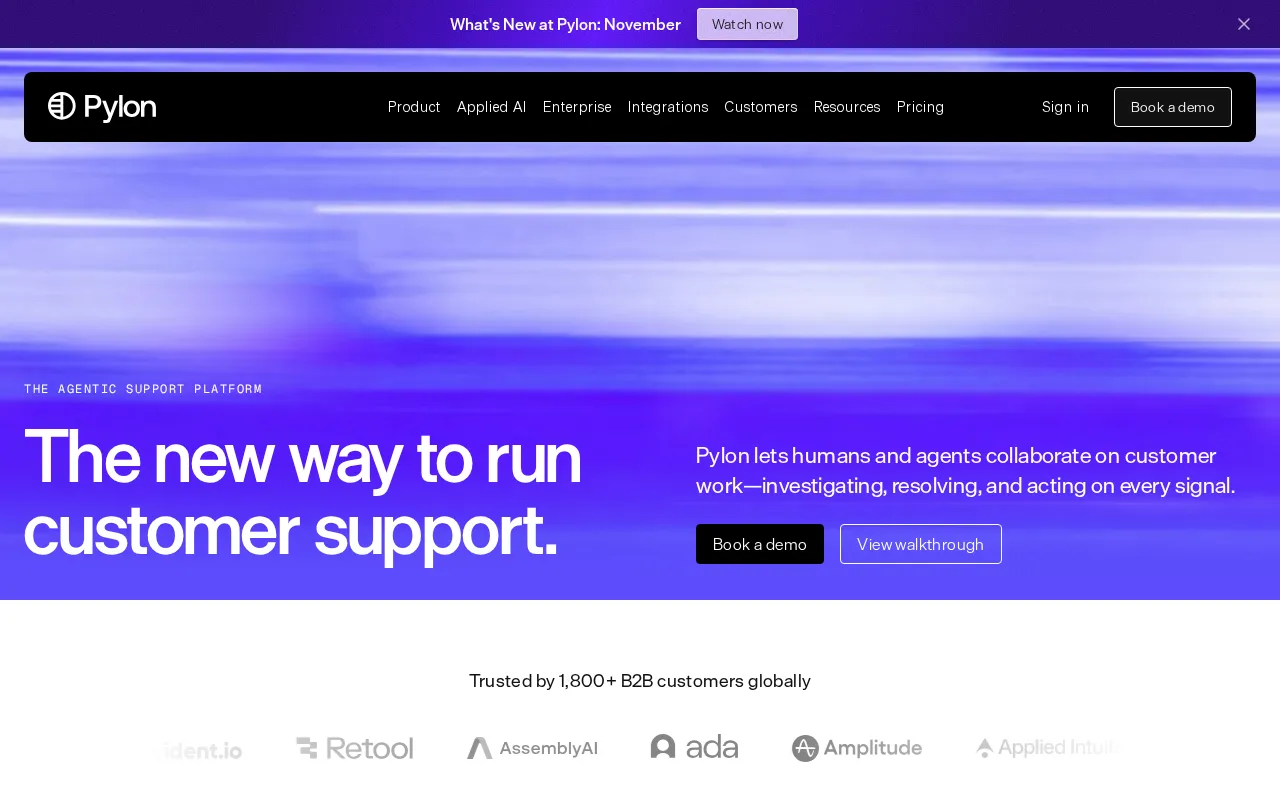
PylonB2B software companies whose customers ask for help in shared Slack channels, with a support team big enough for an annual contract.Per seat on a standard annual contract, plus credits for AINo, buying starts with a demo$267 or more
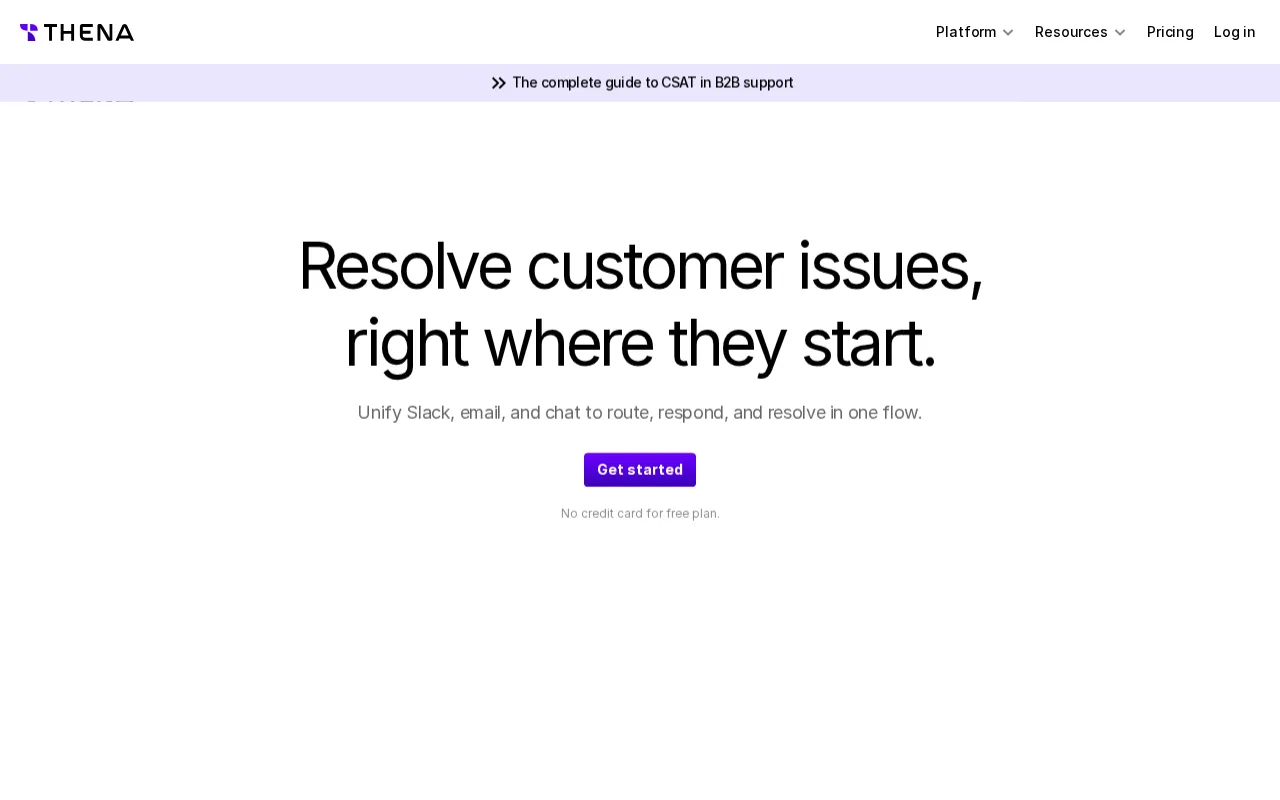
ThenaB2B software companies whose customers ask for help in shared Slack channels, and who are ready to buy through a demo.Per user seat, billed yearly, bought through salesNot on the pricing page; buying starts with a demo, and only a domain Thena approves can create an organization$237 or more
Plain, for comparisonB2B software teams that support customers in shared Slack or Teams channels and want engineers and AI agents building on its API.Per member seat, plus credits for AINo, 7-day trial$425

1. Rinhelp

Rinhelp homepage, November 2026

Plain has changed its price list four times since December 2025, and each change moved what a seat or an AI resolution costs. Rinhelp has one paid plan: $49 a month for the whole team with 5,000 AI replies. Like Plain, it lets Claude or ChatGPT work in the inbox through MCP, and a refund or cancellation waits for a teammate.

Best for
Small teams whose customers write by email and website chat rather than Slack, and who want AI replies at a price that doesn’t move.
How it bills
Free for up to 3 teammates. Pro is $49 a month for the whole workspace, with 5,000 AI replies from Rin. No per-seat or per-resolution fees.
Free plan
Yes: 3 teammates, 50 AI replies to try Rin
3 people, 300 AI replies
$49 a month: Pro for the whole workspace, using 300 of its 5,000 AI replies; Free covers your team if you don’t need AI replies.

Pros

  • 3 teammates with 300 AI replies cost $49 a month, where Plain’s Foundation plan comes to $425 with credits.
  • 5,000 AI replies a month come with Pro, and more cost $49 for 5,000, with no credit rates to look up for each feature.
  • All 11 everyday actions work through MCP, including Shopify and Stripe lookups that Plain’s server lacks.
  • Shopify orders and Stripe payments sit beside each conversation, and a refund waits for a teammate’s approval.

Cons

  • Email and live chat only: there is no phone, WhatsApp, SMS or social inbox.
  • Shopify and Stripe are the only integrations.
  • No reports, SLA rules or routing rules: Rin hands a conversation to the teammate with the fewest open ones.
  • The free plan has no Rin beyond 50 AI replies to try it.
Start free

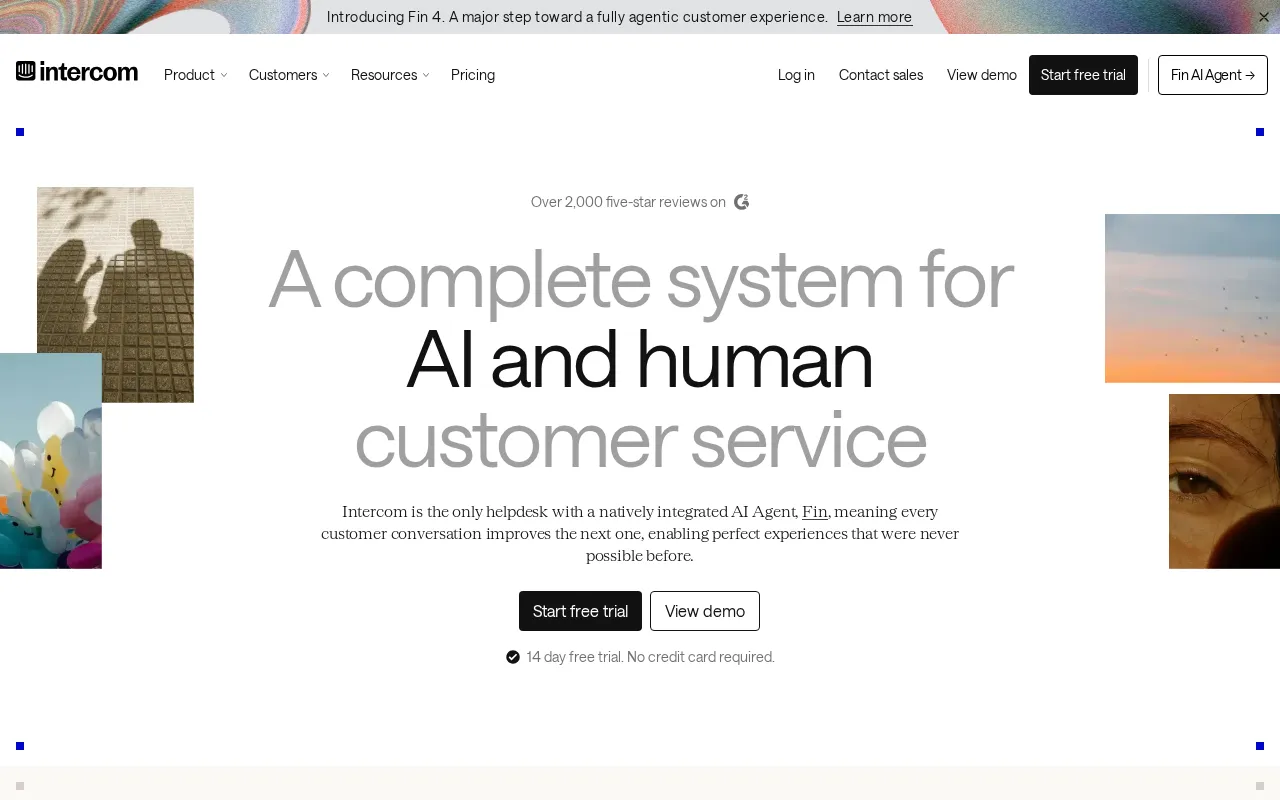
2. Intercom

Intercom homepage, November 2026

Intercom is a customer service help desk with a chat Messenger, a shared inbox, a help center and Fin, its AI agent. Its company renamed itself Fin in May 2026, and Salesforce bought it that September.

Best for
Software and app companies that want chat, email, phone, WhatsApp and SMS in one inbox, with Fin answering across them.
How it bills
Per seat: Essential is $29, Advanced $85 and Expert $132 a seat a month on annual billing ($39, $99 and $139 monthly), and new customers pay $19 for Essential on annual billing. Fin costs $0.99 for each outcome, and WhatsApp, SMS and phone are billed by use.
Free plan
No, 14-day trial
3 people, 300 AI replies
$354 a month: 3 Essential seats at $19, the new-customer price on annual billing (list $29), plus 300 Fin outcomes at $0.99.

Pros

  • Chat, email, phone, WhatsApp, SMS, Slack, Facebook and Instagram all arrive in one inbox.
  • Fin answers on email, live chat and phone, and is charged once per conversation however many questions it answers.
  • Agents can refund or cancel a Shopify order from the inbox sidebar, and the Stripe app shows subscriptions mid-conversation.
  • Its official MCP server can add internal notes and write and publish help center articles, not only read.

Cons

  • Every teammate who replies needs a paid seat, and Fin adds $0.99 an outcome on top.
  • An outcome also counts when a customer simply stops asking after Fin’s answer, or when a Fin workflow hands the conversation to your team.
  • Its MCP server can’t reply to customers, assign or close conversations, and doesn’t serve workspaces hosted in Australia.
  • No free plan, and an annual plan cancelled early gets no prorated refund.

Already on Intercom? See the best Intercom alternatives.

3. Help Scout

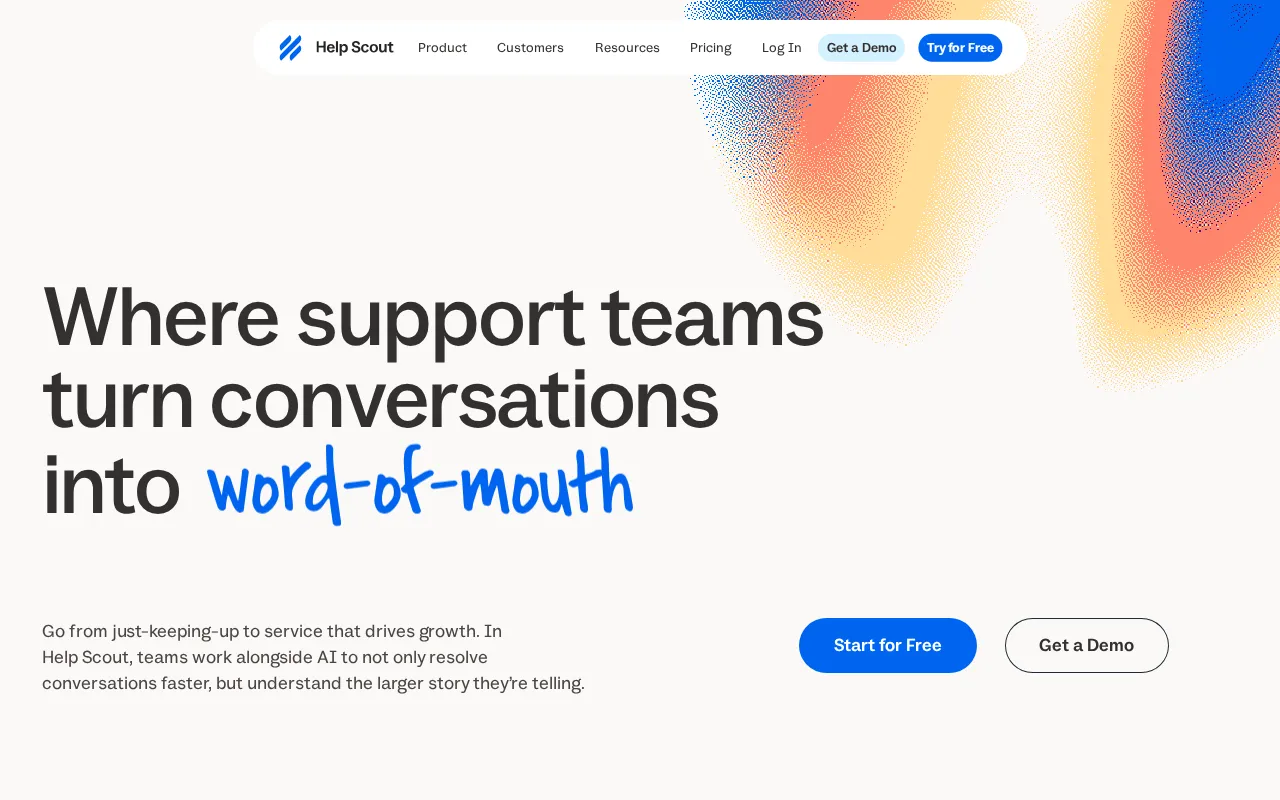
Help Scout homepage, November 2026

Help Scout is a help desk with shared inboxes, a Docs help center and Beacon, a widget for chat and help articles. Scout, its AI agent, answers chat from your help content and is billed per resolution.

Best for
Support teams that think in tickets and want a calm shared inbox, a help center and live chat, with a free plan to start on.
How it bills
Standard is $25, Plus $45 and Pro $75 a user a month on annual billing, which saves 16%. Pro needs at least 10 users and a demo. Scout costs $0.75 per resolution, free for a new account’s first 3 months.
Free plan
Yes: 5 users, 1 inbox, 100 contacts a month
3 people, 300 AI replies
$300 a month: 3 Standard users at $25 on annual billing, plus 300 AI resolutions at $0.75.

Pros

  • A free plan for up to 5 users, with 1 inbox, a Docs site and 100 contacts a month.
  • Agents can refund, cancel or edit recent Shopify orders, and refund Stripe payments or cancel subscriptions, from the sidebar.
  • Standard brings email, live chat, SMS, WhatsApp, Instagram and Messenger into one inbox.
  • You can cap AI spending each month, and Scout switches off when it reaches the cap.

Cons

  • Its official MCP server is read-only: your own AI can search conversations and Docs, but can’t reply, add notes or close.
  • Scout answers website and in-app chat only, and lists email as “Coming Soon”.
  • Scout can’t look up orders or act in other tools yet: its connection to payment processors and CRMs is still to come.
  • Seats and AI are billed separately, so the bill grows with every user and every resolution.

Already on Help Scout? See the best Help Scout alternatives.

4. Front

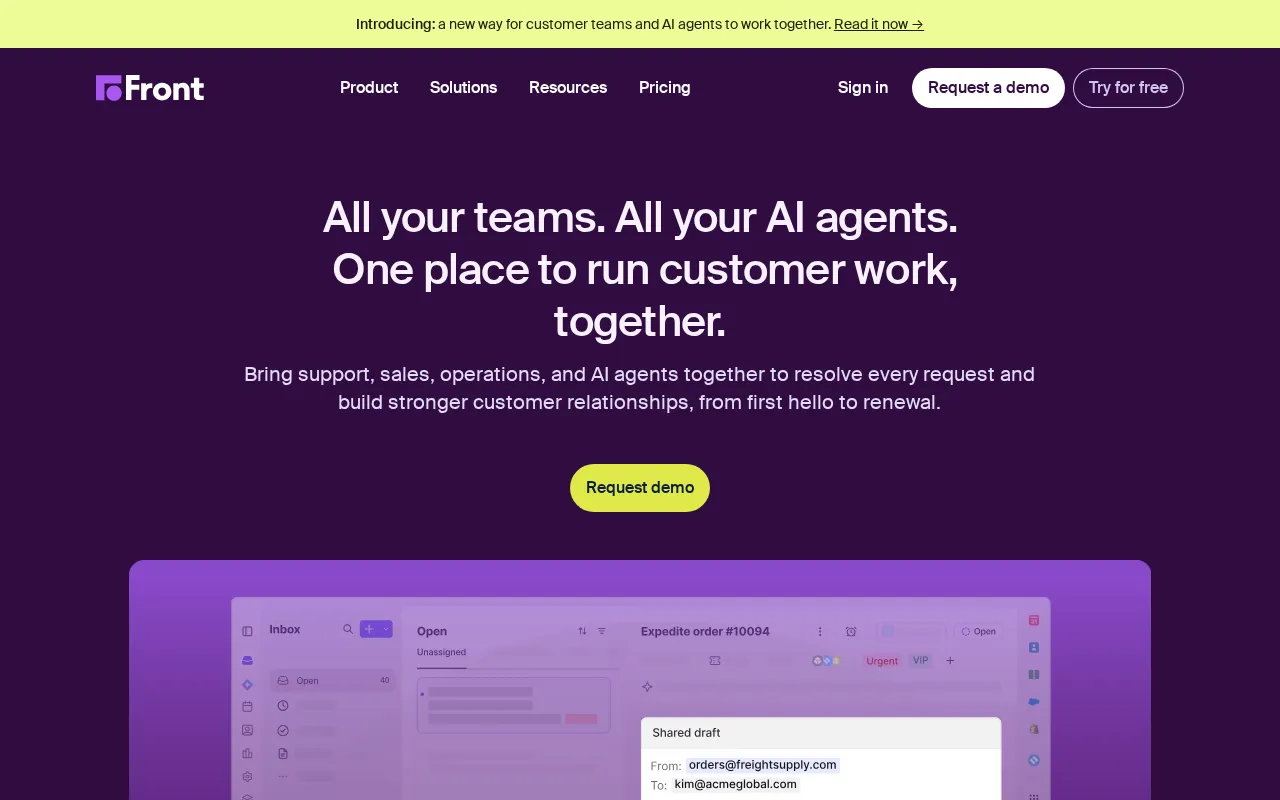
Front homepage, November 2026

Front is a customer service platform built on shared inboxes, where support, sales and operations teams handle email, chat, SMS and social together. Autopilot, its AI agent, is billed by what it does in each conversation.

Best for
Teams that run many shared addresses, bring in colleagues outside support, and want people and AI agents working one queue.
How it bills
Starter is $25 a seat a month for up to 10 seats, Professional $65 for up to 50 and Enterprise $105, on annual billing ($35 and $85 monthly; Enterprise is annual only). Autopilot charges $0.39 to hand off and $0.89 to resolve a conversation, and Copilot is $20 a seat.
Free plan
No, 14-day trial
3 people, 300 AI replies
$342 a month: 3 Starter seats at $25 on annual billing, plus 300 Autopilot resolutions at $0.89.

Pros

  • Its official MCP server can search, draft, send, comment, assign, tag and archive, with sending behind its own permission.
  • Guest accounts let colleagues outside support comment on a conversation without a paid seat.
  • Autopilot answers on email, chat, SMS, WhatsApp and Slack, and its 30-day trial covers up to 1,000 resolutions.
  • Outside AI agents built with Claude, OpenAI or Sierra can be assigned conversations like a teammate, on every plan.

Cons

  • Starter stops at 10 seats and one channel type, so an 11th seat or a second channel means Professional at $65 a seat.
  • Autopilot charges for handoffs too, not only for conversations it resolves.
  • There is no export you can run yourself: Support makes one, and it leaves out contacts, templates, tags and individual inboxes.
  • Monthly and annual payments are nonrefundable, even if you cancel early.

Already on Front? See the best Front alternatives.

5. Zendesk

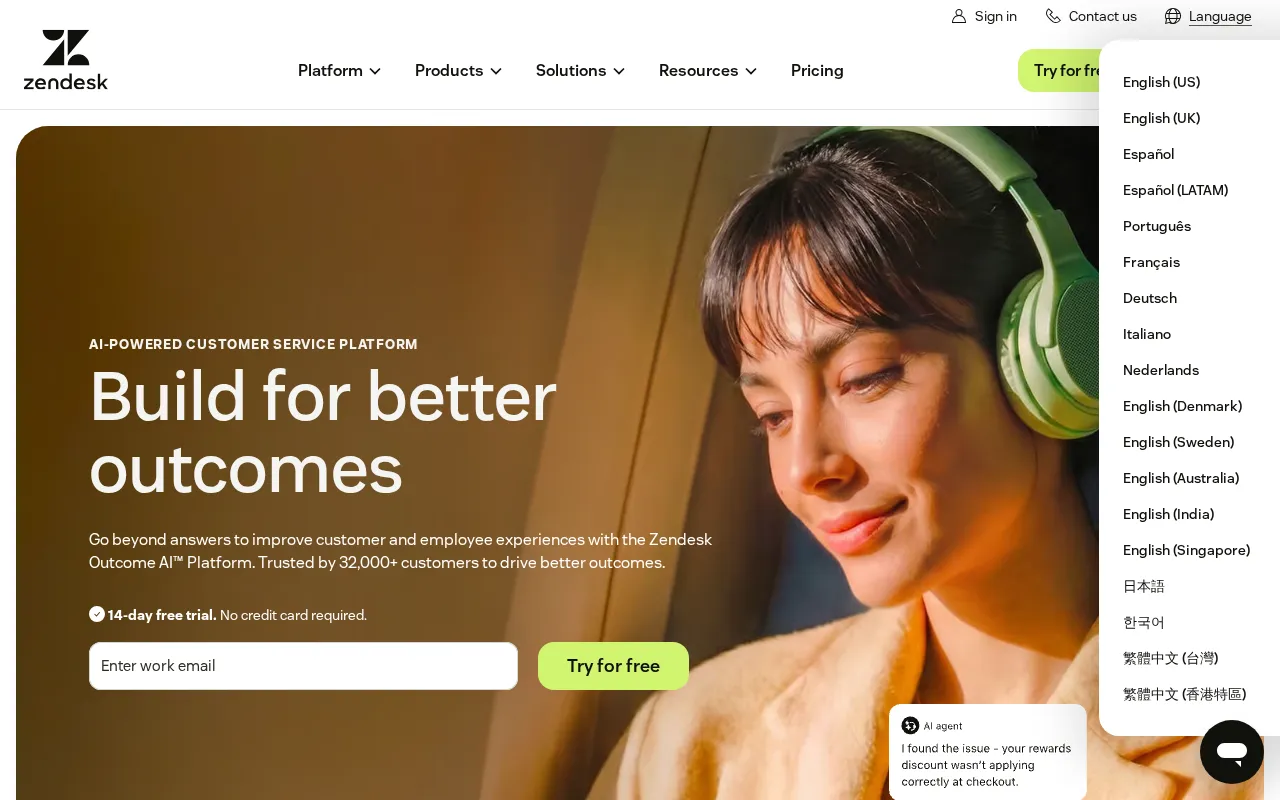
Zendesk homepage, November 2026

Zendesk is a customer service suite for email, messaging, live chat, social and voice, with AI agents that answer customers and are billed per automated resolution.

Best for
Growing and large teams that need voice, many channels, 1,800+ apps and integrations, and enterprise controls to grow into.
How it bills
Per agent: Support Team is $19, Suite Team $55 and Suite Professional $115 a month on annual billing ($25, $69 and $149 monthly). Each agent brings 5 automated resolutions a month (10 on Professional), then each costs $1.50 committed or $2.00 pay as you go. Copilot is $50 more an agent.
Free plan
No, 14-day trial
3 people, 300 AI replies
$485 a month: 3 Support Team agents at $19 on annual billing, plus 285 automated resolutions at $1.50 committed beyond the 15 included, on email only.

Pros

  • Email, messaging, live chat, WhatsApp, social and voice sit in one Suite, and AI agents can answer on email, messaging or voice.
  • Its marketplace lists 1,800+ apps, partners and integrations.
  • Agents refund and cancel Shopify orders inside a ticket, and an admin can connect Zendesk’s AI agents to Stripe’s MCP server.
  • The 14-day trial opens every Suite Professional feature, Copilot included, and startups can get 6 months of Suite free for up to 50 agents.

Cons

  • Every agent is a seat, and each automated resolution past the 5 per agent a plan includes costs $1.50 to $2.00.
  • No official MCP server for outside AI tools yet: Zendesk announced one in May 2026 for early access and has published no tools for it.
  • Data exports are off until the account owner asks support, and the export tools aren’t on Team plans.
  • Zendesk gives no refunds or credits for unused seats or time.

Already on Zendesk? See the best Zendesk alternatives.

6. HubSpot

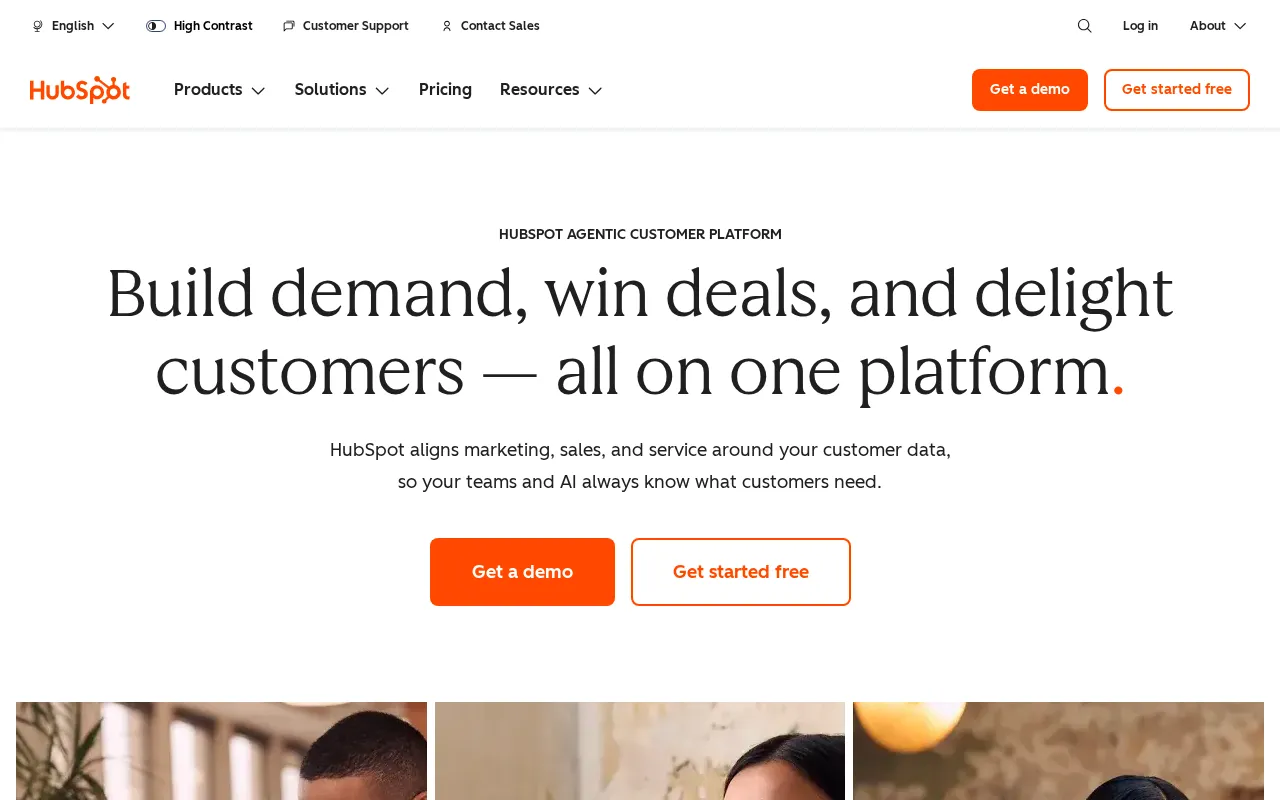
HubSpot homepage, November 2026

HubSpot Service Hub is the customer service part of HubSpot’s CRM: a help desk inbox for email, chat, WhatsApp and calls, a knowledge base, and the customer agent, an AI that answers customers.

Best for
Teams already running sales or marketing on HubSpot that want support on the same customer records.
How it bills
Per seat: Starter is $7 and Professional $90 a seat a month on annual billing ($10 and $100 paid monthly, with Professional still committed for a year), and Enterprise starts at $150. Starter’s prices are new-customer discounts on a $20 list price. Professional adds a required $1,500 onboarding fee, and Enterprise $3,500. The customer agent uses 50 credits, $0.50, per resolved conversation, after 3,000 credits a month included on Professional.
Free plan
Yes: 2 users, with HubSpot branding on chat and email
3 people, 300 AI replies
$390 a month: 3 Professional seats at $90 on annual billing, plus 300 resolutions by the customer agent at 50 credits each, $120 after the 3,000 included credits. A one-time $1,500 onboarding fee comes on top.

Pros

  • Support, sales and marketing share one CRM, so every ticket sits next to the customer’s deals and emails.
  • The customer agent is billed only when it resolves a conversation, and a handoff to a person costs nothing.
  • Professional puts calling, WhatsApp and Facebook Messenger in the same inbox as email and chat.
  • The official MCP server reads inbox conversations and writes tickets, notes and contacts, asking you to confirm each change.

Cons

  • The customer agent needs Professional at $90 a seat on annual billing, plus a required $1,500 onboarding fee.
  • AI credits are shared with every other credit feature, and the customer agent stops taking new conversations when they run out.
  • The MCP server can’t send a reply to a customer or reach the knowledge base.
  • HubSpot’s examples of customer agent actions are password resets and booking meetings, with no refunds or order changes.

Already on HubSpot? See the best HubSpot alternatives.

7. Freshdesk

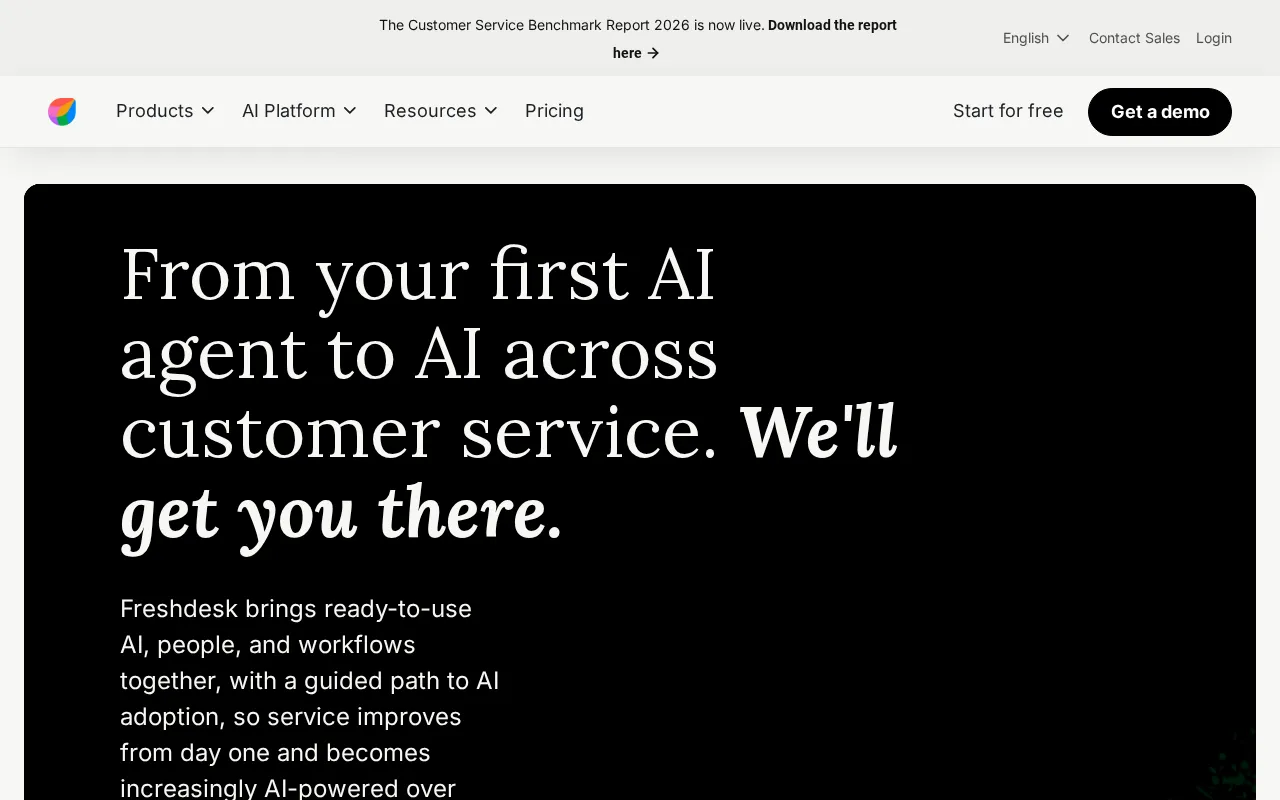
Freshdesk homepage, November 2026

Freshdesk is Freshworks’ help desk: email ticketing with a customer portal and knowledge base, with Freshdesk Omni adding chat, phone and messaging. Its Freddy AI agent answers customers and is billed per session.

Best for
Teams that want a full ticketing help desk with SLAs, routing and a knowledge base, and chat and messaging for less per agent than Zendesk’s Suite Team.
How it bills
Per agent on annual billing: Growth is $19, Pro $55 and Enterprise $89 a month, or $29, $79 and $119 on Freshdesk Omni with chat and messaging. Freddy AI agent sessions cost $49 per 100 after 500 free ones, once per account. Voice is $15 to $69 more an agent, and MCP actions $15 per 1,000.
Free plan
No, 14-day trial
3 people, 300 AI replies
$204 a month: 3 Growth agents at $19 on annual billing, plus 3 packs of 100 AI sessions at $49, on email only.

Pros

  • SLA policies, custom dashboards, skill-based routing and audit logs come on its higher plans, with skill-based routing at $89 an agent where Zendesk asks $115.
  • Freshdesk Omni adds chat, phone, WhatsApp, Messenger, Instagram and Line to the same tickets.
  • Day passes from $2 let occasional helpers answer without a full seat.
  • Its official MCP server can reply, add notes, update tickets and write knowledge base articles.

Cons

  • List prices rose early in 2026, from $15 to $19 an agent on Growth, and the free plan is gone.
  • Freddy AI agent costs 49 cents a session after the first 500, which never come back.
  • Every MCP call counts as an action, and Growth includes only 1,200 a year.
  • Fees are non-refundable, and a cancellation only takes effect at the end of your term.

Already on Freshdesk? See the best Freshdesk alternatives.

8. Missive

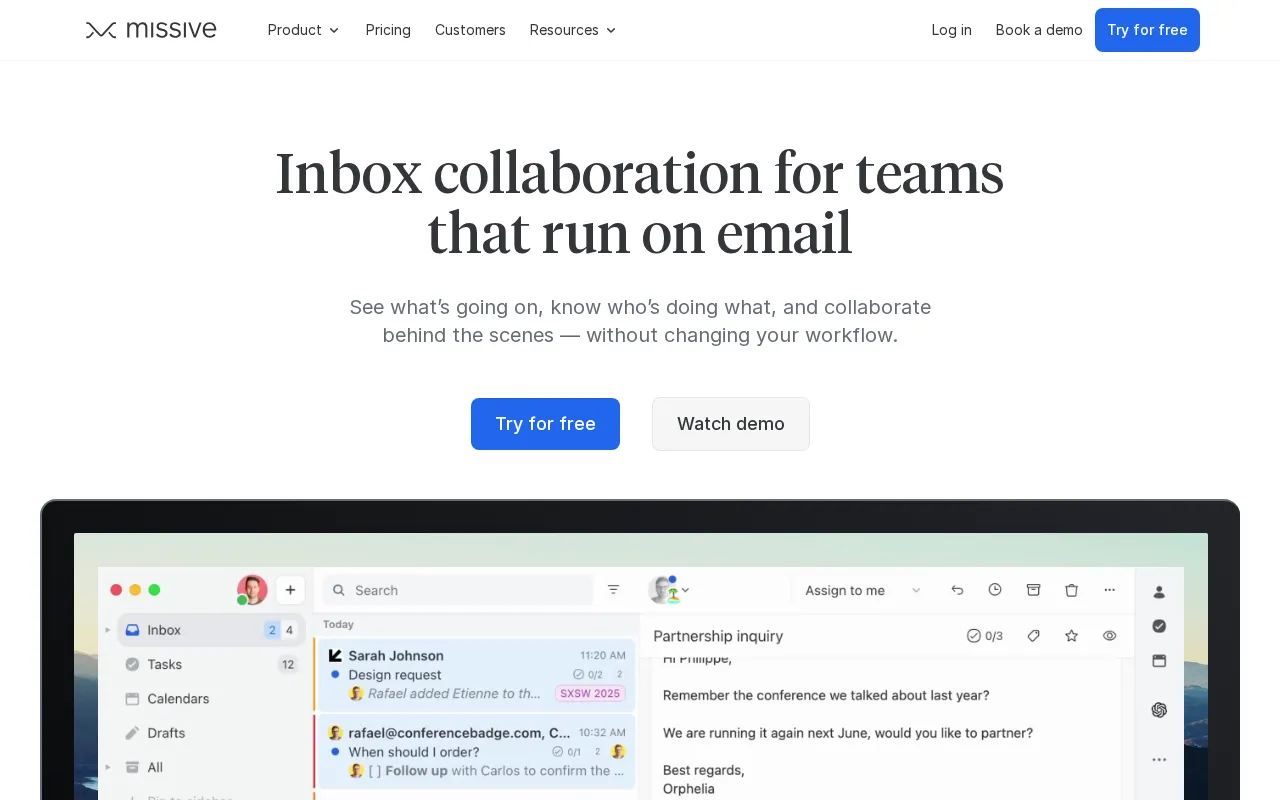
Missive homepage, November 2026

Missive is a team email app that puts personal and shared inboxes, comments, tasks, calendars and internal chat in one place. Its AI assistant drafts, summarizes and translates, but doesn’t answer customers on its own.

Best for
Small teams that answer email together and want internal chat and tasks beside their messages.
How it bills
Starter is $14 a user a month for up to 5 users, Productive $24 for up to 50 and Business $36, on annual billing ($18, $30 and $45 monthly). AI runs on Missive credits at the provider’s price plus 25%, or on your own key with no markup, and Productive and Business start with $5 of free credits. Each user adds 5 shared accounts to a pool, and every 5 past it cost $15 a month.
Free plan
No, 30-day trial
3 people, 300 AI replies
$72 or more a month: 3 Productive users at $24 on annual billing, plus AI drafts at token prices. No AI answers customers.

Pros

  • Personal and shared email, comments, tasks, calendars and internal chat live in one app.
  • Bring your own Anthropic, OpenAI or Gemini key and pay no markup on AI.
  • Its AI assistant reaches Stripe, Notion and Linear through MCP, and asks you to approve actions before anything happens.
  • Native apps for iOS, Android, macOS and Windows, with SMS, WhatsApp, Messenger and Instagram beside email.

Cons

  • No AI answers customers: AI rules can only create a draft for a teammate to send.
  • No help center, and live chat needs your own Twilio account.
  • The API and MCP need Productive.
  • No free plan: after the 30-day trial an unpaid organization is paused, and its data is eventually deleted.

Already on Missive? See the best Missive alternatives.

9. Chatwoot

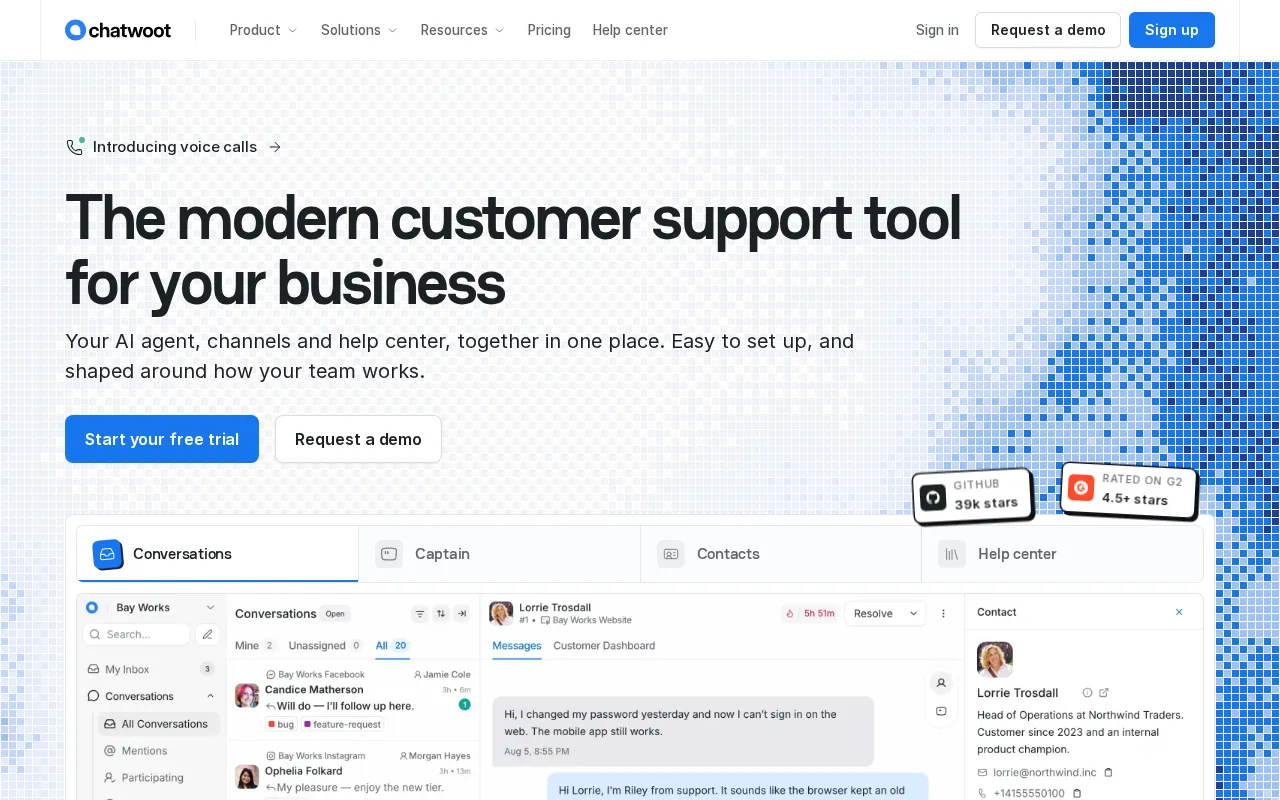
Chatwoot homepage, November 2026

Chatwoot is open-source support software with one inbox for live chat, email, WhatsApp, social and voice, a help center, and Captain, its AI agent. You can use Chatwoot Cloud or host it yourself.

Best for
Teams that want many channels at a low seat price, or want to run their help desk on their own servers.
How it bills
Cloud is per agent a month: Startups $19, Business $39 and Enterprise $99, with 300, 500 or 800 Captain credits for the account. Each Captain reply uses a credit, extra credits are $20 per 1,000, and no annual price is published. Credits never top up by themselves: once they run out, new conversations go straight to your team with no Captain reply.
Free plan
Yes: 2 agents, live chat only, 500 conversations a month
3 people, 300 AI replies
$57 a month: 3 Startups agents at $19, with the 300 included Captain credits covering 300 AI replies.

Pros

  • Open source: the self-hosted Community Edition is free, and your data stays on your own servers.
  • One inbox for live chat, email, WhatsApp, Instagram, Messenger, TikTok and, from Business, voice calls.
  • Startups includes every channel but voice, plus a help center, at $19 an agent a month.
  • An official CLI and agent skill let coding agents such as Claude Code work in Chatwoot.

Cons

  • Startups has no automation rules or teams; those start on Business at $39 an agent.
  • Captain uses a credit for every reply, and bought credits expire after 6 months and aren’t refunded.
  • Since July 2026 the free Cloud plan has no API or webhook access.
  • No official MCP server, and Captain’s custom tools have no built-in approval step for actions like refunds.

Already on Chatwoot? See the best Chatwoot alternatives.

10. Crisp

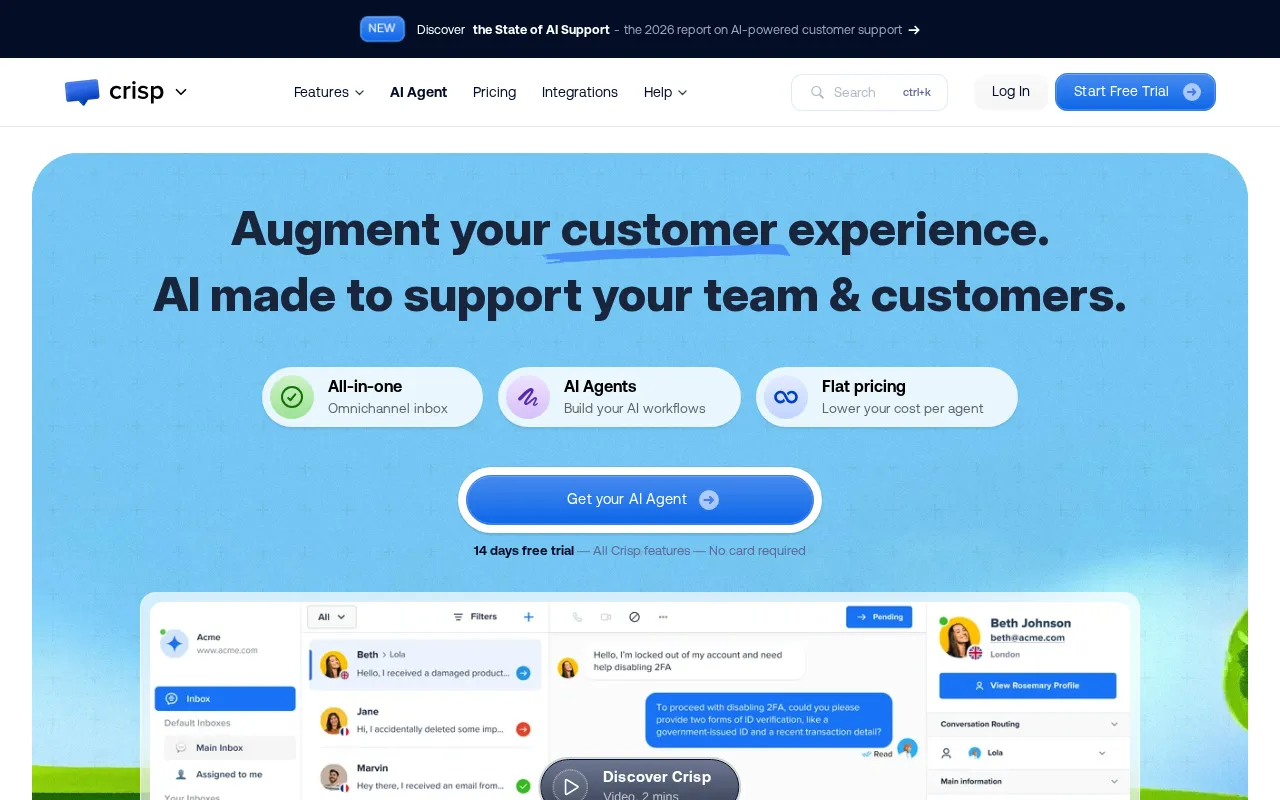
Crisp homepage, November 2026

Crisp is a French customer support platform built around a website chat widget, with a shared inbox, many messaging channels and Hugo, its AI agent.

Best for
Small teams that start with free website chat and want WhatsApp, Instagram, SMS and phone in the same inbox later.
How it bills
Per workspace a month: Mini is $45 with 4 seats, Essentials $95 with 10 and Plus $295 with 20, including $5, $25 and $75 of AI credits (about 90, 450 and 1,350 Hugo conversations). Extra seats are $10 each, sold on Plus only, and Hugo past the credits runs on Pay-As-You-Go at about $0.05 to $0.10 a conversation.
Free plan
Yes: 2 seats, chat only, no AI
3 people, 300 AI replies
$66 or more a month: Mini at $45 for 4 seats with about 90 Hugo conversations in its credits, plus about 210 more at about $0.10 each.

Pros

  • One price per workspace, with 10 seats on Essentials for $95 a month.
  • WhatsApp, Instagram, Messenger, SMS, Telegram and phone sit in the same inbox from Essentials.
  • Its official MCP server can read, reply, add notes, resolve and write help center articles.
  • Hugo can look up orders and refund through Shopify, WooCommerce, PrestaShop and Stripe, after a one-time code checks the customer.

Cons

  • The free plan has no email inbox and no AI, and Mini has no help center, WhatsApp or MCP server.
  • Hugo stops answering when the month’s credits run out unless you turn on Pay-As-You-Go, whose rates aren’t published.
  • Stripe data in the inbox comes only with Plus at $295 a month.
  • Crisp’s terms refund no fees, monthly or yearly.

Already on Crisp? See the best Crisp alternatives.

11. Pylon

Pylon homepage, November 2026

Pylon is a support platform built for B2B companies. It turns messages from shared Slack Connect channels, email, a chat widget, WhatsApp and more into issues in one queue, with a knowledge base and AI agents that run on credits.

Best for
B2B software companies whose customers ask for help in shared Slack channels, with a support team big enough for an annual contract.
How it bills
Per seat: Professional is $89 and Advanced $139 a seat a month on an annual contract, and Enterprise is quoted. Pylon says monthly billing exists but lists no monthly price. AI agents spend credits, bought as you go or committed up front at rates only sales give. Phone is $35 a seat a month, Account Intelligence $10 per customer account a month, and SAML SSO on Advanced $125 a month. New customers buy a minimum number of seats, which Pylon doesn’t publish.
Free plan
No, buying starts with a demo
3 people, 300 AI replies
$267 or more a month: 3 Professional seats at $89 on an annual contract, plus credits for 300 answers from its AI that only sales price. Pylon’s minimum seat count is unpublished, so 3 may not be enough to buy.

Pros

  • Shared Slack Connect channels, Slack Community, Discord, Telegram, WhatsApp, SMS, email and a chat widget feed one queue on every plan, and phone is a $35 a seat add-on.
  • Its official MCP server can reply, add notes, assign, close, draft and publish knowledge base articles and save macros, acting as your own user or a token’s identity.
  • Pylon bills seats and AI credits, never each ticket.
  • Issues link to Linear, Jira, GitHub, Asana and Shortcut, and accounts sync with Salesforce, HubSpot, Attio and Pipedrive.

Cons

  • No self-serve signup: every plan starts with “Book a demo” or “Talk to sales”, and a sales representative sets up the trial.
  • Standard contracts are annual, and new customers buy a minimum number of seats that Pylon doesn’t publish.
  • AI agents spend credits that only sales put a price on, so the AI share of the bill is unknown before a call.
  • Fees are non-refundable, and an order renews for the period its order form sets unless either side gives written notice at least 30 days before the term ends.

Already on Pylon? See the best Pylon alternatives.

12. Thena

Thena homepage, November 2026

Thena is a help desk for B2B companies. It turns messages in shared Slack channels, email and web chat into tickets tied to each customer account, with AI agents that answer and an MCP server for your own AI.

Best for
B2B software companies whose customers ask for help in shared Slack channels, and who are ready to buy through a demo.
How it bills
Per user a month on yearly billing: Starter is $29 for up to 5 user seats and 1,000 tickets a month, and Standard $79, or $99 billed monthly in Thena’s plans doc. Enterprise shows $119 with no unit beside it, and the plans doc calls it custom pricing. No plan has a buy button: signing up offers only sign-in or “Request a demo”, and customers buy on an order form.
Free plan
Not on the pricing page; buying starts with a demo, and only a domain Thena approves can create an organization
3 people, 300 AI replies
$237 or more a month: 3 Standard seats at $79 on yearly billing, since Starter has no AI replies; AI auto-responses come with the seat, and the pricing page marks AI agents “Limited” on Standard without a number.

Pros

  • Messages in shared Slack channels with your customers become tickets, and AI on every plan spots which ones are requests and summarizes them.
  • Email, Slack and AI web chat share one queue, and Enterprise adds Microsoft Teams and Discord.
  • Its official MCP server can search tickets, read their comments, reply, add private notes, assign and change status.
  • Standard’s seat price includes AI auto-responses, web chat and the AI agent studio, with no fee per AI reply.

Cons

  • No buy button, and the pricing page lists no free plan: signing up offers only sign-in or “Request a demo”, and a new organization needs a domain Thena approves.
  • Starter has no AI replies, API or MCP, and stops at 5 user seats and 1,000 tickets a month.
  • The pricing page marks routing, workflows, CSAT, the customer portal, HubSpot, Salesforce and Jira as Enterprise only.
  • Its terms make fees non-refundable and non-cancelable, and there is no phone, WhatsApp, Shopify or Stripe.

Already on Thena? See the best Thena alternatives.

Why people leave Plain

The price list keeps changing

Plain’s pricing page has shown five different price lists since December 2025. In September, Foundation came with 2,000 credits and Horizon with 15,000; today they include 1,000 and 2,500, and seats are priced one by one. Plain pricing, 7 September 2026, .

A shorter trial and no free plan

The free trial was 14 days in May 2026 and 7 days by September. There is no free plan to fall back on when it ends. Plain plans, .

AI stops when credits run out

When a workspace runs out of credits, every feature that uses them stops until someone tops up, and the customer agent hands each new thread to your team without replying. Plain credits, .

Frequent breaking API changes

Plain is built for teams that code against its API, and its changelog listed changed or removed fields on September 16, September 23 and October 23, 2026 alone. Plain API changelog, .

Built for B2B, not shops

Plain sells itself as the support stack for B2B teams. It has no phone, WhatsApp or SMS, and no Shopify or Stripe integration for order and payment questions. Plain pricing, .

What users say about Plain

Plain has no Trustpilot page of its own, checked 5 November 2026, so these themes come from reviews elsewhere.

  • Hard to find old threads. Reviewers on G2 say search isn’t strong enough to find past tickets quickly.
  • Best with engineers on hand. Reviewers note that the API-first setup pays off most when developers build on it, and smaller teams without one get less from it.
  • Pricing that’s hard to forecast. Seats, credits and per-plan limits mix together, so reviewers find the monthly bill hard to predict.

Features compared

A check means the vendor’s own pages say a plan includes it. Plain is in the last row for comparison.

ToolEmailLive chatWhatsAppVoiceHelp centerAI that answers customersShopifyStripeFree planSignup without a sales call
Rinhelp
Intercom
Help Scout
Front
Zendesk
HubSpot
Freshdesk
Missive
Chatwoot
Crisp
Pylon
Thena
Plain

What your AI can do in each tool

Connect Claude, ChatGPT or your own AI agent through the vendor’s official MCP server, and this is what it can do of 11 everyday actions: search and read conversations, reply to a customer, add an internal note, assign, close or reopen, search the help center, write or update an article, publish an article, create a saved reply, look up an order, refund or cancel.

ToolThrough official MCPWhat it can doMoney moves wait for a teammate
Rinhelp11 of 11Search and read conversations, reply to a customer, add an internal note, assign, close or reopen, search the help center, write or update an article, publish an article, create a saved reply, look up an order, refund or cancelYes, a teammate approves first
Intercom5 of 11Search and read conversations, add an internal note, search the help center, write or update an article, publish an articleNo refunds or cancellations through MCP
Help Scout2 of 11Search and read conversations, search the help centerNo refunds or cancellations through MCP
Front5 of 11Search and read conversations, reply to a customer, add an internal note, assign, close or reopenNo refunds or cancellations through MCP
Zendesk0 of 11No official MCP server, or nothing from this listNo refunds or cancellations through MCP
HubSpot5 of 11Search and read conversations, add an internal note, assign, close or reopen, look up an orderNo refunds or cancellations through MCP
Freshdesk7 of 11Search and read conversations, reply to a customer, add an internal note, assign, close or reopen, write or update an article, publish an articleNo refunds or cancellations through MCP
Missive4 of 11Search and read conversations, reply to a customer, assign, close or reopenNo refunds or cancellations through MCP
Chatwoot0 of 11No official MCP server, or nothing from this listNo refunds or cancellations through MCP
Crisp6 of 11Search and read conversations, reply to a customer, add an internal note, close or reopen, search the help center, write or update an articleNo refunds or cancellations through MCP
Pylon9 of 11Search and read conversations, reply to a customer, add an internal note, assign, close or reopen, search the help center, write or update an article, publish an article, create a saved replyNo refunds or cancellations through MCP
Thena5 of 11Search and read conversations, reply to a customer, add an internal note, assign, close or reopenNo refunds or cancellations through MCP
Plain7 of 11Search and read conversations, reply to a customer, add an internal note, assign, close or reopen, search the help center, write or update an articleNo refunds or cancellations through MCP

More on each MCP server, and connectors from other companies, which don’t count:

  • Intercom: Workspaces with Fin Operator get five more MCP tools, which change Fin’s setup rather than conversations.
  • Help Scout: A few accounts from Help Scout’s MCP beta kept write tools, but new connections are read-only and write actions have no date. Phone calls need Aircall or another integration.
  • Front: Front’s own AI reaches Stripe through a connector that can create refunds, with each action off until someone turns it on. Your outside agent can’t use it through Front’s MCP server.
  • Zendesk: Zendesk’s announced MCP server has no published docs or tool list yet.
  • HubSpot: HubSpot’s server assigns and closes tickets, not inbox threads, and reads orders only as a beta.
  • Freshdesk: Assigning, closing and publishing go through the general ticket and article tools, and there is no tool to search the knowledge base or read canned responses. Every call is metered.
  • Missive: Missive’s own AI assistant connects out to Stripe, Notion, Linear and others through MCP. That is separate from the server your outside AI agent uses, and an admin must turn the server on.
  • Chatwoot: Only community MCP servers exist. Chatwoot’s official CLI and agent skill let coding agents work in Chatwoot, but aren’t MCP.
  • Crisp: The MCP server comes with Essentials and Plus. Hugo can call your own MCP servers too, and its refund tools ask the customer for a one-time code, not a teammate.
  • Pylon: Pylon’s MCP server saves macros, its saved replies, and has no order or refund tools. A reply it sends can’t be unsent, so Pylon tells AI tools to show you the message first.
  • Plain: Its article tool creates or updates an article, and Plain’s docs don’t say whether that publishes it.

Pricing at three sizes

What each tool costs a month in US dollars, with AI answering, and how each total adds up. Each AI reply counts as one resolved conversation.

Tool3 people, 300 AI replies5 people, 1,000 AI replies10 people, 3,000 AI replies
Rinhelp$49Pro for the whole workspace, using 300 of its 5,000 AI replies; Free covers your team if you don’t need AI replies.$49Pro for the whole workspace, using 1,000 of its 5,000 AI replies.$49Pro for the whole workspace, using 3,000 of its 5,000 AI replies.
Intercom$3543 Essential seats at $19, the new-customer price on annual billing (list $29), plus 300 Fin outcomes at $0.99.$1,0855 Essential seats at $19, the new-customer price on annual billing (list $29), plus 1,000 Fin outcomes at $0.99.$3,16010 Essential seats at $19, the new-customer price on annual billing (list $29), plus 3,000 Fin outcomes at $0.99.
Help Scout$3003 Standard users at $25 on annual billing, plus 300 AI resolutions at $0.75.$8755 Standard users at $25 on annual billing, plus 1,000 AI resolutions at $0.75.$2,50010 Standard users at $25 on annual billing, plus 3,000 AI resolutions at $0.75.
Front$3423 Starter seats at $25 on annual billing, plus 300 Autopilot resolutions at $0.89.$1,0155 Starter seats at $25 on annual billing, plus 1,000 Autopilot resolutions at $0.89.$2,92010 Starter seats at $25 on annual billing, plus 3,000 Autopilot resolutions at $0.89.
Zendesk$4853 Support Team agents at $19 on annual billing, plus 285 automated resolutions at $1.50 committed beyond the 15 included, on email only.$1,5585 Support Team agents at $19 on annual billing, plus 975 automated resolutions at $1.50 committed beyond the 25 included, on email only.$4,61510 Support Team agents at $19 on annual billing, plus 2,950 automated resolutions at $1.50 committed beyond the 50 included, on email only.
HubSpot$3903 Professional seats at $90 on annual billing, plus 300 resolutions by the customer agent at 50 credits each, $120 after the 3,000 included credits. A one-time $1,500 onboarding fee comes on top.$9205 Professional seats at $90, plus 1,000 resolutions, 47,000 credits beyond the included 3,000 at $0.01.$2,37010 Professional seats at $90, plus 3,000 resolutions, 147,000 credits beyond the included 3,000 at $0.01.
Freshdesk$2043 Growth agents at $19 on annual billing, plus 3 packs of 100 AI sessions at $49, on email only.$5855 Growth agents at $19 on annual billing, plus 10 packs of 100 AI sessions at $49, on email only.$1,66010 Growth agents at $19 on annual billing, plus 30 packs of 100 AI sessions at $49, on email only.
Missive$72 or more3 Productive users at $24 on annual billing, plus AI drafts at token prices. No AI answers customers.$120 or more5 Productive users at $24 plus AI drafts, with no AI answering customers.$240 or more10 Productive users at $24 plus AI drafts, with no AI answering customers.
Chatwoot$573 Startups agents at $19, with the 300 included Captain credits covering 300 AI replies.$1155 Startups agents at $19, plus 1,000 extra Captain credits at $20.$25010 Startups agents at $19, plus 3,000 extra Captain credits at $20 per 1,000.
Crisp$66 or moreMini at $45 for 4 seats with about 90 Hugo conversations in its credits, plus about 210 more at about $0.10 each.$150 or moreEssentials at $95 for 10 seats with about 450 Hugo conversations, plus about 550 more at about $0.10 each.$350 or moreEssentials at $95 for 10 seats, plus about 2,550 Hugo conversations at about $0.10 each, since Crisp bills AI by tokens.
Pylon$267 or more3 Professional seats at $89 on an annual contract, plus credits for 300 answers from its AI that only sales price. Pylon’s minimum seat count is unpublished, so 3 may not be enough to buy.$445 or more5 Professional seats at $89, plus a credit quote for 1,000 AI answers. Pylon’s seat minimum is unpublished.$890 or more10 Professional seats at $89 a month on an annual contract, with credits for 3,000 AI answers priced on a sales call.
Thena$237 or more3 Standard seats at $79 on yearly billing, since Starter has no AI replies; AI auto-responses come with the seat, and the pricing page marks AI agents “Limited” on Standard without a number.$395 or more5 Standard seats at $79; Starter would fit 5 people and 1,000 tickets a month, but answers with people only.$790 or more10 Standard seats at $79, past Starter’s 5-seat and 1,000-ticket caps, with AI replies inside an unpublished “Limited” allowance.
Plain$4253 Foundation seats at $45 on annual billing, plus 29,000 credits at $10 per 1,000 for 300 customer agent resolutions beyond the 1,000 credits included.$1,2155 Foundation seats at $45 plus 99,000 extra credits for 1,000 resolutions.$3,96510 Horizon seats at $99, since Foundation stops at 5, plus 297,500 extra credits for 3,000 resolutions beyond the 2,500 included.

The best Plain alternative for each kind of team

Best Plain alternative for small teams on email and chat: Rinhelp

Plain’s Foundation plan with 300 AI resolutions comes to about $425 a month for 3 people. Rinhelp is $49 for the whole team, Rin answers email and live chat first, and your own AI agent can do the rest through MCP.

Best Plain alternative for customers who write in Slack: Intercom

Intercom takes Slack, email, chat, phone and WhatsApp into one inbox, and Fin answers for $0.99 an outcome. Essential seats are $29 a month on annual billing, or $19 for new customers.

Best Plain alternative for a free shared inbox: Help Scout

Help Scout’s free plan covers 5 users, one inbox and one Docs site, and paid plans start at $25 a user. It suits teams whose B2B customers still write by email.

Best Plain alternative for shared email across many teams: Front

Front is built for many shared addresses and colleagues outside support. Starter is $25 a seat on annual billing for up to 10 seats, and its MCP server can send replies.

Best Plain alternative for enterprise depth: Zendesk

Zendesk brings voice, more than 1,800 apps and admin controls that larger B2B support teams grow into. It bills per agent plus each automated resolution past the 5 each agent includes.

Best Plain alternative for keeping support beside your CRM: HubSpot

Plain syncs with a CRM on Horizon; HubSpot is the CRM. Tickets sit beside contacts and deals, it is free for 2 users, and its customer agent needs Professional.

Best Plain alternative for hosting it yourself: Chatwoot

Chatwoot is open source: the Community Edition is free to run on your own servers, and its paid cloud plans start at $19 an agent with its Captain AI.

When Plain is still the right choice

Stay with Plain ifSwitch if
Most of your customers talk to you in shared Slack, Teams or Discord channels.Your customers write by email and website chat.
Your engineers build workflows on Plain’s GraphQL API and keep up with its changes.You’d rather not track breaking API changes every few weeks.
Linear, Jira or incident.io links on every thread are part of how you work.You want Shopify orders and Stripe payments beside each conversation.
Your credits stay well inside the monthly allowance.Credits keep running out, or each new price list sends you back to the calculator.

Moving from Plain to Rinhelp

Plain threads, customers and help center articles can be read through Plain’s official MCP server or its GraphQL API. Messages live in each customer’s timeline rather than in the thread, so the full history is read customer by customer.

  1. Start Rinhelp free and keep Plain running until you’re sure.
  2. Make a Plain API key with thread read and snippet read permissions for a coding agent, or sign in to Plain’s MCP server with your own account for a chat app.
  3. Paste this prompt into Claude or ChatGPT: “Connect Plain’s MCP server at https://mcp.plain.com/mcp next to Rinhelp, then follow https://rinhelp.com/migrate/plain.md to copy my Plain help center articles into Rinhelp, and save each of my Plain snippets as a saved reply.”
  4. Your AI agent brings the history over, no per-minute limit to time it by for 10,000 conversations. Importing is free and never emails your customers.
  5. Switch your support email to Rinhelp.
  6. Replace your chat widget.
See the full move from Plain

Questions about Plain and switching

How much does Plain cost?

Foundation is $45 a member seat a month on annual billing or $55 monthly, for up to 5 seats. Horizon is $99 or $139 for 3 to 10 seats, Frontier is quoted, and viewer seats are free on every plan.

How do Plain credits work?

Foundation includes 1,000 credits a month and Horizon 2,500, and they don’t roll over. A customer agent resolution uses 100 credits, your own connected agent 15 per assignment, and extra credits cost $10 per 1,000 and never expire.

What counts as a customer agent resolution?

A thread where the customer agent replied at least once, nobody on your team stepped in, and the thread stayed done for 7 days. If the customer writes again in that time, the 7 days start over.

Does Plain have a free plan or free trial?

No free plan. Every plan starts with a 7-day trial that needs no card, and early-stage startups can ask sales for up to 50% off.

How do I cancel Plain?

Plain’s terms say a subscription renews for the same period unless you give written notice at least 30 days before it ends. Its docs show no cancel button, so write to Plain before your renewal date.

Does Plain give refunds?

Not as a rule. Its terms bill fees monthly in arrears and only promise a refund of prepaid fees if Plain itself ends the agreement.

How do I export my data from Plain?

There is no export button in Plain’s docs, and its terms tell you to keep your own backup. Threads, customers and articles are read through the GraphQL API, and you can ask sales@plain.com to delete your data afterwards.

Can I connect Claude or ChatGPT to Plain?

Yes. Plain’s official MCP server signs in as your own user and does 7 of the 11 actions we check, including replying, assigning and closing. It has no order or refund tools, and confirms writes only if your AI client asks.

Can I bring my own AI agent to Plain?

Yes, as a connected agent, in beta. It can do anything a user can, and costs 15 credits each time you assign it a thread or start a discussion with it.

What happened to Plain’s Ari?

Plain renamed Ari, its AI agent for customers, and now calls it the customer agent in its docs. Customers see neither name: replies show your workspace’s display name with an AI agent badge.

Does Plain work with Shopify or Stripe?

Not that its pages show. Plain’s integrations are Linear, Jira, GitHub, incident.io and CRMs such as HubSpot, Attio and Salesforce. Rinhelp shows Shopify orders and Stripe payments beside each conversation.

What is the cheapest Plain alternative?

Rinhelp is free for up to 3 teammates and $49 a month on Pro for any team size. Help Scout has a free plan for 5 users, and Chatwoot’s Community Edition is free if you host it.

Can my Slack customers reach me in Rinhelp?

Not in Slack itself. Rinhelp answers email and live chat, so customers who now message you in a shared Slack channel would write to your support address or the chat widget instead.

Which Plain data comes across to Rinhelp?

Threads with their messages, customers, labels and help center articles. Workflows, Slack connections and reports stay behind, and you set up the matching rules in Rinhelp.

How we picked and checked

We listed the tools a team leaving Plain weighs most often, and only tools we keep checked facts for. Rinhelp is first because it is our product and we wrote this page, so check each figure against the vendor’s own page before you decide.

Costs are list prices in US dollars for three team sizes, on the cheapest plan that covers them, counting each AI reply as one resolved conversation. Features count only when the vendor’s own pages say a plan includes them. The AI column counts actions an official MCP server from the vendor can take, out of 11, and leaves third-party connectors out.

We checked every source below on 5 November 2026 unless it shows another date.

Why people leave Plain

Rinhelp

Intercom

Checked

Help Scout

Checked

Front

Checked

Zendesk

Checked

HubSpot

Checked

Freshdesk

Checked

Missive

Checked

Chatwoot

Crisp

Pylon

Checked

Thena

Checked

Plain

Try Rinhelp next to Plain.

Start free with up to 3 teammates and 50 AI replies. Keep Plain running until you’re sure.

Start free