Start free

Plain vs Pylon (2026): pricing, AI and features

By , founder of Rinhelp, which appears in this comparison · Facts checked

The short answer

Plain fits B2B software teams of up to 10 who would rather sign up online today, try it for 7 days, and know what each AI resolution costs before they buy. Pylon suits a larger B2B support team that also hears from customers on WhatsApp, SMS, Telegram or the phone, and is ready for a demo, an annual contract and a seat minimum Pylon keeps private. For 5 people whose AI answers 1,000 conversations a month, Plain Foundation comes to $1,215 with extra credits, while 5 Pylon Professional seats are $445 before AI credits that only Pylon’s sales team prices, so the full Pylon bill is unknown until a call.

See Rinhelp on your own site. Enter your website and Rin builds your help desk from it: a chat widget, a help center and an inbox.

Free. No sign-up to look. Ready in a minute or two.

Is your help center somewhere else?

Rin will read . If your help articles or docs live at another address, like help. or a Notion page, Rin can read those too.

Where is your help center?

Rin reads it along with and turns it into your help center.

Plain vs Pylon at a glance

ToolBest forHow it billsFree plan3 people, 300 AI replies
PlainB2B software teams that support customers in shared Slack or Teams channels and want engineers and AI agents building on its API.Per member seat, plus credits for AINo, 7-day trial$425
PylonB2B software companies whose customers ask for help in shared Slack channels, with a support team big enough for an annual contract.Per seat on a standard annual contract, plus credits for AINo, buying starts with a demo$267 or more
RinhelpSmall teams that want AI on every conversation at one flat price, and want their own AI agents working in the inbox.One price per workspaceYes: 3 teammates, 50 AI replies to try Rin$49

Key differences

Plain sells online, Pylon sells through a demo

You can open a Plain account with no sales call, and it starts with a 7-day trial. On Pylon, every plan’s button reads “Book a demo” or “Talk to sales”, a sales representative sets up the trial, standard contracts run a year, and new customers buy a minimum number of seats that Pylon doesn’t publish. Pylon says monthly billing exists but lists no monthly price, while Plain’s plans docs give both: $45 or $55 a seat on Foundation, $99 or $139 on Horizon.

Pylon reaches more channels on its first plan

On Pylon’s Professional plan, email, a chat widget, WhatsApp, SMS, Telegram and Discord land in one queue beside Slack Connect and Slack Community, and phone joins as an add-on at $35 a seat a month. Advanced is needed for Google Chat and Microsoft Teams. Plain covers Slack, email, live chat and in-app forms on Foundation, though only 25 Slack channels and 2 email addresses; Horizon lifts the Slack cap and adds Teams, and Discord waits for Frontier, which is quoted. Plain has no phone, WhatsApp or SMS on any plan.

One AI price is printed, the other is quoted

Plain charges 100 credits, $1 at the top-up rate of $10 per 1,000, for each thread its customer agent resolves, and only once the thread has stayed done for 7 days with no teammate stepping in. Foundation’s 1,000 monthly credits cover 10 such resolutions and Horizon’s 2,500 cover 25. Pylon’s AI agents spend credits too, paid for as you go or through an up-front commitment, but only its sales team says what a credit costs, so the AI share of a Pylon bill stays blank until the call.

A seat cap on Plain, a hidden seat floor on Pylon

A Pylon Professional seat costs $89 a month on an annual contract, almost twice Plain’s $45 Foundation seat, and Advanced is $139 against Horizon’s $99. Plain’s cheaper seats come with headcount limits: Foundation stops at 5 member seats, Horizon runs from 3 to 10, and past that Frontier sets custom seats by quote. On Pylon, a 10-person team pays $89 a seat, as long as 10 clears a minimum Pylon doesn’t publish. People who only read threads can join either as viewers, and Plain’s viewer seats are free and unlimited.

Pylon’s MCP server goes a step further

Both have an official MCP server that lets an AI agent such as Claude reply, add notes, assign and close. Pylon’s can also publish knowledge base articles and save macros, its saved replies, and it acts as your own user or as a token’s identity. Plain’s writes help center articles, but its docs don’t say whether that publishes them, and it signs in as your own user. Plain makes up for it with a GraphQL API that does everything its app can. Neither server has tools for orders or refunds.

Pricing at three sizes

What each tool costs a month in US dollars, with AI answering, and how each total adds up. Each AI reply counts as one resolved conversation.

Tool3 people, 300 AI replies5 people, 1,000 AI replies10 people, 3,000 AI replies
Plain$4253 Foundation seats at $45 on annual billing, plus 29,000 credits at $10 per 1,000 for 300 customer agent resolutions beyond the 1,000 credits included.$1,2155 Foundation seats at $45 plus 99,000 extra credits for 1,000 resolutions.$3,96510 Horizon seats at $99, since Foundation stops at 5, plus 297,500 extra credits for 3,000 resolutions beyond the 2,500 included.
Pylon$267 or more3 Professional seats at $89 on an annual contract, plus credits for 300 answers from its AI that only sales price. Pylon’s minimum seat count is unpublished, so 3 may not be enough to buy.$445 or more5 Professional seats at $89, plus a credit quote for 1,000 AI answers. Pylon’s seat minimum is unpublished.$890 or more10 Professional seats at $89 a month on an annual contract, with credits for 3,000 AI answers priced on a sales call.
Rinhelp$49Pro for the whole workspace, using 300 of its 5,000 AI replies; Free covers your team if you don’t need AI replies.$49Pro for the whole workspace, using 1,000 of its 5,000 AI replies.$49Pro for the whole workspace, using 3,000 of its 5,000 AI replies.

Features compared

A check means the vendor’s own pages say a plan includes it.

ToolEmailLive chatWhatsAppVoiceHelp centerAI that answers customersShopifyStripeFree planSignup without a sales call
Plain
Pylon
Rinhelp

What your AI can do in each tool

Connect Claude, ChatGPT or your own AI agent through the vendor’s official MCP server, and this is what it can do of 11 everyday actions: search and read conversations, reply to a customer, add an internal note, assign, close or reopen, search the help center, write or update an article, publish an article, create a saved reply, look up an order, refund or cancel.

ToolThrough official MCPWhat it can doMoney moves wait for a teammate
Plain7 of 11Search and read conversations, reply to a customer, add an internal note, assign, close or reopen, search the help center, write or update an articleNo refunds or cancellations through MCP
Pylon9 of 11Search and read conversations, reply to a customer, add an internal note, assign, close or reopen, search the help center, write or update an article, publish an article, create a saved replyNo refunds or cancellations through MCP
Rinhelp11 of 11Search and read conversations, reply to a customer, add an internal note, assign, close or reopen, search the help center, write or update an article, publish an article, create a saved reply, look up an order, refund or cancelYes, a teammate approves first

More on each MCP server, and connectors from other companies, which don’t count:

  • Plain: Its article tool creates or updates an article, and Plain’s docs don’t say whether that publishes it.
  • Pylon: Pylon’s MCP server saves macros, its saved replies, and has no order or refund tools. A reply it sends can’t be unsent, so Pylon tells AI tools to show you the message first.

Plain

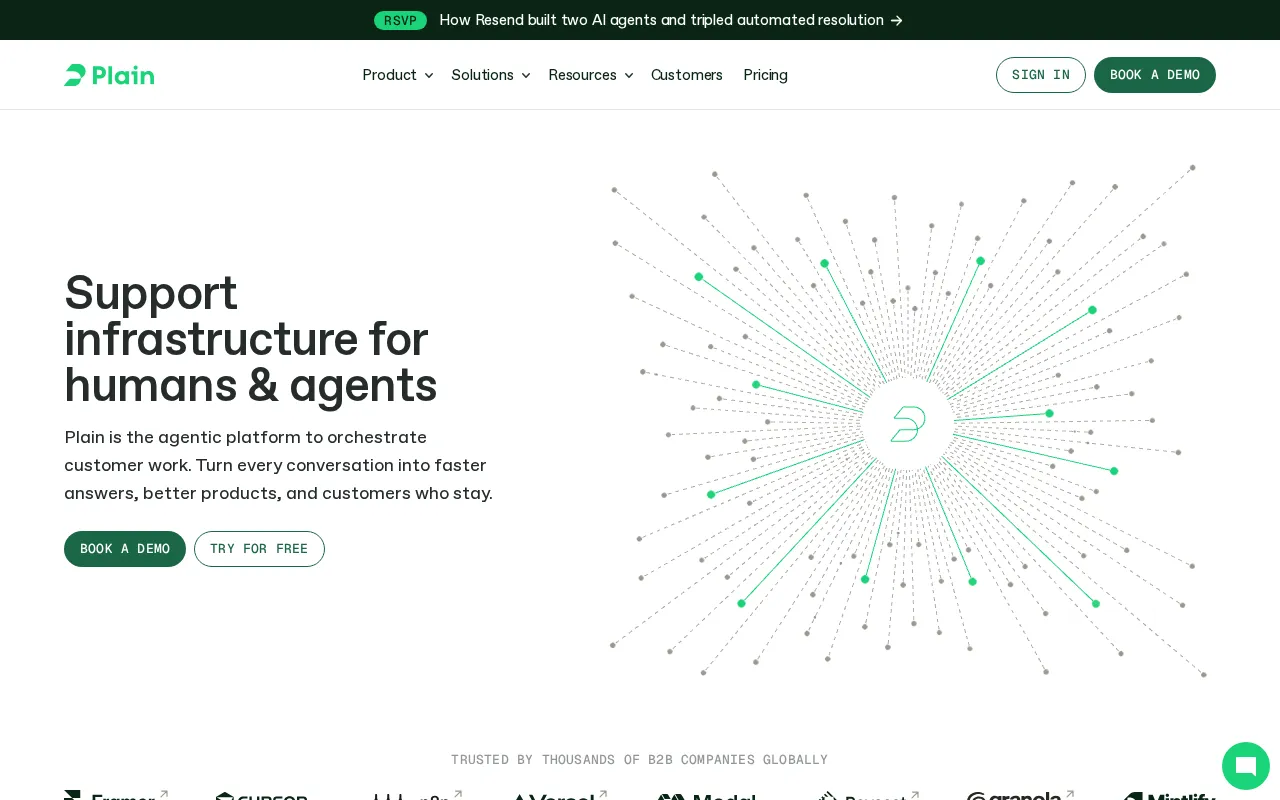
Plain homepage, November 2026

Plain is a support platform for B2B software companies. It answers customers in Slack, Microsoft Teams, Discord, email, chat and a help center, with an AI customer agent and a GraphQL API that does everything its app can.

Best for
B2B software teams that support customers in shared Slack or Teams channels and want engineers and AI agents building on its API.
How it bills
Per member seat: Foundation is $45 a month on annual billing ($55 monthly) for up to 5 seats with 1,000 credits, and Horizon $99 ($139 monthly) for 3 to 10 seats with 2,500 credits; Frontier is quoted. Each customer agent resolution uses 100 credits, extra credits are $10 per 1,000, and viewer seats are free.
Free plan
No, 7-day trial
3 people, 300 AI replies
$425 a month: 3 Foundation seats at $45 on annual billing, plus 29,000 credits at $10 per 1,000 for 300 customer agent resolutions beyond the 1,000 credits included.

Pros

  • Slack, Microsoft Teams and Discord work as support channels next to email, which suits B2B customers.
  • Its official MCP server can reply, add notes, assign, close and write help center articles, signed in as your own user.
  • A customer agent resolution is charged only after the thread stays done for 7 days with no teammate stepping in.
  • Viewer seats are free and unlimited, and Linear, Jira, GitHub and incident.io link to threads.

Cons

  • Its price list has changed four times since December 2025, most recently raising Foundation’s seat price and halving its included credits.
  • No free plan, and the trial shrank from 14 days to 7 in 2026.
  • No phone, WhatsApp, SMS, Shopify or Stripe.
  • Foundation stops at 5 seats and 2 email addresses, so a sixth teammate means Horizon at $99 a seat.

Already on Plain? See the best Plain alternatives.
Pylon

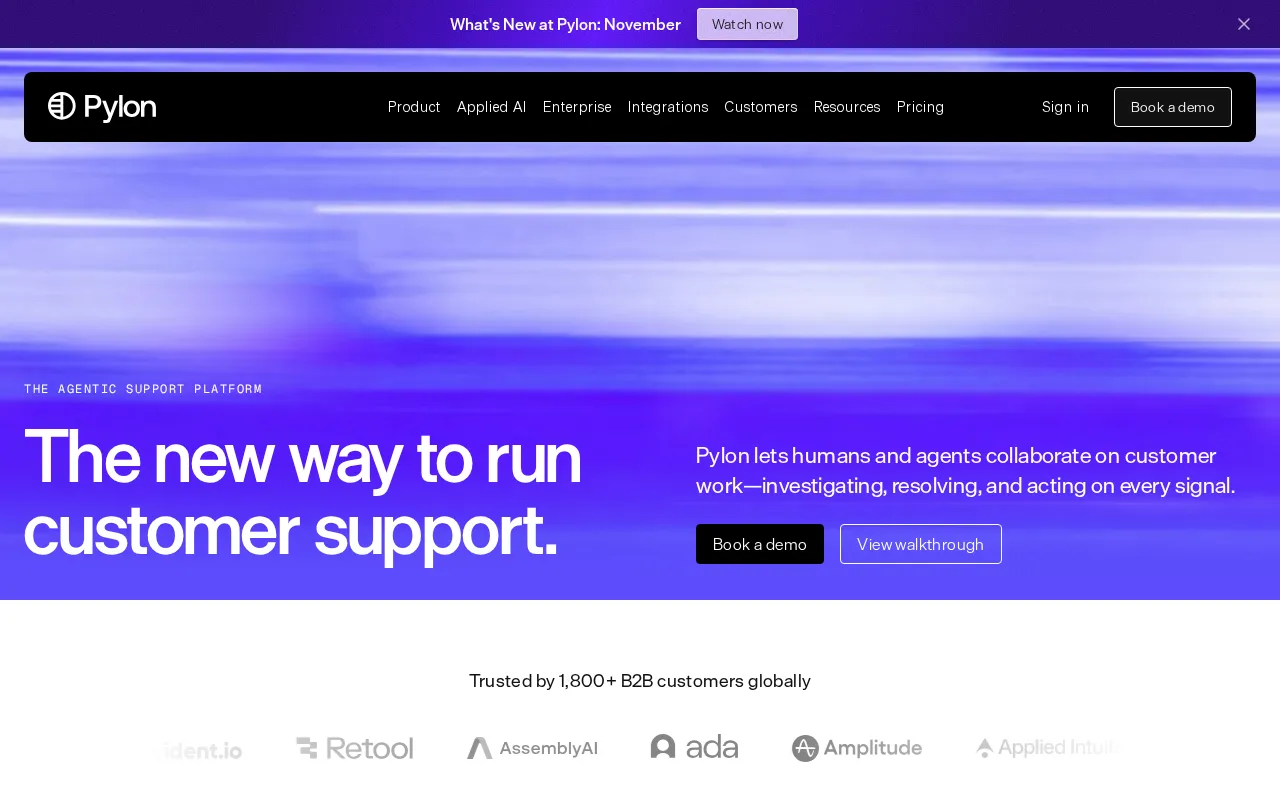
Pylon homepage, November 2026

Pylon is a support platform built for B2B companies. It turns messages from shared Slack Connect channels, email, a chat widget, WhatsApp and more into issues in one queue, with a knowledge base and AI agents that run on credits.

Best for
B2B software companies whose customers ask for help in shared Slack channels, with a support team big enough for an annual contract.
How it bills
Per seat: Professional is $89 and Advanced $139 a seat a month on an annual contract, and Enterprise is quoted. Pylon says monthly billing exists but lists no monthly price. AI agents spend credits, bought as you go or committed up front at rates only sales give. Phone is $35 a seat a month, Account Intelligence $10 per customer account a month, and SAML SSO on Advanced $125 a month. New customers buy a minimum number of seats, which Pylon doesn’t publish.
Free plan
No, buying starts with a demo
3 people, 300 AI replies
$267 or more a month: 3 Professional seats at $89 on an annual contract, plus credits for 300 answers from its AI that only sales price. Pylon’s minimum seat count is unpublished, so 3 may not be enough to buy.

Pros

  • Shared Slack Connect channels, Slack Community, Discord, Telegram, WhatsApp, SMS, email and a chat widget feed one queue on every plan, and phone is a $35 a seat add-on.
  • Its official MCP server can reply, add notes, assign, close, draft and publish knowledge base articles and save macros, acting as your own user or a token’s identity.
  • Pylon bills seats and AI credits, never each ticket.
  • Issues link to Linear, Jira, GitHub, Asana and Shortcut, and accounts sync with Salesforce, HubSpot, Attio and Pipedrive.

Cons

  • No self-serve signup: every plan starts with “Book a demo” or “Talk to sales”, and a sales representative sets up the trial.
  • Standard contracts are annual, and new customers buy a minimum number of seats that Pylon doesn’t publish.
  • AI agents spend credits that only sales put a price on, so the AI share of the bill is unknown before a call.
  • Fees are non-refundable, and an order renews for the period its order form sets unless either side gives written notice at least 30 days before the term ends.

Already on Pylon? See the best Pylon alternatives.

Pick Plain if

  • You want to sign up and try it this week, without booking a demo first.
  • Up to 10 people answer customers, and you’d rather pick monthly or annual billing from a printed price list: $55 or $45 a seat on Foundation, $139 or $99 on Horizon.
  • You want the AI price in writing: 100 credits a resolution, charged only after the thread stays done for 7 days.
  • Engineers, founders and account managers should read threads on free viewer seats.
  • Your engineers want to build on a GraphQL API that can do everything the app does.

Pick Pylon if

  • Customers reach you on WhatsApp, SMS, Telegram or Discord as well as shared Slack channels, and all of it should land in one queue from the first plan.
  • Some of your support happens by phone, which Pylon adds for $35 a seat a month.
  • Customer success managers want Account Intelligence on each customer account, at $10 an account a month.
  • Your AI agent should publish knowledge base articles and save macros through MCP.
  • A yearly contract, a seat minimum and a sales call are how your company already buys software.

When to consider Rinhelp instead

Consider Rinhelp if 2 to 10 people answer customers by email and the chat on your website rather than in shared Slack channels, and you want to start today without Plain’s per-seat bill or Pylon’s demo. Pro is $49 a month for the whole workspace with 5,000 AI replies from Rin, our built-in AI, and more cost $49 for 5,000, so the AI price is printed, not quoted. Free covers up to 3 teammates. Through MCP, your own AI agent handles the inbox, and a Shopify or Stripe refund or cancellation it asks for waits for a teammate’s approval. Rinhelp isn’t the fit if your B2B customers expect answers in Slack, Teams or Discord, if calls, WhatsApp or SMS reach you, or if you need SLAs, reports or routing rules: Plain is the one to buy online for Slack support, and Pylon covers phone and a big team on a contract.

Start free

Moving to Rinhelp

From Plain

Plain threads, customers and help center articles can be read through Plain’s official MCP server or its GraphQL API. Messages live in each customer’s timeline rather than in the thread, so the full history is read customer by customer. See the full move from Plain.

From Pylon

Pylon’s REST API lists issues by the date they were created and returns each issue’s full message history, replies and internal notes, oldest first. Knowledge base articles and macros come from their own list calls. See the full move from Pylon.

Questions about Plain vs Pylon

Can we try Pylon before signing a contract?

Yes, but not on your own. Pylon’s trial is set up by a sales representative after you book a demo or talk to sales. Plain lets you sign up yourself for a 7-day trial.

Can we avoid a yearly commitment?

On Plain, yes: Foundation is $55 a seat month to month and Horizon $139. Pylon says monthly billing exists but prints no monthly price, and its standard contracts are annual. Its terms also make fees non-refundable and renew an order unless either side gives written notice at least 30 days before the term ends.

Which one gives us SSO without an enterprise deal?

Pylon does: its Advanced plan adds SAML SSO for $125 a month, and Enterprise includes SAML SSO, SCIM and a BAA. Plain keeps SSO, SCIM and HIPAA for Frontier, its quoted plan.

Do both connect to Linear, Jira and GitHub?

Yes. Plain links threads to Linear, Jira, GitHub and incident.io from Foundation, and Pylon links issues to Linear, Jira, GitHub, Asana and Shortcut. For CRMs, Plain syncs HubSpot, Attio and Salesforce from Horizon, and Pylon syncs accounts with Salesforce, HubSpot, Attio and Pipedrive.

How we checked

We compared Plain and Pylon using the facts we keep on each, checked against the vendor’s own pages on the date shown beside its sources. Rinhelp is in every table because it is our product and we wrote this page, so check each figure against the vendor’s own page before you decide.

Costs are list prices in US dollars for three team sizes, on the cheapest plan that covers them, counting each AI reply as one resolved conversation. Features count only when the vendor’s own pages say a plan includes them. The AI column counts actions an official MCP server from the vendor can take, out of 11, and leaves third-party connectors out.

Try Rinhelp next to Plain or Pylon.

Start free with up to 3 teammates and 50 AI replies.

Start free