Start free

Chatbase vs Voiceflow (2026): pricing, AI and features

By , founder of Rinhelp, which appears in this comparison · Facts checked

The short answer

Chatbase suits a small team that wants an AI agent trained on its website and documents, answering on the site, in messaging apps, by email and on the phone, with a Helpdesk inbox where teammates take over. Voiceflow suits a team with its own builders, in product, CX or an agency, who will build, test and ship each agent for web chat, phone and SMS, and who already run a support platform such as Zendesk or Kustomer for the handoffs. For 1,000 AI replies a month, a team of 5 pays $400 a month on Chatbase Business with annual billing, or $500 billed monthly. Voiceflow’s part of that month is $5 in credits for 1,000 customer messages plus the model’s tokens, on top of a plan fee and any extra editor seats it prices only inside the app.

See Rinhelp on your own site. Enter your website and Rin builds your help desk from it: a chat widget, a help center and an inbox.

Free. No sign-up to look. Ready in a minute or two.

Is your help center somewhere else?

Rin will read . If your help articles or docs live at another address, like help. or a Notion page, Rin can read those too.

Where is your help center?

Rin reads it along with and turns it into your help center.

Chatbase vs Voiceflow at a glance

ToolBest forHow it billsFree plan3 people, 300 AI replies
ChatbaseTeams that want a chatbot on their website and messaging apps first, with a choice of models from OpenAI, Anthropic, Gemini and others, and a help desk second.Per plan, in message creditsNot on the pricing page: Basic and Business each start with a 7-day trial$120
VoiceflowProduct and CX teams, and agencies building for clients, that have people to design, test and ship their own chat and voice agents.Plan fee plus usage creditsYes: a one-time credit grant that doesn’t renew, not meant for productionQuote only
RinhelpSmall teams that want AI on every conversation at one flat price, and want their own AI agents working in the inbox.One price per workspaceYes: 3 teammates, 50 AI replies to try Rin$49

Key differences

Chatbase keeps handed-off customers, Voiceflow sends them elsewhere

Chatbase’s Helpdesk inbox is included from Basic, its cheapest plan. A teammate can take over a conversation the AI is still having, and it becomes a ticket with an AI-written summary, in the same product the chatbot runs in. Voiceflow has no inbox of its own: when a customer needs a person, it passes them natively to Genesys, UJET, Kustomer, Dixa or Zendesk, or to another platform through a service you host, so your people reply in a second tool.

One prints its plan prices, the other shows them inside the app

Chatbase Basic is $150 a month and Business $500, or $120 and $400 a month on annual billing, and each starts with a 7-day trial. Voiceflow’s pricing page lists no fees: Pro, Business, their add-ons and credit bundles are priced in “Plans and Billing” after you sign up, and businesses are offered a demo. Voiceflow does have a Free plan, but its credits are a one-time grant that doesn’t renew, meant for trying the builder rather than serving customers.

A monthly credit pool against credits drawn per event

A Chatbase plan comes with a monthly pool of message credits, 4,000 on Basic and 15,000 on Business, and each reply takes 1 to 5 of them on the recommended models, and more when it runs an action. Leftover credits don’t roll over, and when the pool is empty the chatbots go silent unless auto recharge buys more at $40 per 1,000. Voiceflow draws its credits per event: $0.005 for each customer message, $0.05 for each phone minute, and the model’s tokens on top, so long replies and long calls both show up on the bill.

Email, Messenger and Instagram on Chatbase, SMS on Voiceflow

Besides your website and the phone, a Chatbase agent answers on WhatsApp, Messenger, Instagram, Slack and email. Voiceflow’s docs list web chat, where customers can type or speak, phone calls, and SMS through Twilio. Its Gmail tool lets an agent send mail, but customers can’t start a conversation with it by email. For calls, Chatbase includes voice and telephony from Basic with 10 concurrent calls, or 20 on Business, and Voiceflow includes one phone number per workspace on Pro and Business, billing each minute in credits.

Two MCP servers with different jobs

Chatbase’s official MCP server works the support queue: on Basic or above, Claude or ChatGPT can search conversations, reply to Helpdesk tickets, leave internal notes, and assign or close them. Voiceflow’s works on the agent itself: Claude Code or another client edits prompts, playbooks and workflows, manages knowledge base documents, runs tests and evaluations, and reads transcripts. It can also run a saved integration action, such as cancelling a Shopify order, but none of its tools answers a customer mid-conversation.

Pricing at three sizes

What each tool costs a month in US dollars, with AI answering, and how each total adds up. Each AI reply counts as one resolved conversation.

Tool3 people, 300 AI replies5 people, 1,000 AI replies10 people, 3,000 AI replies
Chatbase$120Basic at $120 a month on annual billing ($150 monthly), the cheapest plan, with 3 members. Its 4,000 message credits cover 300 replies even at 5 credits each.$400Business at $400 a month on annual billing ($500 monthly), the first plan with 5 members. Its 15,000 credits cover 1,000 replies on any recommended model.$400 or moreBusiness at $400 a month on annual billing, whose 15,000 credits cover 3,000 replies at up to 5 credits each. It includes 5 members, and the other 5 need extra member slots, whose price the pricing page doesn’t show.
VoiceflowQuote onlyVoiceflow publishes no plan fee, so the base price shows only in the app. On top of it, 300 customer messages use $1.50 of credits at $0.005 each, plus the model’s tokens, and 3 editors need enough editor seats.Quote onlyAn unpublished plan fee, plus $5 of credits for 1,000 customer messages at $0.005 each and the tokens the chosen model uses, with any editors beyond the plan’s free seats as an add-on.Quote onlyThe plan fee isn’t on Voiceflow’s site. 3,000 customer messages add $15 of chat credits plus model tokens, and editors past the included free seats are an add-on priced in the app.
Rinhelp$49Pro for the whole workspace, using 300 of its 5,000 AI replies; Free covers your team if you don’t need AI replies.$49Pro for the whole workspace, using 1,000 of its 5,000 AI replies.$49Pro for the whole workspace, using 3,000 of its 5,000 AI replies.

Features compared

A check means the vendor’s own pages say a plan includes it.

ToolEmailLive chatWhatsAppVoiceHelp centerAI that answers customersShopifyStripeFree planSignup without a sales call
Chatbase
Voiceflow
Rinhelp

What your AI can do in each tool

Connect Claude, ChatGPT or your own AI agent through the vendor’s official MCP server, and this is what it can do of 11 everyday actions: search and read conversations, reply to a customer, add an internal note, assign, close or reopen, search the help center, write or update an article, publish an article, create a saved reply, look up an order, refund or cancel.

ToolThrough official MCPWhat it can doMoney moves wait for a teammate
Chatbase5 of 11Search and read conversations, reply to a customer, add an internal note, assign, close or reopenNo refunds or cancellations through MCP
Voiceflow3 of 11Search and read conversations, look up an order, refund or cancelNo, they run at once
Rinhelp11 of 11Search and read conversations, reply to a customer, add an internal note, assign, close or reopen, search the help center, write or update an article, publish an article, create a saved reply, look up an order, refund or cancelYes, a teammate approves first

More on each MCP server, and connectors from other companies, which don’t count:

  • Chatbase: The MCP server needs a paid plan, Basic or higher, and returns an error on a trial that signed up with a personal email address. Its tools cover chatbots, their sources, conversations and Helpdesk tickets, and a ticket message can be a reply the customer receives or an internal note only your team sees.
  • Voiceflow: Voiceflow’s MCP server works on agents rather than a queue: it edits prompts, playbooks and workflows, manages knowledge base documents, runs tests and evaluations, and fetches transcripts. It can also run a saved integration action, such as looking up or cancelling a Shopify order, without a conversation. None of its tools replies to a customer in a live conversation.

Chatbase

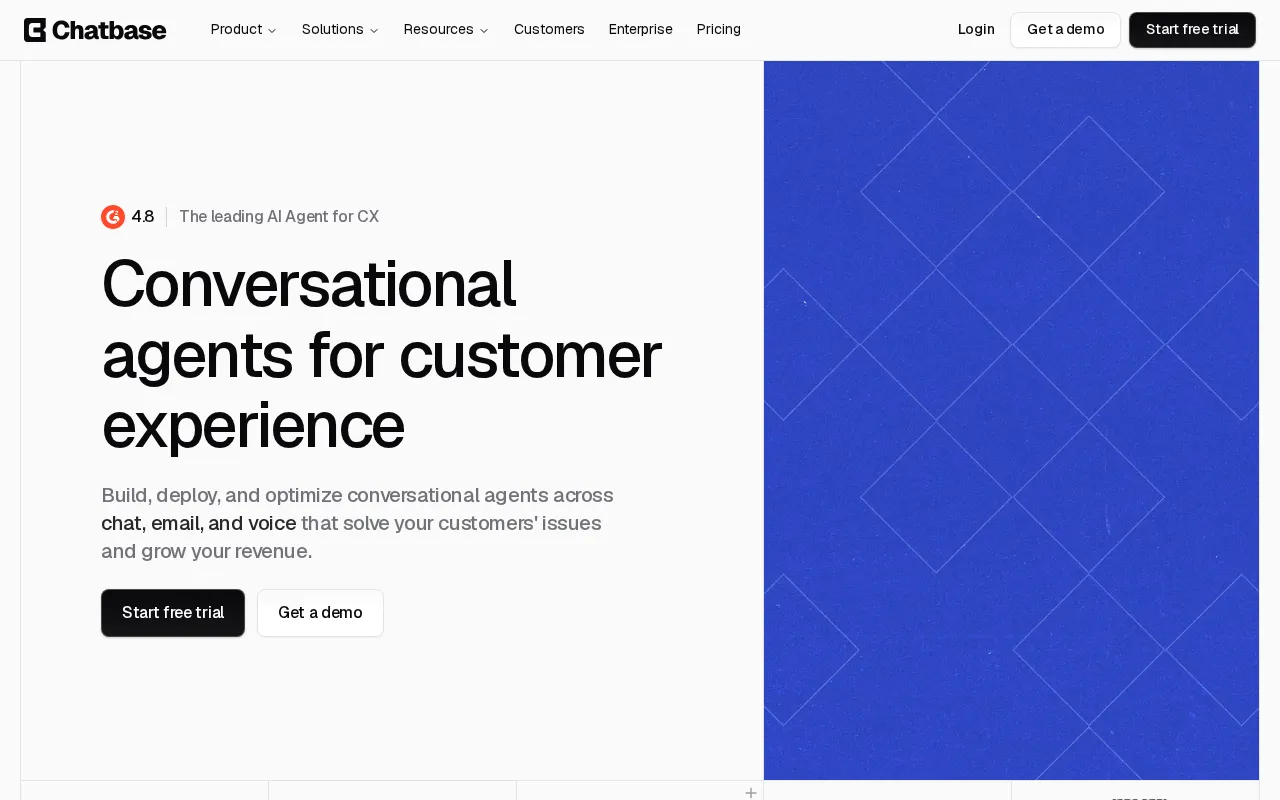
Chatbase homepage, November 2026

Chatbase builds an AI agent trained on your own content, such as your website and documents, and puts it on your site, WhatsApp, Messenger, Instagram, Slack, email and the phone. Its Helpdesk inbox, included from Basic, its cheapest plan, lets your team take over what the AI can’t solve.

Best for
Teams that want a chatbot on their website and messaging apps first, with a choice of models from OpenAI, Anthropic, Gemini and others, and a help desk second.
How it bills
Basic is $150 and Business $500 a month on monthly billing ($120 and $400 a month on annual billing), with 4,000 and 15,000 message credits and 3 and 5 members. The recommended models use 1 to 5 credits a message, unused credits don’t carry over, and auto recharge adds credits at $40 per 1,000.
Free plan
Not on the pricing page: Basic and Business each start with a 7-day trial
3 people, 300 AI replies
$120 a month: Basic at $120 a month on annual billing ($150 monthly), the cheapest plan, with 3 members. Its 4,000 message credits cover 300 replies even at 5 credits each.

Pros

  • Every plan includes advanced models from OpenAI, Anthropic, Gemini, DeepSeek, Mistral and others, so you choose the one each chatbot runs on.
  • The chatbot answers on your website, WhatsApp, Messenger, Instagram, Slack, email and the phone.
  • A teammate can take over a live AI conversation from the Helpdesk, which turns it into a ticket with an AI-written summary.
  • Its AI can escalate a conversation as a ticket to Zendesk, Salesforce, Intercom, Zoho Desk, Freshdesk, HubSpot, Help Scout, Gorgias or Odoo, with the customer’s details.
  • Its official MCP server lets Claude or ChatGPT search conversations, reply to Helpdesk tickets or leave internal notes on them, and assign or close them.

Cons

  • Members are capped by plan: 3 on Basic and 5 on Business.
  • When message credits run out, the chatbots stop responding until the credits reset, unless auto recharge buys more.
  • An action can make the chatbot send 2 or more requests to the model for one reply, and each one uses credits.
  • Removing “Powered By Chatbase” is a $99 a month add-on.

Already on Chatbase? See the best Chatbase alternatives.
Voiceflow

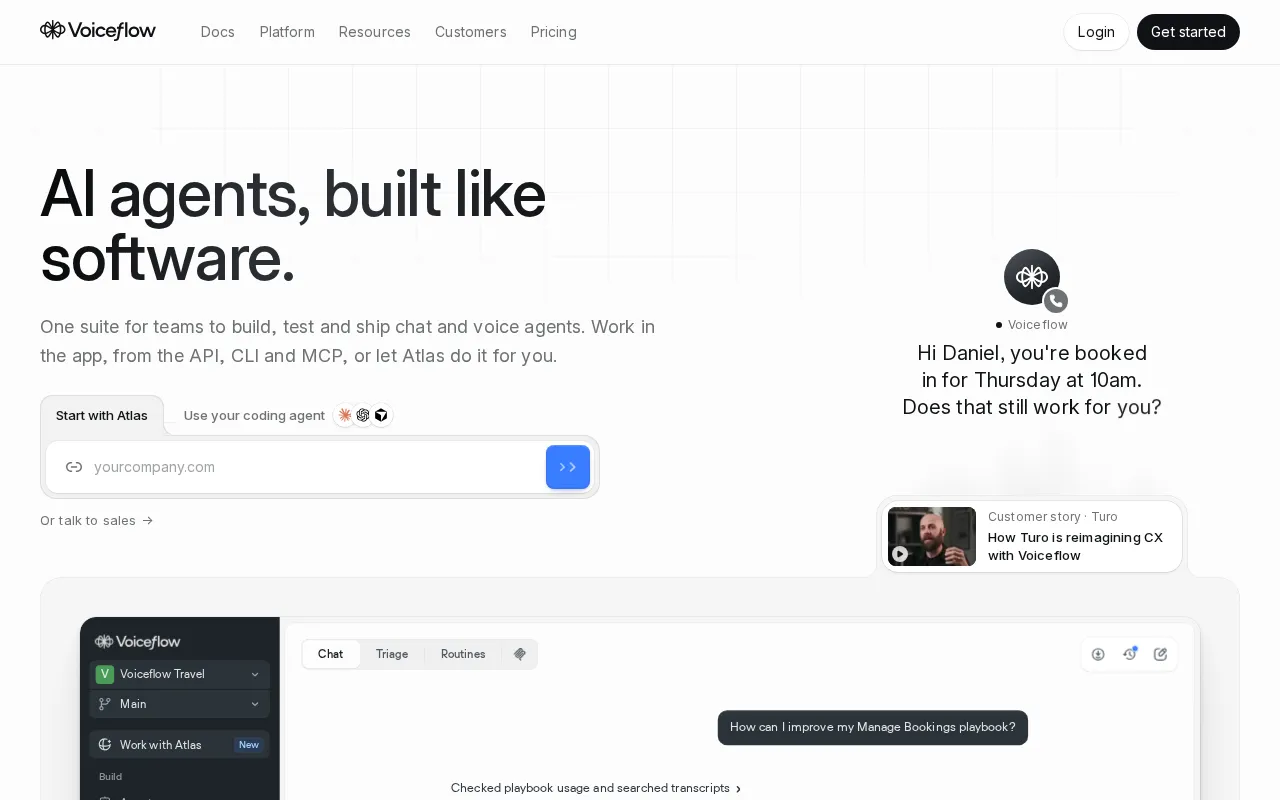
Voiceflow homepage, November 2026

Voiceflow is a platform for building AI agents that answer customers on web chat, phone and SMS. Your team writes each agent’s instructions, playbooks and workflows, connects knowledge and tools, and Voiceflow hands customers who need a person to a support platform such as Zendesk or Kustomer.

Best for
Product and CX teams, and agencies building for clients, that have people to design, test and ship their own chat and voice agents.
How it bills
Free, Pro, Business and Enterprise plans. The pricing page shows no prices: plan, add-on and credit bundle prices appear in “Plans and Billing” inside Voiceflow, and businesses are offered a demo. Each paid plan includes some free editor seats and a monthly credit allotment, and more editor seats and phone numbers are add-ons. Credits pay for usage: $0.005 for each customer message, $0.05 a phone minute, and the model’s tokens on top.
Free plan
Yes: a one-time credit grant that doesn’t renew, not meant for production
3 people, 300 AI replies
Quote only: Voiceflow publishes no plan fee, so the base price shows only in the app. On top of it, 300 customer messages use $1.50 of credits at $0.005 each, plus the model’s tokens, and 3 editors need enough editor seats.

Pros

  • One agent answers in a website chat widget with text or voice input, on phone calls, and by SMS through Twilio.
  • You pick the model each agent runs on, from Anthropic, OpenAI, Google, Groq, xAI or Voiceflow’s own, and pay its token rate in credits.
  • Handoffs reach Genesys, UJET, Kustomer, Dixa and Zendesk natively, and other support platforms through a service you host.
  • Its official MCP server lets Claude Code or another MCP client edit agents, run tests and evaluations, and fetch and search transcripts.

Cons

  • No prices on the pricing page: plan fees, editor seats and credit bundles are priced inside the app.
  • It isn’t a help desk: people answer handed-off conversations in another support platform that bills separately.
  • Credits pay for every customer message, the model’s tokens and phone minutes, so the bill moves with how long replies and calls run.
  • Its docs list web chat, phone and SMS as channels: the Gmail tool sends mail, but customers can’t write to the agent by email.

Already on Voiceflow? See the best Voiceflow alternatives.

Pick Chatbase if

  • You want to see the plan prices, from $120 a month on annual billing, before anyone creates an account.
  • Customers message you on Messenger or Instagram, or write by email, as well as on your site.
  • Up to 5 people pick up what the AI can’t finish, and you don’t want a second help desk for them.
  • Claude or ChatGPT should work the Helpdesk queue for you: replying, adding notes, assigning and closing.

Pick Voiceflow if

  • You have builders who want to shape every instruction, playbook and workflow, then test and evaluate the agent before it ships.
  • Handed-off customers should land in the Zendesk, Kustomer or Dixa queue your team already works, or in Genesys or UJET.
  • Customers text you, and the agent should answer their SMS through Twilio.
  • You want to try building on a free plan before anyone talks price, knowing its credits don’t renew.
  • You want fallback models behind the agent, which Voiceflow lists on its Business plan.

When to consider Rinhelp instead

Rinhelp fits a team of 2 to 10 whose customers write by email and website chat, and who would rather not build an agent or buy a second help desk for the handoffs. Rin, our built-in AI, answers first from your help center and website, and a conversation it can’t finish goes to a teammate in the same inbox with a short summary. Pro is $49 a month for the workspace, with 5,000 AI replies however many teammates you add, and Free covers up to 3 teammates. Claude, ChatGPT or another AI agent can reply, add notes, assign and close over MCP, and a refund or cancellation it asks for waits for a teammate to approve. Look elsewhere if callers, texts or WhatsApp, Messenger and Instagram bring in your work, if your agent must follow workflows you design, if you need reports or routing rules, or if you rely on integrations beyond Shopify and Stripe. Chatbase answers the phone and messaging apps at a printed price, and Voiceflow suits a team that builds its own agent and hands customers to Genesys, UJET, Zendesk or Kustomer.

Start free

Questions about Chatbase vs Voiceflow

Can I see what Voiceflow costs before I sign up?

Only the usage rates. Its pricing page shows no plan fees and offers businesses a demo, and the plan, add-on and credit bundle prices sit in “Plans and Billing” inside Voiceflow. Its docs do publish what credits pay for: $0.005 per customer message and $0.05 per phone minute, plus the model’s tokens. Chatbase prints its Basic and Business prices, from $150 a month, or $120 on annual billing.

Do I still need a help desk next to either one?

Not with Chatbase, whose Helpdesk comes with Basic and Business: a teammate who takes over a live AI conversation turns it into a ticket with a summary the AI wrote. Voiceflow is built to hand off instead. A customer who asks for a person goes to Zendesk, Kustomer, Dixa, Genesys or UJET, or to another platform through a service you host.

Which suits an agency building agents for clients?

Voiceflow is aimed at teams that build agents, agencies among them, and each agent can run on a model from Anthropic, OpenAI, Google, Groq, xAI or Voiceflow itself. Chatbase Basic and Business include 1 AI agent, with more at $25 a month each, and white-labeling only on Enterprise. On a self-serve Chatbase plan, removing “Powered By Chatbase” is a $99 a month add-on.

How we checked

We compared Chatbase and Voiceflow using the facts we keep on each, checked against the vendor’s own pages on the date shown beside its sources. Rinhelp is in every table because it is our product and we wrote this page, so check each figure against the vendor’s own page before you decide.

Costs are list prices in US dollars for three team sizes, on the cheapest plan that covers them, counting each AI reply as one resolved conversation. Features count only when the vendor’s own pages say a plan includes them. The AI column counts actions an official MCP server from the vendor can take, out of 11, and leaves third-party connectors out.

Try Rinhelp next to Chatbase or Voiceflow.

Start free with up to 3 teammates and 50 AI replies.

Start free