Start free

10 best Hugo alternatives (2026)

By , founder of Rinhelp · Facts checked

The short answer

The best Hugo alternatives are Rinhelp, if you want the inbox and the AI in one tool at a flat price counted by the reply, and SiteGPT if you’d keep Crisp and only swap the AI. Hugo is the AI agent Crisp sells, so each Hugo plan is a Crisp membership, from $45 a month for 4 seats with $5 of AI credits, while Rinhelp is $49 a month for the whole team with 5,000 AI replies, and free for 3 teammates. Pick Chatbase or Wonderchat for an AI agent with its own inbox, Botpress to build one yourself, Kommunicate for phone calls too, DocsBot to hand chats to Help Scout or Zendesk, Tidio for a small store, and Fin or Zendesk AI for a large queue.

See Rinhelp on your own site. Enter your website and Rin builds your help desk from it: a chat widget, a help center and an inbox.

Free. No sign-up to look. Ready in a minute or two.

Is your help center somewhere else?

Rin will read . If your help articles or docs live at another address, like help. or a Notion page, Rin can read those too.

Where is your help center?

Rin reads it along with and turns it into your help center.

Hugo alternatives at a glance

ToolBest forHow it billsFree plan3 people, 300 AI replies
RinhelpSmall teams answering email and website chat that want to know what their AI costs before the month starts.One price per workspaceYes: 3 teammates, 50 AI replies to try Rin$49
SiteGPTSites that want a chatbot answering from their own pages and docs, with a person stepping in now and then.Per plan, by monthly messages and team membersNo, 7-day trial with a credit card$79
ChatbaseTeams that want a chatbot on their website and messaging apps first, with a choice of models from OpenAI, Anthropic, Gemini and others, and a help desk second.Per plan, in message creditsNot on the pricing page: Basic and Business each start with a 7-day trial$120
WonderchatTeams that want one AI agent on their website and messaging apps, with as many teammates as they like in its inbox, and lead capture from the same chat.By AI reply credits, with unlimited seatsYes: 2 seats, 50 AI replies a month$33
BotpressTeams with someone technical who want to build custom AI agents with multi-step workflows across many channels, and pay by conversation rather than by seat.Per conversation, with AI spend at costYes: 3 seats, 100 conversations, no top-ups$215 or more
KommunicateTeams that want one AI agent across website chat, mobile apps, WhatsApp and phone, with a small team taking what it hands off.Plan by conversations, plus team members and AI agentsOnly in its Shopify app; otherwise a 30-day free trial without a card$75
DocsBotTeams happy with their help desk that want an AI answering from their docs on the website, with hard questions passed to that help desk.Per plan, with monthly AI creditsYes: 1 user, 100 AI credits a month$149 or more
TidioShopify and WooCommerce stores that want chat, WhatsApp and Instagram in one inbox and an AI that recommends products.By conversation, plus each Lyro conversationYes: 10 seats, 50 conversations a month$199 or more
FinTeams with a large queue on Zendesk, Salesforce, HubSpot or Freshdesk that want a strong AI answering customers without changing help desks.Per outcome, $49 a month minimumNo, 14-day trial$297 or more
Zendesk AITeams settled on Zendesk that want an AI answering inside it, beside the tickets, triggers and reports they already run.Per automated resolution, on top of Zendesk seatsNo, 14-day trial$428 or more
Hugo, for comparisonSmall teams happy to run support on Crisp that want an AI agent billed by the token, a few cents a conversation, inside a chat and email inbox.Crisp membership per workspace, plus AI usageNo: a 14-day trial, since Crisp’s free plan has no Hugo credits$66 or more

1. Rinhelp

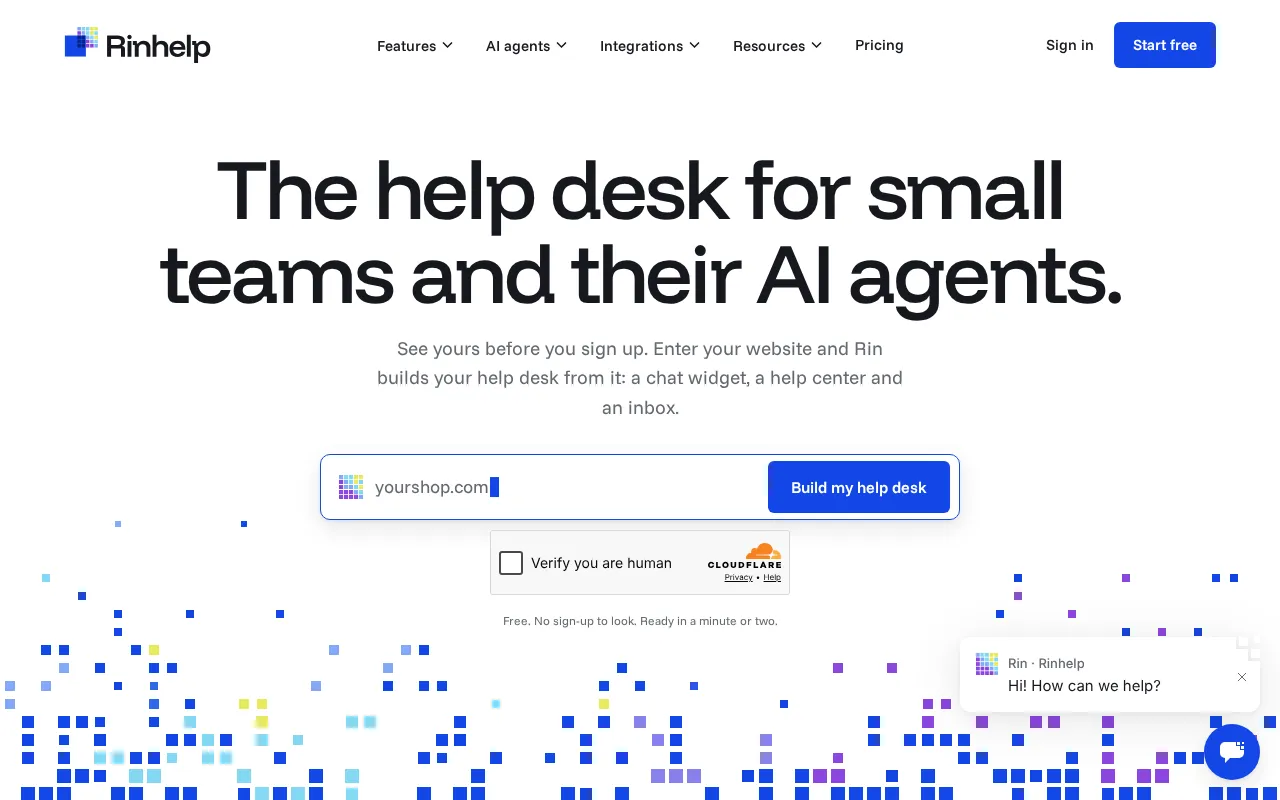
Rinhelp homepage, November 2026

Hugo charges by the token on top of a Crisp membership, so the month’s bill depends on how much customers write, how large your knowledge is and which model you pick. Rinhelp is the inbox and the AI in one, $49 a month for the whole team with 5,000 AI replies from Rin, the AI built into Rinhelp. A refund or cancellation waits for a teammate before it goes out.

Best for
Small teams answering email and website chat that want to know what their AI costs before the month starts.
How it bills
Free for up to 3 teammates. Pro is $49 a month for the whole workspace, with 5,000 AI replies from Rin. No per-seat or per-resolution fees.
Free plan
Yes: 3 teammates, 50 AI replies to try Rin
3 people, 300 AI replies
$49 a month: Pro for the whole workspace, using 300 of its 5,000 AI replies; Free covers your team if you don’t need AI replies.

Pros

  • 5,000 AI replies come in the $49 price, where Essentials at $95 carries $25 of Hugo credits.
  • Rin answers on email and live chat from your help center and website, and passes the conversation to a teammate when it can’t help.
  • Shopify orders and Stripe payments sit beside each conversation on every plan, and a refund waits for a teammate’s approval.
  • Through MCP, Claude, ChatGPT or an agent you build can take all 11 everyday actions, including assigning, publishing articles and looking up orders.

Cons

  • Email and live chat only: there is no phone, WhatsApp, SMS or social inbox.
  • Shopify and Stripe are the only integrations.
  • No reports, SLA rules or routing rules: Rin hands a conversation to the teammate with the fewest open ones.
  • The free plan has no Rin beyond 50 AI replies to try it.
Start free

2. SiteGPT

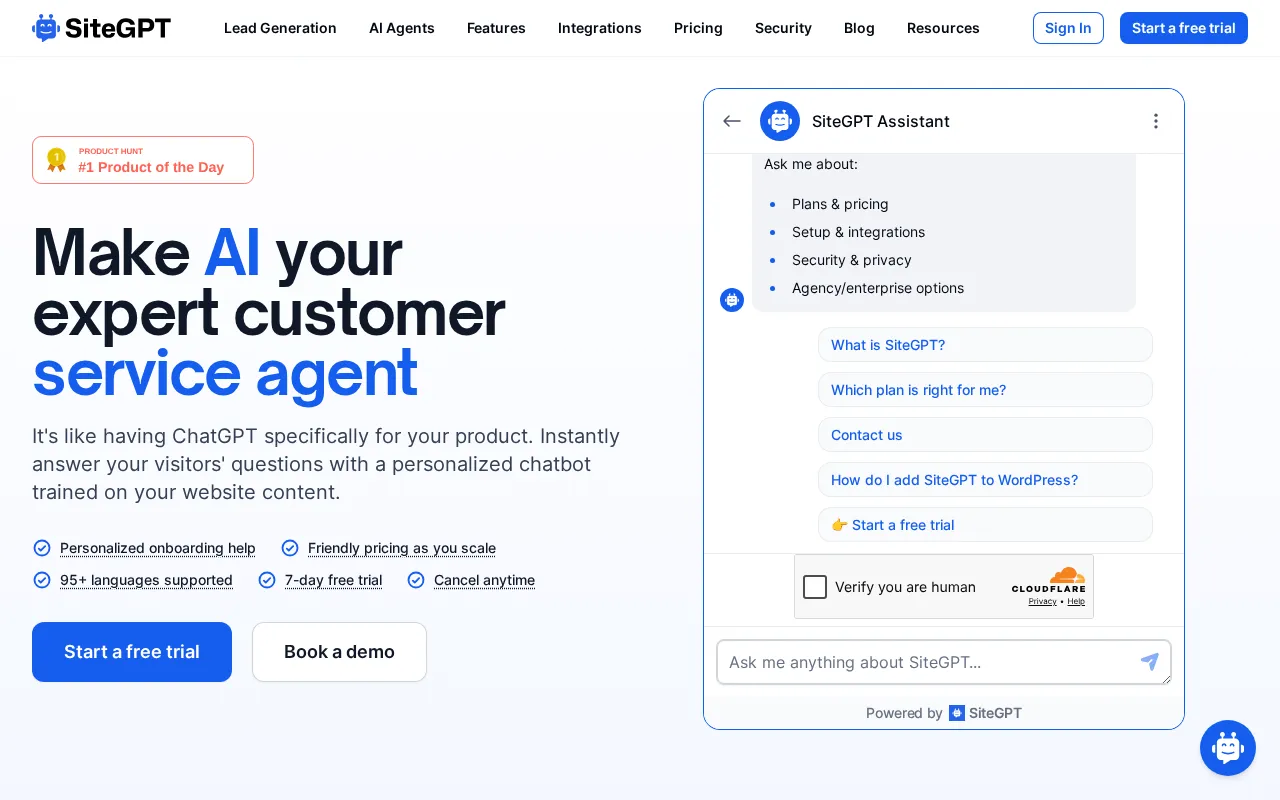
SiteGPT homepage, November 2026

SiteGPT is an AI chatbot trained on your website, files and other content. It answers on your site and in tools like Slack, Crisp and Zendesk, and hands a chat to your team when a customer needs a person.

Best for
Sites that want a chatbot answering from their own pages and docs, with a person stepping in now and then.
How it bills
On annual billing, Starter is $39 a month for 1 member and 4,000 GPT-4.1 mini messages, Growth $79 for 4 team members and 10,000, and Scale $259 for 10 and 40,000 ($59, $129 and $429 monthly). A customer’s question and the chatbot’s answer count as 2 messages, and a GPT-4.1 message uses as much as 10 on GPT-4.1 mini. Email and WhatsApp are add-ons, each $59 a month per inbox or number, or $468 a year.
Free plan
No, 7-day trial with a credit card
3 people, 300 AI replies
$79 a month: Growth at $79 on annual billing ($948 a year, or $129 monthly), with 4 team members. 300 answers use 600 messages, inside its 10,000 on GPT-4.1 mini or 1,000 on GPT-4.1.

Pros

  • Your team can reply, take over and resolve chats from Chat History or the iPhone app, and the chatbot stays quiet while a person has the conversation.
  • One chatbot answers on your website, WhatsApp, Messenger, Slack and email, and replies from the dashboard reach customers on WhatsApp, Messenger and email.
  • On Scale it can be the AI agent inside Zendesk Messaging, handing conversations to your Zendesk agents with full history.
  • Its official MCP server lets Claude or ChatGPT read conversations, reply to customers and change chatbot settings, and you can limit a connection to read-only.

Cons

  • Team members are capped by plan: 1 on Starter, 4 on Growth and 10 on Scale.
  • Both sides of a chat count against your allowance, and new chatbots start on GPT-4.1, whose messages use 10 times as much as GPT-4.1 mini.
  • Email and WhatsApp are paid add-ons per inbox and per number, and Slack, Messenger, MCP and the API need Growth or above.
  • Once a subscription ends, its chatbots stop answering, and their conversations, documents and leads are scheduled for deletion no earlier than 30 days later.

Already on SiteGPT? See the best SiteGPT alternatives.

3. Chatbase

Chatbase homepage, November 2026

Chatbase builds an AI agent trained on your own content, such as your website and documents, and puts it on your site, WhatsApp, Messenger, Instagram, Slack, email and the phone. Its Helpdesk inbox, included from Basic, its cheapest plan, lets your team take over what the AI can’t solve.

Best for
Teams that want a chatbot on their website and messaging apps first, with a choice of models from OpenAI, Anthropic, Gemini and others, and a help desk second.
How it bills
Basic is $150 and Business $500 a month on monthly billing ($120 and $400 a month on annual billing), with 4,000 and 15,000 message credits and 3 and 5 members. The recommended models use 1 to 5 credits a message, unused credits don’t carry over, and auto recharge adds credits at $40 per 1,000.
Free plan
Not on the pricing page: Basic and Business each start with a 7-day trial
3 people, 300 AI replies
$120 a month: Basic at $120 a month on annual billing ($150 monthly), the cheapest plan, with 3 members. Its 4,000 message credits cover 300 replies even at 5 credits each.

Pros

  • Every plan includes advanced models from OpenAI, Anthropic, Gemini, DeepSeek, Mistral and others, so you choose the one each chatbot runs on.
  • The chatbot answers on your website, WhatsApp, Messenger, Instagram, Slack, email and the phone.
  • A teammate can take over a live AI conversation from the Helpdesk, which turns it into a ticket with an AI-written summary.
  • Its AI can escalate a conversation as a ticket to Zendesk, Salesforce, Intercom, Zoho Desk, Freshdesk, HubSpot, Help Scout, Gorgias or Odoo, with the customer’s details.
  • Its official MCP server lets Claude or ChatGPT search conversations, reply to Helpdesk tickets or leave internal notes on them, and assign or close them.

Cons

  • Members are capped by plan: 3 on Basic and 5 on Business.
  • When message credits run out, the chatbots stop responding until the credits reset, unless auto recharge buys more.
  • An action can make the chatbot send 2 or more requests to the model for one reply, and each one uses credits.
  • Removing “Powered By Chatbase” is a $99 a month add-on.

Already on Chatbase? See the best Chatbase alternatives.

4. Wonderchat

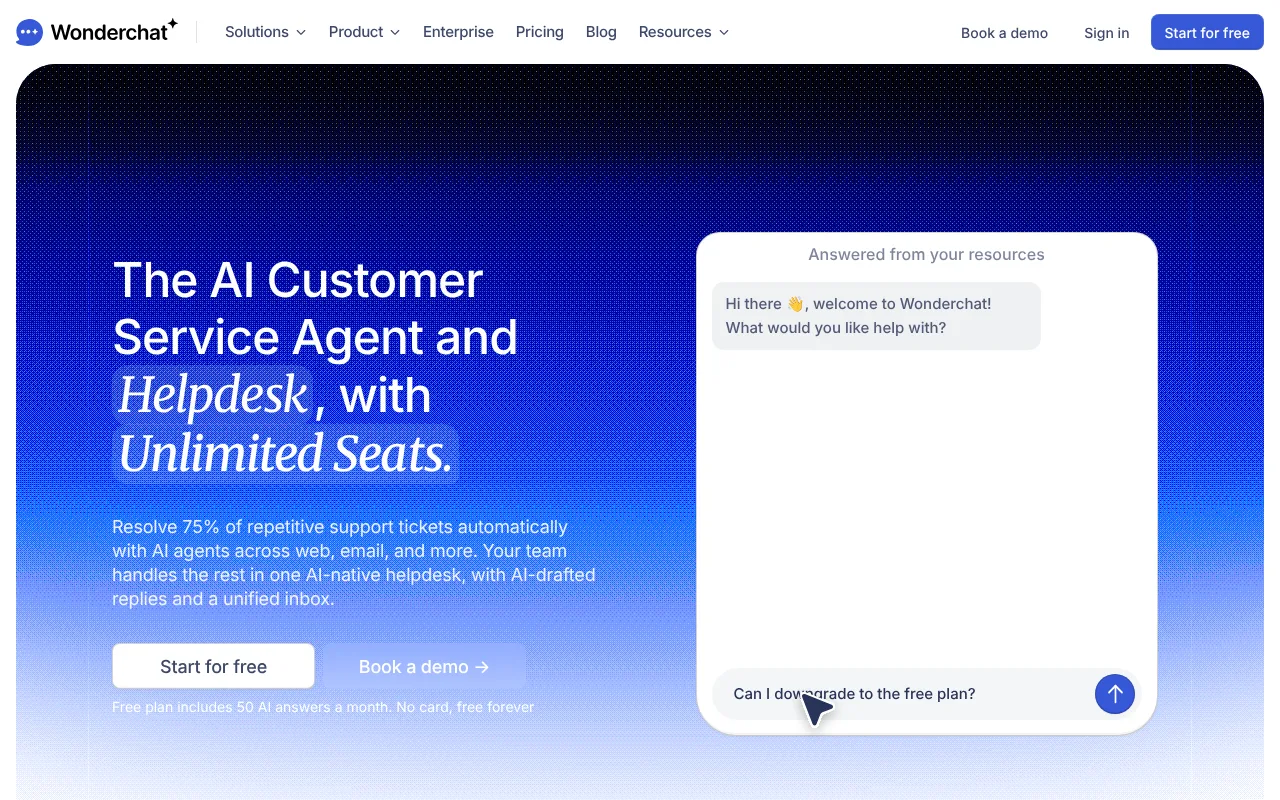
Wonderchat homepage, November 2026

Wonderchat is an AI agent that answers customers from your website pages and files, on a chat widget, email and messaging apps. Every plan includes a help desk with a shared inbox, where your team takes over live chats and tickets the AI hands on.

Best for
Teams that want one AI agent on their website and messaging apps, with as many teammates as they like in its inbox, and lead capture from the same chat.
How it bills
Starter is $32.50, Basic $125 and Scale $417 a month billed yearly ($39, $149 and $499 billed monthly), with 500, 3,000 and 10,000 AI replies a month and unlimited team seats. A reply on a fast model uses 1 credit, and one on a frontier model can use more. Unused credits expire at the end of each billing period, and Enterprise has tailored pricing.
Free plan
Yes: 2 seats, 50 AI replies a month
3 people, 300 AI replies
$33 a month: Starter at $32.50 a month billed yearly ($39 monthly), with unlimited seats and 500 AI replies at 1 credit each on its fast models.

Pros

  • Unlimited team seats on every paid plan, and the help desk and shared inbox come free, with 2 seats on Free.
  • It answers on your website, email, Messenger, Instagram, Discord and Telegram on every plan, and on WhatsApp from Starter.
  • In the inbox, an action that can’t be undone, such as a refund, waits until one of that action’s approvers approves it.
  • You can switch the AI model behind your agent at any time, with fast models on every plan and frontier models from Basic.

Cons

  • When the month’s credits run out, the chatbot pauses and stops responding until you upgrade or buy more.
  • A reply from a frontier model, or with a deeper answer setting, can use more than 1 credit, so the same plan covers fewer replies.
  • The “Powered by Wonderchat” badge comes off only on Enterprise.
  • Its MCP Connector lets the chatbot call other servers’ tools, but Wonderchat isn’t an MCP server your own AI agent can work in.

Already on Wonderchat? See the best Wonderchat alternatives.

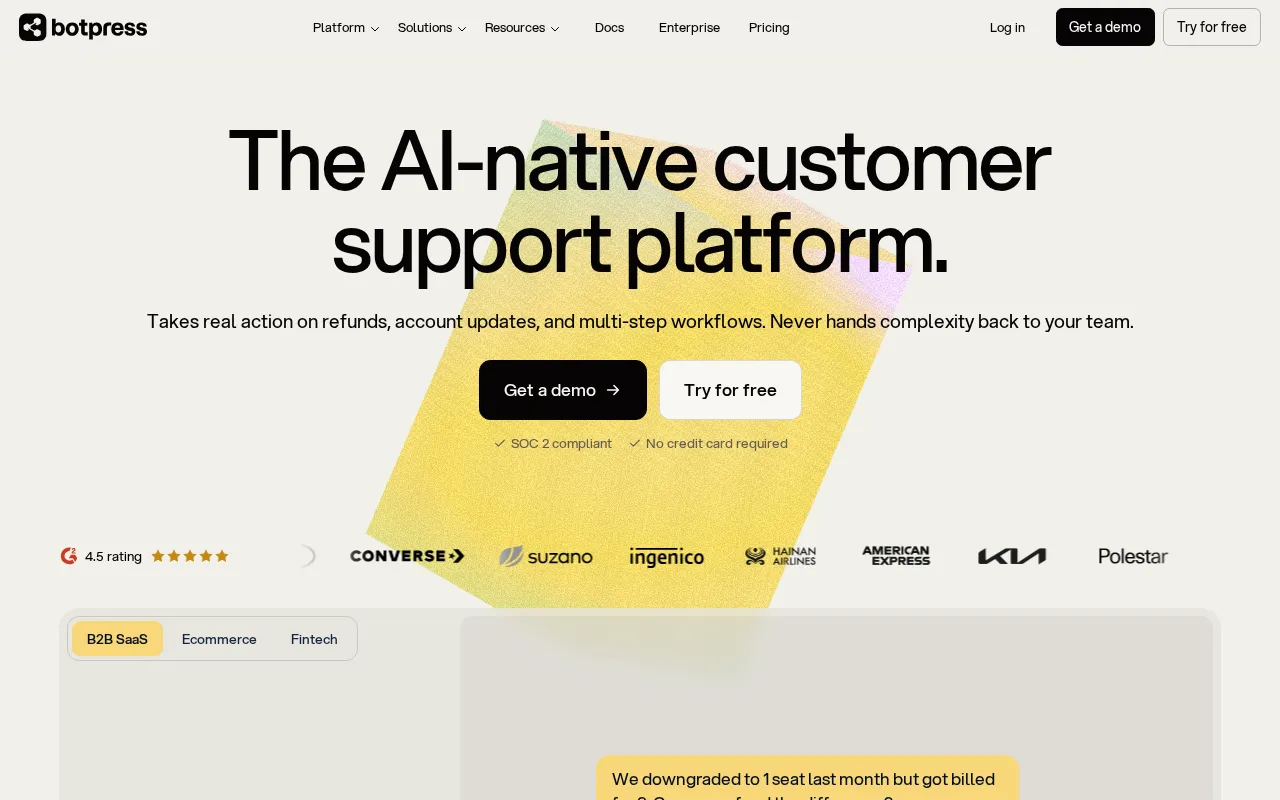
5. Botpress

Botpress homepage, November 2026

Botpress is a platform for building AI agents: from a prompt in Botpress Viber, on a visual canvas in Botpress Studio, or in TypeScript with its ADK. Its agents answer on web chat, WhatsApp, email and other messaging apps, and Botpress Desk, its built-in help desk, gives your team an inbox for handoffs and a help center.

Best for
Teams with someone technical who want to build custom AI agents with multi-step workflows across many channels, and pay by conversation rather than by seat.
How it bills
Free has 3 seats and 100 conversations. Plus is $150 and Team $750 a month on annual billing ($189 and $939 monthly), with 250 and 1,500 conversations, $25 and $150 of AI usage, and 3 seats on Plus or unlimited on Team. More conversations come in packs of 100, $65 on Plus or $50 on Team, added automatically, and AI spend past the allowance is bought at cost in $10 credit grants. Voice is on Enterprise only, priced by sales.
Free plan
Yes: 3 seats, 100 conversations, no top-ups
3 people, 300 AI replies
$215 or more a month: Plus at $150 a month on annual billing ($189 monthly), with 3 seats and 250 conversations, plus one $65 pack of 100 for the other 50. AI spend past Plus’s $25 is extra, at cost.

Pros

  • Build an agent by describing it to Botpress Viber, on Botpress Studio’s drag-and-drop canvas, or in TypeScript with the ADK, and switch to code when logic gets complex.
  • Botpress Desk answers web chat, email and WhatsApp, with voice on Enterprise, and adds a help center the AI answers from.
  • Team includes unlimited seats, with routing, roles and team analytics.
  • The agent can work on top of Zendesk or Intercom instead, with no help desk to move.

Cons

  • Plus stops at 3 seats, so a fourth teammate means Team at $750 a month on annual billing.
  • Conversation packs are added automatically at 95% of the quota, and you can’t turn that off.
  • AI spend past the plan’s allowance is billed at cost, so the bill moves with how much the model works.
  • Shopify order lookups come from third-party integrations, and refunds are actions your team connects to its own systems.

Already on Botpress? See the best Botpress alternatives.

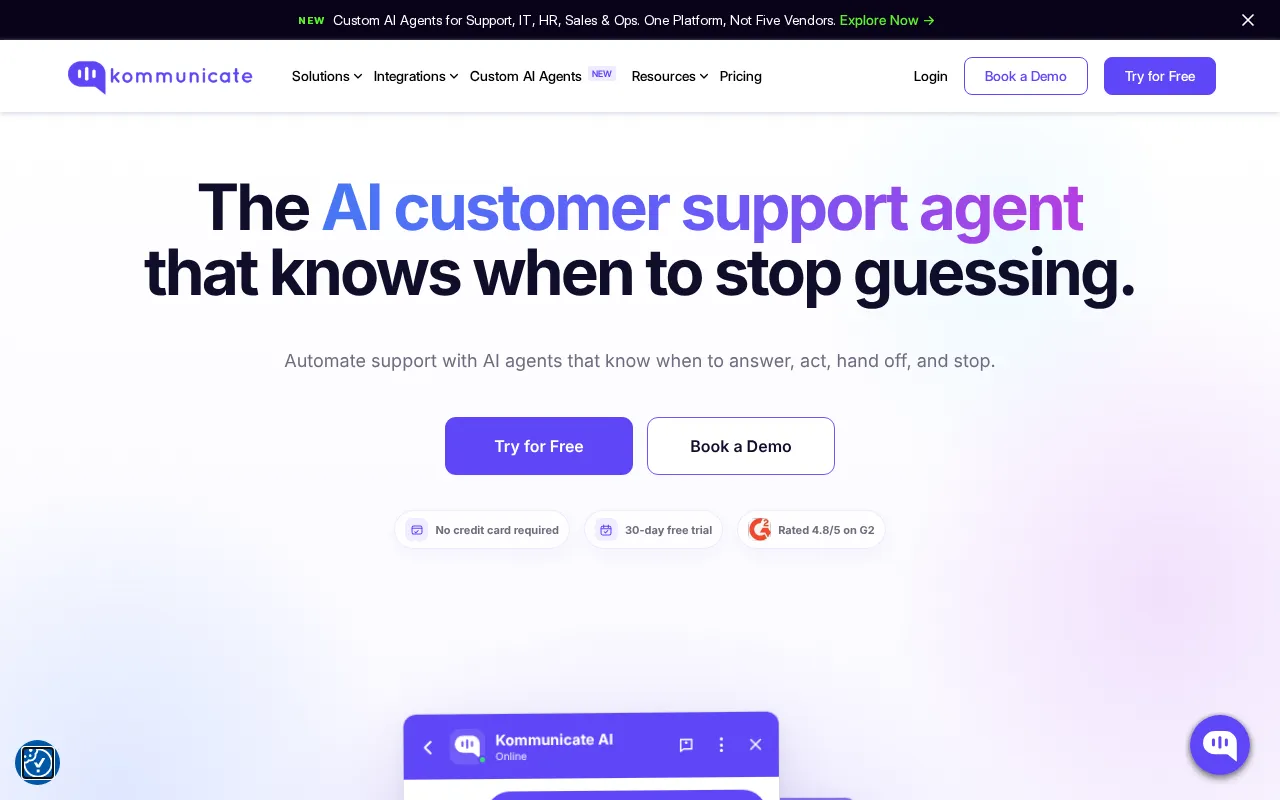
6. Kommunicate

Kommunicate homepage, November 2026

Kommunicate is an AI customer support agent from Intentive Technologies in Bengaluru. You build agents in its Kompose builder on OpenAI, Gemini or Claude models, train them on your website, docs and help center, and put them on website chat, mobile apps, WhatsApp, Instagram, Telegram, email and phone, with live chat and handoff to your team in its dashboard.

Best for
Teams that want one AI agent across website chat, mobile apps, WhatsApp and phone, with a small team taking what it hands off.
How it bills
Starter is $34 and Professional $167 a month on annual billing ($40 and $200 monthly), with 1 and 3 team members, 1 and 2 AI agents, and 250 and 2,000 conversations a month. Each extra team member or AI agent is $20 a month on Starter and $30 on Professional, extra conversations are $15 per 1,000 on Starter and $10 per 1,000 on Professional, and Voice AI is $0.06 a minute. A conversation counts every message in a session. Enterprise is priced by sales.
Free plan
Only in its Shopify app; otherwise a 30-day free trial without a card
3 people, 300 AI replies
$75 a month: Starter at $34 a month on annual billing ($40 monthly) with 1 team member and 250 conversations, plus 2 more team members at $20 and 50 more conversations at $15 per 1,000.

Pros

  • AI answers aren’t billed one by one: plans count conversations, and 1,000 more cost $15 on Starter or $10 on Professional.
  • One AI agent answers on website chat, mobile apps, WhatsApp, Instagram, Telegram and email, and Voice AI takes phone calls at $0.06 a minute.
  • You choose the model behind each agent from OpenAI, Google Gemini and Anthropic Claude, or bring a Dialogflow, Amazon Lex or IBM Watson bot.
  • Its Helpcenter hosts your articles on your own domain, shows them inside the chat widget, and connects to the AI agent as a knowledge source.

Cons

  • Starter includes 1 team member and 1 AI agent, and each one past that is $20 a month, or $30 on Professional.
  • Zendesk and Freshdesk integrations, API and webhooks access, and AI summaries start on Professional, at $167 a month on annual billing.
  • No free plan outside its Shopify app, and its terms say a subscription can’t be cancelled early or refunded.
  • Its MCP server is a Python project you run yourself, and none of its tools reads or searches a conversation.

Already on Kommunicate? See the best Kommunicate alternatives.

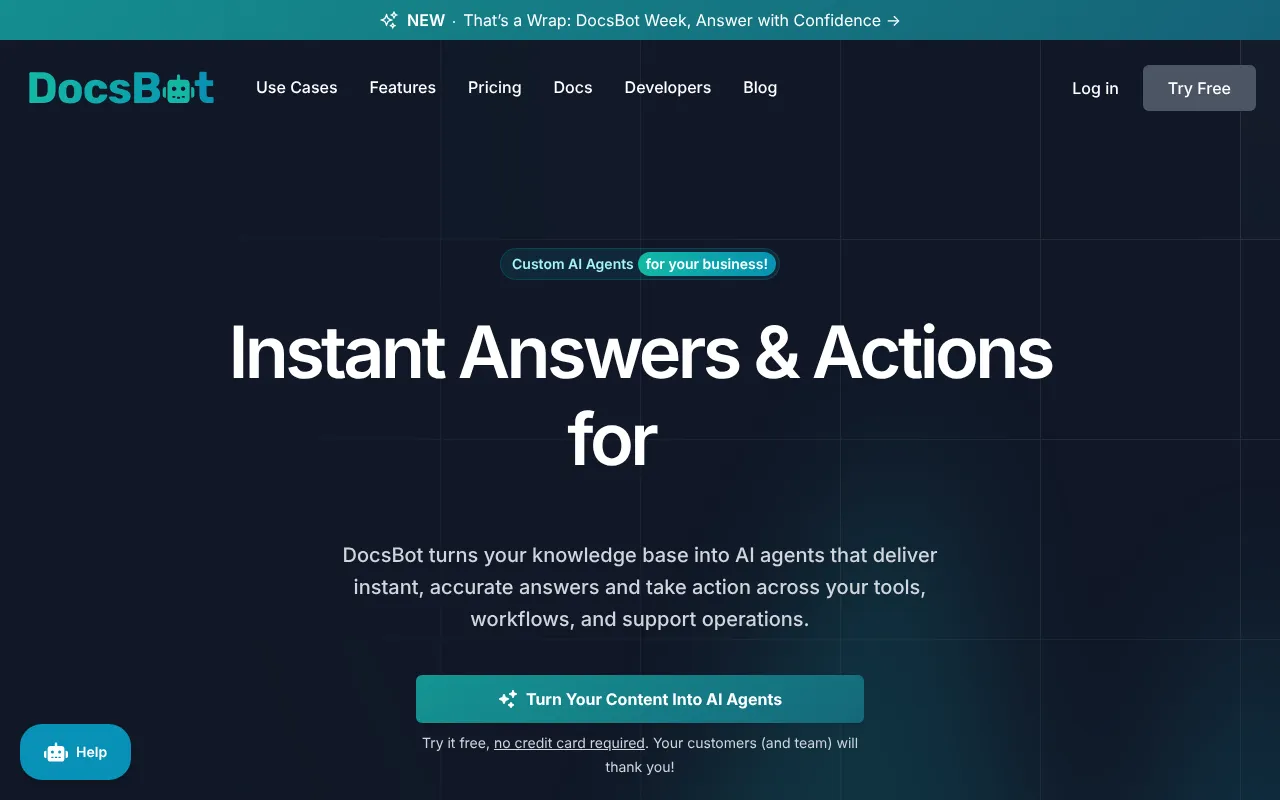
7. DocsBot

DocsBot homepage, November 2026

DocsBot turns your docs, website and other content into AI agents that answer customers in a chat widget, Slack or WhatsApp. When a customer needs a person, it hands them to the help desk widget you already use, such as Help Scout, Zendesk or Intercom.

Best for
Teams happy with their help desk that want an AI answering from their docs on the website, with hard questions passed to that help desk.
How it bills
Personal is $49 a month for 1 team user and 5k AI credits, Standard $149 for 5 team users and 15k, and Business $499 for 10 team users and 60k, with 2 months free on annual plans. A chat message starts at 1 credit and uses more on larger models and AI actions, and each 5k more credits cost $49 a month. Extra team users are $19 each, on Business and Enterprise only.
Free plan
Yes: 1 user, 100 AI credits a month
3 people, 300 AI replies
$149 or more a month: Standard at $149, the first plan with escalation tickets for your help desk, using 300 of its 15k AI credits at 1 credit a message. Your help desk’s seats come on top.

Pros

  • A free plan with 100 AI credits a month, and a 14-day money-back guarantee on paid plans.
  • It learns from dozens of content sources, such as Notion, Confluence, Google Drive, Zendesk Guide and solved Help Scout or Freshdesk tickets.
  • On Standard, its widget hands a customer to your Help Scout, Zendesk, Intercom, Freshdesk, HubSpot, LiveChat or Gorgias widget, with the chat history and an AI-written ticket.
  • It answers in Slack, Messenger, WhatsApp and Telegram from Personal, and adds realtime voice agents and Stripe billing actions on Standard.

Cons

  • DocsBot is not a help desk: the teammate who takes over answers in another tool, billed separately.
  • When the month’s AI credits run out, it stops answering and shows customers an error, unless you turn on auto-add.
  • Standard stops at 5 team users, and extra users are sold only from Business at $499 a month.
  • Removing DocsBot branding from the widget needs Business.

Already on DocsBot? See the best DocsBot alternatives.

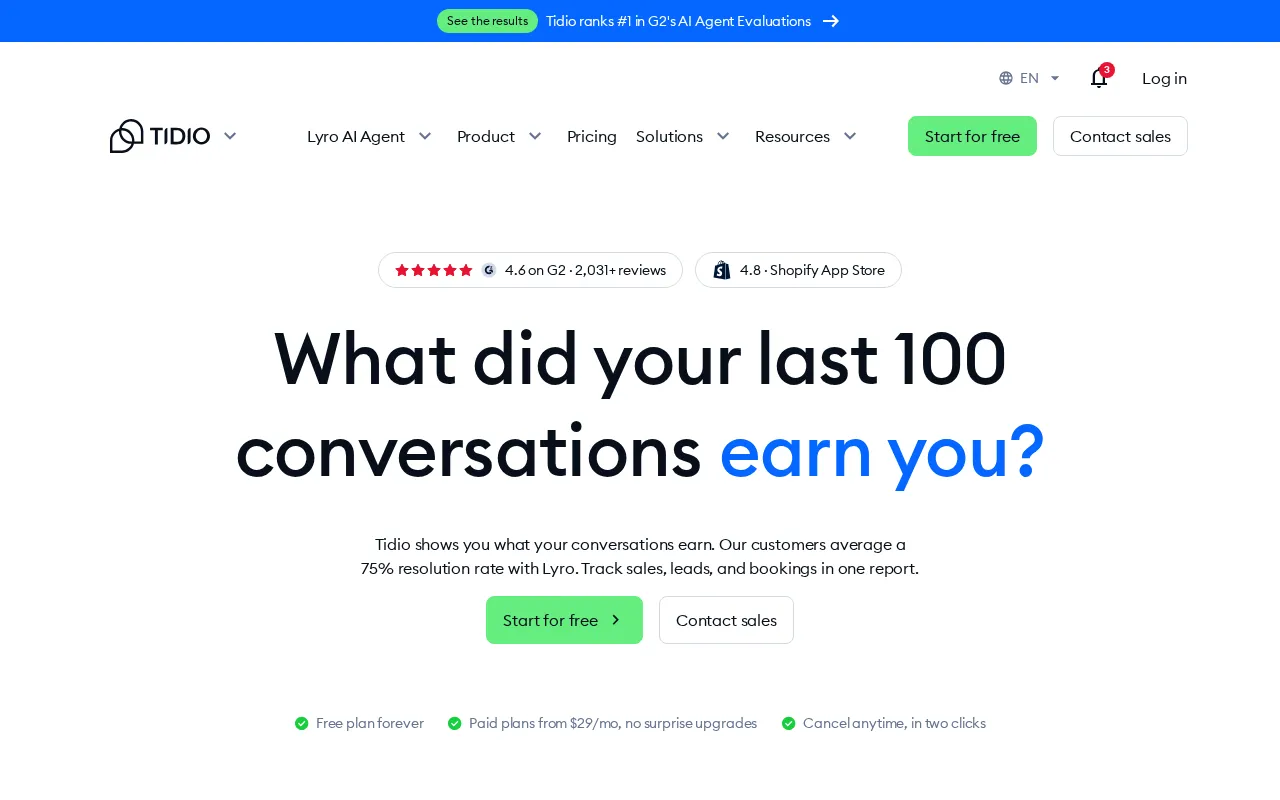
8. Tidio

Tidio homepage, November 2026

Tidio is a live chat and help desk tool built for online stores, especially Shopify, with Lyro, an AI agent sold as an add-on, and a help center since 2026.

Best for
Shopify and WooCommerce stores that want chat, WhatsApp and Instagram in one inbox and an AI that recommends products.
How it bills
Plans are priced by the conversations your team answers, with 10 seats: Starter is $24.17 a month on annual billing ($29 monthly) for 100, and Growth runs from $49.17 for 250 ($59 monthly) to $349 monthly for 2,000. Lyro is an add-on from $32.50 a month for 50 conversations to $583.33 for 1,000 on annual billing ($39 for 50, $210 for 300 and $700 for 1,000 monthly), and Plus starts at $300 a month plus usage.
Free plan
Yes: 10 seats, 50 conversations a month
3 people, 300 AI replies
$199 or more a month: Starter at $24.17 on annual billing plus 300 Lyro conversations at $175. Starter covers 100 conversations your team answers, and more needs Growth.

Pros

  • Up to 10 seats on Free, Starter and Growth, so the bill doesn’t grow as you add teammates.
  • WhatsApp, Instagram, Messenger and email on every plan, including Free.
  • Lyro recommends products and adds them to the cart on Shopify and WooCommerce.
  • Lyro’s actions can check orders, cancel or change them and refund, and Lyro can call your own MCP servers.

Cons

  • Lyro is a separate add-on billed per conversation, about $0.58 to $0.78 each by tier and billing, and over 1,000 a month is priced by sales.
  • The API and Stripe integration need Plus, from $300 a month.
  • Its official MCP server only reads analytics data, loaded once a day, so your own AI can’t reply or close.
  • No refunds for time left after you cancel.

Already on Tidio? See the best Tidio alternatives.

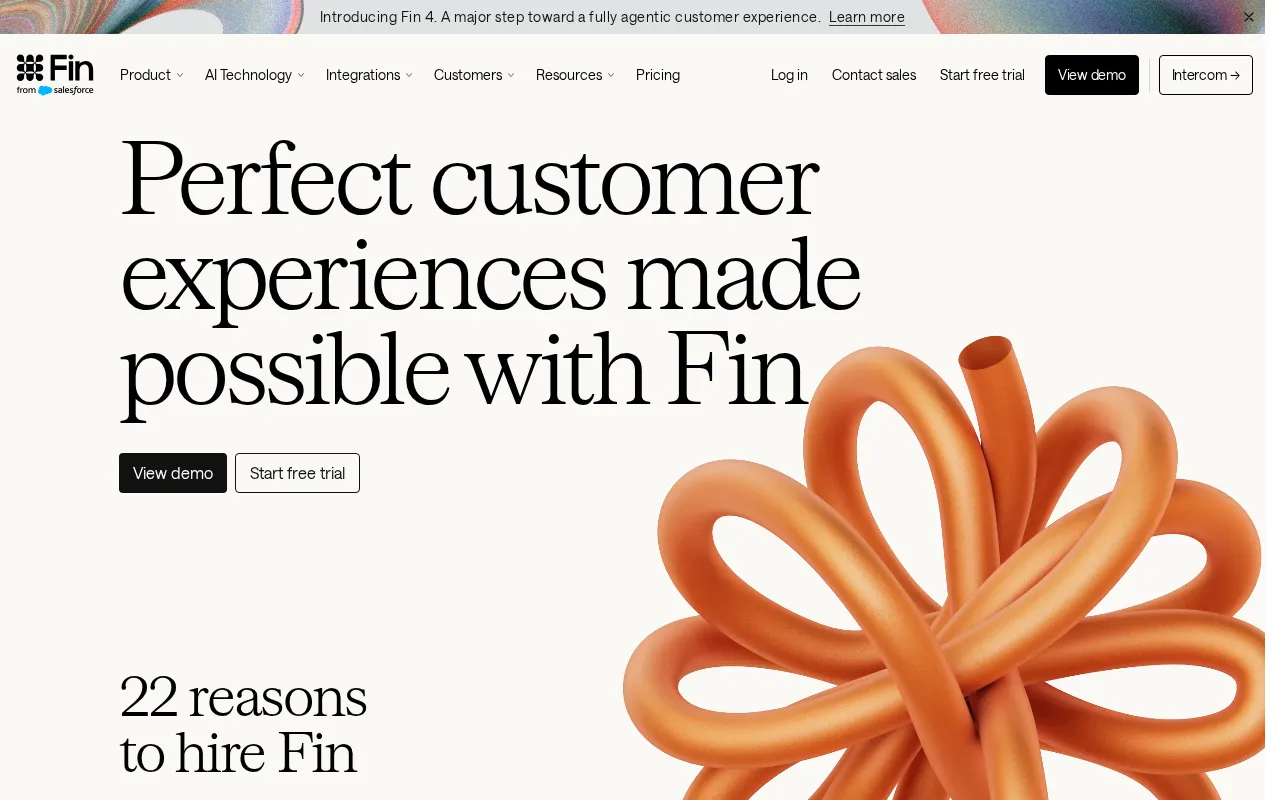
9. Fin

Fin homepage, November 2026

Fin is an AI that answers customers on chat, email, voice and social. It runs inside Intercom, or on top of a help desk you already use, such as Zendesk, Salesforce, HubSpot or Freshdesk, and hands your team what it can’t solve.

Best for
Teams with a large queue on Zendesk, Salesforce, HubSpot or Freshdesk that want a strong AI answering customers without changing help desks.
How it bills
A $49 base plan covers the first 50 outcomes a month, then each costs $0.99, charged at most once per conversation. Unused outcomes don’t carry over. Fin Voice is $1.99 a voice outcome through sales, and your help desk’s seats are billed separately.
Free plan
No, 14-day trial
3 people, 300 AI replies
$297 or more a month: 300 outcomes: $49 for the first 50, then 250 at $0.99. Your help desk’s seats come on top.

Pros

  • It works inside the help desk you already have, so your team keeps it as the system of record.
  • You pay at most once per conversation, and nothing when a customer asks for a person or a Procedure fails.
  • Procedures connect Fin to Stripe and Shopify, so it can check an order and refund it in the same conversation.
  • It answers on chat, email, voice, social and Slack, and on WhatsApp through Freshdesk, with spending limits you set.

Cons

  • Fin is an AI, not a help desk, so its outcomes come on top of your help desk’s seats.
  • An outcome counts when a customer stays silent for 24 hours after Fin’s answer, and when a Procedure ends in a handoff to your team.
  • A Procedure can refund on its own under a threshold you set, with no person approving it.
  • Buying Fin for another help desk starts with “Contact sales” on its pricing page.

Already on Fin? See the best Fin alternatives.

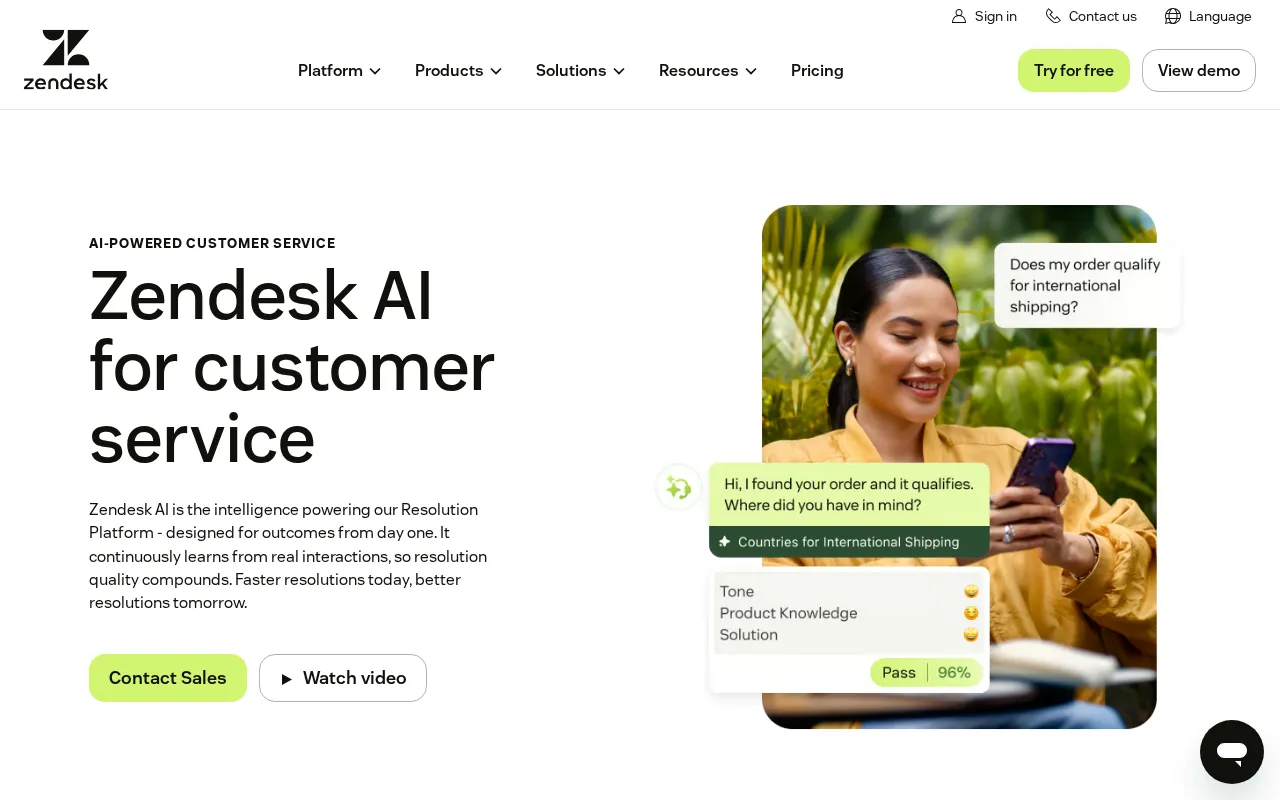
10. Zendesk AI

Zendesk AI homepage, November 2026

Zendesk AI is the AI built into Zendesk: AI agents that answer customers on messaging, email and voice, and Copilot, which helps your team. The AI agents come with a Zendesk plan and bill per automated resolution, while Forethought, which Zendesk bought, sells AI agents for other help desks through sales.

Best for
Teams settled on Zendesk that want an AI answering inside it, beside the tickets, triggers and reports they already run.
How it bills
AI agents come with every Zendesk plan, so each teammate needs a seat: $19 on Support Team or $55 on Suite Team, which adds messaging and voice, on annual billing. Each seat includes 5 automated resolutions a month on Team plans and 10 on Suite Professional, up to 10,000 a year, then each costs $1.50 committed or $2.00 pay as you go. Copilot is $50 more an agent.
Free plan
No, 14-day trial
3 people, 300 AI replies
$428 or more a month: 285 automated resolutions at $1.50 committed, past the 15 that 3 seats on a Team plan include. The seats come on top: $19 each on Support Team for email, or $55 on Suite Team for chat.

Pros

  • It answers inside the Zendesk you already run, so tickets, routing, triggers and reports stay where they are.
  • Escalations aren’t billed, and an LLM checks each conversation before it counts as a paid resolution.
  • AI agents answer from your help center, a web crawler or sources like Google Drive, on messaging, email and voice.
  • You can cap the bill by pausing AI agents at your limit, and through the MCP client they can use tools from Stripe’s and other MCP servers.

Cons

  • Zendesk’s own AI agents can’t be bought alone: every teammate needs a Zendesk seat, and resolutions come on top.
  • Accounts are moving to resolution tiers, paid from an allowance of $2 a seat a month on Team plans, up to $5,000 a year, and Zendesk gives tier prices through sales.
  • Each AI agent works on one kind of channel, and AI agents on Support Team need messaging for chat, which comes with Suite Team at $55 a seat.
  • AI agent tickets can’t be exported with Zendesk’s export tools, and it refunds no unused seats or time.

Already on Zendesk AI? See the best Zendesk AI alternatives.

Why people leave Hugo

Hugo only comes with Crisp

Every price on hugo.ai is a Crisp membership plus AI usage, and signing up opens a Crisp account, so choosing Hugo means moving your inbox to Crisp. Hugo pricing, .

It goes quiet when the credits run out

Once the plan’s credits are spent, Hugo stops answering and new conversations are escalated to your team, unless you switch on Pay-As-You-Go. How Hugo AI pricing and billing works, .

No fixed price per conversation

Hugo is billed by tokens, so message length, how deep a conversation goes, the size of your knowledge, the language and the model all change what each one costs. How Hugo AI pricing and billing works, .

Trying it spends credits

Training, tests and Playground runs during the trial can use paid AI models, and they draw on the same credits. How Hugo AI pricing and billing works, .

The customer confirms an action, not your team

Before a tool runs, Hugo can verify the customer with a one-time code by email or SMS. Nothing in its MCP setup asks a teammate to approve a refund first. Build MCP integrations with Hugo, .

Features compared

A check means the vendor’s own pages say a plan includes it. Hugo is in the last row for comparison.

ToolEmailLive chatWhatsAppVoiceHelp centerAI that answers customersShopifyStripeFree planSignup without a sales call
Rinhelp
SiteGPT
Chatbase
Wonderchat
Botpress
Kommunicate
DocsBot
Tidio
Fin
Zendesk AI
Hugo

What your AI can do in each tool

Connect Claude, ChatGPT or your own AI agent through the vendor’s official MCP server, and this is what it can do of 11 everyday actions: search and read conversations, reply to a customer, add an internal note, assign, close or reopen, search the help center, write or update an article, publish an article, create a saved reply, look up an order, refund or cancel.

ToolThrough official MCPWhat it can doMoney moves wait for a teammate
Rinhelp11 of 11Search and read conversations, reply to a customer, add an internal note, assign, close or reopen, search the help center, write or update an article, publish an article, create a saved reply, look up an order, refund or cancelYes, a teammate approves first
SiteGPT3 of 11Search and read conversations, reply to a customer, close or reopenNo refunds or cancellations through MCP
Chatbase5 of 11Search and read conversations, reply to a customer, add an internal note, assign, close or reopenNo refunds or cancellations through MCP
Wonderchat0 of 11No official MCP server, or nothing from this listNo refunds or cancellations through MCP
Botpress0 of 11No official MCP server, or nothing from this listNo refunds or cancellations through MCP
Kommunicate3 of 11Reply to a customer, assign, close or reopenNo refunds or cancellations through MCP
DocsBot1 of 11Search and read conversationsNo refunds or cancellations through MCP
Tidio1 of 11Search and read conversationsNo refunds or cancellations through MCP
Fin0 of 11No official MCP server, or nothing from this listNo refunds or cancellations through MCP
Zendesk AI0 of 11No official MCP server, or nothing from this listNo refunds or cancellations through MCP
Hugo6 of 11Search and read conversations, reply to a customer, add an internal note, close or reopen, search the help center, write or update an articleNo refunds or cancellations through MCP

More on each MCP server, and connectors from other companies, which don’t count:

  • SiteGPT: The MCP server needs Growth or above. Resolving or reopening a conversation goes through its execute_write tool, which can make any API v2 call.
  • Chatbase: The MCP server needs a paid plan, Basic or higher, and returns an error on a trial that signed up with a personal email address. Its tools cover chatbots, their sources, conversations and Helpdesk tickets, and a ticket message can be a reply the customer receives or an internal note only your team sees.
  • Wonderchat: Wonderchat’s pricing table lists “API and MCP access” from Basic. Its MCP Connector, on Scale and above, only connects out to other MCP servers, and its docs say it doesn’t expose your chatbot as one. We found no official MCP server for Wonderchat.
  • Botpress: Botpress lists an MCP server that exposes Botpress Desk’s help desk operations as tools for Claude Code, Claude Desktop and Cursor, but we found no page that lists its tools, so none are counted. Its ADK also runs an MCP server, for building agents rather than working in Desk.
  • Kommunicate: Kommunicate’s GitHub has a Python MCP server you install into Claude Desktop with an API key from the dashboard. It creates conversations, sends messages, assigns them, changes their status and reads or updates customer details, and Kommunicate’s product docs don’t mention it. API and webhooks access starts on Professional.
  • DocsBot: DocsBot’s MCP servers manage its agents and sources, and search an agent’s docs and past questions. None replies to a customer, since the conversation your team takes over lives in your help desk.
  • Tidio: The MCP server reads the Analytics API’s chat and ticket messages. Replying to and solving tickets goes through the OpenAPI on Plus and Premium, not MCP.
  • Fin: Intercom’s MCP server reads Intercom data in US and EU workspaces. We found no official MCP server for Fin on another help desk.
  • Zendesk AI: Zendesk announced an MCP server for outside AI tools in May 2026, for early access that summer, and has published no docs for it. Its MCP client, generally available since August 10, 2026, works the other way, letting Zendesk’s AI agents call tools on other MCP servers.
  • Hugo: These tools come from Crisp’s MCP server, on Essentials and Plus, which works on the Crisp workspace Hugo answers in. Hugo itself calls MCP servers you connect, and can check the customer with a one-time code before a tool runs, but asks no teammate.

Pricing at three sizes

What each tool costs a month in US dollars, with AI answering, and how each total adds up. Each AI reply counts as one resolved conversation.

Tool3 people, 300 AI replies5 people, 1,000 AI replies10 people, 3,000 AI replies
Rinhelp$49Pro for the whole workspace, using 300 of its 5,000 AI replies; Free covers your team if you don’t need AI replies.$49Pro for the whole workspace, using 1,000 of its 5,000 AI replies.$49Pro for the whole workspace, using 3,000 of its 5,000 AI replies.
SiteGPT$79Growth at $79 on annual billing ($948 a year, or $129 monthly), with 4 team members. 300 answers use 600 messages, inside its 10,000 on GPT-4.1 mini or 1,000 on GPT-4.1.$259Scale at $259 on annual billing ($3,108 a year, or $429 monthly), since Growth stops at 4 team members. 1,000 answers use 2,000 messages, inside its 4,000 on GPT-4.1.$259 or moreScale at $259 on annual billing, with 10 team members. 3,000 answers use 6,000 messages, inside its 40,000 on GPT-4.1 mini but past its 4,000 on GPT-4.1, where packs of extra messages come on top.
Chatbase$120Basic at $120 a month on annual billing ($150 monthly), the cheapest plan, with 3 members. Its 4,000 message credits cover 300 replies even at 5 credits each.$400Business at $400 a month on annual billing ($500 monthly), the first plan with 5 members. Its 15,000 credits cover 1,000 replies on any recommended model.$400 or moreBusiness at $400 a month on annual billing, whose 15,000 credits cover 3,000 replies at up to 5 credits each. It includes 5 members, and the other 5 need extra member slots, whose price the pricing page doesn’t show.
Wonderchat$33Starter at $32.50 a month billed yearly ($39 monthly), with unlimited seats and 500 AI replies at 1 credit each on its fast models.$125Basic at $125 a month billed yearly ($149 monthly), with unlimited seats and 3,000 AI replies, at 1 credit each on a fast model.$125 or moreBasic at $125 billed yearly, whose 3,000 credits cover 3,000 AI replies only on a fast model. A frontier model can use more credits per reply, which means extra credits or Scale at $417.
Botpress$215 or morePlus at $150 a month on annual billing ($189 monthly), with 3 seats and 250 conversations, plus one $65 pack of 100 for the other 50. AI spend past Plus’s $25 is extra, at cost.$750 or moreTeam at $750 a month on annual billing ($939 monthly), since Plus stops at 3 seats. Its 1,500 conversations cover 1,000, and AI spend past the included $150 is billed at cost.$1,500 or moreTeam at $750 a month on annual billing, plus 15 packs of 100 conversations at $50 each for the 1,500 past its quota: $1,500 a month ($1,689 monthly), with AI spend past $150 at cost.
Kommunicate$75Starter at $34 a month on annual billing ($40 monthly) with 1 team member and 250 conversations, plus 2 more team members at $20 and 50 more conversations at $15 per 1,000.$125Starter at $34 a month on annual billing ($40 monthly) with 1 team member and 250 conversations, plus 4 more team members at $20 and 750 more conversations at $15 per 1,000.$255Starter at $34 a month on annual billing ($40 monthly) with 1 team member and 250 conversations, plus 9 more team members at $20 and 2,750 more conversations at $15 per 1,000.
DocsBot$149 or moreStandard at $149, the first plan with escalation tickets for your help desk, using 300 of its 15k AI credits at 1 credit a message. Your help desk’s seats come on top.$149 or moreStandard at $149, with 1,000 messages inside its 15k AI credits on a 1x model. The help desk your team answers handoffs in bills on top.$149 or moreStandard at $149, with 3,000 messages inside its 15k AI credits, since your teammates answer in your help desk rather than DocsBot. That help desk is billed separately.
Tidio$199 or moreStarter at $24.17 on annual billing plus 300 Lyro conversations at $175. Starter covers 100 conversations your team answers, and more needs Growth.$608 or moreStarter at $24.17 plus 1,000 Lyro conversations at $583.33, both on annual billing, before any move to Growth for your team’s own conversations.$300 or morePlus from $300 a month plus usage, since Lyro above 1,000 conversations is priced only by sales.
Fin$297 or more300 outcomes: $49 for the first 50, then 250 at $0.99. Your help desk’s seats come on top.$990 or more1,000 outcomes: $49 for the first 50, then 950 at $0.99, plus the seats your help desk charges.$2,970 or more3,000 outcomes: $49 for the first 50, then 2,950 at $0.99. The help desk Fin answers in bills its seats on top.
Zendesk AI$428 or more285 automated resolutions at $1.50 committed, past the 15 that 3 seats on a Team plan include. The seats come on top: $19 each on Support Team for email, or $55 on Suite Team for chat.$1,463 or more975 automated resolutions at $1.50 beyond the 25 included with 5 Team seats, which are billed on top.$4,425 or more2,950 automated resolutions at $1.50 beyond the 50 that 10 Team seats include. Seats are extra, from $19 an agent on annual billing.
Hugo$66 or moreA Crisp Mini membership at $45 for 4 seats. Its $5 of credits pay for about 90 Hugo conversations, and the other 210 or so cost up to about $0.10 each on Pay-As-You-Go.$150 or moreA Crisp Essentials membership at $95, since 5 people outgrow Mini’s 4 seats. Its $25 of credits pay for about 450 conversations, and the remaining 550 or so up to about $0.10 each.$350 or moreEssentials at $95 still seats 10. About 2,550 conversations past its credits run on Pay-As-You-Go at up to about $0.10 each, because Hugo is billed by tokens.

The best Hugo alternative for each kind of team

Best Hugo alternative for a fixed AI bill: Rinhelp

Hugo’s cost per conversation rises with longer messages, bigger knowledge sources and pricier models, and when the credits are gone it’s Pay-As-You-Go or silence. Rinhelp counts replies instead: 5,000 of them in $49 a month, with no seat price.

Best Hugo alternative for teams keeping Crisp: SiteGPT

SiteGPT can answer inside Crisp, so the inbox stays and only the AI changes. Growth is $79 a month on annual billing for 4 team members, and each question and answer counts as 2 messages.

Best Hugo alternative for an AI agent with its own inbox: Chatbase

Chatbase includes its Helpdesk inbox from Basic, $120 a month on annual billing with 4,000 message credits, and answers on WhatsApp, Messenger, Instagram, Slack, email and the phone.

Best Hugo alternative for a large team on a small budget: Wonderchat

Wonderchat’s paid help desk plans never cap seats. Starter is $32.50 a month billed yearly for 500 AI replies, where Hugo on Mini stops at 4 seats and on Essentials at 10.

Best Hugo alternative for building the agent yourself: Botpress

Botpress has a free plan with 3 seats and 100 conversations, then Plus at $150 a month on annual billing, with AI spend past the allowance bought at cost. Botpress Desk gives your team an inbox for handoffs.

Best Hugo alternative for phone calls as well as chat: Kommunicate

Kommunicate puts its agents on website chat, WhatsApp, Instagram, Telegram, email and phone, with Voice AI at $0.06 a minute. Starter is $34 a month on annual billing for 250 conversations.

Best Hugo alternative for small online shops: Tidio

Tidio is live chat with Lyro, its AI agent, built into its plans, with 10 seats on Starter and Growth, and the conversations Lyro answers share one allowance with your team’s.

Best Hugo alternative for a large queue on another help desk: Fin

Fin answers on chat, email, voice, social and Slack inside Intercom, Zendesk, Salesforce, HubSpot or Freshdesk, from $49 a month for 50 outcomes, then $0.99 each, on top of that help desk’s seats.

When Hugo is still the right choice

Stay with Hugo ifSwitch if
Your team already lives in Crisp and Hugo settles most chats for a few cents each.You’d leave Crisp if the inbox and the AI cost less together.
Customers write on WhatsApp, Instagram or the contact form, and Hugo should answer there.Email and the chat on your site carry nearly all your conversations.
You want to pick Hugo’s model yourself, such as Claude, Gemini or one Crisp hosts.You’d rather not weigh models against token costs.
Your own MCP server already exposes your back office for Hugo to call.You want a teammate to approve anything that moves money.

Moving from Hugo to Rinhelp

Hugo answers inside your help desk, and your conversation history lives there, so you move it from that help desk.

Find your help desk’s move

Questions about Hugo and switching

How much does Hugo cost?

Hugo comes with a Crisp membership: Mini at $45 a month with $5 of AI credits, Essentials at $95 with $25, and Plus at $295 with $75. hugo.ai estimates a conversation at $0.05 and Crisp’s billing help at about $0.05 to $0.10, so each conversation past the credits adds a few cents.

Is Hugo the same as Crisp?

Hugo is Crisp’s AI agent, and hugo.ai is Crisp’s own site for it: you sign up and log in at Crisp, under Crisp’s terms. That’s why Crisp isn’t on this list, since moving from Hugo to Crisp changes nothing. To keep Crisp’s inbox and replace only the AI, SiteGPT can answer inside Crisp.

Can I buy Hugo without Crisp?

No. Each plan on hugo.ai is a Crisp membership plus AI usage, and Hugo answers in Crisp’s inbox, where the conversations it can’t solve go to your team.

Is there a free trial of Hugo?

Yes, 14 days with no card. Crisp’s free plan includes no Hugo credits, so to keep Hugo answering after the trial you pay for Mini or above.

Which AI model does Hugo run on?

You decide. Hugo can choose for you, currently GPT-5.6 Luna from OpenAI, or you can pick a model from OpenAI, Anthropic, Google, Mistral, or one hosted by Crisp. The more capable models use more credits.

Can Hugo look up orders or refund?

Through integrations, yes: Shopify, WooCommerce, PrestaShop and Stripe connect from Hugo’s “Integrations & MCP” menu, and your own MCP server can expose actions such as refunds. Hugo can ask the customer for a one-time code first, but no teammate approves. In Rinhelp, refunds and cancellations wait for a teammate.

Where is my history if I leave Hugo?

In Crisp, where Hugo answers, so you move from Crisp: its conversations, customer profiles and published “Knowledge Base” articles come across through Crisp’s MCP server, which needs Essentials or Plus.

Can Claude or ChatGPT work where Hugo answers?

Through Crisp’s MCP server, on Essentials and Plus, an AI agent can read and reply to conversations, add notes, resolve them and write “Knowledge Base” articles. It can’t assign a conversation or look up an order there.

How we picked and checked

We listed the tools a team leaving Hugo weighs most often, and only tools we keep checked facts for. Rinhelp is first because it is our product and we wrote this page, so check each figure against the vendor’s own page before you decide.

Costs are list prices in US dollars for three team sizes, on the cheapest plan that covers them, counting each AI reply as one resolved conversation. Features count only when the vendor’s own pages say a plan includes them. The AI column counts actions an official MCP server from the vendor can take, out of 11, and leaves third-party connectors out.

We checked every source below on 20 November 2026 unless it shows another date.

Why people leave Hugo

Rinhelp

Checked

SiteGPT

Checked

Chatbase

Checked

Wonderchat

Checked

Botpress

Checked

Kommunicate

Checked

DocsBot

Checked

Tidio

Checked

Fin

Checked

Zendesk AI

Checked

Hugo

Try Rinhelp next to Hugo.

Start free with up to 3 teammates and 50 AI replies. Keep Hugo running until you’re sure.

Start free