1. Rinhelp
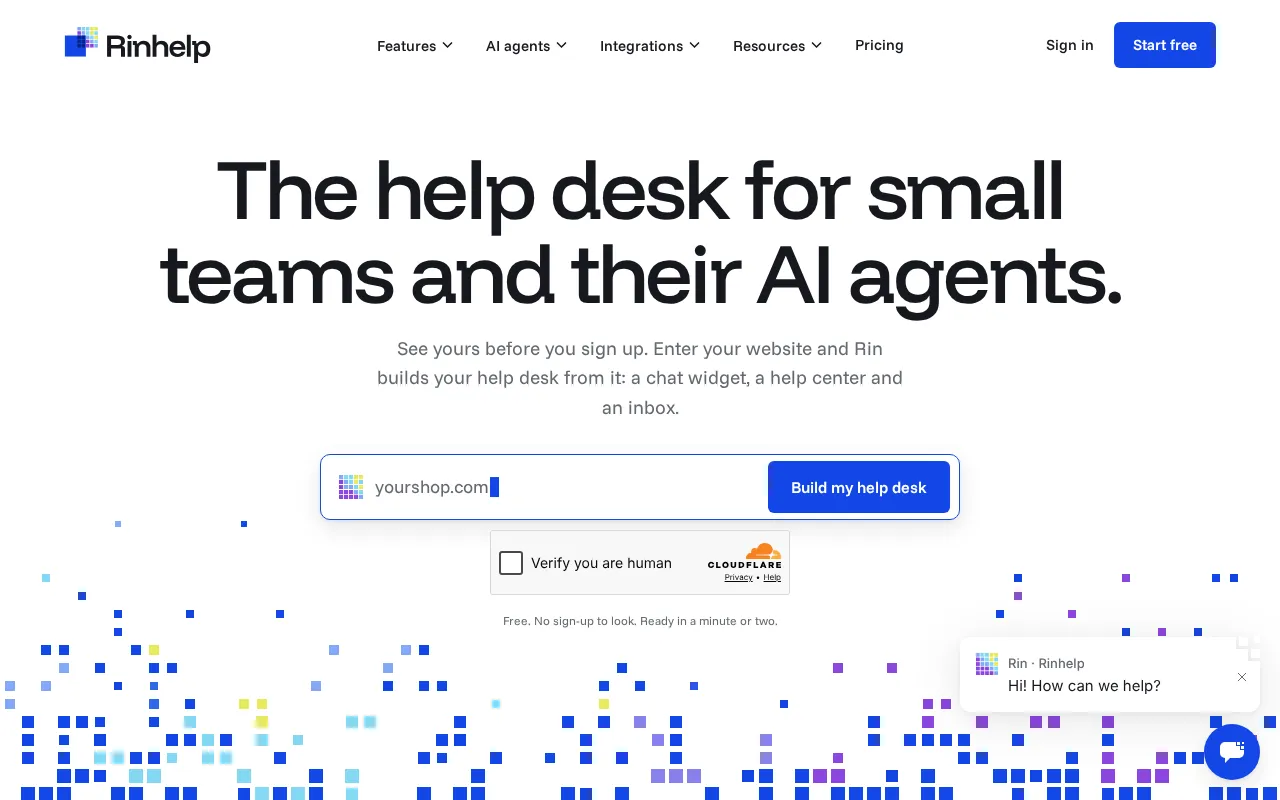
An eyewear brand’s inbox mixes order questions with ones about lenses, frame sizes and prescriptions. Rin, our built-in AI, answers the product questions from your help center and website, hands a conversation to your team when the answer isn’t there, and discusses an order only after a purchase check. A teammate sees the order’s items, fulfillment and tracking beside the conversation, refunds all or part of it, or cancels it before it ships. A refund or cancellation Rin or an AI agent asks for waits for that teammate’s approval. Remakes, frame swaps and address changes still happen in Shopify, and there’s no phone line. The whole team pays $49 a month, with 5,000 AI replies.
- Best for
- Eyewear brands of 2 to 10 people on Shopify that support customers by email and chat, pay one flat price, and want a person to approve anything that moves money or can’t be undone.
- How it bills
- Free for up to 3 teammates. Pro is $49 a month for the whole workspace, with 5,000 AI replies from Rin. No per-seat or per-resolution fees.
- Free plan
- Yes: 3 teammates, 50 AI replies to try Rin
- 3 people, 300 AI replies
- $49 a month: Pro for the whole workspace, using 300 of its 5,000 AI replies; Free covers your team if you don’t need AI replies.
Pros
- One price, $49 a month, covers the whole team and 5,000 AI replies, so staff from your shops who help online don’t each need a seat.
- Teammates find an order by the customer’s email or its number and refund part of it, all of it, or cancel it without opening Shopify.
- Rin answers questions about lens options, frame fit and care from your own help center, and passes anything it can’t answer to a teammate.
- Claude, ChatGPT or your own AI agent can work the inbox through MCP, and a refund or cancellation it asks for waits for a teammate.
Cons
- Email and live chat only: there is no phone, WhatsApp, SMS or social inbox.
- Shopify and Stripe are the only integrations.
- No reports, SLA rules or routing rules: Rin hands a conversation to the teammate with the fewest open ones.
- The free plan has no Rin beyond 50 AI replies to try it.
2. Help Scout
Help Scout is a help desk with shared inboxes, a Docs help center and Beacon, a widget for chat and help articles. Scout, its AI agent, answers chat from your help content and is billed per resolution.
Help Scout’s Pro plan includes SSO and HIPAA compliance for a brand whose prescription emails call for it, though Pro needs at least 10 users and a demo. Standard and up bring SMS and WhatsApp in beside email and chat, and teammates refund or cancel Shopify orders from the sidebar.
- Best for
- Support teams that think in tickets and want a calm shared inbox, a help center and live chat, with a free plan to start on.
- How it bills
- Standard is $25, Plus $45 and Pro $75 a user a month on annual billing, which saves 16%. Pro needs at least 10 users and a demo. Scout costs $0.75 per resolution, free for a new account’s first 3 months.
- Free plan
- Yes: 5 users, 1 inbox, 100 contacts a month
- 3 people, 300 AI replies
- $300 a month: 3 Standard users at $25 on annual billing, plus 300 AI resolutions at $0.75.
Pros
- A free plan for up to 5 users, with 1 inbox, a Docs site and 100 contacts a month.
- Agents can refund, cancel or edit recent Shopify orders, and refund Stripe payments or cancel subscriptions, from the sidebar.
- Standard brings email, live chat, SMS, WhatsApp, Instagram and Messenger into one inbox.
- You can cap AI spending each month, and Scout switches off when it reaches the cap.
Cons
- Its official MCP server is read-only: your own AI can search conversations and Docs, but can’t reply, add notes or close.
- Scout answers website and in-app chat only, and lists email as “Coming Soon”.
- Scout can’t look up orders or act in other tools yet: its connection to payment processors and CRMs is still to come.
- Seats and AI are billed separately, so the bill grows with every user and every resolution.
Already on Help Scout? See the best Help Scout alternatives.
3. Gladly
Gladly is a customer service platform for retail brands that keeps one lifelong conversation per customer across voice, email, chat, SMS and social media. It now presents itself on gladly.ai as commerce AI, with an AI agent that also helps shoppers buy.
Gladly keeps voice with IVR, SMS, WhatsApp, email and chat on one lifelong timeline per customer, so the call about a lens and the email about its order sit together. Its AI changes addresses, cancels orders and refunds after confirming the amount with the customer, and direct prices come from sales.
- Best for
- Large retail brands that want voice, messaging and an AI that sells and serves in one customer timeline.
- How it bills
- Gladly’s site publishes no prices and sends you to sales. Its Shopify app lists a free plan with 1 seat and 100 AI interactions, and a pay-as-you-go Starter cap plan shown at $250 a month: $120 a team member a month, plus $1.50 per AI Resolution and $0.25 per AI Assist, up to a monthly spending cap you set.
- Free plan
- Yes on Shopify: 1 seat, 100 AI interactions
- 3 people, 300 AI replies
- $810 or more a month: 3 team members at $120 on the Shopify Starter cap plan, plus 300 AI Resolutions at $1.50. Direct contracts are quoted by sales.
Pros
- Voice with IVR, SMS, WhatsApp, Instagram and Messenger sit in one customer timeline with email and chat.
- Gladly AI can look up Shopify orders, change addresses, cancel orders and issue refunds, confirming the amount with the customer first.
- Its AI also recommends products and lets shoppers check out in chat, before the sale as well as after.
- A help center built from the same Answers your team and the AI use.
Cons
- No prices on gladly.ai: direct contracts are quoted by sales, and only the Shopify app lists a price.
- Each team member costs $120 a month on the Shopify plan, plus $1.50 for each AI resolution.
- No official MCP server, so your own AI can’t work in Gladly without custom code.
- The self-serve export covers only the last 7 days; older history needs Gladly Support.
Already on Gladly? See the best Gladly alternatives.
4. Dixa
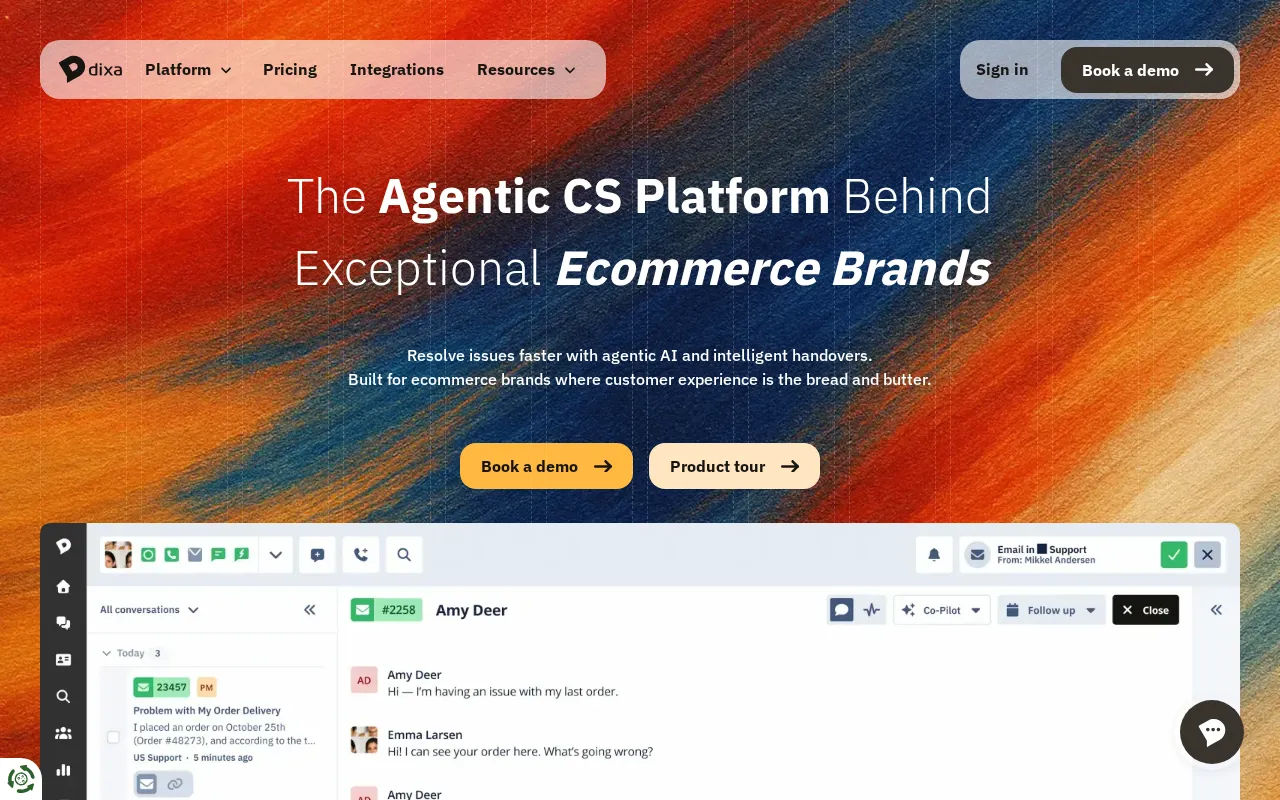
Dixa is a customer service platform for ecommerce brands, founded in Copenhagen in 2015. Phone, email, chat, WhatsApp, social and SMS share one workspace, and Mim, its AI agent, answers customers and acts on their Shopify orders.
Every Dixa plan includes phone with call recording and voicemail, which suits a contact lens seller that checks prescriptions by phone. Mim works on Shopify orders across chat, email and messaging, and contracts run 12 months, priced in euros.
- Best for
- Mid-market ecommerce brands that run phone support alongside messaging and want one AI agent across every channel, on a yearly contract.
- How it bills
- Per agent a month in euros or pounds, billed annually: Growth is €89 and Ultimate €139, and Prime is priced by sales. Mim, the AI agent, is in every plan at a flat €0.40 per conversation, whether it resolves the conversation or hands it to your team. Copilot, which drafts and summarizes for agents, is €39 more an agent, and Quality Assurance €29. Proactive WhatsApp messages and call minutes are billed by use. Contracts run 12 months and renew unless cancelled 3 months ahead.
- Free plan
- No, and no self-serve trial: every rollout starts with a demo
- 3 people, 300 AI replies
- $433 a month: 3 Growth agents at €89 on annual billing, plus 300 Mim conversations at €0.40: €387, about $433 at $1.12 to the euro.
Pros
- Phone with IVR, call recording, callbacks and voicemail comes in every plan, alongside email, chat, WhatsApp, Instagram, Messenger and SMS.
- Mim handles refunds, cancellations, tracking and order changes through Shopify, on chat, email, messaging and, in beta, phone calls.
- Mim costs the same €0.40 for every conversation, with no allowance to run past and no fee per resolution.
- Mim’s AI processing runs inside the EU, and customer data never trains AI models.
Cons
- No free plan and no self-serve trial: you book a demo, and most teams go live in 2 to 4 weeks.
- Growth is €89 an agent a month on annual billing before any AI, and Copilot for your agents is €39 more each.
- Contracts renew for another 12 months unless you give written notice 3 months before the term ends, can’t be cancelled or downgraded mid-term, and rise 5% a year.
- Its MCP server is an open-source beta that Dixa’s support doesn’t cover, and it can’t look up or refund an order.
Already on Dixa? See the best Dixa alternatives.
5. Kustomer
Kustomer is a customer service platform built around one timeline per customer, with chat, email, SMS, WhatsApp, voice and social in one place, and Concierge, an AI agent that answers customers.
Kustomer lists HIPAA as an add-on at $25 a user a month, for a brand that keeps prescription records, and teammates cancel or refund single items of a Shopify order, such as one pair of several. Prices come from sales, and contracts renew unless you give written notice 30 days before the term ends.
- Best for
- Mid-size and large consumer brands that want every order, conversation and channel on one customer timeline, and buy through a sales team.
- How it bills
- Plan prices are quoted by sales: Enterprise and Ultimate today, with older seat-based and usage-based plans still listed. Published add-ons include Concierge at $0.75 per engaged conversation, Envoy at $50 a user a month, and voice from $0.02 a minute.
- Free plan
- No, and no self-serve trial
- 3 people, 300 AI replies
- $225 or more a month: 300 Concierge conversations at $0.75, plus a platform price Kustomer quotes only on a sales call.
Pros
- Chat, email, SMS, WhatsApp, voice, Facebook and Instagram share one timeline for each customer.
- Concierge answers on chat, email, SMS, WhatsApp and voice, and you decide where it acts alone and where it hands off.
- Agents can cancel or refund Shopify order items from the customer’s timeline.
- Built to scale, with up to 300 brands and a 2,000-request-a-minute API on Ultimate.
Cons
- No plan price is published: you fill in a two-minute assessment, then talk to sales.
- No free plan and no self-serve trial.
- Its official MCP server only reads, so your own AI can search conversations but can’t reply, add notes or close.
- Contracts renew automatically unless you give written notice 30 days before the term ends, and fees are non-refundable.
Already on Kustomer? See the best Kustomer alternatives.
6. Hiver
Hiver is a help desk for teams that work from email. It sells two versions at the same prices: Hiver in Gmail, and Hiver Omni, a standalone app for email, live chat, WhatsApp, voice and Slack.
Hiver’s Elite plan adds HIPAA compliance, and Hiver Omni joins email, chat, WhatsApp and voice in one app, with voice at $30 a voice seat. Its AI agents pause on actions you mark sensitive.
- Best for
- Teams that run support from Gmail or Outlook and want shared inboxes, SLAs and AI agents that Hiver’s engineers set up with them.
- How it bills
- Per user, from 2 seats: Growth is $25, Pro $55 and Elite $85 a user a month on annual billing ($35, $65 and $95 monthly). AI agents come on every plan with no published price, and voice is $30 a voice seat.
- Free plan
- No, 7-day trial of Elite
- 3 people, 300 AI replies
- $75 or more a month: 3 Growth users at $25 on annual billing. AI agents come with every plan, but Hiver doesn’t publish what their work costs.
Pros
- Hiver in Gmail keeps your team in the Gmail it knows, and Hiver Omni brings email, live chat, WhatsApp, voice and Slack into one app.
- Its AI agents look up orders, issue refunds and update records in other systems, and pause for approval on actions you mark sensitive.
- Hiver’s engineers build the agent’s integrations with your team, including tools that have no API.
- Elite adds AI quality scoring, skill-based routing, SSO and HIPAA compliance.
Cons
- Every user is a seat from 2 up, and Growth stops at 10 users and 2 shared inboxes.
- The API starts at Pro, at $55 a user a month on annual billing.
- Hiver doesn’t publish what its AI agents cost, saying only that you pay for work correctly delivered.
- Its official MCP can assign, close and add notes, but can’t send a reply, only save a draft.
Already on Hiver? See the best Hiver alternatives.
7. Keeping
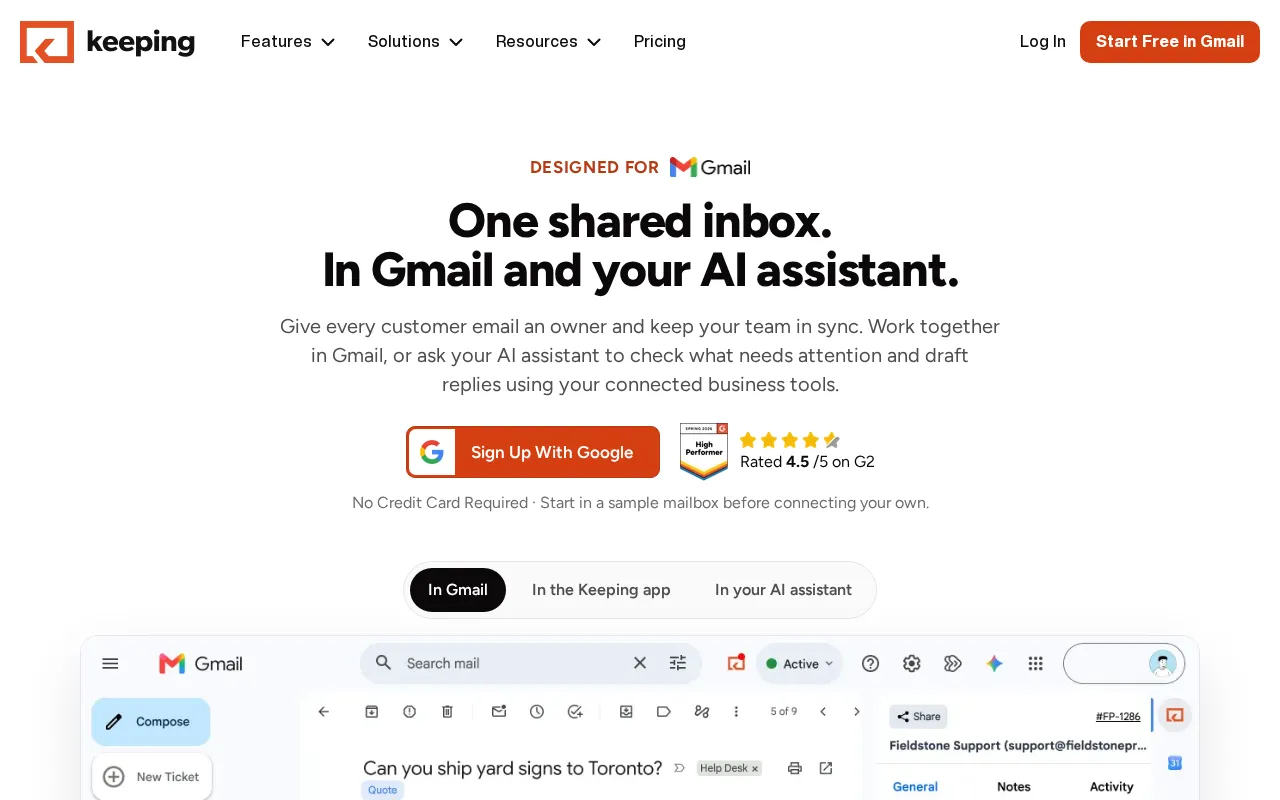
Keeping turns a shared Gmail address such as support@ into a shared inbox inside Gmail, where every email gets an owner, a status and internal notes. It adds a web and mobile app, workflows, reports and an MCP server, but no live chat, help center or AI that answers customers.
For prescriptions that arrive by email, Keeping’s HIPAA plan, $49 a user a month on annual billing, comes with a signed Business Associate Agreement (BAA), and every email stays in your Google Workspace mailbox.
- Best for
- Teams on Google Workspace that answer email from Gmail and want clear owners and no double replies.
- How it bills
- Essentials is $14 a user a month on annual billing ($19 monthly), with 2 shared mailboxes and up to 10 users. Advanced is $24 ($29 monthly) and adds unlimited mailboxes, CSAT, SLAs, round robin and integrations such as Shopify. HIPAA is $49 ($59 monthly) with a signed BAA. Every plan has a 2-user minimum.
- Free plan
- No, 14-day trial with no card
- 3 people, 300 AI replies
- $42 a month: 3 Essentials users at $14 on annual billing, with no AI answering customers.
Pros
- Emails stay in your Google Workspace mailbox, and customers get a normal reply from the shared address.
- Collision detection shows when a teammate is reading or already replying to an email.
- Its official MCP server has more than 80 tools for Claude, ChatGPT and other AI assistants, and drafts replies for a person to send.
- A HIPAA plan comes with a signed BAA.
Cons
- Keeping is for Gmail and Google Workspace: it isn’t for teams that work in Outlook.
- Email only: no live chat, phone or social channels, and no help center.
- No AI answers customers, and the MCP server creates drafts but never sends.
- Shopify, CSAT, SLAs and the full MCP need Advanced at $24 a user on annual billing.
Already on Keeping? See the best Keeping alternatives.
8. Freshdesk
Freshdesk is Freshworks’ help desk: email ticketing with a customer portal and knowledge base, with Freshdesk Omni adding chat, phone and messaging. Its Freddy AI agent answers customers and is billed per session.
Freshdesk Omni brings phone, WhatsApp and Messenger into its tickets, voice costs $15 to $69 more an agent, and day passes from $2 let an optician in one of your shops take the odd ticket. SLA policies and skill-based routing come on the higher plans.
- Best for
- Teams that want a full ticketing help desk with SLAs, routing and a knowledge base, and chat and messaging for less per agent than Zendesk’s Suite Team.
- How it bills
- Per agent on annual billing: Growth is $19, Pro $55 and Enterprise $89 a month, or $29, $79 and $119 on Freshdesk Omni with chat and messaging. Freddy AI agent sessions cost $49 per 100 after 500 free ones, once per account. Voice is $15 to $69 more an agent, and MCP actions $15 per 1,000.
- Free plan
- No, 14-day trial
- 3 people, 300 AI replies
- $204 a month: 3 Growth agents at $19 on annual billing, plus 3 packs of 100 AI sessions at $49, on email only.
Pros
- SLA policies, custom dashboards, skill-based routing and audit logs come on its higher plans, with skill-based routing at $89 an agent where Zendesk asks $115.
- Freshdesk Omni adds chat, phone, WhatsApp, Messenger, Instagram and Line to the same tickets.
- Day passes from $2 let occasional helpers answer without a full seat.
- Its official MCP server can reply, add notes, update tickets and write knowledge base articles.
Cons
- List prices rose early in 2026, from $15 to $19 an agent on Growth, and the free plan is gone.
- Freddy AI agent costs 49 cents a session after the first 500, which never come back.
- Every MCP call counts as an action, and Growth includes only 1,200 a year.
- Fees are non-refundable, and a cancellation only takes effect at the end of your term.
Already on Freshdesk? See the best Freshdesk alternatives.
9. Zoho Desk
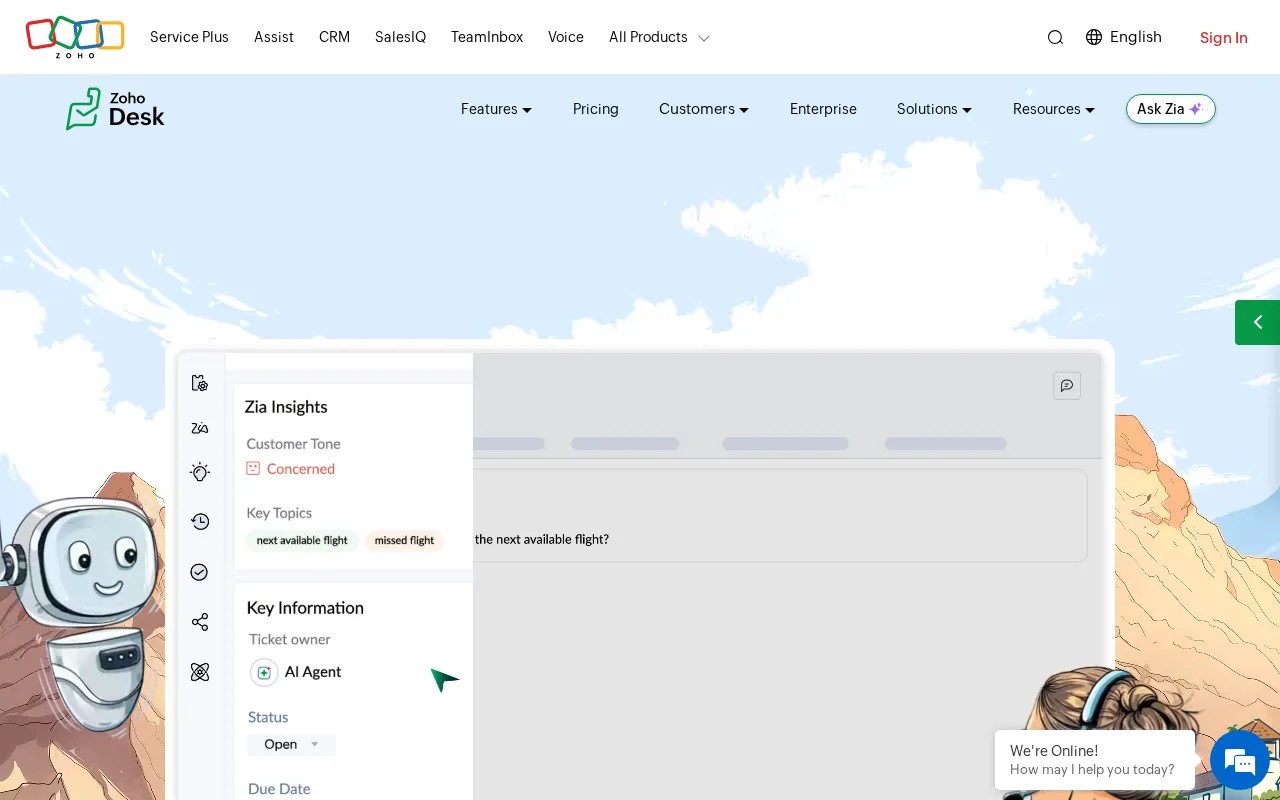
Zoho Desk is the help desk in Zoho’s suite of business apps, with tickets from email, social media, chat, WhatsApp and phone, a multilingual help center, and Zia, Zoho’s AI.
Zoho Desk adds phone support on Professional, $23 a user a month on annual billing, along with a help center you can publish in over 40 languages for lens and frame guides. Express starts at $7 a user but stops at 5 users and has no live chat.
- Best for
- Budget-minded teams that want a full ticketing suite with workflows and SLAs, especially if they already use other Zoho apps.
- How it bills
- Per user: Express is $7, Standard $14, Professional $23 and Enterprise $40 a month on annual billing ($9, $20, $35 and $50 monthly), and light agents are $6 each. Express allows up to 5 users; Standard and above have no user limit. AI agents include up to 30 million free tokens a month. Other generative features run on a key you bring from an AI provider, and Professional and Enterprise add Zia’s own.
- Free plan
- Yes: 3 users, email only
- 3 people, 300 AI replies
- $42 a month: 3 Standard users at $14 on annual billing, the first plan with live chat and Answer Bot, which answers customers from your help center. Zoho publishes no per-answer fee.
Pros
- Low seat prices: Express is $7 a user and Standard $14 on annual billing, with a free plan for 3 users.
- Standard adds live chat, WhatsApp, Telegram and other messaging apps, and Professional adds phone support.
- Workflows, SLAs and several departments, with a help center you can publish in over 40 languages on Professional.
- Zoho’s official MCP server is free and can read tickets, send replies and add comments.
Cons
- Express stops at 5 users, so a sixth teammate moves everyone to Standard at $14.
- Zia’s full AI needs Professional, and the agent that answers email tickets is open only to selected accounts.
- The MCP server has no tools for help center articles or saved replies, and every call uses daily API credits.
- Express has no live chat, and the free plan covers email only.
Already on Zoho Desk? See the best Zoho Desk alternatives.
10. Gorgias
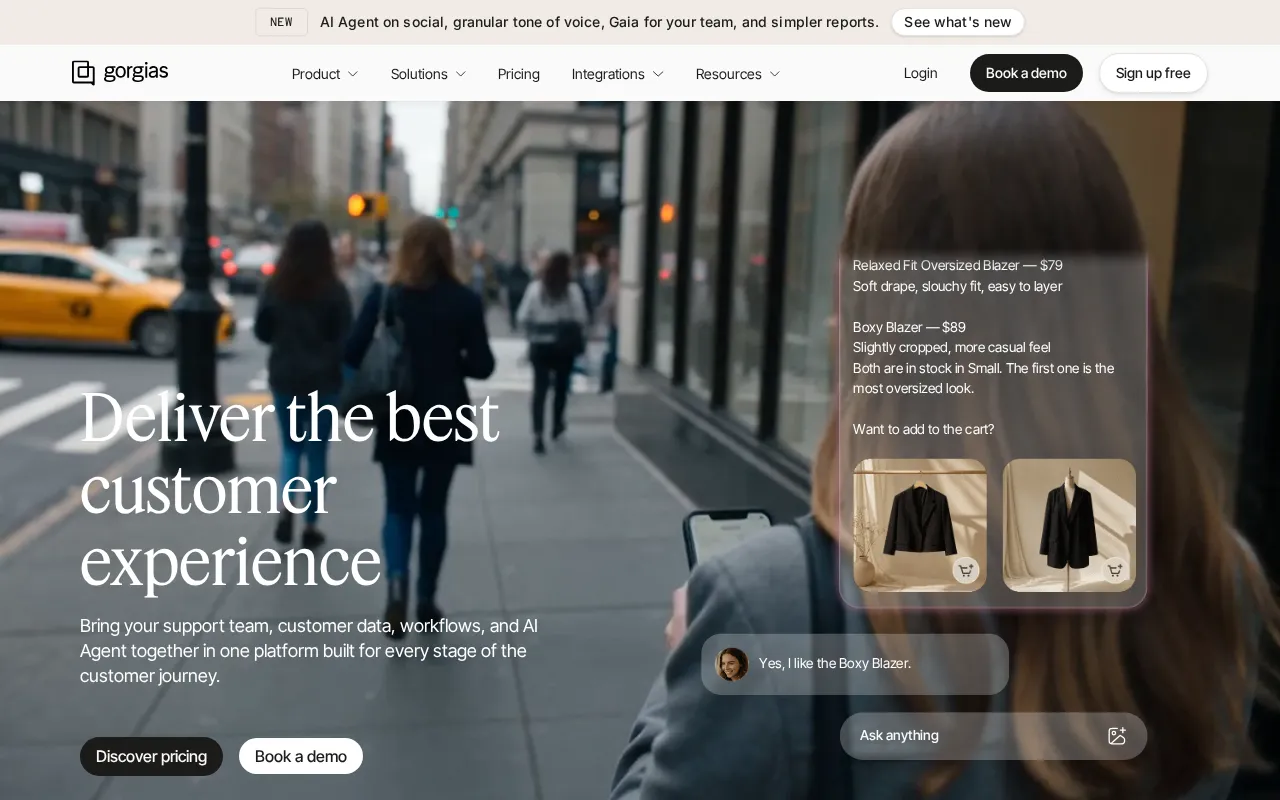
Gorgias is a help desk for ecommerce brands, built around Shopify, with an AI that answers shoppers and can cancel orders or edit addresses. It bills by tickets, not by agents.
Gorgias shows the Shopify order in each ticket and offers voice and SMS add-ons, with no seat price from Basic up. It bills by the ticket, so a frame launch that floods the inbox raises the bill, and a ticket its AI resolves is billed twice.
- Best for
- Shopify brands with a large team that answer on email, chat, SMS, WhatsApp, social and phone from one inbox.
- How it bills
- By the ticket, never per agent: Starter is $10 a month for 50 tickets, and Basic $50 for 300, Pro $300 for 2,000 and Advanced $750 for 5,000 on annual billing ($60, $360 and $900 monthly). Gorgias AI Agent costs $0.90 per automated interaction on annual billing or $1.00 monthly, $1.50 past your tier, and each one also counts as a ticket.
- Free plan
- No, 7-day trial
- 3 people, 300 AI replies
- $320 or more a month: Basic at $50 on annual billing for 300 tickets, plus 300 AI interactions at $0.90 with the AI limit raised to cover them, each also counted as a ticket and $1.50 past that limit.
Pros
- Shopify orders, customers and products show inside every ticket, and Gorgias says 40% of Shopify brands use it.
- Email, chat, SMS, WhatsApp, Instagram, Facebook and phone land in one inbox.
- No seat price: Basic and above allow up to 500 users.
- Its official MCP server lets Claude or ChatGPT reply, assign, close, write macros and publish help center articles on every Helpdesk plan.
Cons
- A ticket the AI resolves on its own is billed twice, as a ticket and as an automated interaction.
- Interactions past your AI tier cost $1.50 each, and tickets past your plan $0.36 to $0.40.
- Cancelling takes written notice 30 days before the term ends, even on monthly billing, and fees aren’t refunded.
- The MCP server is in open beta and has no tool to look up or refund an order.
Already on Gorgias? See the best Gorgias alternatives.
11. Crisp
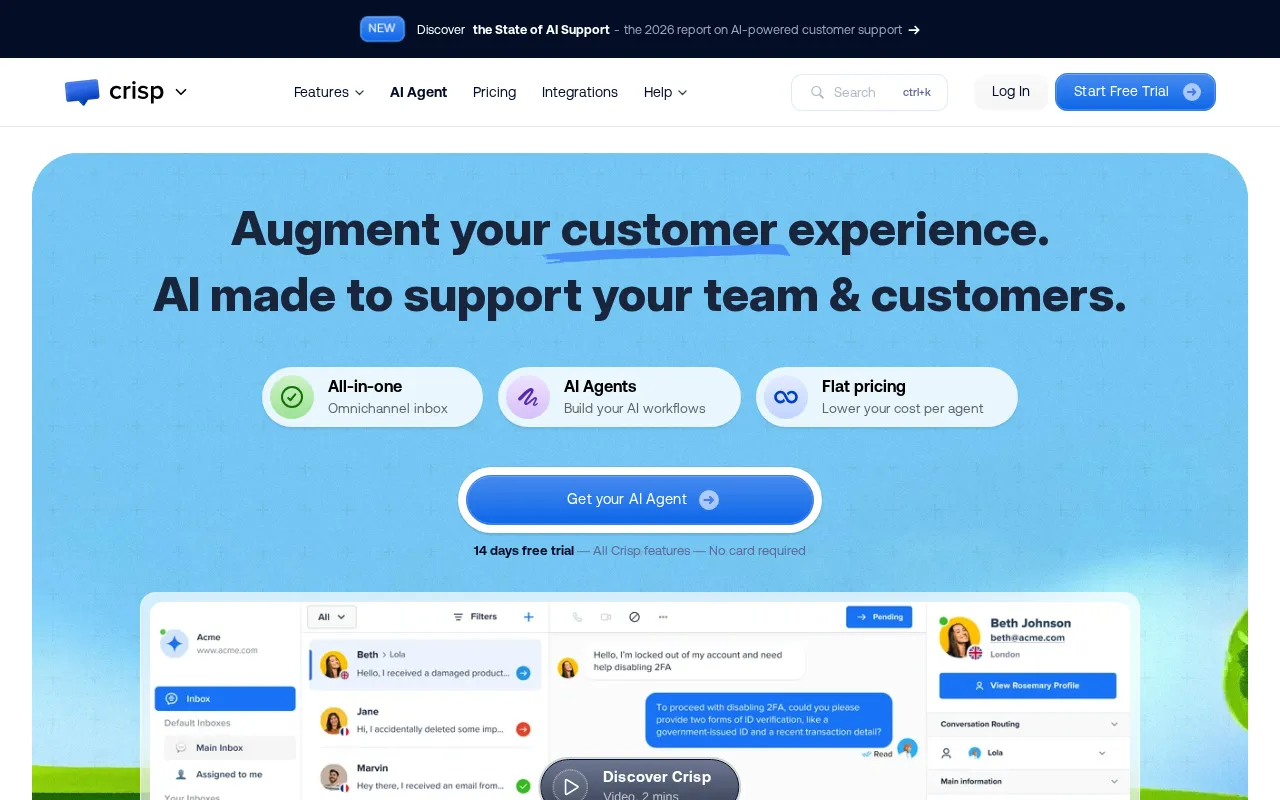
Crisp is a French customer support platform built around a website chat widget, with a shared inbox, many messaging channels and Hugo, its AI agent.
Crisp charges by workspace, $95 a month for 10 seats on Essentials, so shop staff can share one price, and phone and SMS join the same inbox as chat. Hugo can refund a returned pair through Shopify, after a one-time code checks the customer if you turn that on, and Crisp refunds no fees.
- Best for
- Small teams that start with free website chat and want WhatsApp, Instagram, SMS and phone in the same inbox later.
- How it bills
- Per workspace a month: Mini is $45 with 4 seats, Essentials $95 with 10 and Plus $295 with 20, including $5, $25 and $75 of AI credits (about 90, 450 and 1,350 Hugo conversations). Extra seats are $10 each, sold on Plus only, and Hugo past the credits runs on Pay-As-You-Go at about $0.05 to $0.10 a conversation.
- Free plan
- Yes: 2 seats, chat only, no AI
- 3 people, 300 AI replies
- $66 or more a month: Mini at $45 for 4 seats with about 90 Hugo conversations in its credits, plus about 210 more at about $0.10 each.
Pros
- One price per workspace, with 10 seats on Essentials for $95 a month.
- WhatsApp, Instagram, Messenger, SMS, Telegram and phone sit in the same inbox from Essentials.
- Its official MCP server can read, reply, add notes, resolve and write help center articles.
- Hugo can look up orders and refund through Shopify, WooCommerce, PrestaShop and Stripe, after a one-time code checks the customer.
Cons
- The free plan has no email inbox and no AI, and Mini has no help center, WhatsApp or MCP server.
- Hugo stops answering when the month’s credits run out unless you turn on Pay-As-You-Go, whose rates aren’t published.
- Stripe data in the inbox comes only with Plus at $295 a month.
- Crisp’s terms refund no fees, monthly or yearly.
Already on Crisp? See the best Crisp alternatives.
12. Helpwise
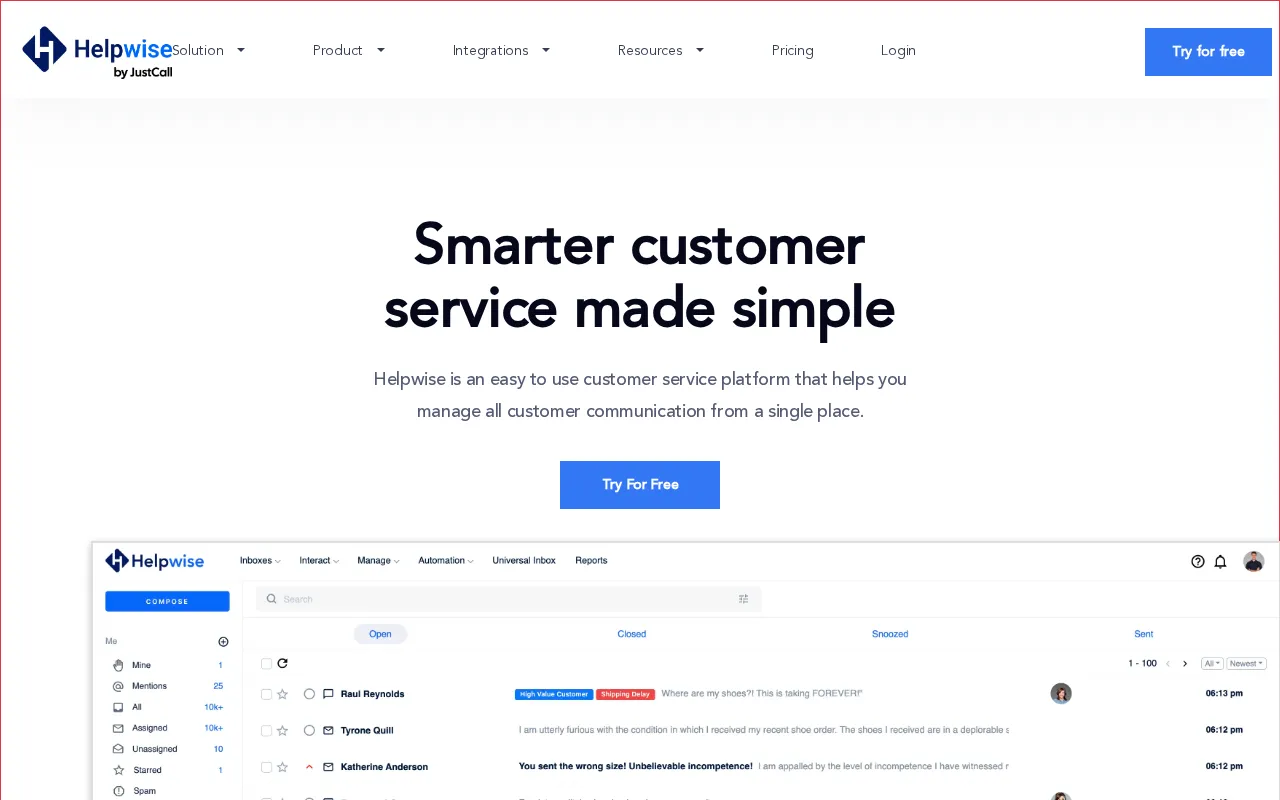
Helpwise is a shared inbox for email, live chat, WhatsApp, SMS, calling and social messages, made by SaaS Labs, the company behind JustCall. It includes help centers, a menu chatbot and an AI that drafts replies.
Helpwise adds calling and SMS beside email from Premium, $23 a user on annual billing, so calls about fit and lenses land in the same inbox, and shows Shopify orders next to each conversation. Its AI only drafts, so a person sends every answer, and Standard leaves Shopify out.
- Best for
- Small teams that want WhatsApp, SMS and calls beside email at a low seat price, and are happy writing every reply themselves.
- How it bills
- Per user: Standard is $12, Premium $23 and Advanced $39 a user a month on annual billing ($15, $29 and $49 monthly), with Standard for 2 to 10 users, Premium from 2 and Advanced from 3. Add-ons on annual billing: the chatbot is $8 a user on Premium ($10 monthly), 3 more inboxes are $42 ($49 monthly) and the cloud phone system is $4 an active user ($5 monthly). AI drafts use prepaid credits topped up from $5.
- Free plan
- No, 7-day trial
- 3 people, 300 AI replies
- $69 or more a month: 3 Premium users at $23 on annual billing, plus prepaid credits for AI drafts, not counted here. No AI answers customers.
Pros
- WhatsApp, SMS, calling, Facebook and Instagram sit in one inbox with email and live chat from Premium.
- Standard is $12 a user a month on annual billing for a plain shared inbox with live chat and a help center.
- Advanced holds up to 30 shared inboxes and 5 help centers, with the chatbot and calling included.
- Shopify orders and Stripe subscriptions show beside each conversation.
Cons
- Its AI drafts replies for agents but never answers a customer by itself.
- There is no official MCP server, and the API needs Premium or above.
- Every charge is non-refundable, and cancelling an annual plan only stops the renewal.
- Standard caps saved replies at 15 and automation rules at 3, and has no API or Shopify.
Already on Helpwise? See the best Helpwise alternatives.
13. Intercom
Intercom is a customer service help desk with a chat Messenger, a shared inbox, a help center and Fin, its AI agent. Its company renamed itself Fin in May 2026, and Salesforce bought it that September.
Intercom lists HIPAA support on Expert, $132 a seat a month on annual billing, and Fin answers by email, chat and phone. Teammates refund or cancel a Shopify order from the sidebar, and each teammate who replies is a paid seat.
- Best for
- Software and app companies that want chat, email, phone, WhatsApp and SMS in one inbox, with Fin answering across them.
- How it bills
- Per seat: Essential is $29, Advanced $85 and Expert $132 a seat a month on annual billing ($39, $99 and $139 monthly), and new customers pay $19 for Essential on annual billing. Fin costs $0.99 for each outcome, and WhatsApp, SMS and phone are billed by use.
- Free plan
- No, 14-day trial
- 3 people, 300 AI replies
- $354 a month: 3 Essential seats at $19, the new-customer price on annual billing (list $29), plus 300 Fin outcomes at $0.99.
Pros
- Chat, email, phone, WhatsApp, SMS, Slack, Facebook and Instagram all arrive in one inbox.
- Fin answers on email, live chat and phone, and is charged once per conversation however many questions it answers.
- Agents can refund or cancel a Shopify order from the inbox sidebar, and the Stripe app shows subscriptions mid-conversation.
- Its official MCP server can add internal notes and write and publish help center articles, not only read.
Cons
- Every teammate who replies needs a paid seat, and Fin adds $0.99 an outcome on top.
- An outcome also counts when a customer simply stops asking after Fin’s answer, or when a Fin workflow hands the conversation to your team.
- Its MCP server can’t reply to customers, assign or close conversations, and doesn’t serve workspaces hosted in Australia.
- No free plan, and an annual plan cancelled early gets no prorated refund.
Already on Intercom? See the best Intercom alternatives.
14. Zendesk
Zendesk is a customer service suite for email, messaging, live chat, social and voice, with AI agents that answer customers and are billed per automated resolution.
Zendesk’s AI agents answer by email, messaging or voice, and teammates refund or cancel Shopify orders inside a ticket, a fit for an optical chain with a large team. Each agent is a seat, and automated resolutions past a plan’s allowance cost $1.50 to $2.00.
- Best for
- Growing and large teams that need voice, many channels, 1,800+ apps and integrations, and enterprise controls to grow into.
- How it bills
- Per agent: Support Team is $19, Suite Team $55 and Suite Professional $115 a month on annual billing ($25, $69 and $149 monthly). Each agent brings 5 automated resolutions a month (10 on Professional), then each costs $1.50 committed or $2.00 pay as you go. Copilot is $50 more an agent.
- Free plan
- No, 14-day trial
- 3 people, 300 AI replies
- $485 a month: 3 Support Team agents at $19 on annual billing, plus 285 automated resolutions at $1.50 committed beyond the 15 included, on email only.
Pros
- Email, messaging, live chat, WhatsApp, social and voice sit in one Suite, and AI agents can answer on email, messaging or voice.
- Its marketplace lists 1,800+ apps, partners and integrations.
- Agents refund and cancel Shopify orders inside a ticket, and an admin can connect Zendesk’s AI agents to Stripe’s MCP server.
- The 14-day trial opens every Suite Professional feature, Copilot included, and startups can get 6 months of Suite free for up to 50 agents.
Cons
- Every agent is a seat, and each automated resolution past the 5 per agent a plan includes costs $1.50 to $2.00.
- No official MCP server for outside AI tools yet: Zendesk announced one in May 2026 for early access and has published no tools for it.
- Data exports are off until the account owner asks support, and the export tools aren’t on Team plans.
- Zendesk gives no refunds or credits for unused seats or time.
Already on Zendesk? See the best Zendesk alternatives.
15. Richpanel

Richpanel is an AI help desk for ecommerce brands. One inbox takes email, chat, social, SMS, WhatsApp and phone, and its AI answers customers and acts on orders, returns and subscriptions.
Richpanel starts with your team approving every AI reply, and you choose which actions run on their own, so a refund or cancellation on a pricey prescription order can wait for a person. Its voice channel is in beta and billed on usage, and one seat with the AI minimum starts at $299 a month.
- Best for
- Ecommerce brands with a support team that want AI to change orders and subscriptions across many channels.
- How it bills
- One plan with no tiers: $99 a seat a month on annual billing or $119 monthly, plus AI credits at $0.50 each annually or $0.60 monthly, with a $200 monthly AI minimum on annual billing ($240 monthly in Richpanel’s calculator). Richpanel puts a whole AI conversation at about $0.20, and one seat with the minimum starts at $299 a month.
- Free plan
- No, demo only
- 3 people, 300 AI replies
- $497 or more a month: 3 seats at $99 on annual billing plus the $200 AI minimum, which more than covers 300 AI conversations at about $0.20.
Pros
- Its AI changes addresses, swaps items, gives store credit and pauses subscriptions, while cancellations, refunds and discounts wait for approval by default.
- Email, chat, SMS, WhatsApp, Instagram, Facebook, TikTok and phone share one inbox.
- It connects to subscription and shipping apps such as Recharge, Subscribfy and ShipHero, not only Shopify.
- A written guarantee: if AI doesn’t resolve half of eligible conversations in the first 30 days, you can claim that month’s subscription fee back.
Cons
- One seat with the AI minimum starts at $299 a month on annual billing, and each extra seat is $99.
- No free plan or trial: you book a demo first.
- The developer API is only for Enterprise, and the MCP shares 60 requests a minute across your whole company.
- Voice is still in beta and billed on usage.
Already on Richpanel? See the best Richpanel alternatives.
16. Re:amaze
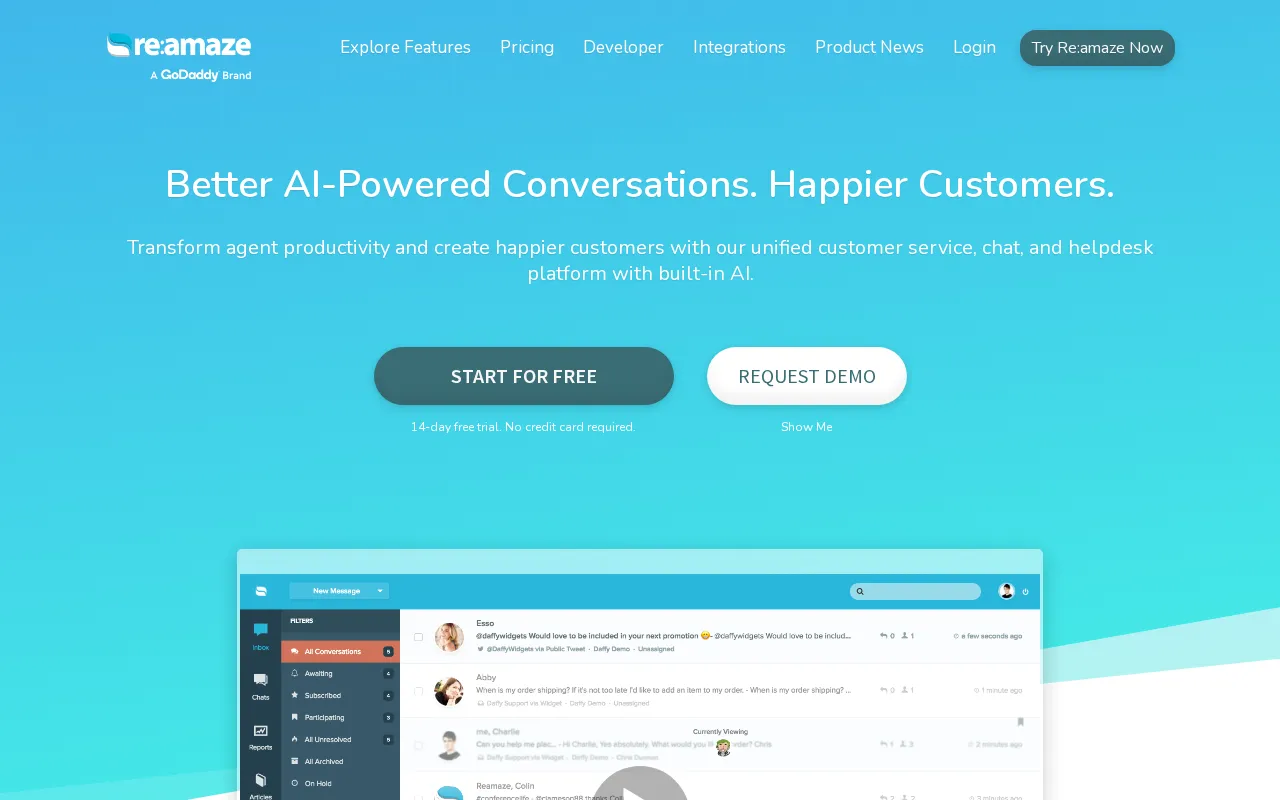
Re:amaze is a help desk for online stores, owned by GoDaddy, with email, live chat, social, SMS and voice in one inbox and an AI agent that answers from your FAQ and store data.
An eyewear company with several frame brands can run them from one Re:amaze account on Pro or Plus, and Pro adds SMS and voice at $44.10 a team member on annual billing. Teammates refund or cancel Shopify orders and refund Stripe payments in the conversation, and each AI resolution past the 10 or 20 per seat on those plans costs $0.85.
- Best for
- Shopify and WooCommerce stores that run several brands and want social, SMS and voice next to email and chat.
- How it bills
- Basic is $29, Pro $49 and Plus $69 a team member a month ($26.10, $44.10 and $62.10 on annual billing), with 5, 10 or 20 AI agent resolutions per seat, then $0.85 each. Starter is $59 a month for unlimited team members and up to 500 responded conversations, with no published AI allowance.
- Free plan
- No, 14-day trial
- 3 people, 300 AI replies
- $321 a month: 3 Basic seats at $26.10 on annual billing, plus 285 AI agent resolutions at $0.85 after the 15 included.
Pros
- Email, live chat and social channels on every plan, with SMS and voice from Pro.
- Pro and Plus run unlimited brands from one account.
- Agents can refund and cancel Shopify orders and refund Stripe payments from inside a conversation.
- Starter gives unlimited team members for $59 a month, up to 500 responded conversations.
Cons
- Each AI resolution past the 5 to 20 per seat costs $0.85, so a busy month adds up fast.
- The AI agent is still labeled beta on the homepage, and no page says it can refund or cancel.
- No official MCP server, so Claude or ChatGPT can only reach it through the REST API or third-party connectors.
- All fees are non-refundable, and closing the account permanently deletes every conversation.
Already on Re:amaze? See the best Re:amaze alternatives.
17. Lorikeet
Lorikeet is an AI customer support platform for complex and regulated businesses, such as fintech, health tech and insurance. Its Concierge agent resolves customers’ issues on chat, email, voice, SMS and WhatsApp by acting through your own systems, inside the help desk you already run, such as Zendesk, Intercom, Salesforce or HubSpot, and hands what it can’t solve to your team there.
Lorikeet suits an eyewear seller that wants its AI under HIPAA terms: it is built for regulated businesses such as health tech and signs a Business Associate Agreement for HIPAA. Start is $2,100 a month paid annually, before any resolution is billed.
- Best for
- Fintech, health tech and insurance companies with multi-step workflows to automate through their own APIs, a help desk they keep, and room for an annual plan from $2,100 a month.
- How it bills
- Start is $2,100 a month and Scale $5,100 a month, both paid annually, and each resolved chat, email or SMS ticket costs $0.99 or $0.90 on top, or $1.50 or $1.20 for a voice call. Escalations, unresolved tickets and tickets you mark bad aren’t charged, and there are no seat fees. Routing tags and automated QA cost $0.30 a ticket each on Start, Signature carries a $75K platform fee, and the help desk it answers in bills separately.
- Free plan
- No, a 30-day free trial with a card at checkout
- 3 people, 300 AI replies
- $2,397 or more a month: Start at $2,100 a month, paid annually, plus 300 resolutions at $0.99. Your help desk’s seats come on top.
Pros
- Concierge answers on chat, email, SMS, WhatsApp and voice, inbound and outbound, and workflows you train once run on every channel.
- It runs multi-step workflows through your APIs, webhooks and MCP servers, from a Stripe refund to an account update, and escalates to your team with what it already tried.
- Its prices are public, and you pay only for resolved tickets: never for escalations, failed attempts or tickets you mark bad, and never per seat.
- It holds SOC 2 Type 2 and ISO 27001, signs a Business Associate Agreement for HIPAA, and never trains AI models on your data.
Cons
- Start is $2,100 a month paid annually, or $25,200 a year, before the first resolution is billed.
- It isn’t a help desk: it works inside Zendesk, Intercom, Salesforce, HubSpot or another you keep, so that help desk stays on your bill.
- Time to the first live ticket averages under 29 days, while you build workflows and test them on your past tickets.
- Its voice agent can’t take a card payment on a call, because Lorikeet doesn’t hold PCI DSS.
Already on Lorikeet? See the best Lorikeet alternatives.
18. eesel AI
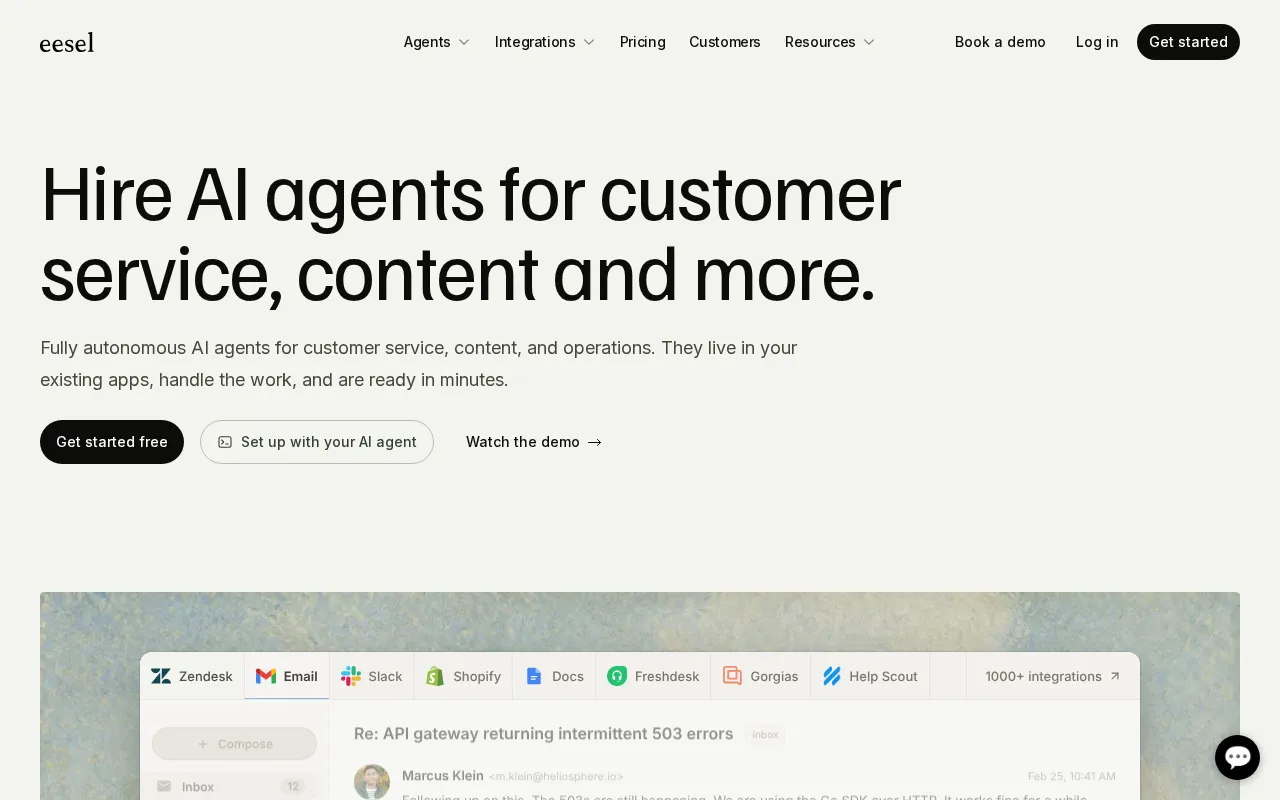
eesel AI is an AI agent that works inside the help desk you already use, such as Zendesk, Freshdesk, Intercom or Gorgias, and in your website chat, Slack and email. It drafts or sends replies from your help center, past tickets and documents.
For an eyewear brand already on another help desk, eesel AI drafts or sends replies inside Zendesk, Freshdesk, Gorgias or Help Scout, with each action set to run, wait for a person or stay off. HIPAA with a signed BAA comes on Enterprise, $1,000 a month on top of a plan that starts at $299.
- Best for
- Teams keeping Zendesk, Freshdesk, Intercom or another help desk that want an AI to draft or send replies there, with each action set to run, ask first or stay off.
- How it bills
- Teammate plans are monthly batches of credits: 500 for $299, 1,000 for $499 and 3,000 for $1,149, up to 5,000 for $1,749. A ticket or a chat is 1 credit however long it runs, and extra credits are $0.80 each up to a monthly cap you set, which starts at $200. Unused credits don’t roll over. Enterprise adds $1,000 a month, and priority support starts at $299 a month.
- Free plan
- No, 7-day trial with 100 credits
- 3 people, 300 AI replies
- $299 or more a month: 300 tickets and chats fit the 500-credit plan at $299. The help desk eesel AI works in bills its seats on top.
Pros
- It works inside the help desk you already use, so your tickets, macros and workflows stay where they are.
- Each action, from a reply to a refund, can run on its own, wait for a person to approve it, or stay off.
- A ticket is 1 credit however many replies go back and forth, with no seat fees and no limit on agents.
- One agent covers Zendesk, Freshdesk, Intercom, Gorgias, HubSpot, Help Scout, Front and Salesforce, plus a website chat bubble, Slack and WhatsApp.
Cons
- It isn’t a help desk: it works inside the one you keep, so that help desk stays on your bill.
- A ticket that wakes the agent uses 1 credit even when the agent decides not to act.
- The smallest plan is $299 a month for 500 credits, and unused credits reset each billing month.
- Default support is eesel AI first, then a human within a few days. Same-day replies need priority support.
Already on eesel AI? See the best eesel AI alternatives.
19. Shopify Inbox
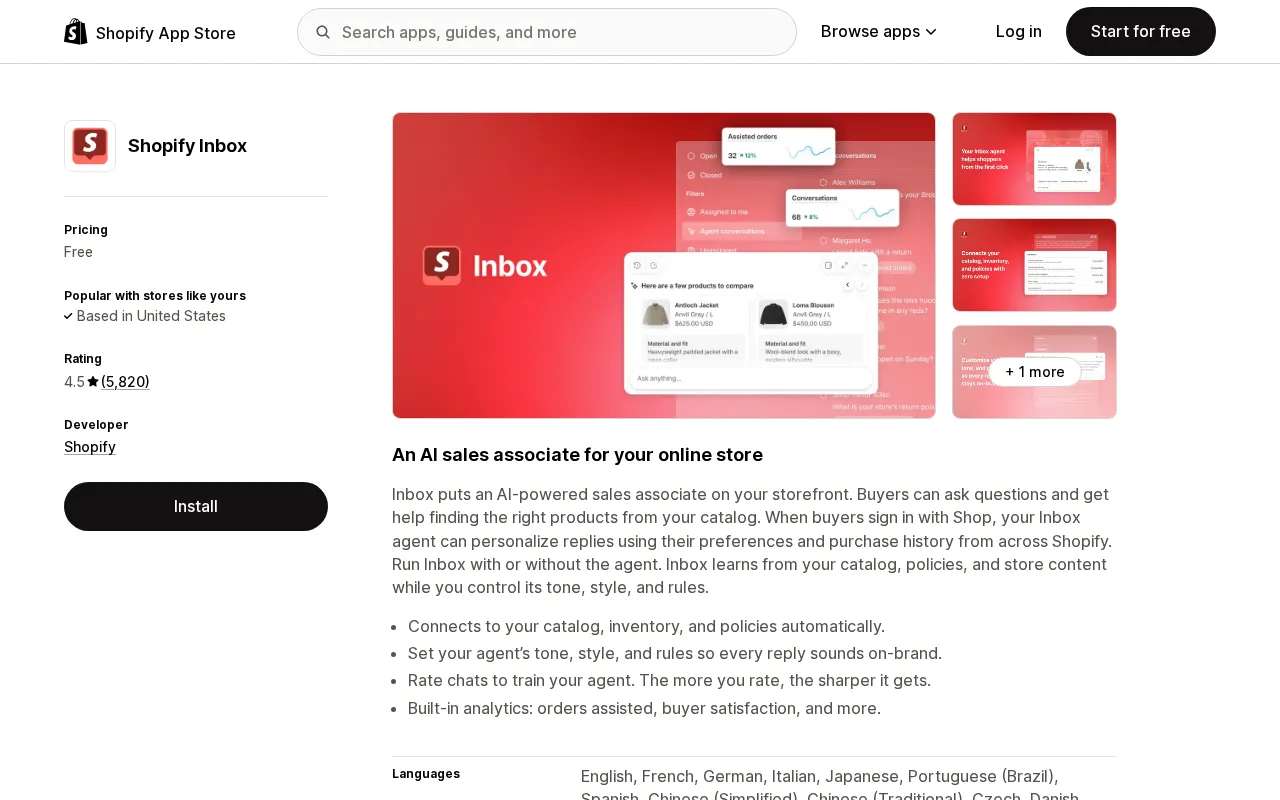
Shopify Inbox is Shopify’s own free chat app for an online store, with an AI agent that answers shoppers in the store’s chat and hands them to staff.
Shopify Inbox costs nothing on a paid Shopify plan, and its AI replies in the shopper’s own language from your catalog and policies. It has no email or phone, so prescription files and calls need another home.
- Best for
- Shopify stores where shoppers reach you through the store’s chat and one or two people answer.
- How it bills
- The app is free, with no seat price and no charge for its AI agent. It works only for stores on Shopify’s Basic, Grow, Advanced or Plus plans.
- Free plan
- Yes, a free app on a paid Shopify plan
- 3 people, 300 AI replies
- $0 a month: Free for 3 people, AI agent included, on top of the paid Shopify plan Inbox needs.
Pros
- Free, with its AI agent included and no seat price.
- The AI answers from your catalog, store policies and published pages, and hands a chat to your staff with what it already said.
- Chats live in the Shopify admin and in apps for desktop, iOS and Android.
- It replies to shoppers in their own language.
Cons
- Chat in your online store only: no email inbox, WhatsApp, social messages or phone.
- Shopify’s help pages describe no API or export for its conversations, and its Sidekick can read them but can’t reply, assign or close.
- The AI agent needs new customer accounts and doesn’t work with legacy ones.
- Suggested replies for staff are in English only.
Already on Shopify Inbox? See the best Shopify Inbox alternatives.