Start free

Crisp vs Tidio (2026): pricing, AI and features

By , founder of Rinhelp, which appears in this comparison · Facts checked

The short answer

Crisp suits a small team that talks to customers on many channels, phone and SMS included, and wants one workspace price with credits for Hugo, its AI, built in. Tidio suits a Shopify or WooCommerce store whose teammates answer most chats themselves, with 10 seats on Free, Starter and Growth, and which buys Lyro, its AI, once it wants the bot to recommend products. With AI answering 1,000 conversations a month, a team of 5 pays about $150 on Crisp Essentials (its $95 plan, plus Pay-As-You-Go for about 550 Hugo conversations past its credits at about $0.10 each, an estimate Crisp says varies with your setup and model), and $607.50 or more on Tidio, Starter plus Lyro on annual billing.

See Rinhelp on your own site. Enter your website and Rin builds your help desk from it: a chat widget, a help center and an inbox.

Free. No sign-up to look. Ready in a minute or two.

Is your help center somewhere else?

Rin will read . If your help articles or docs live at another address, like help. or a Notion page, Rin can read those too.

Where is your help center?

Rin reads it along with and turns it into your help center.

Crisp vs Tidio at a glance

ToolBest forHow it billsFree plan3 people, 300 AI replies
CrispSmall teams that start with free website chat and want WhatsApp, Instagram, SMS and phone in the same inbox later.Per workspace, plus AI usageYes: 2 seats, chat only, no AI$66 or more
TidioShopify and WooCommerce stores that want chat, WhatsApp and Instagram in one inbox and an AI that recommends products.By conversation, plus each Lyro conversationYes: 10 seats, 50 conversations a month$199 or more
RinhelpSmall teams that want AI on every conversation at one flat price, and want their own AI agents working in the inbox.One price per workspaceYes: 3 teammates, 50 AI replies to try Rin$49

Key differences

Crisp counts seats, Tidio counts the conversations your team answers

Crisp sells flat workspace plans with a fixed number of seats: Mini at $45 a month holds 4, Essentials at $95 holds 10 and Plus at $295 holds 20, and only Plus lets you buy more, at $10 a seat. Tidio gives Free, Starter and Growth 10 seats each and charges for volume instead: Starter covers 100 conversations your team answers for $29 a month, or $24.17 on annual billing, and Growth climbs to $349 a month for 2,000. So a fifth hire moves a Crisp team off Mini, while on Tidio it is a busier month that moves you up.

Hugo’s credits come in the plan, Lyro is bought on its own

Each paid Crisp plan includes AI credits: $5 on Mini, enough for about 90 Hugo conversations, $25 on Essentials for about 450 and $75 on Plus for about 1,350. Past them, Hugo stops answering unless you switch on Pay-As-You-Go, billed by tokens at roughly $0.05 to $0.10 a conversation. Tidio’s Free and Starter plans hand you 50 Lyro conversations once, and after that Lyro is an add-on from $32.50 a month for 50 to $583.33 for 1,000 on annual billing, with anything larger priced by sales.

Crisp takes calls and texts, Tidio puts messaging on its free plan

From Essentials, WhatsApp, Instagram, SMS and phone land in the same Crisp inbox as chat and email. Below that, Crisp is thinner: Free is chat only for 2 seats with no AI, and Mini still has no WhatsApp or help center. On Tidio, email, WhatsApp, Instagram and Messenger come with every plan, including a Free plan with 10 seats and 50 conversations a month.

Lyro sells to shoppers, Hugo can check who is asking

On Shopify and WooCommerce, Lyro suggests products and drops them into the shopper’s cart, and its actions look up, change or cancel orders and refund them. Hugo issues refunds through MCP servers you connect, and once you switch that on, it asks the customer for a one-time code first. Lyro can call your own MCP servers too.

Crisp’s MCP server works the inbox, Tidio’s reads yesterday’s numbers

On Essentials and Plus, Crisp’s official MCP server lets Claude or another AI agent read conversations, reply, add notes, resolve them and write help center articles. Tidio’s MCP server reads only its Analytics API, which loads data once a day, so an agent can study past chats but can’t answer or close today’s. Tidio’s OpenAPI, for your own integrations, starts on Plus at $300 a month plus usage.

Pricing at three sizes

What each tool costs a month in US dollars, with AI answering, and how each total adds up. Each AI reply counts as one resolved conversation.

Tool3 people, 300 AI replies5 people, 1,000 AI replies10 people, 3,000 AI replies
Crisp$66 or moreMini at $45 for 4 seats with about 90 Hugo conversations in its credits, plus about 210 more at about $0.10 each.$150 or moreEssentials at $95 for 10 seats with about 450 Hugo conversations, plus about 550 more at about $0.10 each.$350 or moreEssentials at $95 for 10 seats, plus about 2,550 Hugo conversations at about $0.10 each, since Crisp bills AI by tokens.
Tidio$199 or moreStarter at $24.17 on annual billing plus 300 Lyro conversations at $175. Starter covers 100 conversations your team answers, and more needs Growth.$608 or moreStarter at $24.17 plus 1,000 Lyro conversations at $583.33, both on annual billing, before any move to Growth for your team’s own conversations.$300 or morePlus from $300 a month plus usage, since Lyro above 1,000 conversations is priced only by sales.
Rinhelp$49Pro for the whole workspace, using 300 of its 5,000 AI replies; Free covers your team if you don’t need AI replies.$49Pro for the whole workspace, using 1,000 of its 5,000 AI replies.$49Pro for the whole workspace, using 3,000 of its 5,000 AI replies.

Features compared

A check means the vendor’s own pages say a plan includes it.

ToolEmailLive chatWhatsAppVoiceHelp centerAI that answers customersShopifyStripeFree planSignup without a sales call
Crisp
Tidio
Rinhelp

What your AI can do in each tool

Connect Claude, ChatGPT or your own AI agent through the vendor’s official MCP server, and this is what it can do of 11 everyday actions: search and read conversations, reply to a customer, add an internal note, assign, close or reopen, search the help center, write or update an article, publish an article, create a saved reply, look up an order, refund or cancel.

ToolThrough official MCPWhat it can doMoney moves wait for a teammate
Crisp6 of 11Search and read conversations, reply to a customer, add an internal note, close or reopen, search the help center, write or update an articleNo refunds or cancellations through MCP
Tidio1 of 11Search and read conversationsNo refunds or cancellations through MCP
Rinhelp11 of 11Search and read conversations, reply to a customer, add an internal note, assign, close or reopen, search the help center, write or update an article, publish an article, create a saved reply, look up an order, refund or cancelYes, a teammate approves first

More on each MCP server, and connectors from other companies, which don’t count:

  • Crisp: The MCP server comes with Essentials and Plus. Hugo can call your own MCP servers too, and its refund tools ask the customer for a one-time code, not a teammate.
  • Tidio: The MCP server reads the Analytics API’s chat and ticket messages. Replying to and solving tickets goes through the OpenAPI on Plus and Premium, not MCP.

Crisp

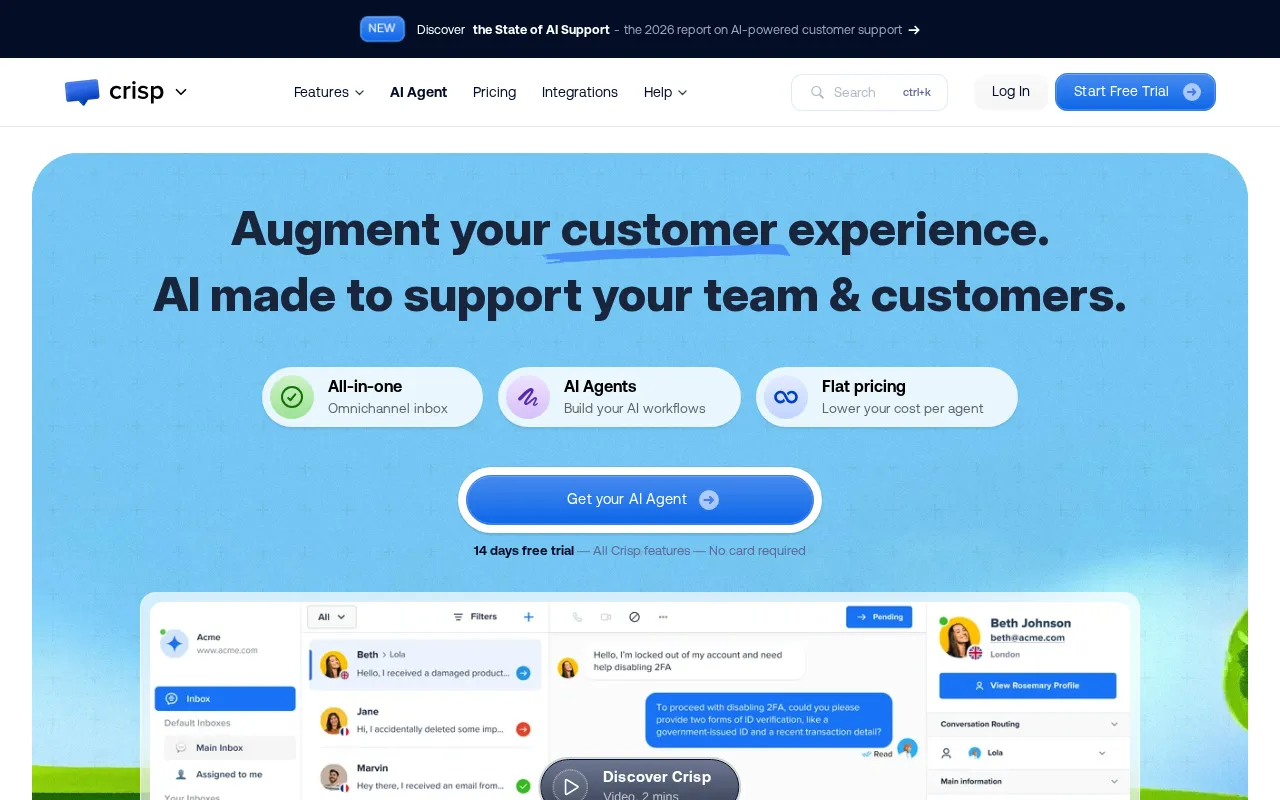
Crisp homepage, November 2026

Crisp is a French customer support platform built around a website chat widget, with a shared inbox, many messaging channels and Hugo, its AI agent.

Best for
Small teams that start with free website chat and want WhatsApp, Instagram, SMS and phone in the same inbox later.
How it bills
Per workspace a month: Mini is $45 with 4 seats, Essentials $95 with 10 and Plus $295 with 20, including $5, $25 and $75 of AI credits (about 90, 450 and 1,350 Hugo conversations). Extra seats are $10 each, sold on Plus only, and Hugo past the credits runs on Pay-As-You-Go at about $0.05 to $0.10 a conversation.
Free plan
Yes: 2 seats, chat only, no AI
3 people, 300 AI replies
$66 or more a month: Mini at $45 for 4 seats with about 90 Hugo conversations in its credits, plus about 210 more at about $0.10 each.

Pros

  • One price per workspace, with 10 seats on Essentials for $95 a month.
  • WhatsApp, Instagram, Messenger, SMS, Telegram and phone sit in the same inbox from Essentials.
  • Its official MCP server can read, reply, add notes, resolve and write help center articles.
  • Hugo can look up orders and refund through Shopify, WooCommerce, PrestaShop and Stripe, after a one-time code checks the customer.

Cons

  • The free plan has no email inbox and no AI, and Mini has no help center, WhatsApp or MCP server.
  • Hugo stops answering when the month’s credits run out unless you turn on Pay-As-You-Go, whose rates aren’t published.
  • Stripe data in the inbox comes only with Plus at $295 a month.
  • Crisp’s terms refund no fees, monthly or yearly.

Already on Crisp? See the best Crisp alternatives.
Tidio

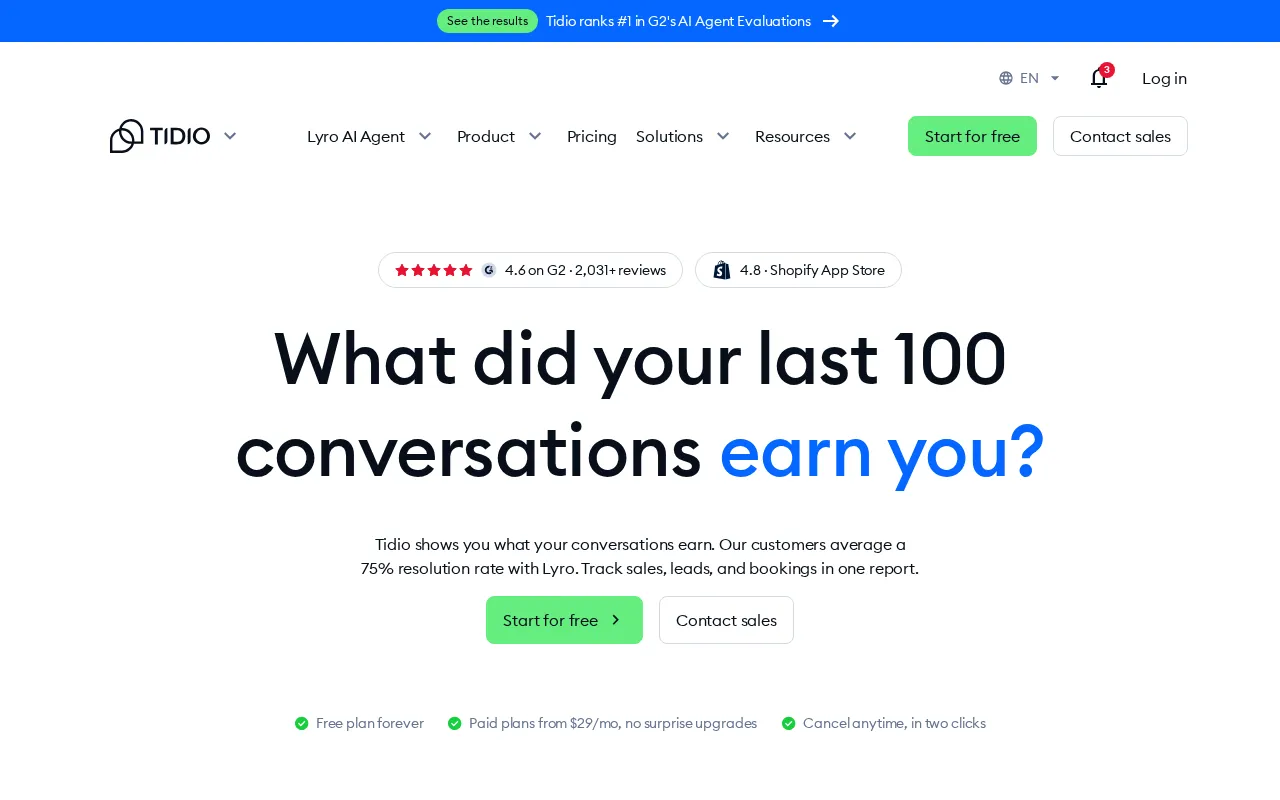
Tidio homepage, November 2026

Tidio is a live chat and help desk tool built for online stores, especially Shopify, with Lyro, an AI agent sold as an add-on, and a help center since 2026.

Best for
Shopify and WooCommerce stores that want chat, WhatsApp and Instagram in one inbox and an AI that recommends products.
How it bills
Plans are priced by the conversations your team answers, with 10 seats: Starter is $24.17 a month on annual billing ($29 monthly) for 100, and Growth runs from $49.17 for 250 ($59 monthly) to $349 monthly for 2,000. Lyro is an add-on from $32.50 a month for 50 conversations to $583.33 for 1,000 on annual billing ($39 for 50, $210 for 300 and $700 for 1,000 monthly), and Plus starts at $300 a month plus usage.
Free plan
Yes: 10 seats, 50 conversations a month
3 people, 300 AI replies
$199 or more a month: Starter at $24.17 on annual billing plus 300 Lyro conversations at $175. Starter covers 100 conversations your team answers, and more needs Growth.

Pros

  • Up to 10 seats on Free, Starter and Growth, so the bill doesn’t grow as you add teammates.
  • WhatsApp, Instagram, Messenger and email on every plan, including Free.
  • Lyro recommends products and adds them to the cart on Shopify and WooCommerce.
  • Lyro’s actions can check orders, cancel or change them and refund, and Lyro can call your own MCP servers.

Cons

  • Lyro is a separate add-on billed per conversation, about $0.58 to $0.78 each by tier and billing, and over 1,000 a month is priced by sales.
  • The API and Stripe integration need Plus, from $300 a month.
  • Its official MCP server only reads analytics data, loaded once a day, so your own AI can’t reply or close.
  • No refunds for time left after you cancel.

Already on Tidio? See the best Tidio alternatives.

Pick Crisp if

  • Customers phone or text you, and you want those calls and SMS beside your chats.
  • Up to 10 teammates should share one $95 workspace, with Hugo’s credits included.
  • Your AI handles hundreds of chats a month, and you’d rather spend included credits and a few cents each than buy a separate AI plan.
  • Claude or another AI agent should reply to, resolve and write articles for your team through an official MCP server.
  • Your team will pass 10 people, and 20 seats on Plus for $295 beats negotiating a custom plan.

Pick Tidio if

  • You run a Shopify or WooCommerce store and want the AI to recommend products and add them to the cart.
  • You want WhatsApp, Instagram and email for 10 people on a free plan while you answer fewer than 50 conversations a month.
  • Your teammates answer about 100 conversations a month, and Starter at $24.17 on annual billing covers them.
  • You already have a help desk and only want an AI on top, through the Lyro-only Core plan from $32.50 a month on annual billing.
  • You want a vendor to guarantee a 50% AI resolution rate and bill per resolution, which Tidio Premium offers through sales.

When to consider Rinhelp instead

Consider Rinhelp if 2 to 10 people answer email and website chat and want AI to answer first without watching a credit balance or buying an AI add-on. Pro is $49 a month for the whole workspace with 5,000 AI replies from Rin, our built-in AI, and Free covers up to 3 teammates. Your own AI agent can reply, assign and close over MCP, and Rinhelp holds anything that moves money or can’t be undone until a teammate approves it, while neither Hugo nor Lyro waits for a teammate before a refund. Rinhelp is the wrong choice if calls, SMS, WhatsApp or Instagram bring in your work, if you need reports or routing rules, or if your chat is a sales counter: Crisp covers those channels and Tidio recommends products, so choose between them. A team that needs SSO should ask Tidio’s sales team about Premium.

Start free

Moving to Rinhelp

From Crisp

Crisp conversations, customer profiles and published “Knowledge Base” articles move through Crisp’s official MCP or its REST API, and shortcuts arrive from a CSV you export. Plan around Crisp’s daily API quota: it has no published number, and a long history may need more than one day. See the full move from Crisp.

From Tidio

Tidio chats and tickets, with internal messages and attachment links, come over its API, which only the Plus and Premium plans include. No way to list Canned Responses was found. Tidio’s help center, open to every plan since 2026, has no API either, so the AI agent reads your published help center pages. See the full move from Tidio.

Questions about Crisp vs Tidio

Which is cheaper for a small store, Crisp or Tidio?

It depends on who answers. If your teammates handle nearly every chat and stay near 100 conversations a month, Tidio Starter at $24.17 on annual billing, with 10 seats, costs less than Crisp Mini at $45 for 4. Once AI takes a real share, Crisp pulls ahead: the $25 of credits in Essentials cover about 450 Hugo conversations, while 300 Lyro conversations alone cost $175 a month on Tidio’s annual billing.

What happens when the AI credits run out?

On Crisp, Hugo goes quiet for the rest of the month, unless you turned on Pay-As-You-Go, which keeps it answering and bills the extra by tokens. On Tidio, the 50 Lyro conversations on Free and Starter are a one-off, so keeping Lyro means buying its add-on, and above 1,000 a month Tidio sends you to sales.

Can I save by paying for a year?

On Tidio, yes: annual billing gives 2 months free, so Starter drops from $29 to $24.17 a month. Crisp publishes no yearly price; you switch to yearly in the app and pay the year up front. Neither hands money back if you leave early, since Crisp’s terms refund no fees and Tidio refunds no time left after you cancel.

Can I take the vendor’s logo off the chat widget?

On Tidio, from Growth, through the “No Tidio branding” add-on at $20 a month, or $16.67 on annual billing. On Crisp, white labelling comes only with Plus at $295 a month, so a team on Essentials keeps the Crisp mark.

How we checked

We compared Crisp and Tidio using the facts we keep on each, checked against the vendor’s own pages on the date shown beside its sources. Rinhelp is in every table because it is our product and we wrote this page, so check each figure against the vendor’s own page before you decide.

Costs are list prices in US dollars for three team sizes, on the cheapest plan that covers them, counting each AI reply as one resolved conversation. Features count only when the vendor’s own pages say a plan includes them. The AI column counts actions an official MCP server from the vendor can take, out of 11, and leaves third-party connectors out.

Try Rinhelp next to Crisp or Tidio.

Start free with up to 3 teammates and 50 AI replies.

Start free