1. Rinhelp
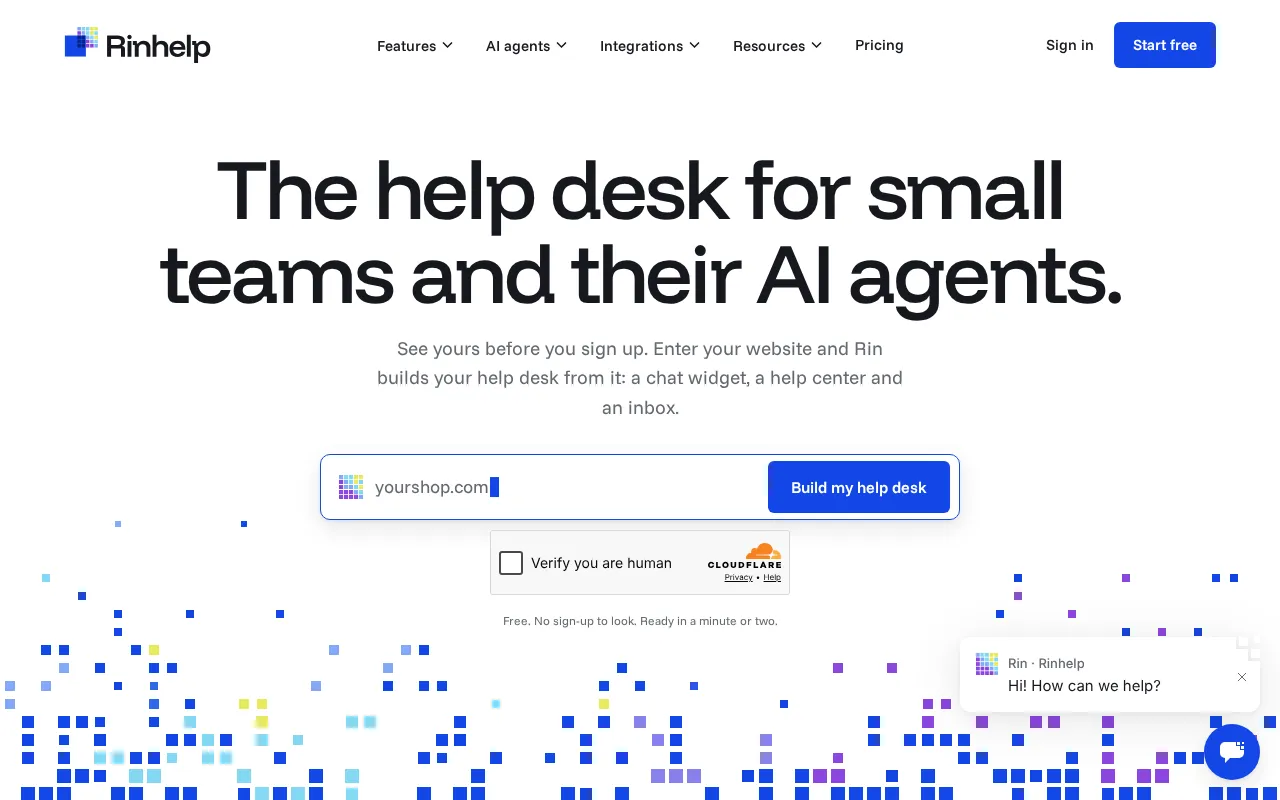
A micro-SaaS is usually one product and one founder who would rather ship than answer email, and sometimes it’s built to be sold. Rinhelp keeps support low-touch: Rin, our built-in AI, answers each new conversation first from your help center and website, and when the answer isn’t in your docs it hands the conversation to you, tagged “Knowledge gap”. With the Rinhelp plugin, Claude finds the questions Rin couldn’t answer, writes the articles and tests Rin again, so a gap gets closed once. Pro is $49 a month for the workspace with 5,000 AI replies, so a cofounder, a contractor or a buyer’s team joins without a seat fee. If you bill through Stripe, subscriptions and payments show beside each conversation, and a refund or cancellation from Rin or an AI agent waits for your approval. Rinhelp’s integrations stop at Stripe and Shopify, so billing through Lemon Squeezy stays in its own dashboard, and the Free plan gives Rin only 50 AI replies to try, once.
- Best for
- Solo founders running one SaaS product, who want an AI answering first and a single price that doesn’t change as the team grows or the business changes hands.
- How it bills
- Free for up to 3 teammates. Pro is $49 a month for the whole workspace, with 5,000 AI replies from Rin. No per-seat or per-resolution fees.
- Free plan
- Yes: 3 teammates, 50 AI replies to try Rin
- 3 people, 300 AI replies
- $49 a month: Pro for the whole workspace, using 300 of its 5,000 AI replies; Free covers your team if you don’t need AI replies.
Pros
- $49 a month with 5,000 AI replies for the whole workspace, so adding a helper, or handing the inbox to a buyer’s team, costs nothing extra.
- Only Rin’s replies count: handoff summaries, tags and priority are free, and so are replies from your own AI agents.
- Claude, with the Rinhelp plugin, answers the conversations waiting on you and writes articles for the questions Rin missed.
- Rin can’t refund or cancel by itself: it files an approval, and the money moves only once you approve.
Cons
- Email and live chat only: there is no phone, WhatsApp, SMS or social inbox.
- Shopify and Stripe are the only integrations.
- No reports, SLA rules or routing rules: Rin hands a conversation to the teammate with the fewest open ones.
- The free plan has no Rin beyond 50 AI replies to try it.
2. Help Scout
Help Scout is a help desk with shared inboxes, a Docs help center and Beacon, a widget for chat and help articles. Scout, its AI agent, answers chat from your help content and is billed per resolution.
Help Scout’s free plan is a workable one-person desk, with 1 inbox, a Docs site and 100 contacts a month, and its sidebar refunds a Stripe payment or cancels a subscription. Once a new account’s 3 free months end, Scout costs $0.75 a resolution, under a monthly cap you set.
- Best for
- Support teams that think in tickets and want a calm shared inbox, a help center and live chat, with a free plan to start on.
- How it bills
- Standard is $25, Plus $45 and Pro $75 a user a month on annual billing, which saves 16%. Pro needs at least 10 users and a demo. Scout costs $0.75 per resolution, free for a new account’s first 3 months.
- Free plan
- Yes: 5 users, 1 inbox, 100 contacts a month
- 3 people, 300 AI replies
- $300 a month: 3 Standard users at $25 on annual billing, plus 300 AI resolutions at $0.75.
Pros
- A free plan for up to 5 users, with 1 inbox, a Docs site and 100 contacts a month.
- Agents can refund, cancel or edit recent Shopify orders, and refund Stripe payments or cancel subscriptions, from the sidebar.
- Standard brings email, live chat, SMS, WhatsApp, Instagram and Messenger into one inbox.
- You can cap AI spending each month, and Scout switches off when it reaches the cap.
Cons
- Its official MCP server is read-only: your own AI can search conversations and Docs, but can’t reply, add notes or close.
- Scout answers website and in-app chat only, and lists email as “Coming Soon”.
- Scout can’t look up orders or act in other tools yet: its connection to payment processors and CRMs is still to come.
- Seats and AI are billed separately, so the bill grows with every user and every resolution.
Already on Help Scout? See the best Help Scout alternatives.
3. tawk.to
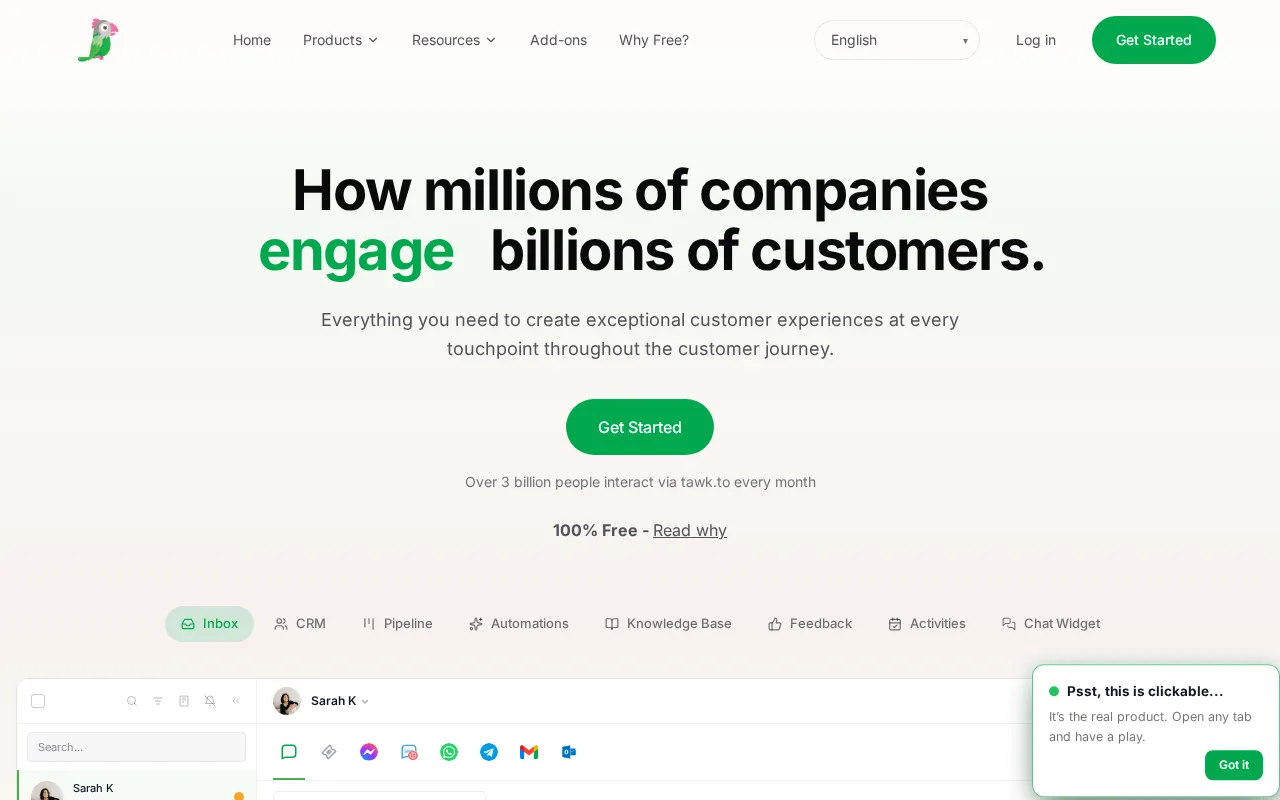
tawk.to is free live chat and ticketing software for websites, with a hosted knowledge base. It makes its money from paid add-ons, such as AI Assist, white label and hired chat agents, billed per website.
tawk.to costs nothing for unlimited agents, chats and websites, with ticketing and a hosted knowledge base, so a product that earns little still gets a desk. Add-ons such as white label at $39 a month are billed per website, and AI Assist drops out of new conversations once its credits are gone.
- Best for
- Small businesses that want website chat for any number of agents at no cost, and don’t mind the tawk.to badge.
- How it bills
- Chat, ticketing and the knowledge base are free for any number of agents. AI Assist is free for 100 credits a month, then $29, $99 or $399 a month ($290, $990 or $3,990 a year) for 1,000, 5,000 or 20,000 credits, and a reply on the default Auto model uses 3.
- Free plan
- Yes: unlimited agents and chats, about 33 AI replies a month
- 3 people, 300 AI replies
- $24 a month: AI Assist Growth at $290 a year, whose 1,000 monthly credits cover 300 replies at 3 credits each on the Auto model. Seats are free.
Pros
- Free for any number of agents, chats and websites, with ticketing and a hosted knowledge base.
- WhatsApp, Messenger, SMS through Twilio and email share one inbox, and the AI answers on chat, WhatsApp, SMS and Messenger.
- Its Shopify app adds a tab where agents check orders, refund and cancel during a chat.
- Hired chat agents start at $1 an hour if you want someone else to answer.
Cons
- AI Assist charges per reply, and once credits run out it stops joining new conversations.
- The “Powered by tawk.to” badge stays unless you pay for white label, $39 a month or $348 a year for each website.
- No official MCP server, and REST API access must be requested and approved first.
- Add-ons are billed per website, so each extra site pays again.
Already on tawk.to? See the best tawk.to alternatives.
4. Crisp
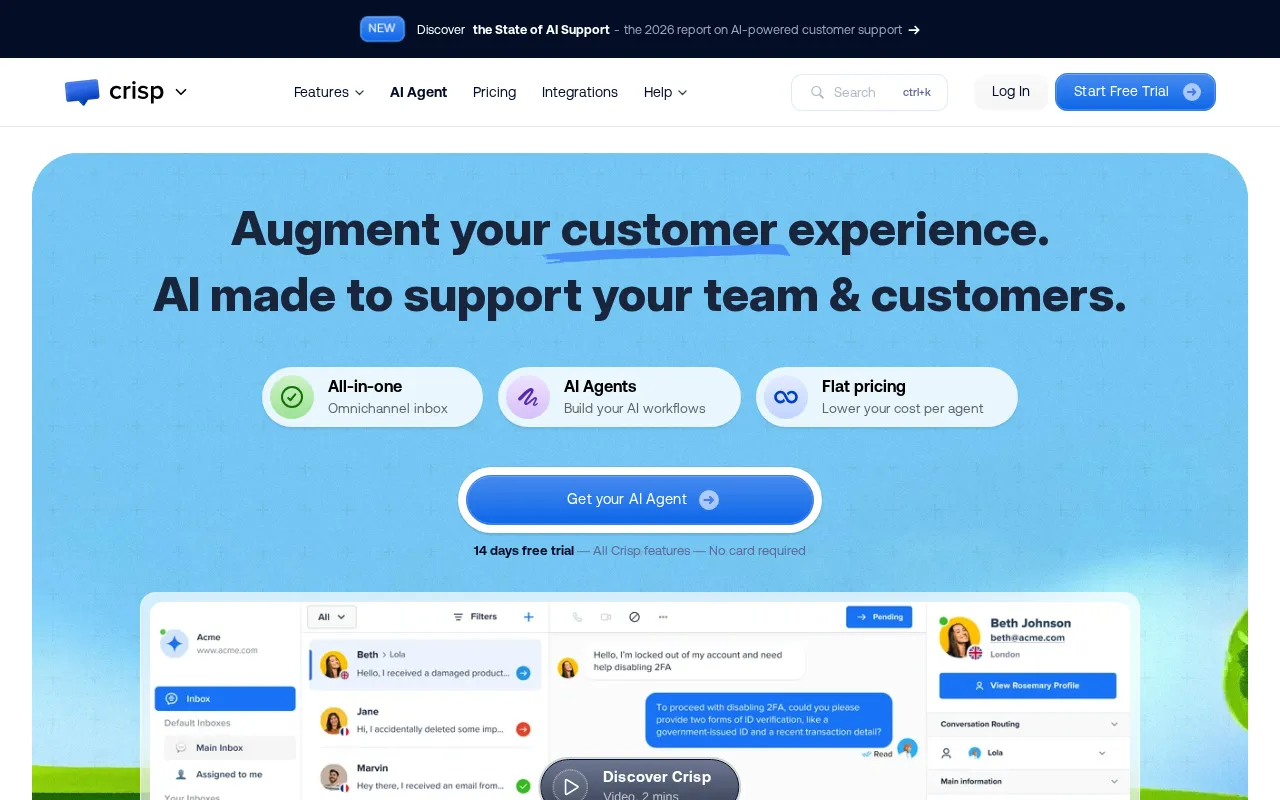
Crisp is a French customer support platform built around a website chat widget, with a shared inbox, many messaging channels and Hugo, its AI agent.
Crisp’s free plan is website chat for 2 seats, with no AI and no email. Mini at $45 a month adds an email inbox and $5 of AI credits, and Hugo stops once those are spent unless you turn on Pay-As-You-Go. Stripe data in the inbox comes only with Plus at $295 a month, a big step for a product that bills through Stripe.
- Best for
- Small teams that start with free website chat and want WhatsApp, Instagram, SMS and phone in the same inbox later.
- How it bills
- Per workspace a month: Mini is $45 with 4 seats, Essentials $95 with 10 and Plus $295 with 20, including $5, $25 and $75 of AI credits (about 90, 450 and 1,350 Hugo conversations). Extra seats are $10 each, sold on Plus only, and Hugo past the credits runs on Pay-As-You-Go at about $0.05 to $0.10 a conversation.
- Free plan
- Yes: 2 seats, chat only, no AI
- 3 people, 300 AI replies
- $66 or more a month: Mini at $45 for 4 seats with about 90 Hugo conversations in its credits, plus about 210 more at about $0.10 each.
Pros
- One price per workspace, with 10 seats on Essentials for $95 a month.
- WhatsApp, Instagram, Messenger, SMS, Telegram and phone sit in the same inbox from Essentials.
- Its official MCP server can read, reply, add notes, resolve and write help center articles.
- Hugo can look up orders and refund through Shopify, WooCommerce, PrestaShop and Stripe, after a one-time code checks the customer.
Cons
- The free plan has no email inbox and no AI, and Mini has no help center, WhatsApp or MCP server.
- Hugo stops answering when the month’s credits run out unless you turn on Pay-As-You-Go, whose rates aren’t published.
- Stripe data in the inbox comes only with Plus at $295 a month.
- Crisp’s terms refund no fees, monthly or yearly.
Already on Crisp? See the best Crisp alternatives.
5. Denser
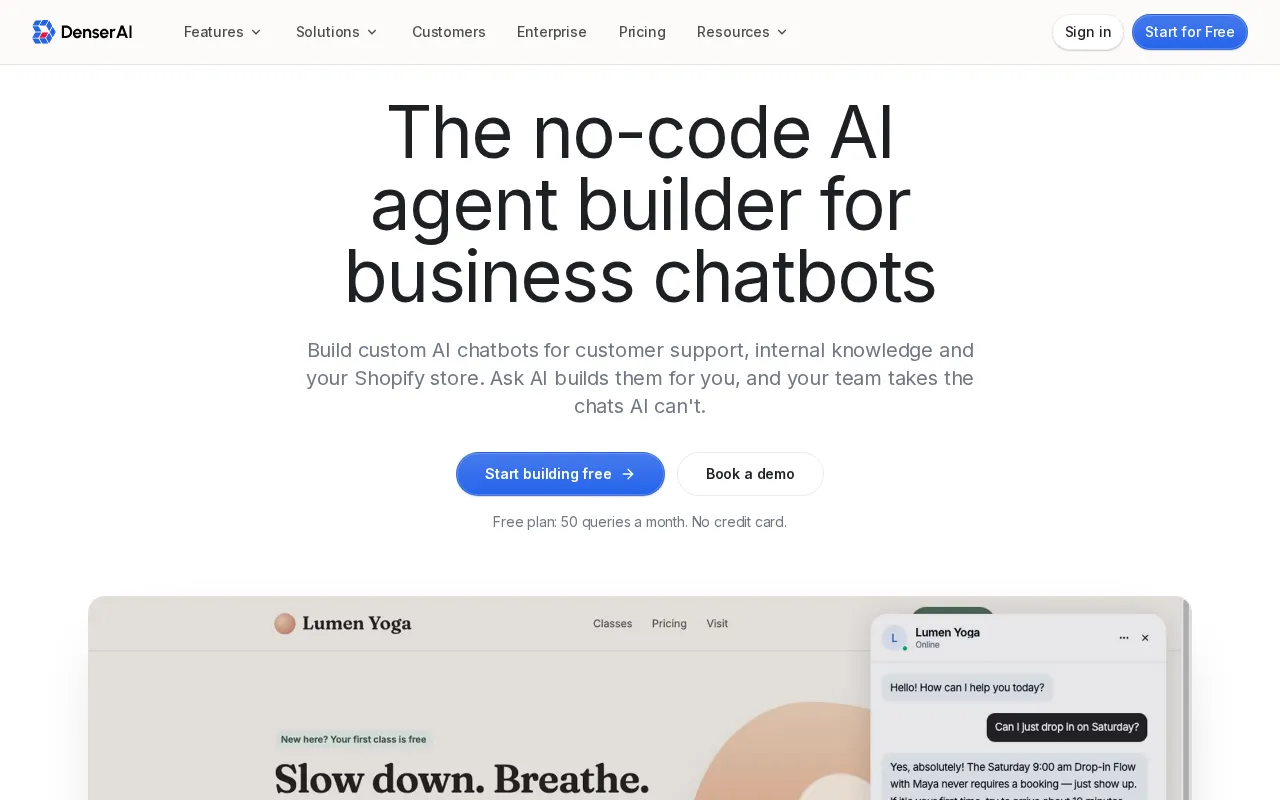
Denser builds AI chatbots that answer from your website, files and written Q&A, and cite the source behind each answer. One chatbot can answer website chat, email, phone calls, WhatsApp, Slack and Telegram, and from Standard a built-in Helpdesk lets your team take over what it can’t solve.
Denser cites the page or file behind every answer, and its free plan gives 1 chatbot 50 queries a month. Starter at $32 a month on yearly billing has 1 team member and no Helpdesk, so stepping into a chat yourself means Standard.
- Best for
- Teams that want a chatbot with cited answers on their website, support inbox and phone line, and Shopify stores that want orders, cancellations and returns handled in the chat.
- How it bills
- Starter is $39, Standard $119, Business $399 and Enterprise $899 a month on monthly billing ($32, $96, $320 and $720 a month on yearly billing), with 1,500, 7,500, 15,000 and 50,000 queries and 1, 5, 10 and 50 team members. A question to a chatbot uses 1 query, and extra seats are sold as add-ons at a price the pricing page doesn’t show.
- Free plan
- Yes: 1 chatbot, 1 team member, 50 queries a month
- 3 people, 300 AI replies
- $96 a month: Standard at $96 a month on yearly billing ($119 monthly), the first plan with Helpdesk, with 5 team members included. 300 replies use 300 of its 7,500 queries.
Pros
- Every answer cites the page or document it came from, whether that’s your website, a PDF, Word or Excel file, Google Drive or Q&A you wrote.
- The same chatbot answers website chat, email, WhatsApp, Slack and Telegram, and phone calls through your Twilio or Vapi number.
- On Shopify it searches your live catalog, fills the native cart and checks orders, and can cancel an unshipped order or start a return once the shopper confirms.
- The email agent can hold each reply it drafts in Helpdesk until a teammate approves, edits or takes it over.
Cons
- Starter has 1 team member and no Helpdesk: a person taking over a chat starts on Standard.
- Each plan includes a set number of team members, 5 on Standard, 10 on Business and 50 on Enterprise, and more are an add-on the pricing page doesn’t price.
- Actions, cards and playbooks share one allowance per chatbot: 1 on Free, 5 on Starter, 10 on Standard and 20 on Business and Enterprise.
- Query logs are kept 30 days on Starter and 90 on Standard.
Already on Denser? See the best Denser alternatives.
6. SiteGPT
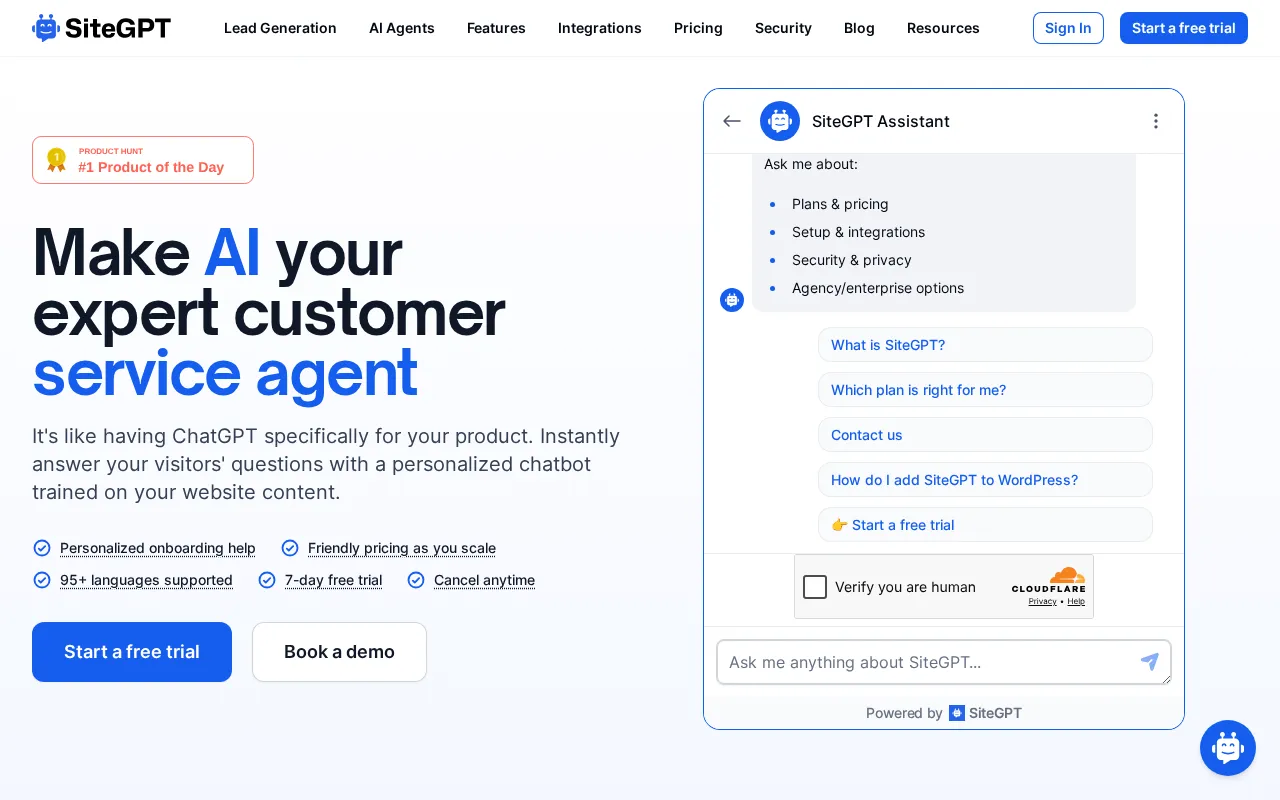
SiteGPT is an AI chatbot trained on your website, files and other content. It answers on your site and in tools like Slack, Crisp and Zendesk, and hands a chat to your team when a customer needs a person.
SiteGPT’s chatbot learns your site and files. Starter is $39 a month on annual billing for 1 member, and Growth at $79 adds its iPhone app, to take over a chat away from your desk. When a subscription ends its conversations and leads are scheduled for deletion no earlier than 30 days later, so keep it paid through any handover.
- Best for
- Sites that want a chatbot answering from their own pages and docs, with a person stepping in now and then.
- How it bills
- On annual billing, Starter is $39 a month for 1 member and 4,000 GPT-4.1 mini messages, Growth $79 for 4 team members and 10,000, and Scale $259 for 10 and 40,000 ($59, $129 and $429 monthly). A customer’s question and the chatbot’s answer count as 2 messages, and a GPT-4.1 message uses as much as 10 on GPT-4.1 mini. Email and WhatsApp are add-ons, each $59 a month per inbox or number, or $468 a year.
- Free plan
- No, 7-day trial with a credit card
- 3 people, 300 AI replies
- $79 a month: Growth at $79 on annual billing ($948 a year, or $129 monthly), with 4 team members. 300 answers use 600 messages, inside its 10,000 on GPT-4.1 mini or 1,000 on GPT-4.1.
Pros
- Your team can reply, take over and resolve chats from Chat History or the iPhone app, and the chatbot stays quiet while a person has the conversation.
- One chatbot answers on your website, WhatsApp, Messenger, Slack and email, and replies from the dashboard reach customers on WhatsApp, Messenger and email.
- On Scale it can be the AI agent inside Zendesk Messaging, handing conversations to your Zendesk agents with full history.
- Its official MCP server lets Claude or ChatGPT read conversations, reply to customers and change chatbot settings, and you can limit a connection to read-only.
Cons
- Team members are capped by plan: 1 on Starter, 4 on Growth and 10 on Scale.
- Both sides of a chat count against your allowance, and new chatbots start on GPT-4.1, whose messages use 10 times as much as GPT-4.1 mini.
- Email and WhatsApp are paid add-ons per inbox and per number, and Slack, Messenger, MCP and the API need Growth or above.
- Once a subscription ends, its chatbots stop answering, and their conversations, documents and leads are scheduled for deletion no earlier than 30 days later.
Already on SiteGPT? See the best SiteGPT alternatives.
7. CustomGPT.ai
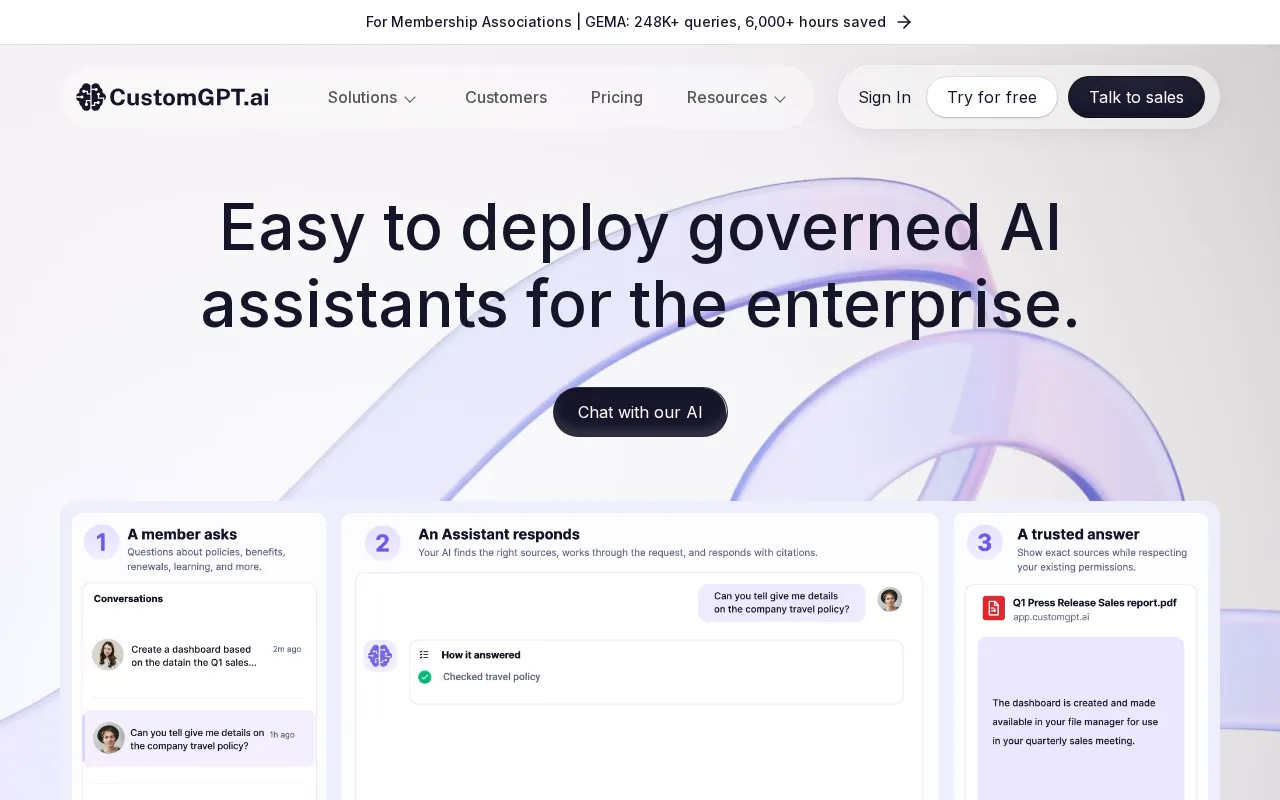
CustomGPT.ai builds AI agents that answer only from your own documents, websites and help center, and cite the source of every answer. You embed them on a website or help center, and they hand off to a person through integrations such as Intercom.
CustomGPT.ai answers only from your own documents and help center and links the source of each answer. It isn’t a help desk: a conversation it can’t answer reaches a person through an integration such as Intercom, so you run a second tool beside Standard at $99 a month for 1,000 queries. The 7-day trial needs a card.
- Best for
- Organizations with large document libraries that need cited, checked answers and SOC 2 controls more than a help desk.
- How it bills
- Standard is $99 a month for 10 agents, 1,000 queries and 3 team members, and Premium $499 for 25 agents, 5,000 queries and 5 team members, or $89 and $449 a month billed annually. A chat message is one query and actions such as Lead Capture use more. Add-ons sell 2,500 more queries for $375 a month and 5 more seats for $100.
- Free plan
- No, 7-day trial with a credit card
- 3 people, 300 AI replies
- $99 or more a month: Standard at $99, using 300 of its 1,000 queries at 1 query an AI reply. The help desk your team answers handoffs in comes on top.
Pros
- Every answer links the document it came from, and Verify Responses checks an answer claim by claim against your sources.
- It reads 1,400+ file types and imports from Google Drive, Notion, Confluence, the Zendesk and HubSpot knowledge bases, and more.
- Its custom actions connect an agent to a remote MCP server, so it can open a ticket or book a meeting in the conversation.
- SOC 2 Type 2 and GDPR on every plan, and it never trains a model on your data.
Cons
- CustomGPT.ai is not a help desk: a person takes over through another tool, such as Intercom, that you pay for separately.
- Agents stop answering when the month’s queries run out, and 2,500 more cost $375.
- The 7-day trial needs a credit card and turns into the paid plan when it ends.
- Removing “Powered by CustomGPT.ai” branding needs Premium at $499 a month.
Already on CustomGPT.ai? See the best CustomGPT.ai alternatives.
8. Botsonic
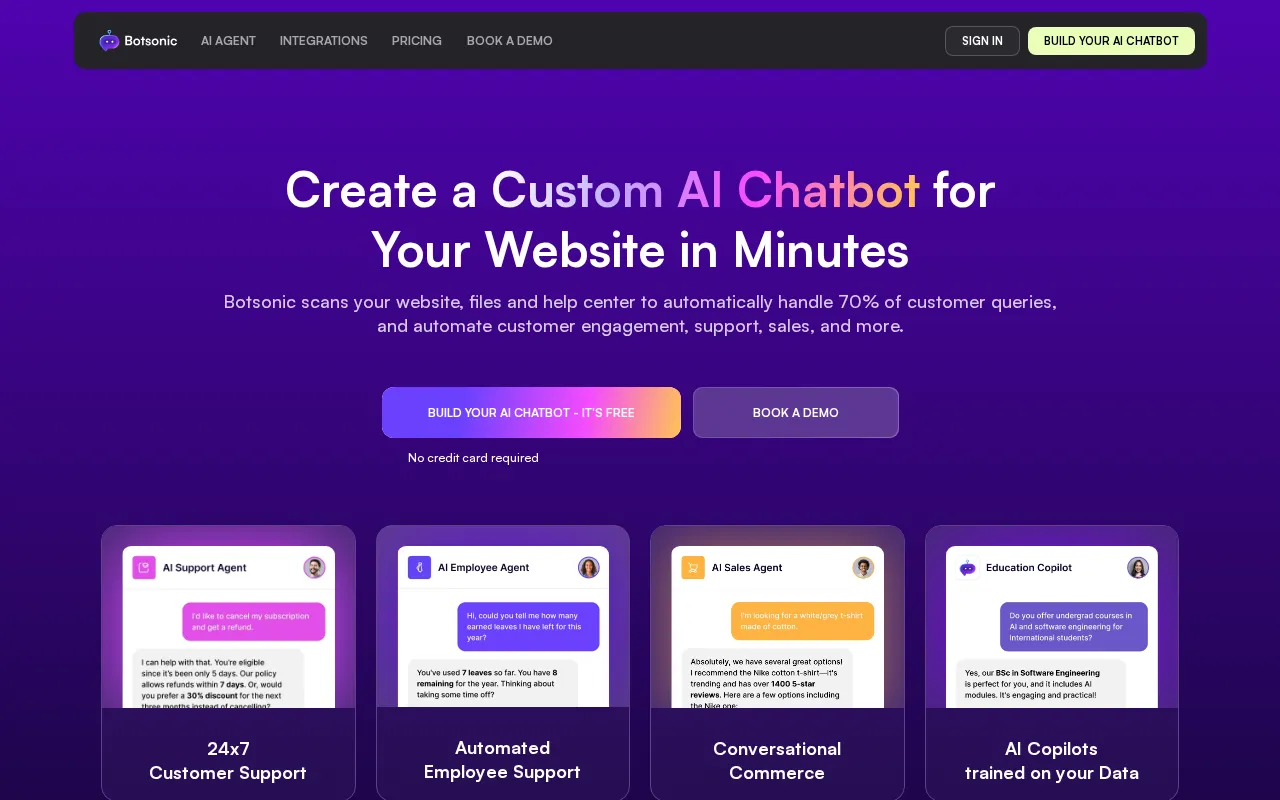
Botsonic is Writesonic’s no-code AI chatbot builder. It trains a chatbot on your website, files and help content, puts it on your site and messaging apps such as WhatsApp, Messenger and Telegram, and hands a customer who needs a person to Zendesk.
Botsonic’s Starter, $16 a month on annual billing, gives 1 team member a chatbot with 1,000 messages, and actions can call your own API mid-chat, such as to cancel an order. A person can take over only in Zendesk, through a $199 a month add-on or Enterprise.
- Best for
- Teams that want a chatbot answering from their own content on the website and messaging apps, with Zendesk handling the conversations it passes on.
- How it bills
- On annual billing, Starter is $16, Professional $41 and Advanced $249 a month ($19, $49 and $299 monthly), with 1, 2 and 5 team members and 1,000, 3,000 and 12,000 messages a month, and Enterprise is priced by sales. A GPT-4o mini reply uses 1 message and a GPT-4o reply 2. Extra team members are $25 a month each, and 2,000 to 16,000 more messages cost $25 to $200 a month. Removing the Botsonic badge is $49 a month, API access $49 below Advanced, 3 more chatbots $99, and Zendesk handoff $199.
- Free plan
- Not on the pricing page: each plan starts with a 7-day trial, no credit card needed
- 3 people, 300 AI replies
- $66 a month: Professional at $41 a month on annual billing ($49 monthly) with 2 team members, plus a third at $25. 300 replies on GPT-4o mini use 300 of its 3,000 messages.
Pros
- It learns from your website, PDFs, Word and Excel files, and syncs from Google Drive, Confluence and Notion.
- One chatbot answers on your website, WhatsApp, Messenger and Telegram from Starter, and in Slack and Google Chat from Professional.
- Actions let the chatbot call your own APIs mid-chat, such as to cancel an order, asking the customer for any detail it still needs first.
- Botsonic is SOC 2 Type II compliant and GDPR compliant, and only uses AI models that aren’t retrained on your data.
Cons
- Starter includes 1 team member and Professional 2, and each extra one costs $25 a month.
- A person takes over only in Zendesk, through a $199 a month add-on or Enterprise, which also hands tickets to Freshdesk and Salesforce.
- A GPT-4o reply uses 2 messages, so Professional’s 3,000 cover 1,500 of them.
- Removing “Powered by Botsonic” is a $49 a month add-on, and so is API access below Advanced.
Already on Botsonic? See the best Botsonic alternatives.
9. Chaport
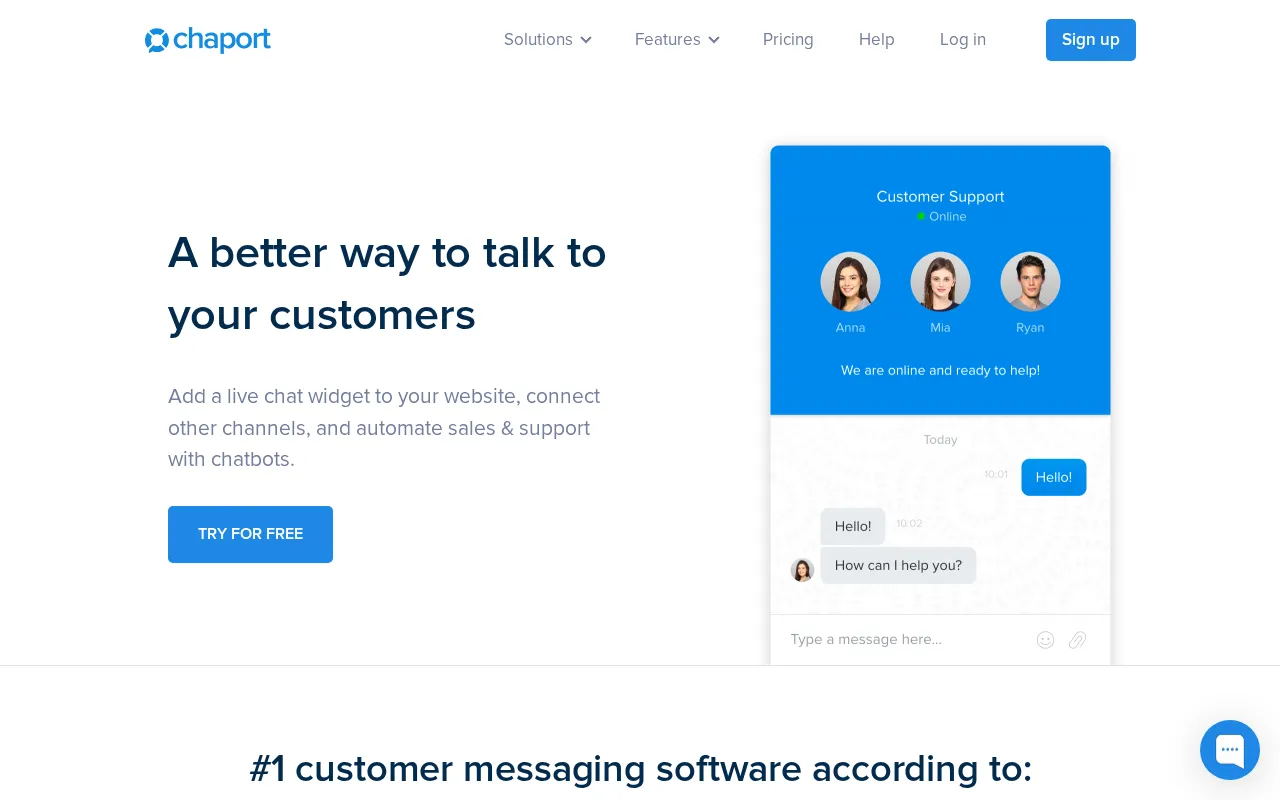
Chaport is live chat software, launched in 2015, with one inbox for website chat, email, Facebook Messenger, Telegram and Viber. It adds chatbots that follow scenarios you build and a knowledge base with an FAQ bot, and its pages describe no AI that writes answers to customers.
Chaport’s Pro is $29 a month on annual billing for 4 operators, with apps for the web, desktop and phones. No AI writes answers, so even on a quiet product every chat waits for you, and the FAQ bot needs Unlimited at $99 on annual billing.
- Best for
- Small teams that want simple website chat at a flat price, with scripted chatbots and a knowledge base on its top plan, and no need for AI to answer.
- How it bills
- Free covers 2 operators. Pro is $29 a month for 4 operators and Unlimited $99 for any number, on annual billing ($39 and $129 monthly), and Pro can add operator seats under “Billing” at a price Chaport doesn’t publish. Chatbots, the knowledge base and the FAQ bot need Unlimited, the pricing page lists no AI or other add-ons, and buyers without a VAT number may pay VAT on top.
- Free plan
- Yes: 2 operators, unlimited chats, 60 days of history, no email or chatbots
- 3 people, 300 AI replies
- $29 a month: Pro at $29 a month on annual billing, which includes 4 operators. Nothing in Chaport answers customers with AI.
Pros
- One flat price covers the team: Pro is $29 a month for 4 operators and Unlimited $99 for as many as you add, on annual billing.
- Website chat, email, Facebook Messenger, Telegram and Viber share one inbox from Pro.
- Unlimited adds a public knowledge base on your own domain, with an FAQ bot that suggests articles inside the chat.
- Every plan, Free included, allows unlimited chats and websites, with apps for the web, Windows, macOS, iOS and Android.
Cons
- No AI writes answers: chatbots follow the scenario you build, and the FAQ bot matches keywords to articles.
- Chaport lists no WhatsApp, SMS or phone among its channels.
- Chatbots, the knowledge base, teams and assignment rules all need Unlimited at $99 a month on annual billing.
- No MCP server, the REST API needs a paid plan, and Chaport refunds no unused time when you cancel or downgrade.
Already on Chaport? See the best Chaport alternatives.
10. Chatra
Chatra is live chat software for websites and online stores, now a Brevo company, with one dashboard for website chat, email, Facebook Messenger and Instagram. Its chatbot runs button scenarios you write, and its pages describe no AI that writes answers to customers.
Chatra’s free plan keeps the complete conversation history for 1 agent and 5 chats a month. Brevo, its owner, says Chatra gets no new features, and data export needs Pro at $33 an agent on annual billing, worth knowing before a buyer asks for your chat history.
- Best for
- Small online stores that want plain website chat with a live visitor list and cart contents, priced per agent, and no AI answering.
- How it bills
- Free covers one agent and 5 chats a month. Essential is $25 and Pro $33 an agent a month on annual billing ($31 and $41 monthly), each with a 10-day trial without a card. Email, Instagram, Messenger and the chatbot start on Essential, while reports, chat ratings, groups, data export, Zapier and the REST API need Pro. Prices exclude VAT.
- Free plan
- Yes: 1 agent, 5 chats a month, no email or chatbot
- 3 people, 300 AI replies
- $75 a month: 3 Essential agents at $25 on annual billing. Nothing in Chatra answers customers with AI: its chatbot follows scenarios you write.
Pros
- Website chat, email, Facebook Messenger and Instagram share one dashboard from Essential, with apps for iOS and Android.
- The real-time visitor list shows where each visitor is and, on Shopify and BigCommerce, what is in their cart.
- Targeted messages open the chat on pages you choose, such as the cart, and a form bot collects contact details while you are away.
- Shopify and BigCommerce install in one click, and even Free keeps the complete conversation history.
Cons
- No AI writes answers: the chatbot sends the message and reply buttons you set for each step.
- Brevo owns Chatra and says it will release no new features in it, only in Brevo Conversations.
- Reports, chat ratings, agent groups, Zapier, the REST API and webhooks all need Pro at $33 an agent a month on annual billing.
- No MCP server, and its plans list no help center, WhatsApp or phone.
Already on Chatra? See the best Chatra alternatives.
11. Pure Chat
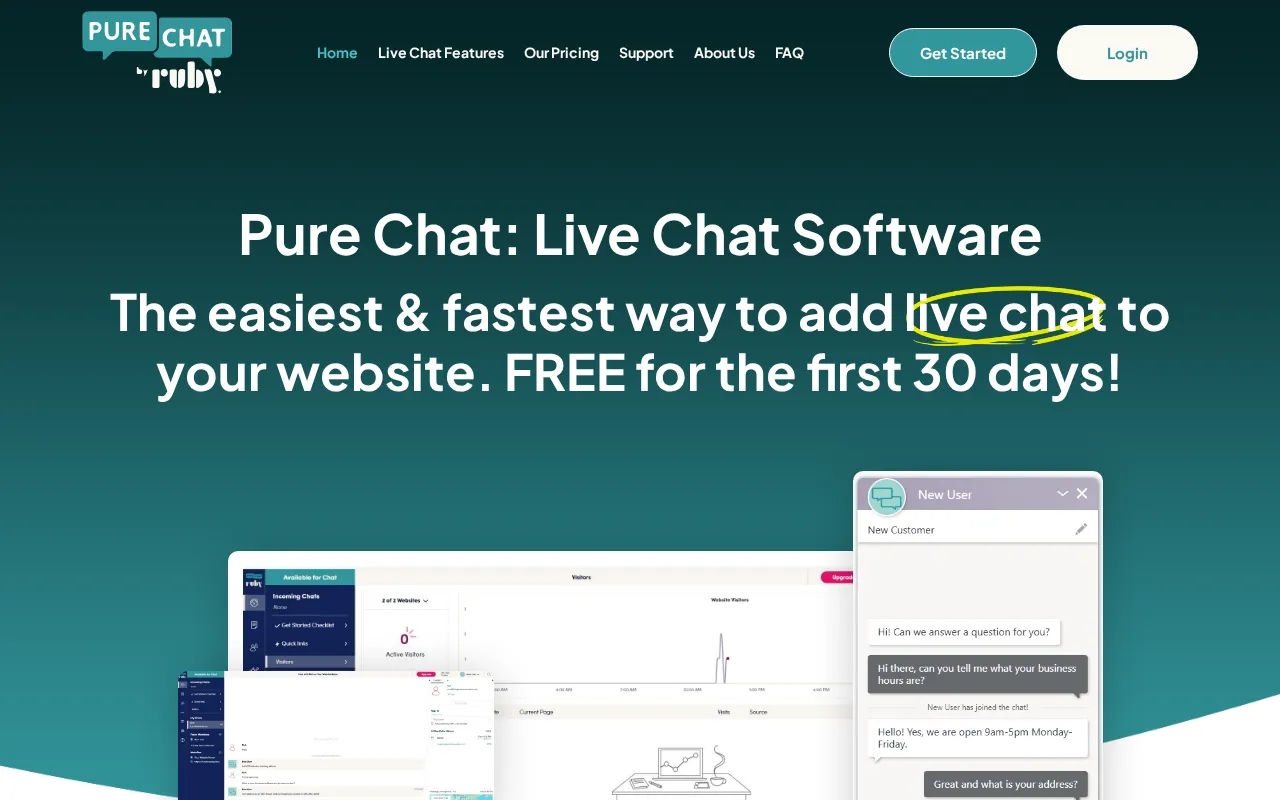
Pure Chat is website live chat software, launched in 2012 and owned since October 2020 by Ruby, the receptionist service. Agents answer from a web dashboard or iOS and Android apps, and its pages describe no chatbot or AI that answers customers.
Pure Chat’s Growth plan is $39 a month on annual billing for 4 users, with unlimited chats and transcripts, phone apps and SMS alerts. No AI answers while you’re away, and when nobody is online a customer gets an email form instead.
- Best for
- Small sales or service teams of up to 10 who answer every website chat themselves, watch visitors live, and want one flat plan price.
- How it bills
- Growth is $39 a month with 4 users and 1 website, and PRO $79 with 10 users and unlimited websites, paid annually ($49 and $99 monthly). Extra users are $13 a month on Growth and $8 on PRO on annual billing ($15 and $10 monthly). Both have unlimited chats and transcripts, only PRO removes the Pure Chat branding, and payment is by credit card only.
- Free plan
- No true free plan, in Pure Chat’s words: after the 30-day trial an account can stay on a limited plan with 1 user and 1 chat box, without visitors, contacts, reports or integrations
- 3 people, 300 AI replies
- $39 a month: Growth at $39 a month on annual billing, which includes 4 users. Nothing in Pure Chat answers customers with AI, so people answer all 300 chats.
Pros
- Growth is $39 a month on annual billing for 4 users and unlimited chats, and PRO $79 for 10.
- Visitors shows each person on your site in real time, with the page they are on, how often they have come and where they came from.
- Agents answer from iOS and Android apps, with push notifications and SMS alerts: 100 a month on Growth and 1,000 on PRO.
- Hosted chat pages give you a chat link for sites that won’t embed a chat box, such as an Etsy shop.
Cons
- No AI or chatbot answers customers: every chat waits for a person, and when nobody is available customers get an email form.
- Website chat only: customers can’t text you, and its pages list no email inbox, WhatsApp or help center.
- The Shopify App Store lists its app as not currently available, so on Shopify you paste the chat code into your theme.
- No MCP server, and its Zapier connection only sends new chats, finished chats and contact emails out; it takes no actions in Pure Chat.
Already on Pure Chat? See the best Pure Chat alternatives.
12. HelpSpot
HelpSpot is an email help desk from UserScape in Poughkeepsie, New York, around since 2005 and used by IT, HR, maintenance and customer support teams. It runs in HelpSpot’s US or EU cloud, or on your own Windows or Linux servers, at the same price.
HelpSpot’s 3-agent tier is $899 a year with every feature, in its US or EU cloud or on your own server with direct SQL access, and its MCP server lets Claude search, update and close requests. There’s no live chat, and its AI drafts rather than answering customers.
- Best for
- IT, HR and support departments that work from email, want every feature and AI drafting at one yearly price, and may need the help desk on their own servers.
- How it bills
- One yearly price by number of agents, sold in tiers: 3 agents are $899 a year, 5 are $1,299, 7 are $1,799 and 10 are $2,199. Every feature, AI included, comes in every tier, cloud or self-hosted, with no per-ticket or per-token fees. Qualified non-profits and academic institutions get 15% off.
- Free plan
- No, 21-day trial with no card
- 3 people, 300 AI replies
- $75 a month: 3 agents, HelpSpot’s smallest tier, at $899 a year. HelpSpot’s AI drafts for agents and never sends, so no AI answers customers.
Pros
- One price covers every feature, unlimited tickets and mailboxes, and AI, with free onboarding.
- The same price buys HelpSpot’s US or EU cloud, or a copy you run on your own servers with direct SQL access.
- An official MCP server lets Claude or ChatGPT search, update and close requests and edit knowledge base pages.
- A 90-day money-back guarantee, and phone support from HelpSpot’s own team on every plan.
Cons
- No AI answers customers: the AI Composer drafts replies, and an agent reviews and sends every one.
- No live chat, WhatsApp or voice. Requests come in by email, the portal or the API.
- Sold a year at a time, and only in tiers: a fourth agent moves you from $899 to $1,299 a year.
- No free plan, no Stripe integration, and Shopify only through a sample script you set up yourself.
Already on HelpSpot? See the best HelpSpot alternatives.
13. FreeScout
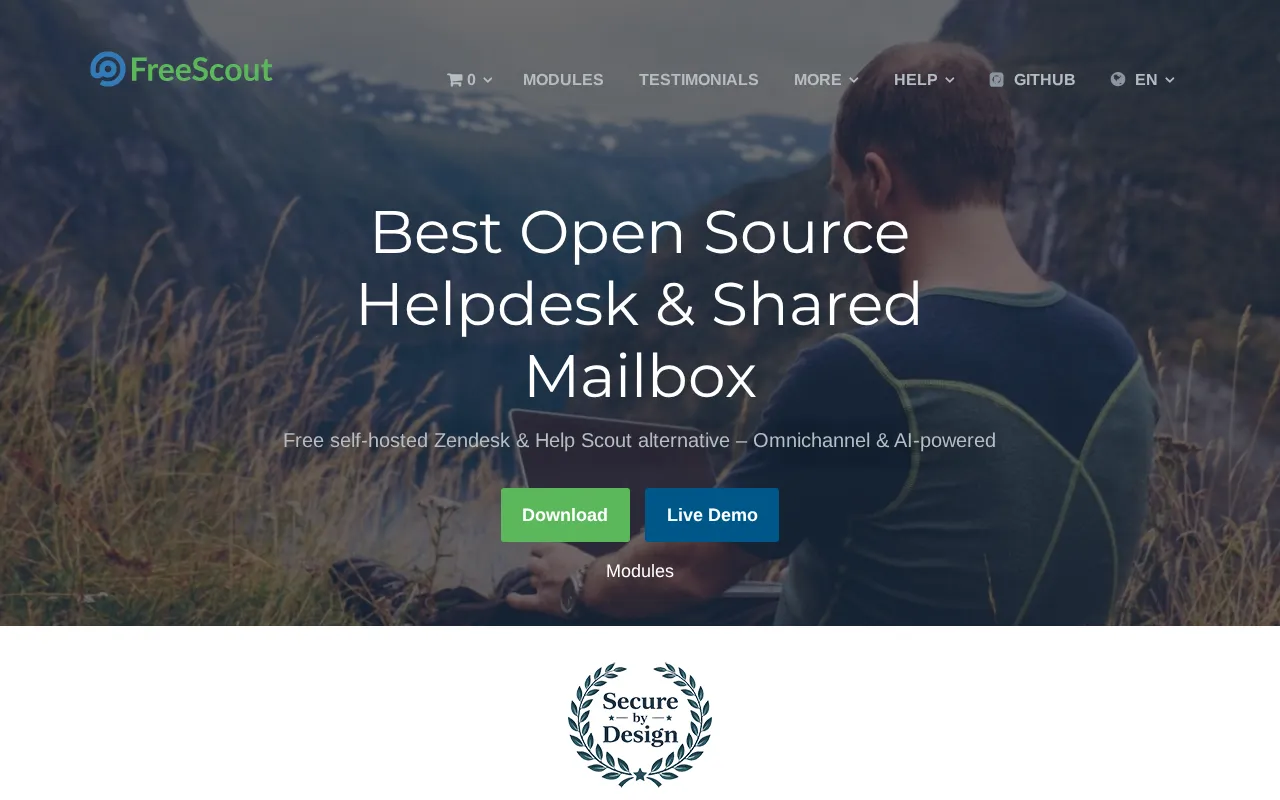
FreeScout is a free, open-source help desk and shared mailbox built with PHP and Laravel, which you install on your own server. Features beyond the core, from live chat to a knowledge base, come as modules sold once.
FreeScout is free and open source on your own server, so every conversation stays on hosting you control, and modules such as live chat for $13 and a knowledge base for $12 are paid once per instance. You run the server yourself, and no AI answers customers.
- Best for
- Teams with someone to run a PHP server who want an email help desk for any number of agents without a monthly bill.
- How it bills
- FreeScout is free and open source for unlimited agents, tickets and mailboxes, and you host it yourself: FreeScout offers no cloud version of its own. Features such as live chat ($13), a knowledge base ($12), saved replies ($4.99), tags ($6.99), workflows ($14.99) and API & Webhooks ($12.99) are modules, each a one-time lifetime license for one FreeScout instance, with no trials and no refunds. The AI module is free and runs on your own AI provider.
- Free plan
- Yes: free and open source for unlimited agents, on your own server
- 3 people, 300 AI replies
- $0 or more a month: 3 agents on the free FreeScout app, on a server you run from $3.10 a month on PikaPods in FreeScout’s one-click list. Live chat ($13), knowledge base ($12) and saved replies ($4.99) are one-time modules, $29.99 together, and no AI answers customers.
Pros
- Free for unlimited agents, tickets and mailboxes, and every conversation stays on a server you control.
- Modules are paid once, with lifetime updates, and their source code is open under AGPL-3.0.
- The free AI module drafts and summarizes with OpenAI, Claude, Gemini or a local model through Ollama.
- Beside email, live chat, WhatsApp, Telegram, Facebook and SMS through Twilio can join the same inbox, each through a module.
Cons
- FreeScout sells no hosted version, so you run the server yourself or pay another company to host it.
- No AI answers customers: the AI module only drafts, summarizes and polishes replies for an agent.
- Saved replies, tags, workflows, live chat and the knowledge base are each a paid module, with no trial and no refund.
- Help with a module is limited to fixing confirmed bugs, and FreeScout points you to a developer for anything else.
Already on FreeScout? See the best FreeScout alternatives.
14. Keeping
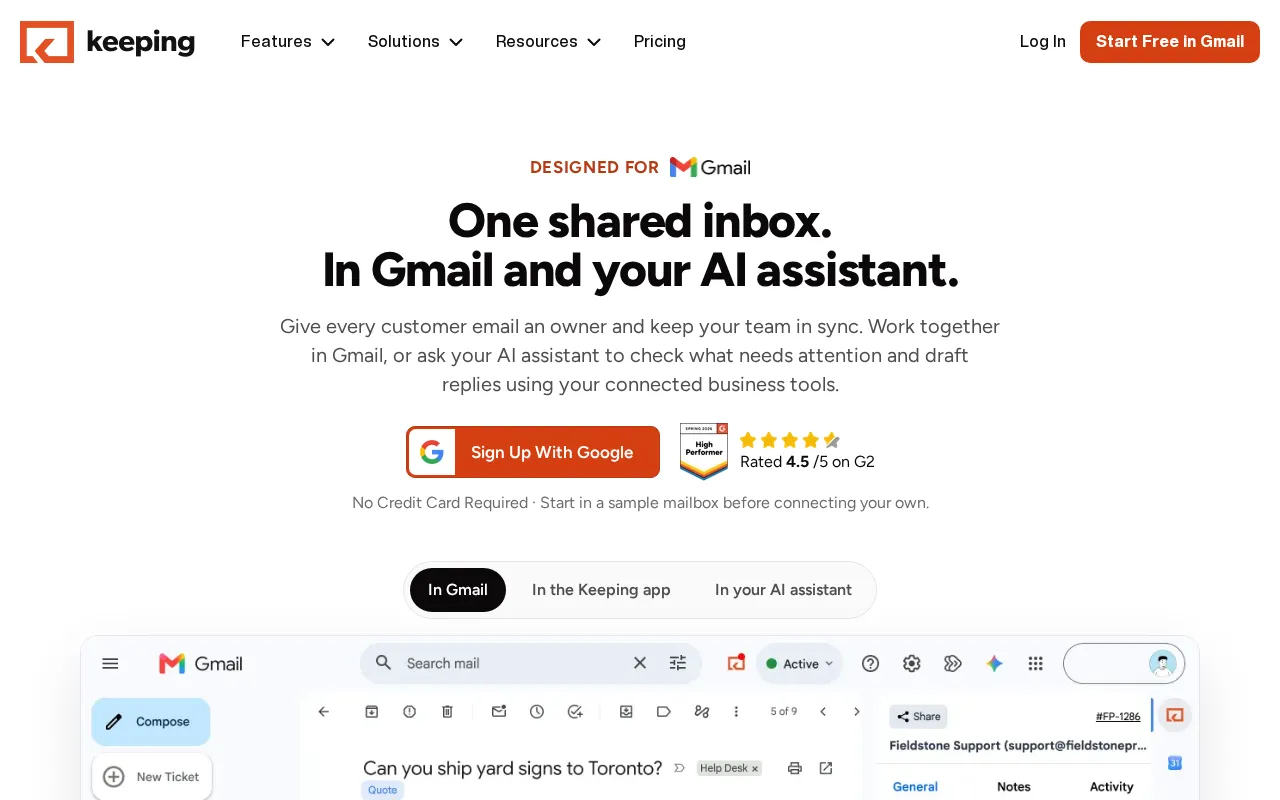
Keeping turns a shared Gmail address such as support@ into a shared inbox inside Gmail, where every email gets an owner, a status and internal notes. It adds a web and mobile app, workflows, reports and an MCP server, but no live chat, help center or AI that answers customers.
Keeping turns support@ into a shared inbox inside Gmail, and every email stays in your Google Workspace mailbox. Each plan has a 2-user minimum, Essentials at $14 a user on annual billing, so a solo founder pays for a second seat, and no AI answers customers.
- Best for
- Teams on Google Workspace that answer email from Gmail and want clear owners and no double replies.
- How it bills
- Essentials is $14 a user a month on annual billing ($19 monthly), with 2 shared mailboxes and up to 10 users. Advanced is $24 ($29 monthly) and adds unlimited mailboxes, CSAT, SLAs, round robin and integrations such as Shopify. HIPAA is $49 ($59 monthly) with a signed BAA. Every plan has a 2-user minimum.
- Free plan
- No, 14-day trial with no card
- 3 people, 300 AI replies
- $42 a month: 3 Essentials users at $14 on annual billing, with no AI answering customers.
Pros
- Emails stay in your Google Workspace mailbox, and customers get a normal reply from the shared address.
- Collision detection shows when a teammate is reading or already replying to an email.
- Its official MCP server has more than 80 tools for Claude, ChatGPT and other AI assistants, and drafts replies for a person to send.
- A HIPAA plan comes with a signed BAA.
Cons
- Keeping is for Gmail and Google Workspace: it isn’t for teams that work in Outlook.
- Email only: no live chat, phone or social channels, and no help center.
- No AI answers customers, and the MCP server creates drafts but never sends.
- Shopify, CSAT, SLAs and the full MCP need Advanced at $24 a user on annual billing.
Already on Keeping? See the best Keeping alternatives.
15. Gmail / Google Workspace
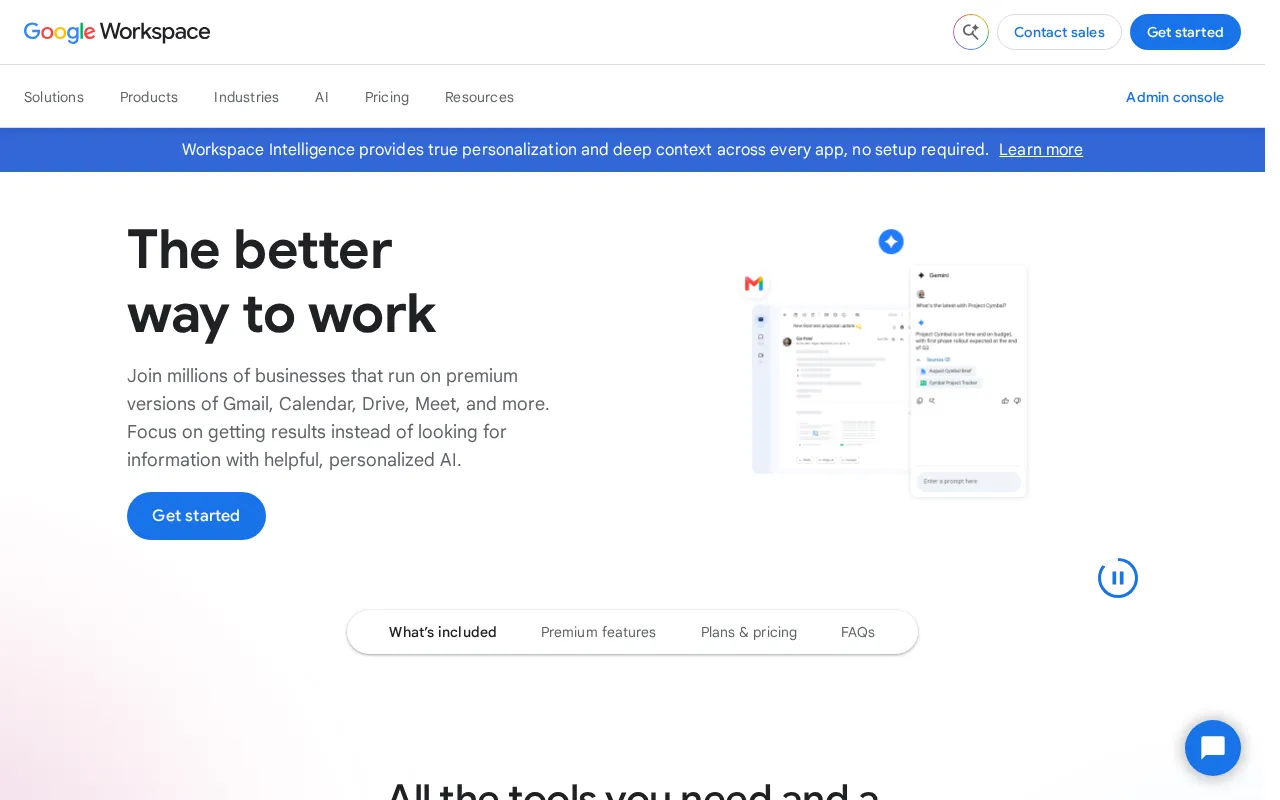
Google Workspace is Google’s business email and office suite. A support team answers from a shared Gmail address, a Google Group set up as a collaborative inbox, or delegated access to one mailbox.
For a founder answering a few emails a week, Google Workspace from $7 a user may be enough, and a collaborative inbox in Google Groups lets you take and resolve conversations. There’s no live chat, help center or Stripe, and Gemini helps you write rather than answering anyone.
- Best for
- Very small teams already on Google Workspace that answer a modest amount of email and need no live chat or help center.
- How it bills
- Per user: Business Starter is $7, Standard $14 and Plus $22 a user a month with a 1-year commitment, and Starter is $8.40 on the monthly “Flexible” plan. Gemini comes with every plan, and a Google Group costs nothing extra.
- Free plan
- No, 14-day trial
- 3 people, 300 AI replies
- $21 a month: 3 Business Starter users at $7 with a 1-year commitment. Gemini is included, but nothing in Gmail answers customers on its own.
Pros
- Most teams already pay for it, and $7 a user covers email, calendar, Meet, Drive and Gemini.
- A collaborative inbox lets members take, assign and resolve conversations at no extra cost.
- Google’s official Gmail MCP server lets an AI client search and read threads and save drafts.
- Since September 2026, Google Workspace Studio flows can act on new mail, including sending replies within a thread.
Cons
- Assigning and resolving happen in Google Groups, not in Gmail itself.
- There is no live chat, help center, Shopify or Stripe for support.
- Gemini helps the person writing, and delegates in a shared mailbox lose Gemini in Gmail.
- The Gmail MCP server is still in early access for developers and can’t send a reply.
Already on Gmail / Google Workspace? See the best Gmail / Google Workspace alternatives.
16. Zoho Desk
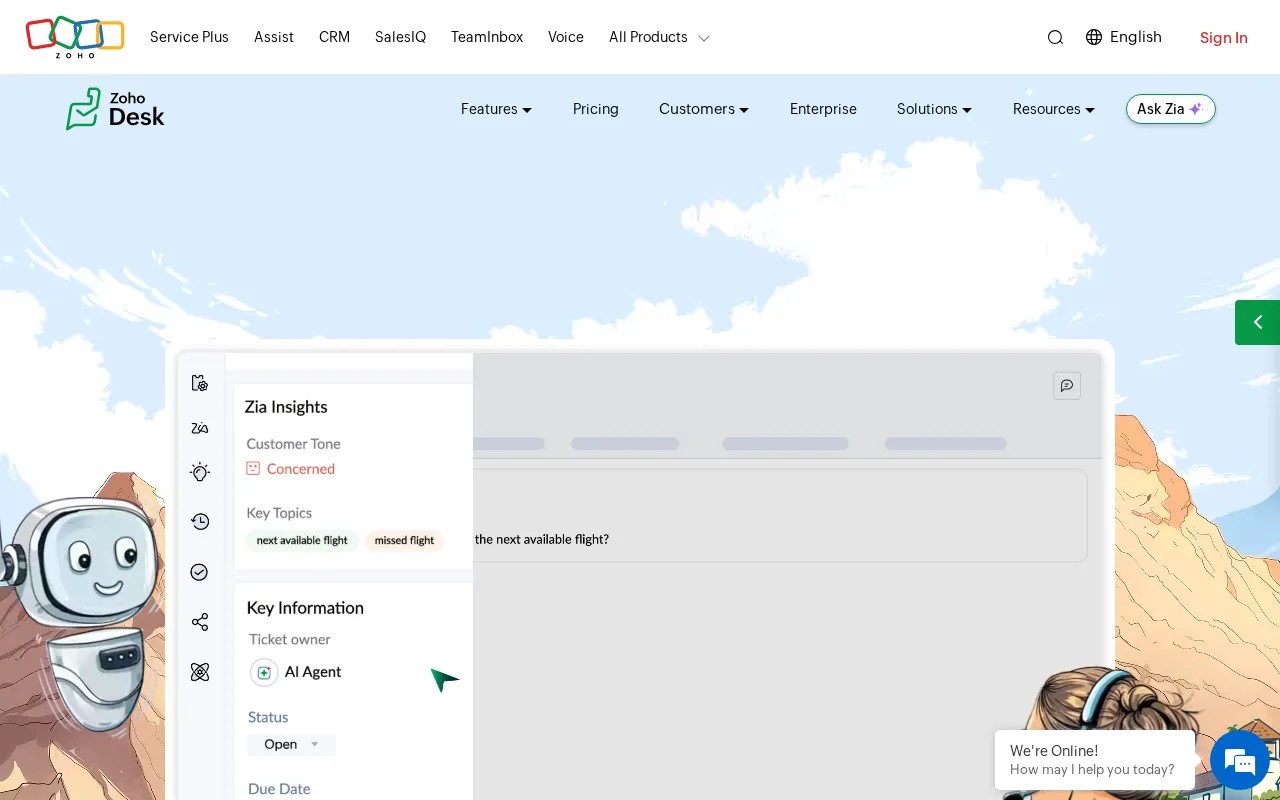
Zoho Desk is the help desk in Zoho’s suite of business apps, with tickets from email, social media, chat, WhatsApp and phone, a multilingual help center, and Zia, Zoho’s AI.
Zoho Desk’s free plan covers 3 users on email only, and Express at $7 a user on annual billing has no live chat, Answer Bot or AI agents. All three start on Standard at $14, with Answer Bot replying from your help center and AI agents including up to 30 million free tokens a month.
- Best for
- Budget-minded teams that want a full ticketing suite with workflows and SLAs, especially if they already use other Zoho apps.
- How it bills
- Per user: Express is $7, Standard $14, Professional $23 and Enterprise $40 a month on annual billing ($9, $20, $35 and $50 monthly), and light agents are $6 each. Express allows up to 5 users; Standard and above have no user limit. AI agents include up to 30 million free tokens a month. Other generative features run on a key you bring from an AI provider, and Professional and Enterprise add Zia’s own.
- Free plan
- Yes: 3 users, email only
- 3 people, 300 AI replies
- $42 a month: 3 Standard users at $14 on annual billing, the first plan with live chat and Answer Bot, which answers customers from your help center. Zoho publishes no per-answer fee.
Pros
- Low seat prices: Express is $7 a user and Standard $14 on annual billing, with a free plan for 3 users.
- Standard adds live chat, WhatsApp, Telegram and other messaging apps, and Professional adds phone support.
- Workflows, SLAs and several departments, with a help center you can publish in over 40 languages on Professional.
- Zoho’s official MCP server is free and can read tickets, send replies and add comments.
Cons
- Express stops at 5 users, so a sixth teammate moves everyone to Standard at $14.
- Zia’s full AI needs Professional, and the agent that answers email tickets is open only to selected accounts.
- The MCP server has no tools for help center articles or saved replies, and every call uses daily API credits.
- Express has no live chat, and the free plan covers email only.
Already on Zoho Desk? See the best Zoho Desk alternatives.
17. Enchant
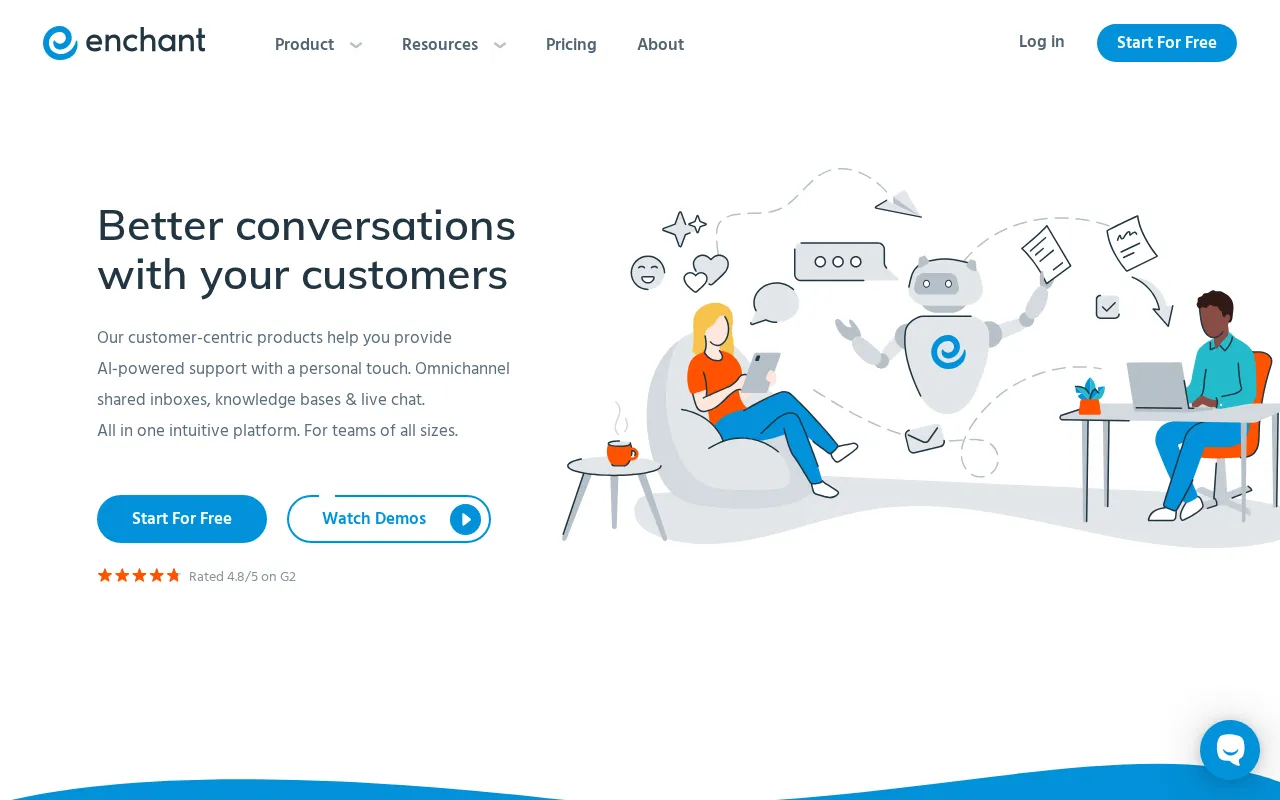
Enchant is a help desk from Senvee, a Canadian company that launched it in 2012. Email, live chat, phone calls, SMS, WhatsApp, Facebook Messenger and Instagram share one inbox, with knowledge bases and an AI add-on that mostly drafts for agents.
Enchant’s free plan gives 2 users the chat widget and knowledge bases, and the paid plan is $20 a user billed monthly with no annual contract. Enchant AI Standard bills $30 per 500 customers helped, counting every customer rather than only those its AI answers, and there’s no Stripe integration.
- Best for
- Small and growing teams that want every channel, phone calls included, in one shared inbox at one price per user, month to month.
- How it bills
- The paid plan is $20 a user a month, billed monthly with no annual contract. Enchant AI Standard is $30 per 500 customers helped, averaged over the past three months and counting every customer, with or without AI. Advanced Security is $5 a user and removing branding $50 a month. Free covers 2 users on the chat widget.
- Free plan
- Yes: 2 users, chat widget only, plus a 30-day trial of the paid plan with no card
- 3 people, 300 AI replies
- $90 a month: 3 users at $20 a month on Enchant’s one paid plan, billed monthly, plus $30 for Enchant AI Standard at 300 customers helped, $30 per 500. Its AI agent, a beta, answers live chat only and at most 100 chats a month, so your team answers the rest.
Pros
- One price per user covers every channel, phone calls, SMS, WhatsApp and Instagram included, billed monthly with no annual contract.
- A built-in call center records calls and runs queues over your own Twilio number, and Enchant adds no fee per call.
- A free plan for 2 users with the chat widget, knowledge bases and a newsletter, and a 30-day trial of the paid plan with no card.
- Paid plans include a free import of your history from your old help desk, done by Enchant’s team.
Cons
- Its AI agent is a beta that answers live chat only, up to 100 chats a month. Email and other channels get AI drafts for agents to send.
- Enchant AI Standard is billed on every customer your team helps, not only the ones AI answers.
- No MCP server, and no Stripe among its integrations. Shopify shows a customer’s details and recent orders beside the conversation.
- Phone calls run on your own Twilio account, which bills its own rates.
Already on Enchant? See the best Enchant alternatives.