1. Rinhelp
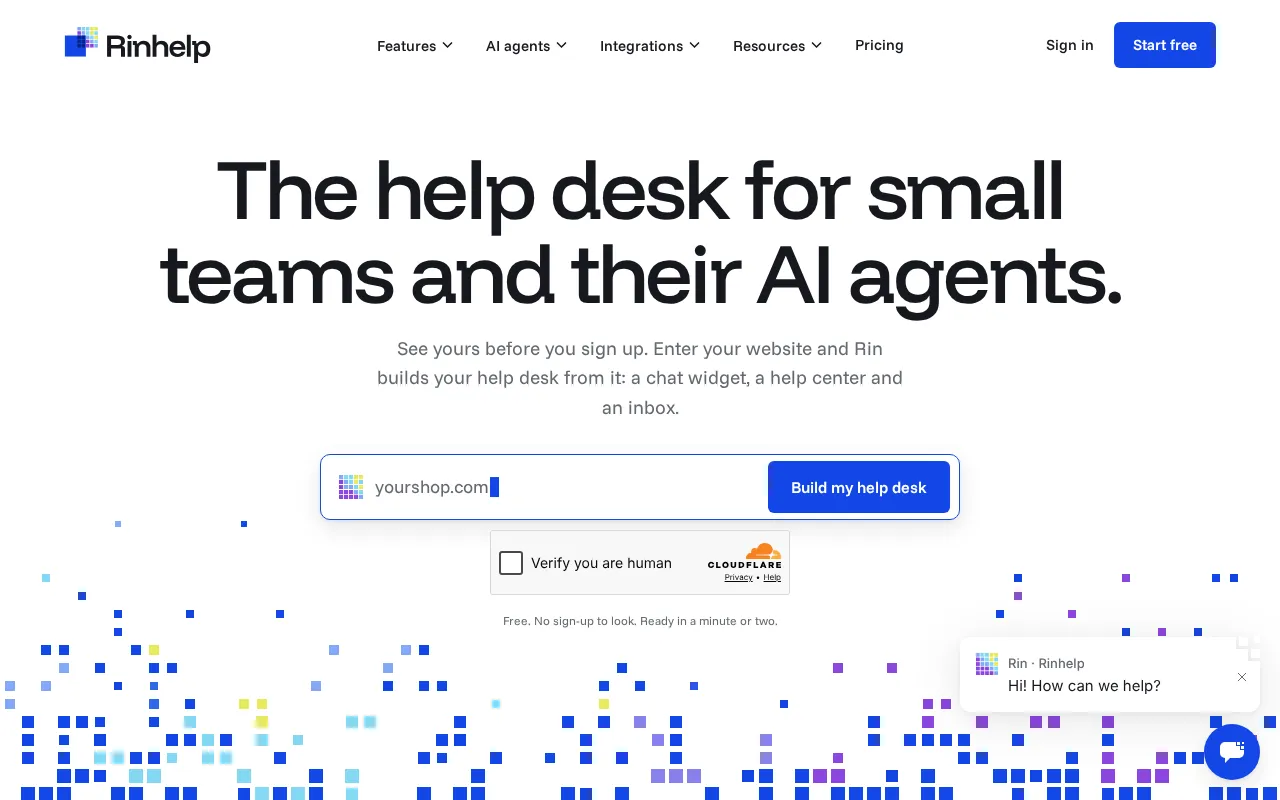
When credit packs are sold as one-off payments, Rinhelp lists a customer’s latest Stripe payments beside the conversation with the amount, status, date, what has been refunded so far and a link to the receipt. When a customer wants their money back for credits they never used, a teammate refunds that payment for the amount they choose, up to what is left, without opening Stripe. Rin, our built-in AI, shares a payment only after the customer gives the invoice or receipt number and the email on it, or is signed in on your site, and a refund it asks for waits for a teammate. Rinhelp doesn’t see credit balances, which live in your own app or in Stripe’s credit grants, so Rin answers credit questions only from what your help center and website say about how credits work. It’s $49 a month for the whole team, with 5,000 AI replies.
- Best for
- Credit-based SaaS teams of 2 to 10 that sell packs through Stripe, answer customers by email and chat, and want a teammate to approve a refund of unused credits before money moves.
- How it bills
- Free for up to 3 teammates. Pro is $49 a month for the whole workspace, with 5,000 AI replies from Rin. No per-seat or per-resolution fees.
- Free plan
- Yes: 3 teammates, 50 AI replies to try Rin
- 3 people, 300 AI replies
- $49 a month: Pro for the whole workspace, using 300 of its 5,000 AI replies; Free covers your team if you don’t need AI replies.
Pros
- $49 a month for the workspace with 5,000 AI replies, so a launch week that floods the inbox with credit questions adds nothing to the bill for seats.
- A refund is for one payment, in full or for an amount you choose, so giving back the unused part of a pack is a single partial refund.
- Search by email, customer ID, or an invoice or receipt number, so a pack bought under another address is still found from its receipt.
- A refund Rin or a connected AI agent such as Claude asks for arrives as an approval with its reason, and no money moves until a teammate approves it.
Cons
- Email and live chat only: there is no phone, WhatsApp, SMS or social inbox.
- Shopify and Stripe are the only integrations.
- No reports, SLA rules or routing rules: Rin hands a conversation to the teammate with the fewest open ones.
- The free plan has no Rin beyond 50 AI replies to try it.
2. Help Scout
Help Scout is a help desk with shared inboxes, a Docs help center and Beacon, a widget for chat and help articles. Scout, its AI agent, answers chat from your help content and is billed per resolution.
From Help Scout’s Stripe sidebar an agent issues a full or partial refund, so the unused share of a pack goes back in a few clicks, and recent payments link straight to Stripe. Seats start at $25 a user on Standard with annual billing, and Scout, its AI agent, can’t act in other tools yet.
- Best for
- Support teams that think in tickets and want a calm shared inbox, a help center and live chat, with a free plan to start on.
- How it bills
- Standard is $25, Plus $45 and Pro $75 a user a month on annual billing, which saves 16%. Pro needs at least 10 users and a demo. Scout costs $0.75 per resolution, free for a new account’s first 3 months.
- Free plan
- Yes: 5 users, 1 inbox, 100 contacts a month
- 3 people, 300 AI replies
- $300 a month: 3 Standard users at $25 on annual billing, plus 300 AI resolutions at $0.75.
Pros
- A free plan for up to 5 users, with 1 inbox, a Docs site and 100 contacts a month.
- Agents can refund, cancel or edit recent Shopify orders, and refund Stripe payments or cancel subscriptions, from the sidebar.
- Standard brings email, live chat, SMS, WhatsApp, Instagram and Messenger into one inbox.
- You can cap AI spending each month, and Scout switches off when it reaches the cap.
Cons
- Its official MCP server is read-only: your own AI can search conversations and Docs, but can’t reply, add notes or close.
- Scout answers website and in-app chat only, and lists email as “Coming Soon”.
- Scout can’t look up orders or act in other tools yet: its connection to payment processors and CRMs is still to come.
- Seats and AI are billed separately, so the bill grows with every user and every resolution.
Already on Help Scout? See the best Help Scout alternatives.
3. Re:amaze
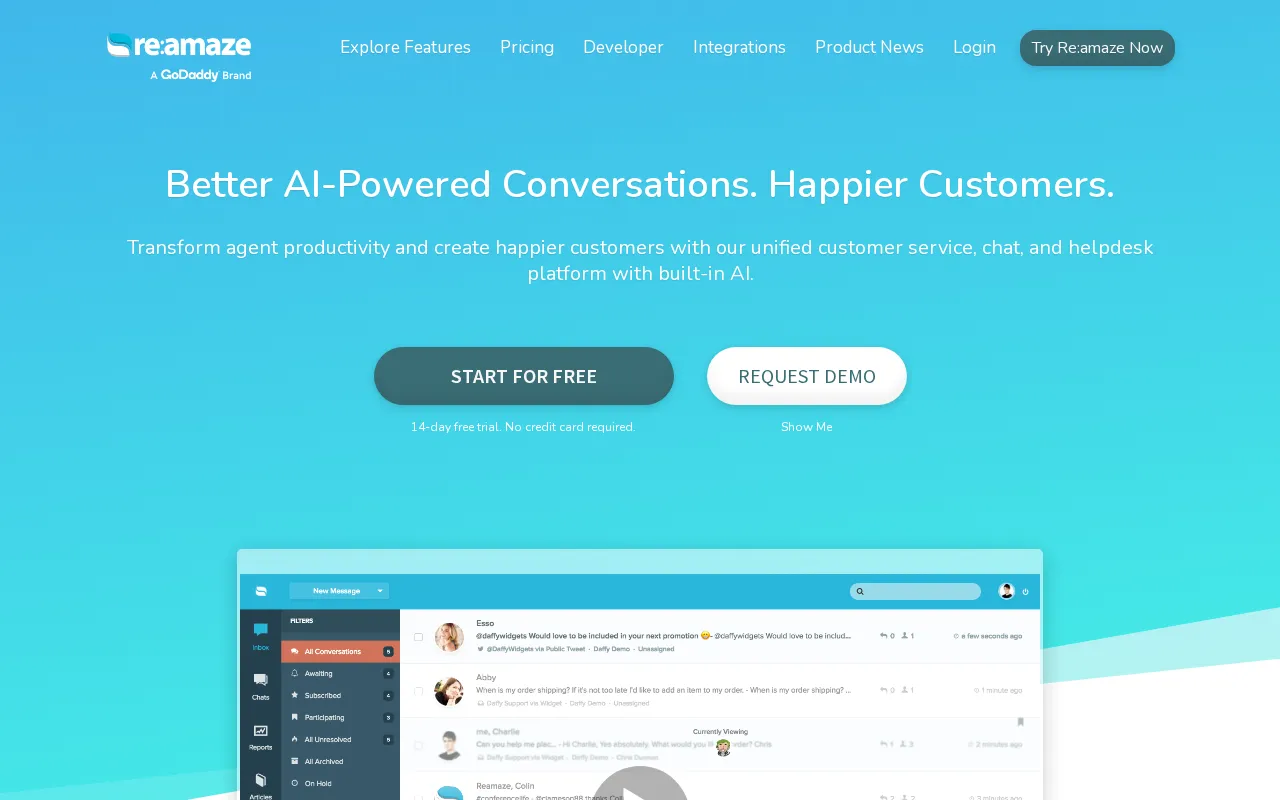
Re:amaze is a help desk for online stores, owned by GoDaddy, with email, live chat, social, SMS and voice in one inbox and an AI agent that answers from your FAQ and store data.
Re:amaze shows the Stripe charges tied to a conversation, and an agent refunds one in full or in part there, or processes a chargeback. Its AI agent costs $0.85 a resolution past the 5 to 20 per seat, and no Re:amaze page says that AI can refund.
- Best for
- Shopify and WooCommerce stores that run several brands and want social, SMS and voice next to email and chat.
- How it bills
- Basic is $29, Pro $49 and Plus $69 a team member a month ($26.10, $44.10 and $62.10 on annual billing), with 5, 10 or 20 AI agent resolutions per seat, then $0.85 each. Starter is $59 a month for unlimited team members and up to 500 responded conversations, with no published AI allowance.
- Free plan
- No, 14-day trial
- 3 people, 300 AI replies
- $321 a month: 3 Basic seats at $26.10 on annual billing, plus 285 AI agent resolutions at $0.85 after the 15 included.
Pros
- Email, live chat and social channels on every plan, with SMS and voice from Pro.
- Pro and Plus run unlimited brands from one account.
- Agents can refund and cancel Shopify orders and refund Stripe payments from inside a conversation.
- Starter gives unlimited team members for $59 a month, up to 500 responded conversations.
Cons
- Each AI resolution past the 5 to 20 per seat costs $0.85, so a busy month adds up fast.
- The AI agent is still labeled beta on the homepage, and no page says it can refund or cancel.
- No official MCP server, so Claude or ChatGPT can only reach it through the REST API or third-party connectors.
- All fees are non-refundable, and closing the account permanently deletes every conversation.
Already on Re:amaze? See the best Re:amaze alternatives.
4. BoldDesk
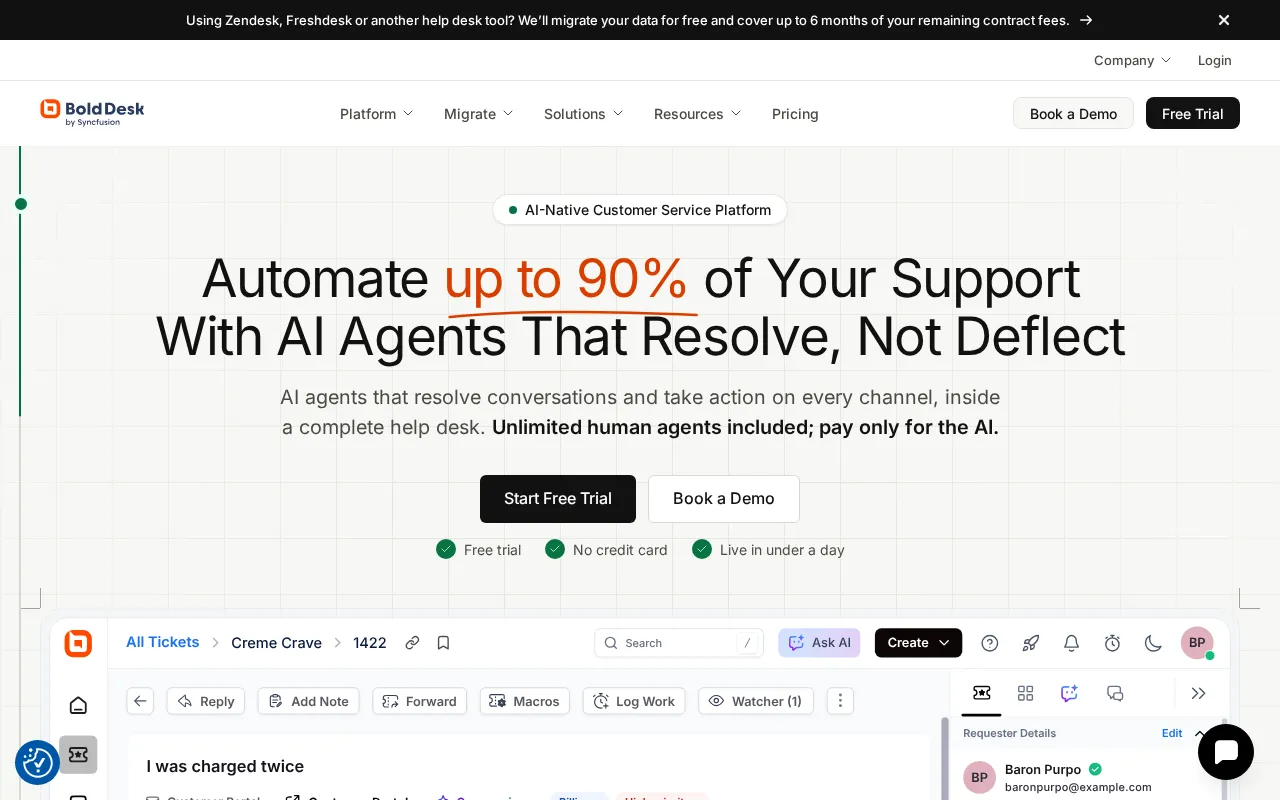
BoldDesk is a help desk and AI customer service platform from Syncfusion. Its AI agents answer on email, chat, WhatsApp, social media and SMS, and its AI plans include unlimited human agents.
BoldDesk’s AI agent can call your own APIs and MCP servers, so it could ask your app for a customer’s credit balance, with each action set to run alone or wait for a person. Agents refund Stripe payments from the ticket, but chat on the unlimited-agent plans starts at $499 a month on annual billing.
- Best for
- Large support teams, often running several brands, that want every agent in the help desk and to pay only for the work AI does.
- How it bills
- Enterprise is $35 an agent a month on annual billing ($40 monthly), with every help desk feature, live chat included. Its pricing page sells AI for it as an add-on, credits at $40 per 1,000 shared across every agent, while BoldDesk’s plan articles say Enterprise has no AI. AI plans instead include unlimited human agents and a monthly allowance of credits: Scale AI is $99 a month with 500, Momentum AI $499 with 1,000 and Enterprise AI $999 with 2,500, on annual billing ($116, $587 and $1,175 monthly). Bought credits never expire, while plan credits lapse at the end of each month.
- Free plan
- No, 15-day trial with no card
- 3 people, 300 AI replies
- $185 or more a month: 3 Enterprise agents at $35 on annual billing, plus 2 AI add-on credit packs of 1,000 at $40 for 300 AI answers at 5 credits each, the default in BoldDesk’s cost calculator, as its per-agent pricing page sells it. BoldDesk’s plan articles say Enterprise has no AI, which would leave Momentum AI at $499 as the first AI plan with chat.
Pros
- The AI plans include unlimited human agents, so on them adding a teammate never raises the bill.
- An official hosted MCP server lets Claude, ChatGPT or Copilot read tickets, reply, add notes, change status and assignee, and search or create knowledge base articles.
- Shopify order history and Stripe subscriptions show beside the ticket, and agents can issue Stripe refunds and cancellations from BoldDesk.
- Its own AI agent can call your APIs and MCP servers, with each action set to run on its own or wait for a person’s approval.
Cons
- On Enterprise every agent is $35 a month and AI credits come on top, and BoldDesk’s pricing page and plan articles disagree on whether that plan can have AI at all. The unlimited-agent plans with chat start at Momentum AI, $499 a month on annual billing, since Scale AI has no chat widget.
- Credits per answer vary with length and complexity, and BoldDesk says the cost of a response can’t be predicted or capped.
- Plan credits expire unused at the end of each cycle, and AI stops answering when the balance reaches zero.
- No free plan, and BoldDesk Voice is still launching soon, so phone calls come in through integrations such as Aircall.
Already on BoldDesk? See the best BoldDesk alternatives.
5. eesel AI
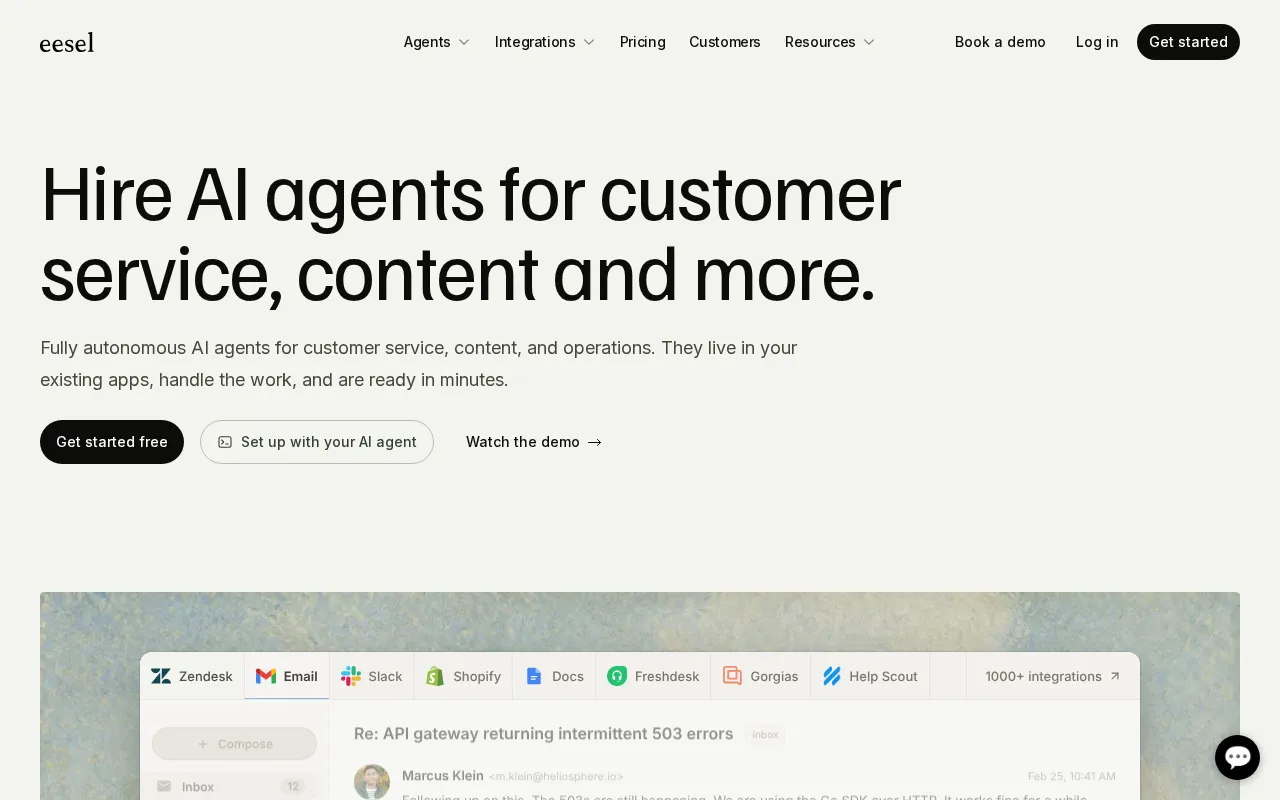
eesel AI is an AI agent that works inside the help desk you already use, such as Zendesk, Freshdesk, Intercom or Gorgias, and in your website chat, Slack and email. It drafts or sends replies from your help center, past tickets and documents.
eesel AI adds an AI agent to the help desk you keep, and its Stripe guide walks through refunding a returned pack, held as an approval card until a person says yes. Refunds can be in full or in part, but the smallest plan is $299 a month for 500 credits, on top of your help desk’s seats.
- Best for
- Teams keeping Zendesk, Freshdesk, Intercom or another help desk that want an AI to draft or send replies there, with each action set to run, ask first or stay off.
- How it bills
- Teammate plans are monthly batches of credits: 500 for $299, 1,000 for $499 and 3,000 for $1,149, up to 5,000 for $1,749. A ticket or a chat is 1 credit however long it runs, and extra credits are $0.80 each up to a monthly cap you set, which starts at $200. Unused credits don’t roll over. Enterprise adds $1,000 a month, and priority support starts at $299 a month.
- Free plan
- No, 7-day trial with 100 credits
- 3 people, 300 AI replies
- $299 or more a month: 300 tickets and chats fit the 500-credit plan at $299. The help desk eesel AI works in bills its seats on top.
Pros
- It works inside the help desk you already use, so your tickets, macros and workflows stay where they are.
- Each action, from a reply to a refund, can run on its own, wait for a person to approve it, or stay off.
- A ticket is 1 credit however many replies go back and forth, with no seat fees and no limit on agents.
- One agent covers Zendesk, Freshdesk, Intercom, Gorgias, HubSpot, Help Scout, Front and Salesforce, plus a website chat bubble, Slack and WhatsApp.
Cons
- It isn’t a help desk: it works inside the one you keep, so that help desk stays on your bill.
- A ticket that wakes the agent uses 1 credit even when the agent decides not to act.
- The smallest plan is $299 a month for 500 credits, and unused credits reset each billing month.
- Default support is eesel AI first, then a human within a few days. Same-day replies need priority support.
Already on eesel AI? See the best eesel AI alternatives.
6. Crisp
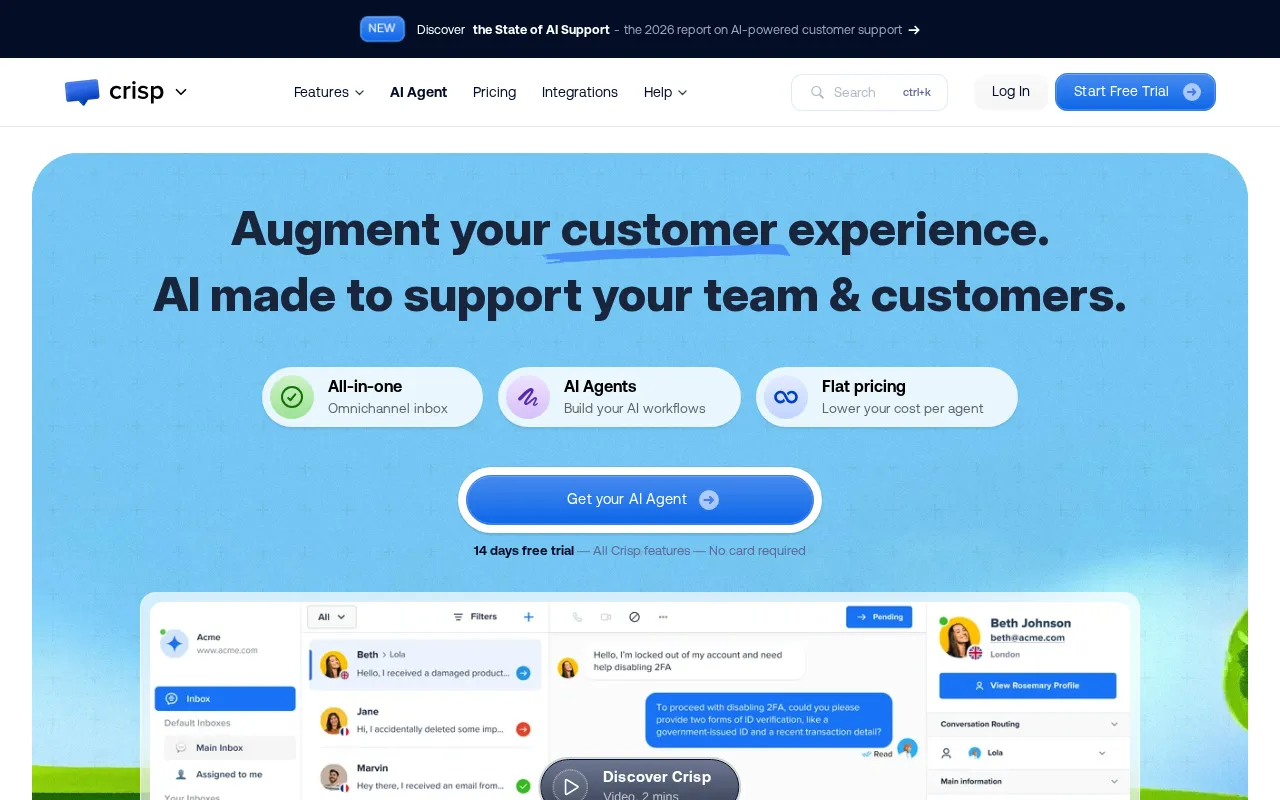
Crisp is a French customer support platform built around a website chat widget, with a shared inbox, many messaging channels and Hugo, its AI agent.
Hugo, Crisp’s AI, can call your own MCP servers, which is one way to answer a balance question or make a refund from your app, and a tool can require a one-time code from the customer before it runs, with no teammate in between. The inbox shows Stripe data only on Plus, $295 a month for 20 seats.
- Best for
- Small teams that start with free website chat and want WhatsApp, Instagram, SMS and phone in the same inbox later.
- How it bills
- Per workspace a month: Mini is $45 with 4 seats, Essentials $95 with 10 and Plus $295 with 20, including $5, $25 and $75 of AI credits (about 90, 450 and 1,350 Hugo conversations). Extra seats are $10 each, sold on Plus only, and Hugo past the credits runs on Pay-As-You-Go at about $0.05 to $0.10 a conversation.
- Free plan
- Yes: 2 seats, chat only, no AI
- 3 people, 300 AI replies
- $66 or more a month: Mini at $45 for 4 seats with about 90 Hugo conversations in its credits, plus about 210 more at about $0.10 each.
Pros
- One price per workspace, with 10 seats on Essentials for $95 a month.
- WhatsApp, Instagram, Messenger, SMS, Telegram and phone sit in the same inbox from Essentials.
- Its official MCP server can read, reply, add notes, resolve and write help center articles.
- Hugo can look up orders and refund through Shopify, WooCommerce, PrestaShop and Stripe, after a one-time code checks the customer.
Cons
- The free plan has no email inbox and no AI, and Mini has no help center, WhatsApp or MCP server.
- Hugo stops answering when the month’s credits run out unless you turn on Pay-As-You-Go, whose rates aren’t published.
- Stripe data in the inbox comes only with Plus at $295 a month.
- Crisp’s terms refund no fees, monthly or yearly.
Already on Crisp? See the best Crisp alternatives.
7. Tidio
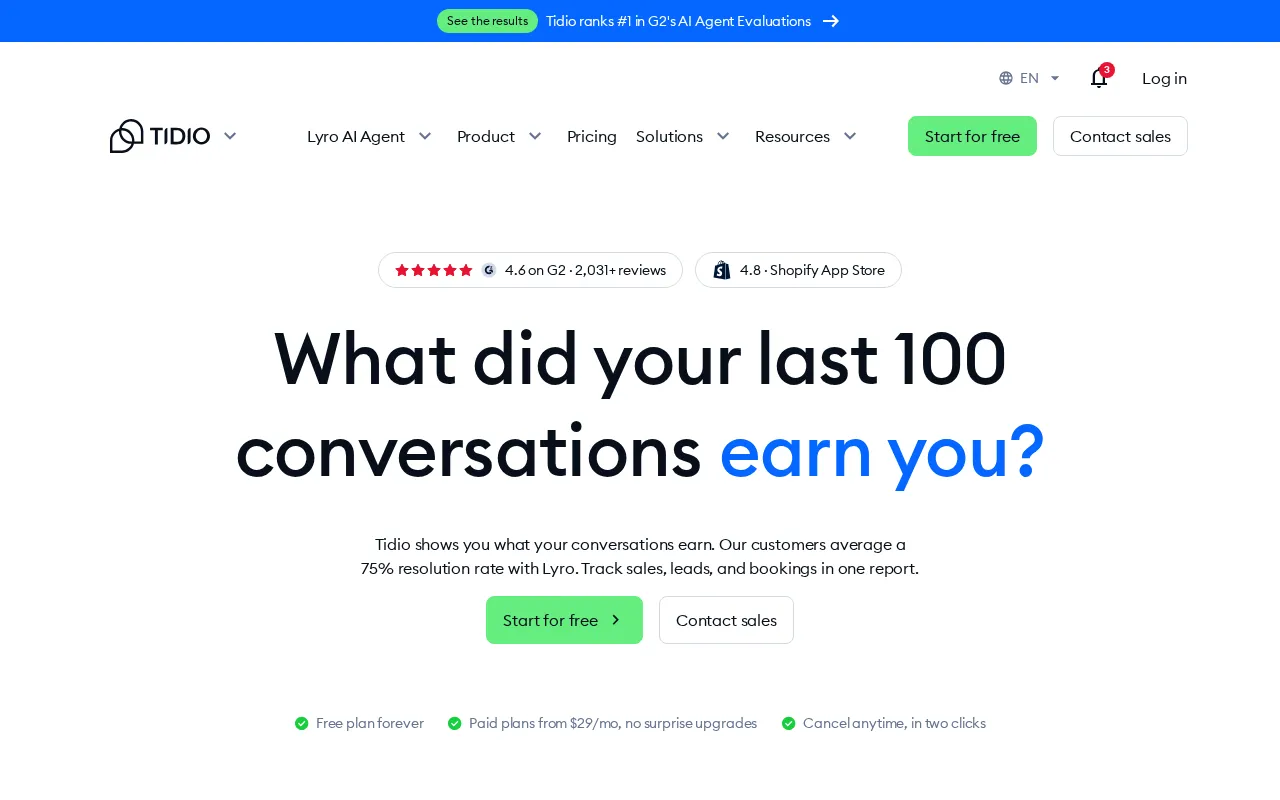
Tidio is a live chat and help desk tool built for online stores, especially Shopify, with Lyro, an AI agent sold as an add-on, and a help center since 2026.
Lyro, Tidio’s AI, can call your own MCP servers, and Tidio’s Stripe integration puts transaction history and billing details beside the chat. That integration needs Plus, from $300 a month, and it retrieves payment data without processing payments.
- Best for
- Shopify and WooCommerce stores that want chat, WhatsApp and Instagram in one inbox and an AI that recommends products.
- How it bills
- Plans are priced by the conversations your team answers, with 10 seats: Starter is $24.17 a month on annual billing ($29 monthly) for 100, and Growth runs from $49.17 for 250 ($59 monthly) to $349 monthly for 2,000. Lyro is an add-on from $32.50 a month for 50 conversations to $583.33 for 1,000 on annual billing ($39 for 50, $210 for 300 and $700 for 1,000 monthly), and Plus starts at $300 a month plus usage.
- Free plan
- Yes: 10 seats, 50 conversations a month
- 3 people, 300 AI replies
- $199 or more a month: Starter at $24.17 on annual billing plus 300 Lyro conversations at $175. Starter covers 100 conversations your team answers, and more needs Growth.
Pros
- Up to 10 seats on Free, Starter and Growth, so the bill doesn’t grow as you add teammates.
- WhatsApp, Instagram, Messenger and email on every plan, including Free.
- Lyro recommends products and adds them to the cart on Shopify and WooCommerce.
- Lyro’s actions can check orders, cancel or change them and refund, and Lyro can call your own MCP servers.
Cons
- Lyro is a separate add-on billed per conversation, about $0.58 to $0.78 each by tier and billing, and over 1,000 a month is priced by sales.
- The API and Stripe integration need Plus, from $300 a month.
- Its official MCP server only reads analytics data, loaded once a day, so your own AI can’t reply or close.
- No refunds for time left after you cancel.
Already on Tidio? See the best Tidio alternatives.
8. Kayako
Kayako is a help desk that now leads with Kay, an AI agent billed per resolved ticket. Kay runs on Kayako One, Kayako’s own help desk, or on top of Zendesk, Freshdesk or Intercom.
Kay, Kayako’s AI, can issue refunds through Stripe or your own API, and you pay $1 only for a ticket it fully solves. Kayako’s pages describe no approval step before Kay refunds, and Kayako One, the help desk around Kay, has no published price.
- Best for
- Support leaders who want an AI agent set up for them and paid per resolved ticket, on Kayako or on the help desk they already use.
- How it bills
- Kay is $1 for each ticket it resolves, with no seat or setup fees, and handoffs to a person aren’t charged. Kayako One, the help desk with Kay and white-glove setup, has no published price.
- Free plan
- No, and no trial on the pricing page
- 3 people, 300 AI replies
- $300 or more a month: 300 Kay resolutions at $1, plus a Kayako One platform fee that isn’t published.
Pros
- Kay can run on Zendesk, Freshdesk or Intercom, so a team can add an AI agent without moving help desks.
- You pay for Kay only when it fully solves a ticket: escalations to a person and simple deflections are free.
- Kay can act as well as answer, such as issuing refunds, creating accounts and sending return labels through Stripe, Shopify or your own API.
- Kayako Classic is still offered as a self-hosted, on-premises help desk.
Cons
- Kayako One has no published price, so you can’t see the full bill on Kayako’s site.
- No free plan, and the pricing page offers no trial.
- No official MCP server for your own AI agent, and Kayako’s pages describe no approval step before Kay refunds.
- There is no cancel button: you send a request to Trilogy with a copy of a paid invoice.
Already on Kayako? See the best Kayako alternatives.
9. Intercom
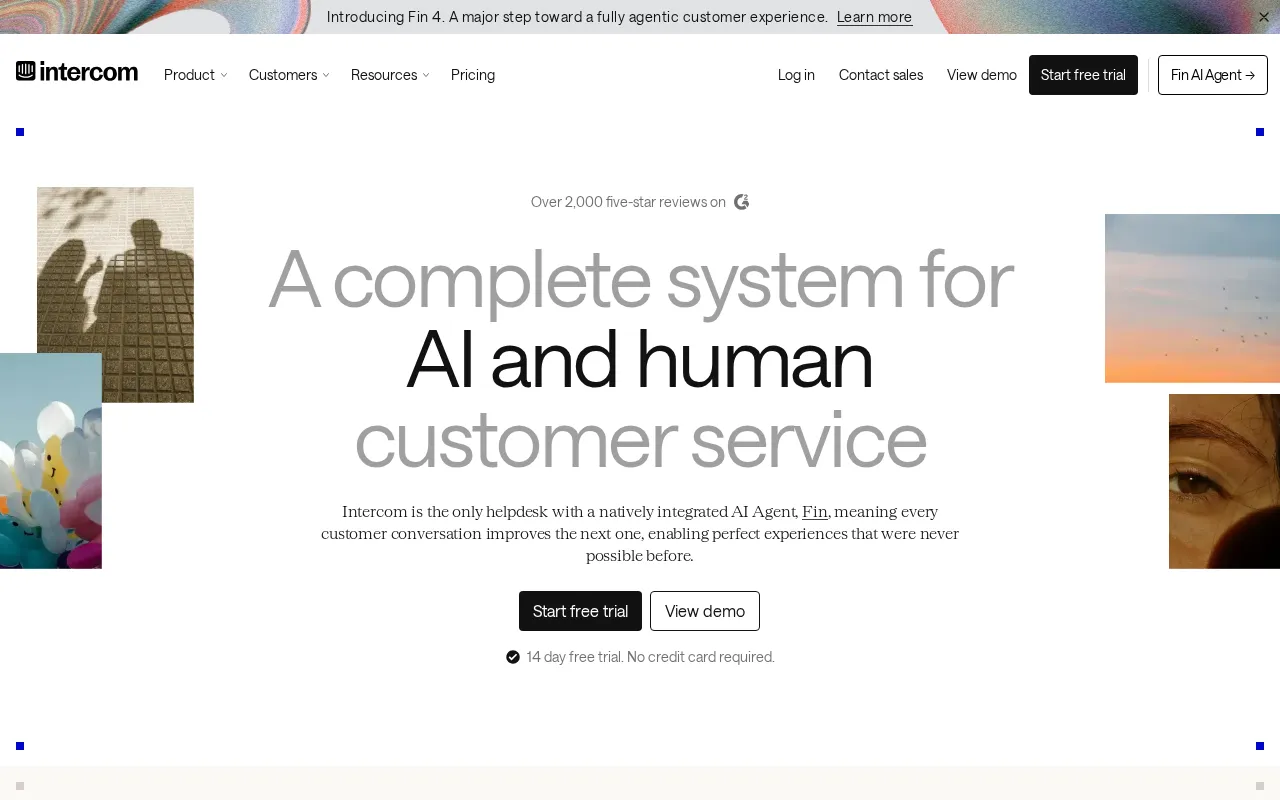
Intercom is a customer service help desk with a chat Messenger, a shared inbox, a help center and Fin, its AI agent. Its company renamed itself Fin in May 2026, and Salesforce bought it that September.
Intercom’s Stripe app shows a customer’s three most recent payments in the inbox, with an expanded view meant for payment and account balance questions, and Fin can read recent payments to answer. Every teammate who replies takes a seat, from $19 for new customers on Essential with annual billing ($29 list), plus $0.99 a Fin outcome.
- Best for
- Software and app companies that want chat, email, phone, WhatsApp and SMS in one inbox, with Fin answering across them.
- How it bills
- Per seat: Essential is $29, Advanced $85 and Expert $132 a seat a month on annual billing ($39, $99 and $139 monthly), and new customers pay $19 for Essential on annual billing. Fin costs $0.99 for each outcome, and WhatsApp, SMS and phone are billed by use.
- Free plan
- No, 14-day trial
- 3 people, 300 AI replies
- $354 a month: 3 Essential seats at $19, the new-customer price on annual billing (list $29), plus 300 Fin outcomes at $0.99.
Pros
- Chat, email, phone, WhatsApp, SMS, Slack, Facebook and Instagram all arrive in one inbox.
- Fin answers on email, live chat and phone, and is charged once per conversation however many questions it answers.
- Agents can refund or cancel a Shopify order from the inbox sidebar, and the Stripe app shows subscriptions mid-conversation.
- Its official MCP server can add internal notes and write and publish help center articles, not only read.
Cons
- Every teammate who replies needs a paid seat, and Fin adds $0.99 an outcome on top.
- An outcome also counts when a customer simply stops asking after Fin’s answer, or when a Fin workflow hands the conversation to your team.
- Its MCP server can’t reply to customers, assign or close conversations, and doesn’t serve workspaces hosted in Australia.
- No free plan, and an annual plan cancelled early gets no prorated refund.
Already on Intercom? See the best Intercom alternatives.
10. Fin
Fin is an AI that answers customers on chat, email, voice and social. It runs inside Intercom, or on top of a help desk you already use, such as Zendesk, Salesforce, HubSpot or Freshdesk, and hands your team what it can’t solve.
Fin works inside the help desk you already have, and a Procedure connected to Stripe can check a purchase and refund it in the same conversation. Under a threshold you set it refunds with no person approving, so decide that limit before small pack refunds start flowing through it.
- Best for
- Teams with a large queue on Zendesk, Salesforce, HubSpot or Freshdesk that want a strong AI answering customers without changing help desks.
- How it bills
- A $49 base plan covers the first 50 outcomes a month, then each costs $0.99, charged at most once per conversation. Unused outcomes don’t carry over. Fin Voice is $1.99 a voice outcome through sales, and your help desk’s seats are billed separately.
- Free plan
- No, 14-day trial
- 3 people, 300 AI replies
- $297 or more a month: 300 outcomes: $49 for the first 50, then 250 at $0.99. Your help desk’s seats come on top.
Pros
- It works inside the help desk you already have, so your team keeps it as the system of record.
- You pay at most once per conversation, and nothing when a customer asks for a person or a Procedure fails.
- Procedures connect Fin to Stripe and Shopify, so it can check an order and refund it in the same conversation.
- It answers on chat, email, voice, social and Slack, and on WhatsApp through Freshdesk, with spending limits you set.
Cons
- Fin is an AI, not a help desk, so its outcomes come on top of your help desk’s seats.
- An outcome counts when a customer stays silent for 24 hours after Fin’s answer, and when a Procedure ends in a handoff to your team.
- A Procedure can refund on its own under a threshold you set, with no person approving it.
- Buying Fin for another help desk starts with “Contact sales” on its pricing page.
Already on Fin? See the best Fin alternatives.
11. Front
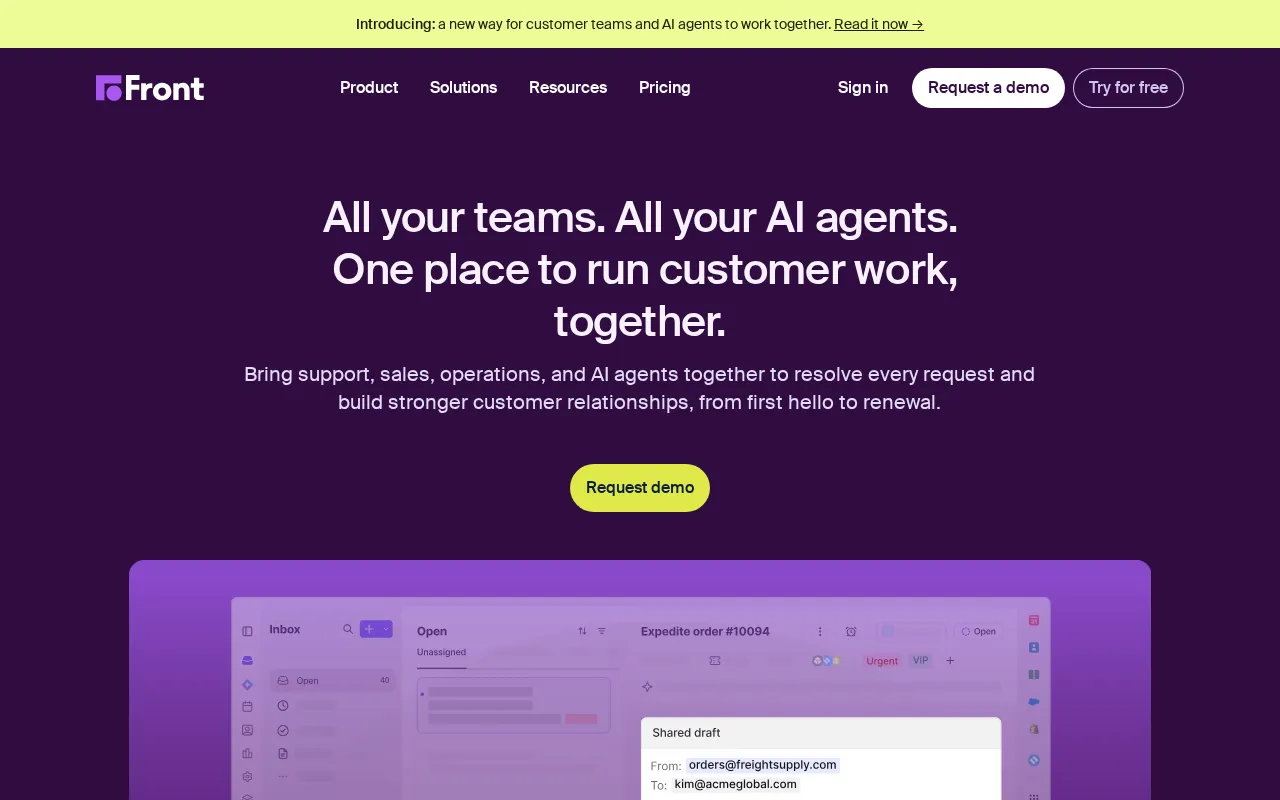
Front is a customer service platform built on shared inboxes, where support, sales and operations teams handle email, chat, SMS and social together. Autopilot, its AI agent, is billed by what it does in each conversation.
Front’s own AI reaches Stripe through a connector that can create refunds, with each action off until someone turns it on, so you choose whether pack refunds are within its reach. Autopilot charges $0.89 a resolution and $0.39 a handoff, on seats from $25 on Starter.
- Best for
- Teams that run many shared addresses, bring in colleagues outside support, and want people and AI agents working one queue.
- How it bills
- Starter is $25 a seat a month for up to 10 seats, Professional $65 for up to 50 and Enterprise $105, on annual billing ($35 and $85 monthly; Enterprise is annual only). Autopilot charges $0.39 to hand off and $0.89 to resolve a conversation, and Copilot is $20 a seat.
- Free plan
- No, 14-day trial
- 3 people, 300 AI replies
- $342 a month: 3 Starter seats at $25 on annual billing, plus 300 Autopilot resolutions at $0.89.
Pros
- Its official MCP server can search, draft, send, comment, assign, tag and archive, with sending behind its own permission.
- Guest accounts let colleagues outside support comment on a conversation without a paid seat.
- Autopilot answers on email, chat, SMS, WhatsApp and Slack, and its 30-day trial covers up to 1,000 resolutions.
- Outside AI agents built with Claude, OpenAI or Sierra can be assigned conversations like a teammate, on every plan.
Cons
- Starter stops at 10 seats and one channel type, so an 11th seat or a second channel means Professional at $65 a seat.
- Autopilot charges for handoffs too, not only for conversations it resolves.
- There is no export you can run yourself: Support makes one, and it leaves out contacts, templates, tags and individual inboxes.
- Monthly and annual payments are nonrefundable, even if you cancel early.
Already on Front? See the best Front alternatives.
12. Missive
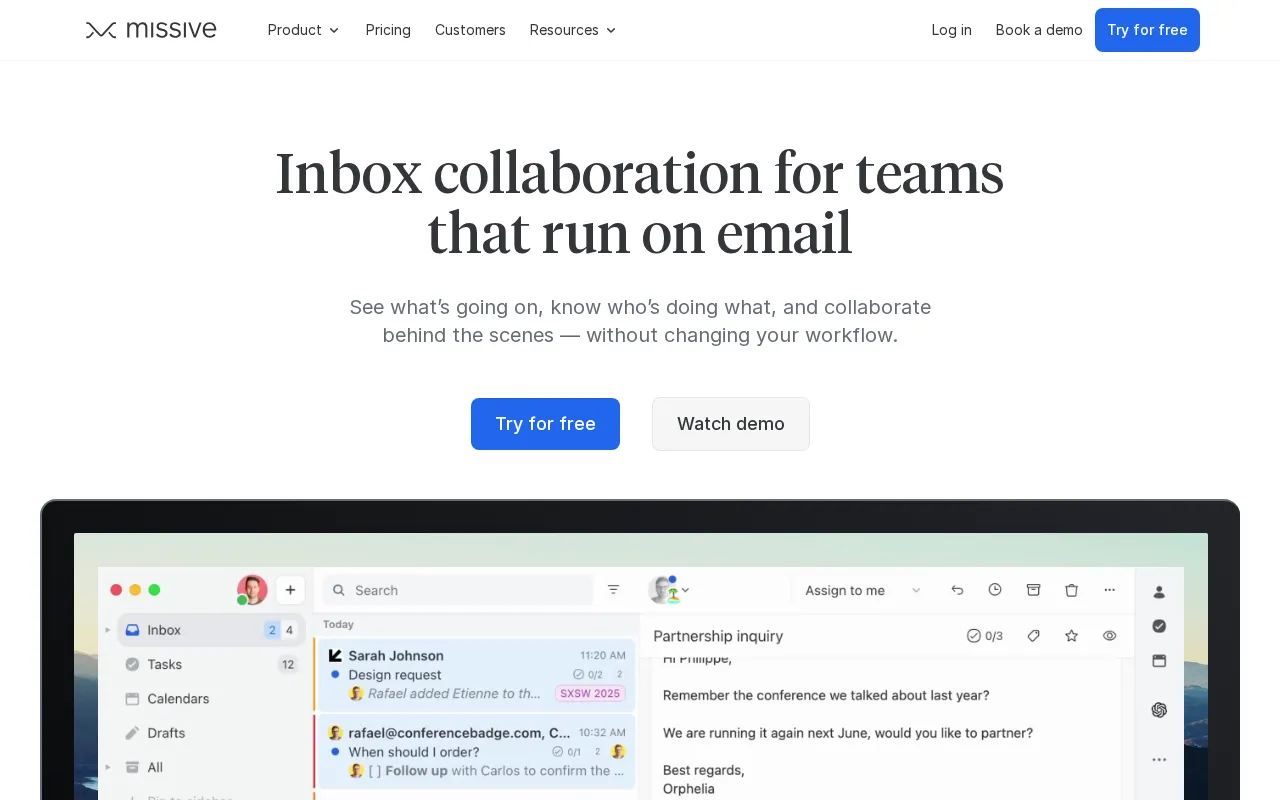
Missive is a team email app that puts personal and shared inboxes, comments, tasks, calendars and internal chat in one place. Its AI assistant drafts, summarizes and translates, but doesn’t answer customers on its own.
Missive’s AI assistant reaches Stripe through MCP, where it can create refunds, so a teammate can return a pack without leaving the shared inbox. No AI answers customers, since AI rules only write drafts, and the API and MCP need Productive at $24 a user on annual billing.
- Best for
- Small teams that answer email together and want internal chat and tasks beside their messages.
- How it bills
- Starter is $14 a user a month for up to 5 users, Productive $24 for up to 50 and Business $36, on annual billing ($18, $30 and $45 monthly). AI runs on Missive credits at the provider’s price plus 25%, or on your own key with no markup, and Productive and Business start with $5 of free credits. Each user adds 5 shared accounts to a pool, and every 5 past it cost $15 a month.
- Free plan
- No, 30-day trial
- 3 people, 300 AI replies
- $72 or more a month: 3 Productive users at $24 on annual billing, plus AI drafts at token prices. No AI answers customers.
Pros
- Personal and shared email, comments, tasks, calendars and internal chat live in one app.
- Bring your own Anthropic, OpenAI or Gemini key and pay no markup on AI.
- Its AI assistant reaches Stripe, Notion and Linear through MCP, and asks you to approve actions before anything happens.
- Native apps for iOS, Android, macOS and Windows, with SMS, WhatsApp, Messenger and Instagram beside email.
Cons
- No AI answers customers: AI rules can only create a draft for a teammate to send.
- No help center, and live chat needs your own Twilio account.
- The API and MCP need Productive.
- No free plan: after the 30-day trial an unpaid organization is paused, and its data is eventually deleted.
Already on Missive? See the best Missive alternatives.
13. Chatbase
Chatbase builds an AI agent trained on your own content, such as your website and documents, and puts it on your site, WhatsApp, Messenger, Instagram, Slack, email and the phone. Its Helpdesk inbox, included from Basic, its cheapest plan, lets your team take over what the AI can’t solve.
Chatbase’s Stripe actions let a signed-in customer pull up their invoices, payment details and billing records in the chat bubble, without waiting for a teammate. They run in the chat bubble only, and Chatbase bills its own AI in message credits that don’t carry over, from $120 a month on annual billing.
- Best for
- Teams that want a chatbot on their website and messaging apps first, with a choice of models from OpenAI, Anthropic, Gemini and others, and a help desk second.
- How it bills
- Basic is $150 and Business $500 a month on monthly billing ($120 and $400 a month on annual billing), with 4,000 and 15,000 message credits and 3 and 5 members. The recommended models use 1 to 5 credits a message, unused credits don’t carry over, and auto recharge adds credits at $40 per 1,000.
- Free plan
- Not on the pricing page: Basic and Business each start with a 7-day trial
- 3 people, 300 AI replies
- $120 a month: Basic at $120 a month on annual billing ($150 monthly), the cheapest plan, with 3 members. Its 4,000 message credits cover 300 replies even at 5 credits each.
Pros
- Every plan includes advanced models from OpenAI, Anthropic, Gemini, DeepSeek, Mistral and others, so you choose the one each chatbot runs on.
- The chatbot answers on your website, WhatsApp, Messenger, Instagram, Slack, email and the phone.
- A teammate can take over a live AI conversation from the Helpdesk, which turns it into a ticket with an AI-written summary.
- Its AI can escalate a conversation as a ticket to Zendesk, Salesforce, Intercom, Zoho Desk, Freshdesk, HubSpot, Help Scout, Gorgias or Odoo, with the customer’s details.
- Its official MCP server lets Claude or ChatGPT search conversations, reply to Helpdesk tickets or leave internal notes on them, and assign or close them.
Cons
- Members are capped by plan: 3 on Basic and 5 on Business.
- When message credits run out, the chatbots stop responding until the credits reset, unless auto recharge buys more.
- An action can make the chatbot send 2 or more requests to the model for one reply, and each one uses credits.
- Removing “Powered By Chatbase” is a $99 a month add-on.
Already on Chatbase? See the best Chatbase alternatives.
14. DocsBot
DocsBot turns your docs, website and other content into AI agents that answer customers in a chat widget, Slack or WhatsApp. When a customer needs a person, it hands them to the help desk widget you already use, such as Help Scout, Zendesk or Intercom.
DocsBot answers from your docs, so a clear page on how credits are spent and when they expire carries much of the load, and Standard at $149 a month adds Stripe billing actions. It isn’t a help desk: a customer it can’t help goes to the widget of a help desk you pay for separately.
- Best for
- Teams happy with their help desk that want an AI answering from their docs on the website, with hard questions passed to that help desk.
- How it bills
- Personal is $49 a month for 1 team user and 5k AI credits, Standard $149 for 5 team users and 15k, and Business $499 for 10 team users and 60k, with 2 months free on annual plans. A chat message starts at 1 credit and uses more on larger models and AI actions, and each 5k more credits cost $49 a month. Extra team users are $19 each, on Business and Enterprise only.
- Free plan
- Yes: 1 user, 100 AI credits a month
- 3 people, 300 AI replies
- $149 or more a month: Standard at $149, the first plan with escalation tickets for your help desk, using 300 of its 15k AI credits at 1 credit a message. Your help desk’s seats come on top.
Pros
- A free plan with 100 AI credits a month, and a 14-day money-back guarantee on paid plans.
- It learns from dozens of content sources, such as Notion, Confluence, Google Drive, Zendesk Guide and solved Help Scout or Freshdesk tickets.
- On Standard, its widget hands a customer to your Help Scout, Zendesk, Intercom, Freshdesk, HubSpot, LiveChat or Gorgias widget, with the chat history and an AI-written ticket.
- It answers in Slack, Messenger, WhatsApp and Telegram from Personal, and adds realtime voice agents and Stripe billing actions on Standard.
Cons
- DocsBot is not a help desk: the teammate who takes over answers in another tool, billed separately.
- When the month’s AI credits run out, it stops answering and shows customers an error, unless you turn on auto-add.
- Standard stops at 5 team users, and extra users are sold only from Business at $499 a month.
- Removing DocsBot branding from the widget needs Business.
Already on DocsBot? See the best DocsBot alternatives.
15. Teamwork Desk
Teamwork Desk is the help desk from Teamwork.com, the project platform for client-service businesses. Client emails become tickets that can turn into Teamwork.com tasks, with live chat from Pro, Help Docs knowledge bases and Dotty, an AI add-on that drafts replies for agents.
Teamwork Desk shows a customer’s Stripe invoices and subscriptions in the ticket sidebar, which covers a pack sold on an invoice, though Stripe there only shows billing history, so refunds happen in Stripe. Starter is $9.50 an agent billed yearly, and Dotty drafts replies without answering customers.
- Best for
- Agencies, consultancies and IT services firms on Teamwork.com that bill support time to client projects and retainers.
- How it bills
- Starter is $9.50 an agent a month billed yearly ($12 monthly) for up to 10 agents, Pro $17 ($21) and Premium $33 ($41); Enterprise is quoted. Dotty is $69 a month for the whole site, with 1,000 tickets analyzed and 100 suggested replies, then $9 per 100 replies. Each Help Docs site past the free one is $20 a month.
- Free plan
- No, 30-day trial with no card
- 3 people, 300 AI replies
- $29 a month: 3 agents on Starter at $9.50, billed yearly. Dotty, $69 a month, only drafts, so no AI answers customers. Live chat needs Pro, $17.
Pros
- A ticket can become a Teamwork.com task, and time logged on tickets updates Teamwork.com budgets and retainers.
- An official MCP server, at no extra cost, lets Claude or ChatGPT reply, add notes, assign, change status and write Help Docs articles.
- Starter is $9.50 an agent billed yearly, with a Help Docs site and customer portal, and every plan starts with a 30-day trial and no card.
- Stripe shows a customer’s invoices and subscriptions in the ticket sidebar.
Cons
- No AI answers customers: Dotty drafts replies, summarizes and finds similar tickets, and an agent sends every reply.
- Live chat needs Pro, $17 an agent billed yearly, and customers reach it through the embeddable contact form widget.
- No WhatsApp, voice or social channels, and no Shopify integration.
- Starter stops at 10 agents, and there is no free plan.
Already on Teamwork Desk? See the best Teamwork Desk alternatives.
16. Zendesk
Zendesk is a customer service suite for email, messaging, live chat, social and voice, with AI agents that answer customers and are billed per automated resolution.
An admin can connect Zendesk’s AI agents to Stripe’s MCP server, and the Suite puts email, messaging, WhatsApp and voice in one place. Seats start at $19 an agent on Support Team with annual billing, and each automated resolution past a plan’s allowance is $1.50 committed or $2.00 as you go.
- Best for
- Growing and large teams that need voice, many channels, 1,800+ apps and integrations, and enterprise controls to grow into.
- How it bills
- Per agent: Support Team is $19, Suite Team $55 and Suite Professional $115 a month on annual billing ($25, $69 and $149 monthly). Each agent brings 5 automated resolutions a month (10 on Professional), then each costs $1.50 committed or $2.00 pay as you go. Copilot is $50 more an agent.
- Free plan
- No, 14-day trial
- 3 people, 300 AI replies
- $485 a month: 3 Support Team agents at $19 on annual billing, plus 285 automated resolutions at $1.50 committed beyond the 15 included, on email only.
Pros
- Email, messaging, live chat, WhatsApp, social and voice sit in one Suite, and AI agents can answer on email, messaging or voice.
- Its marketplace lists 1,800+ apps, partners and integrations.
- Agents refund and cancel Shopify orders inside a ticket, and an admin can connect Zendesk’s AI agents to Stripe’s MCP server.
- The 14-day trial opens every Suite Professional feature, Copilot included, and startups can get 6 months of Suite free for up to 50 agents.
Cons
- Every agent is a seat, and each automated resolution past the 5 per agent a plan includes costs $1.50 to $2.00.
- No official MCP server for outside AI tools yet: Zendesk announced one in May 2026 for early access and has published no tools for it.
- Data exports are off until the account owner asks support, and the export tools aren’t on Team plans.
- Zendesk gives no refunds or credits for unused seats or time.
Already on Zendesk? See the best Zendesk alternatives.
17. Gmail / Google Workspace
Google Workspace is Google’s business email and office suite. A support team answers from a shared Gmail address, a Google Group set up as a collaborative inbox, or delegated access to one mailbox.
A collaborative inbox in Google Groups lets members take and resolve conversations at no cost beyond $7 a user. There is no Stripe, live chat or help center for support, so explaining how credits work and refunding a pack both happen somewhere else.
- Best for
- Very small teams already on Google Workspace that answer a modest amount of email and need no live chat or help center.
- How it bills
- Per user: Business Starter is $7, Standard $14 and Plus $22 a user a month with a 1-year commitment, and Starter is $8.40 on the monthly “Flexible” plan. Gemini comes with every plan, and a Google Group costs nothing extra.
- Free plan
- No, 14-day trial
- 3 people, 300 AI replies
- $21 a month: 3 Business Starter users at $7 with a 1-year commitment. Gemini is included, but nothing in Gmail answers customers on its own.
Pros
- Most teams already pay for it, and $7 a user covers email, calendar, Meet, Drive and Gemini.
- A collaborative inbox lets members take, assign and resolve conversations at no extra cost.
- Google’s official Gmail MCP server lets an AI client search and read threads and save drafts.
- Since September 2026, Google Workspace Studio flows can act on new mail, including sending replies within a thread.
Cons
- Assigning and resolving happen in Google Groups, not in Gmail itself.
- There is no live chat, help center, Shopify or Stripe for support.
- Gemini helps the person writing, and delegates in a shared mailbox lose Gemini in Gmail.
- The Gmail MCP server is still in early access for developers and can’t send a reply.
Already on Gmail / Google Workspace? See the best Gmail / Google Workspace alternatives.