1. Rinhelp
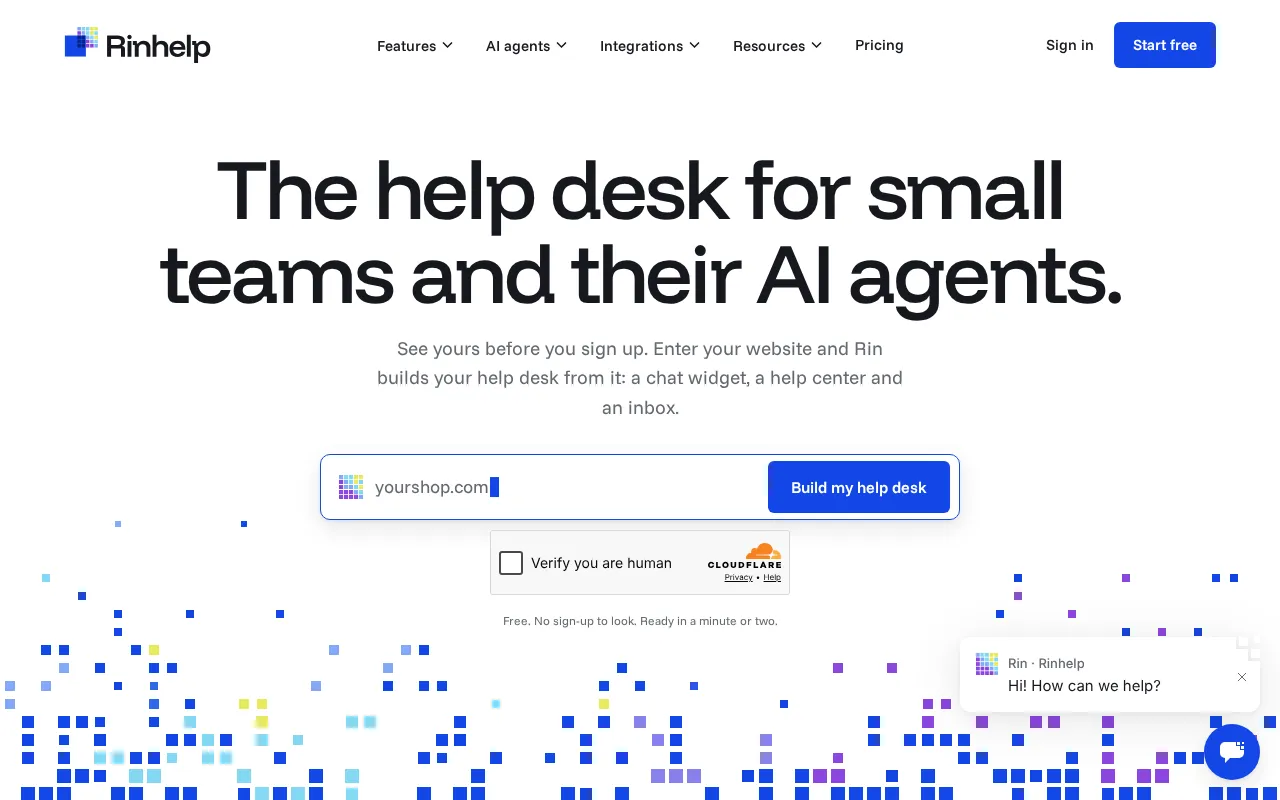
Rinhelp is for the cloud customers who pay you and write in privately. Add your docs site and help center as knowledge sources, and Rin, our built-in AI, answers the setup, account and configuration questions they cover, handing the conversation to a maintainer when they don’t. Pro is one price for the workspace, so every maintainer who takes the odd support shift joins at no extra cost, and their Claude or Claude Code can work the inbox through MCP. When a cloud customer asks about a charge, their Stripe subscriptions, invoices and payments sit beside the conversation, and a refund or cancellation Rin asks for becomes an approval a teammate decides. Shopify and Stripe are Rinhelp’s only integrations, and it answers email and live chat only. It’s $49 a month with 5,000 AI replies.
- Best for
- Open-source companies of 2 to 10 that sell a hosted cloud through Stripe and want paying customers answered by email and chat, apart from the community.
- How it bills
- Free for up to 3 teammates. Pro is $49 a month for the whole workspace, with 5,000 AI replies from Rin. No per-seat or per-resolution fees.
- Free plan
- Yes: 3 teammates, 50 AI replies to try Rin
- 3 people, 300 AI replies
- $49 a month: Pro for the whole workspace, using 300 of its 5,000 AI replies; Free covers your team if you don’t need AI replies.
Pros
- $49 a month for the workspace with 5,000 AI replies, however many maintainers join the rotation.
- The free plan covers 3 teammates with 50 AI replies to try Rin, enough to test it on cloud customers before paying.
- Maintainers connect Claude, Claude Code or ChatGPT through MCP, and the replies their agents send don’t use AI replies.
- A cloud customer’s Stripe payments sit beside the conversation, and a refund Rin or an AI agent asks for becomes an approval a teammate decides.
Cons
- Email and live chat only: there is no phone, WhatsApp, SMS or social inbox.
- Shopify and Stripe are the only integrations.
- No reports, SLA rules or routing rules: Rin hands a conversation to the teammate with the fewest open ones.
- The free plan has no Rin beyond 50 AI replies to try it.
2. Chatwoot
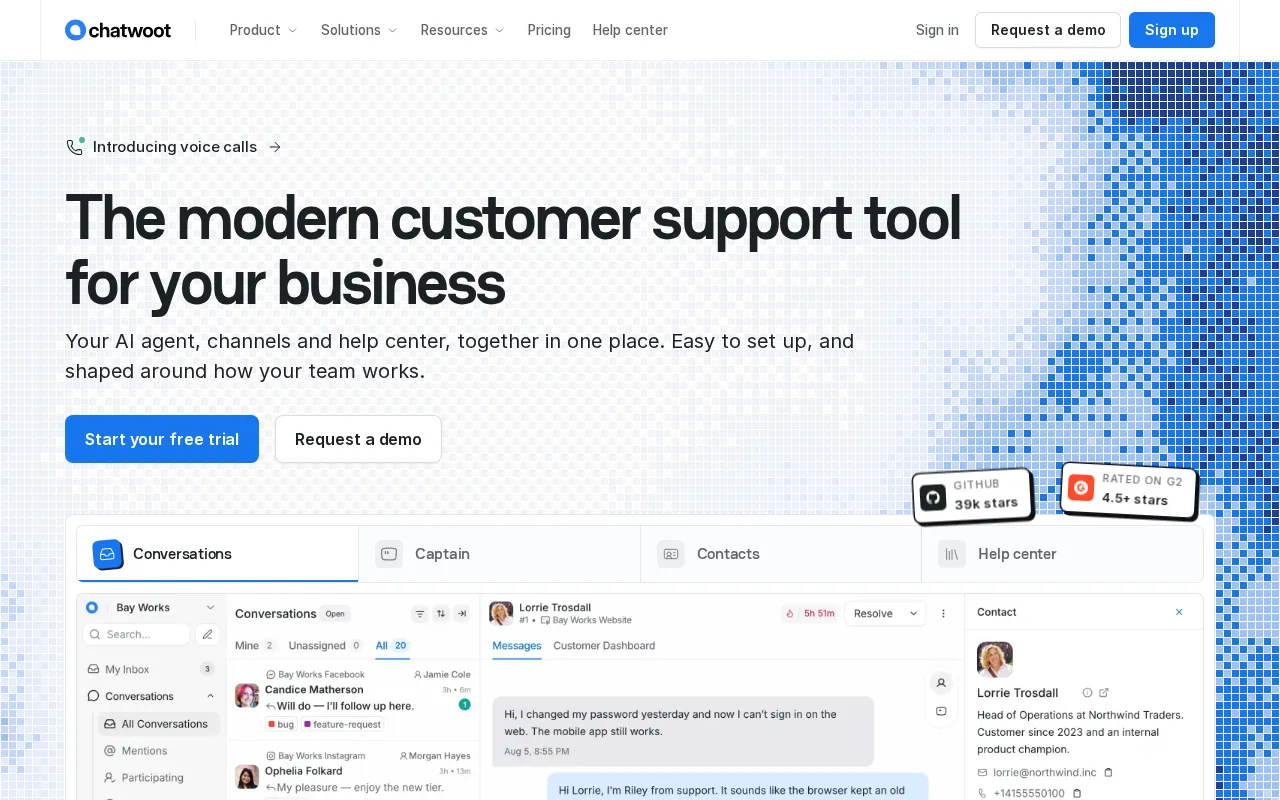
Chatwoot is open-source support software with one inbox for live chat, email, WhatsApp, social and voice, a help center, and Captain, its AI agent. You can use Chatwoot Cloud or host it yourself.
Chatwoot sells the way an open-source SaaS company does: the Community Edition free to host, and a Cloud with a free plan for 2 agents and paid plans from $19 an agent. If your own product would call Chatwoot’s API, note that the free Cloud plan lost API and webhook access in July 2026.
- Best for
- Teams that want many channels at a low seat price, or want to run their help desk on their own servers.
- How it bills
- Cloud is per agent a month: Startups $19, Business $39 and Enterprise $99, with 300, 500 or 800 Captain credits for the account. Each Captain reply uses a credit, extra credits are $20 per 1,000, and no annual price is published. Credits never top up by themselves: once they run out, new conversations go straight to your team with no Captain reply.
- Free plan
- Yes: 2 agents, live chat only, 500 conversations a month
- 3 people, 300 AI replies
- $57 a month: 3 Startups agents at $19, with the 300 included Captain credits covering 300 AI replies.
Pros
- Open source: the self-hosted Community Edition is free, and your data stays on your own servers.
- One inbox for live chat, email, WhatsApp, Instagram, Messenger, TikTok and, from Business, voice calls.
- Startups includes every channel but voice, plus a help center, at $19 an agent a month.
- An official CLI and agent skill let coding agents such as Claude Code work in Chatwoot.
Cons
- Startups has no automation rules or teams; those start on Business at $39 an agent.
- Captain uses a credit for every reply, and bought credits expire after 6 months and aren’t refunded.
- Since July 2026 the free Cloud plan has no API or webhook access.
- No official MCP server, and Captain’s custom tools have no built-in approval step for actions like refunds.
Already on Chatwoot? See the best Chatwoot alternatives.
3. Zammad
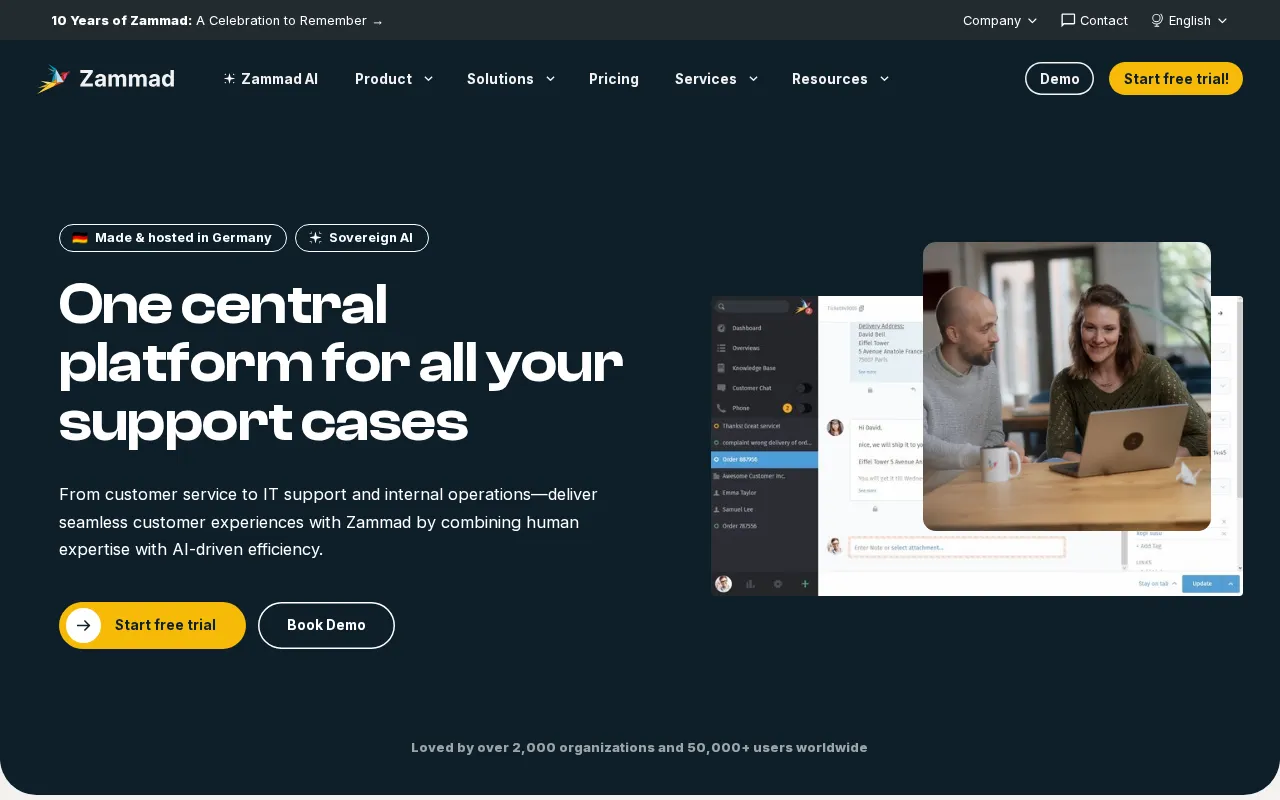
Zammad is an open-source ticketing help desk from Zammad GmbH in Germany, founded in 2014 by Martin Edenhofer, who earlier created OTRS. Email, chat, SMS, Telegram, Facebook and WhatsApp share one ticket queue with a knowledge base, on your own server for free or hosted by Zammad in Germany.
Zammad publishes its full feature set as open source, and its hosted plans run in ISO 27001-certified data centers in Germany, an answer ready for a European customer’s procurement review. Running it yourself takes 2 CPU cores and 6 GB of RAM before Elasticsearch, and support contracts start at €2,999 a year.
- Best for
- Teams that want an open-source ticketing system they can run themselves, or have hosted in Germany, with AI that sorts and summarizes tickets rather than answering customers.
- How it bills
- Hosted plans are per agent a month in euros, excluding VAT: Starter v2 is €7 for up to 5 agents, Professional v2 €16 for up to 35 and Plus v2 €25 for any number on annual billing (€9, €18 and €27 monthly). Chat and the knowledge base start on Professional v2, WhatsApp and Facebook on Plus v2. AI needs Professional v2 or Plus v2, and Zammad AI costs €0.03 per AI call, or you connect your own provider. Self-hosting is free, with support contracts from €2,999 a year.
- Free plan
- Yes: free and open source on your own server, and a 30-day hosted trial on Professional v2
- 3 people, 300 AI replies
- $54 a month: 3 Professional v2 agents at €16 on annual billing, the first plan with chat and a knowledge base: €48, about $54 at $1.12 to the euro. No Zammad AI answers customers, so your team answers every conversation.
Pros
- Open source with the full feature set, so you can run it yourself for free and keep every ticket on your own servers.
- Email, chat, SMS, Telegram, Facebook and WhatsApp share one ticket queue, with SLAs, triggers and a knowledge base.
- Its AI runs on Zammad AI, your own OpenAI, Anthropic or Azure account, or a local model through Ollama.
- The hosted version runs in ISO 27001-certified data centers in Germany, and monthly billing can be cancelled any month.
Cons
- No AI answers customers: it summarizes tickets, polishes drafts and sets fields, and a person sends every reply.
- Hosted chat and the knowledge base need Professional at €16 an agent, and WhatsApp needs Plus at €25.
- Running it yourself takes at least 2 CPU cores and 6 GB of RAM, plus 4 GB for Elasticsearch on the same server.
- No Shopify or Stripe integration, and its phone integrations only log calls: you can’t call from inside Zammad.
Already on Zammad? See the best Zammad alternatives.
4. FreeScout
FreeScout is a free, open-source help desk and shared mailbox built with PHP and Laravel, which you install on your own server. Features beyond the core, from live chat to a knowledge base, come as modules sold once.
FreeScout is AGPL-3.0 down to its paid modules and free for any number of teammates. It sells no hosted version, but its own list of hosts starts with fully managed ones, such as PikaPods from $3.10 a month. Live chat, a knowledge base and saved replies are one-time modules, $29.99 together.
- Best for
- Teams with someone to run a PHP server who want an email help desk for any number of agents without a monthly bill.
- How it bills
- FreeScout is free and open source for unlimited agents, tickets and mailboxes, and you host it yourself: FreeScout offers no cloud version of its own. Features such as live chat ($13), a knowledge base ($12), saved replies ($4.99), tags ($6.99), workflows ($14.99) and API & Webhooks ($12.99) are modules, each a one-time lifetime license for one FreeScout instance, with no trials and no refunds. The AI module is free and runs on your own AI provider.
- Free plan
- Yes: free and open source for unlimited agents, on your own server
- 3 people, 300 AI replies
- $0 or more a month: 3 agents on the free FreeScout app, on a server you run from $3.10 a month on PikaPods in FreeScout’s one-click list. Live chat ($13), knowledge base ($12) and saved replies ($4.99) are one-time modules, $29.99 together, and no AI answers customers.
Pros
- Free for unlimited agents, tickets and mailboxes, and every conversation stays on a server you control.
- Modules are paid once, with lifetime updates, and their source code is open under AGPL-3.0.
- The free AI module drafts and summarizes with OpenAI, Claude, Gemini or a local model through Ollama.
- Beside email, live chat, WhatsApp, Telegram, Facebook and SMS through Twilio can join the same inbox, each through a module.
Cons
- FreeScout sells no hosted version, so you run the server yourself or pay another company to host it.
- No AI answers customers: the AI module only drafts, summarizes and polishes replies for an agent.
- Saved replies, tags, workflows, live chat and the knowledge base are each a paid module, with no trial and no refund.
- Help with a module is limited to fixing confirmed bugs, and FreeScout points you to a developer for anything else.
Already on FreeScout? See the best FreeScout alternatives.
5. osTicket
osTicket is a free, open-source ticketing system from Enhancesoft, built on PHP and MySQL, that you install on your own server. Enhancesoft also runs it for you as SupportSystem, priced per agent.
osTicket is GPL with every feature in one download, and Enhancesoft hosts the same code as SupportSystem from $12 an agent. Its API only creates tickets, so your cloud product can file one, but no AI agent of yours can answer through it.
- Best for
- Teams with someone to run a PHP and MySQL server who want email and web-form tickets routed by department, help topic and SLA, with no license fee.
- How it bills
- osTicket is free and open source under the GPL, with every feature in the one download. Cloud-hosted as SupportSystem, it starts at $12 an agent a month on Basic, then $16 on Standard and $24 on Premium, with unlimited customers and tickets and no commitment; the tiers differ in attachment size, plugins and data center. The Virtual Appliance is priced on request, and commercial support from Enhancesoft is $12,500 or $25,000 a year.
- Free plan
- Yes: free and open source on your own server, or a 30-day SupportSystem trial with no card
- 3 people, 300 AI replies
- $0 or more a month: 3 agents on free, open-source osTicket, on a server you run. Hosted as SupportSystem Basic it is $36 a month at $12 an agent. No AI answers customers, so your team answers all 300 conversations.
Pros
- Free and open source under the GPL, with every feature in one edition and no tiers to climb.
- Departments, help topics, ticket filters, SLA plans and custom forms route and track every request.
- A customer portal where customers follow their tickets and search a knowledge base of FAQs.
- The same software comes hosted as SupportSystem from $12 an agent a month, with no commitment and a 30-day trial with no card.
Cons
- No live chat and no AI: requests arrive by email, web forms and the API, and an agent answers each one.
- Self-hosted, you run the server, its upgrades and its backups, and support from Enhancesoft starts at $12,500 a year.
- Its API only creates tickets, so no other tool can read, answer or close them.
- No Shopify or Stripe: its core plugins cover sign-in, security and where attachments are stored.
Already on osTicket? See the best osTicket alternatives.
6. UVdesk
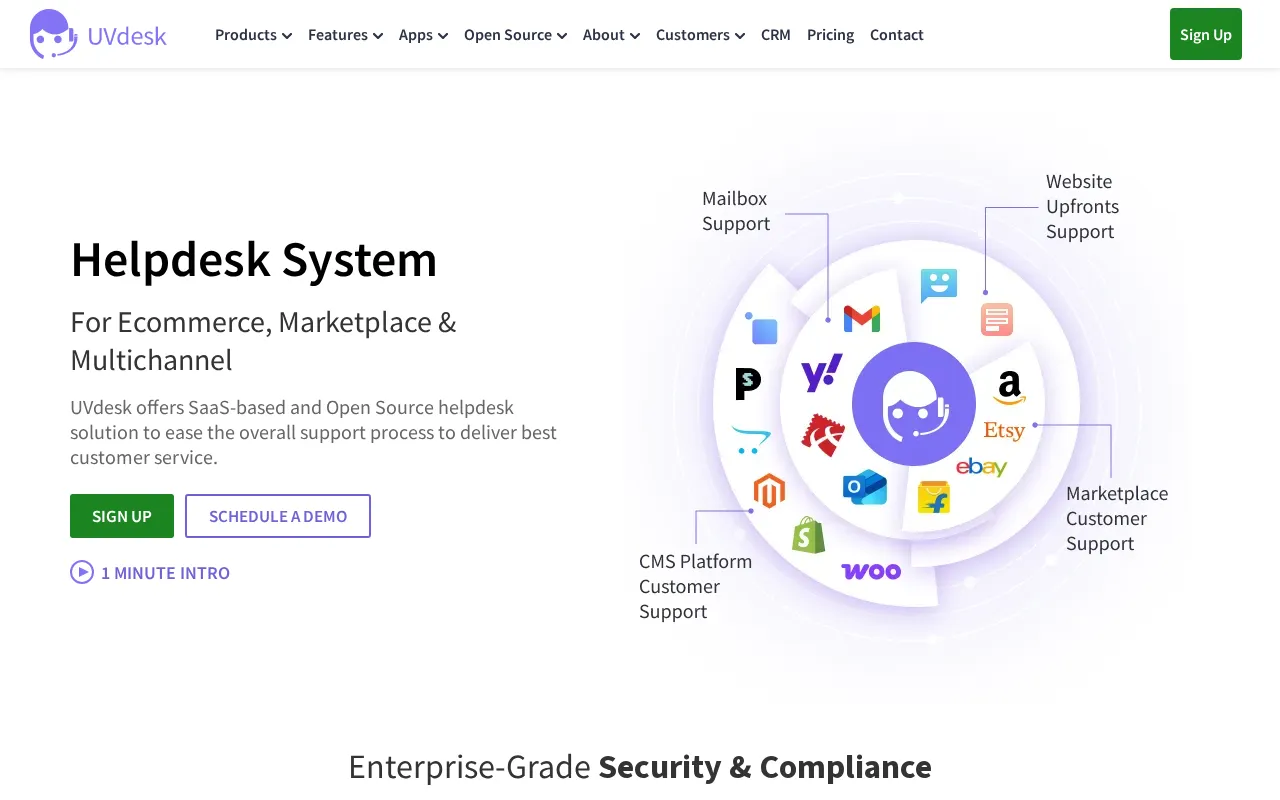
UVdesk is a ticketing help desk from Webkul, sold hosted per agent or as a free open-source edition built on PHP and Symfony that you run yourself. Email, website forms and marketplace messages become tickets, with a knowledge base, workflows and apps that fetch orders from online stores.
UVdesk’s open-source edition is free for any number of teammates, with PHP and Symfony code you can change, but its apps lean toward online stores, fetching orders from Shopify, Magento and WooCommerce. Hosted Pro is $8 an agent on annual billing, and its plans list no AI that answers.
- Best for
- Online sellers who want tickets from email, their store and marketplaces such as Amazon in one place, hosted or on their own PHP server.
- How it bills
- Hosted plans are per agent a month with a 2-agent minimum: Pro is $8 on annual billing or $11 month to month, so $22 a month for 2, and Enterprise $15 or $18, so $36 for 2. Pro allows 5 mailboxes and 200 knowledge base articles; Enterprise lifts both limits. The open-source edition is free for any number of agents on your own server, and its apps are sold separately, such as Shopify order lookup for $49 and WhatsApp for $299.
- Free plan
- Yes: free and open source on your own server, and a 30-day hosted trial on Pro
- 3 people, 300 AI replies
- $0 or more a month: 3 agents on free, open-source UVdesk, on a server you run. Hosted, Pro is $24 a month at $8 an agent on annual billing. UVdesk’s plans list no AI, so your team answers all 300 conversations.
Pros
- The open-source edition is free for any number of agents, and you can read and change its PHP and Symfony code.
- Hosted Pro is $8 an agent a month on annual billing, with a 30-day trial and a sign-up that needs no sales call.
- Apps show orders from Shopify, Magento, WooCommerce and other stores on the ticket, and Amazon Seller Central messages arrive as tickets.
- Hosted Pro imports tickets, customers and agents from Zendesk, Freshdesk, Help Scout and osTicket.
Cons
- Its plans list no AI that answers customers. Its AI chatbot is something UVdesk’s team builds for you to order.
- No live chat of its own: a ChatWhizz integration lets a chat operator turn a chat into a ticket.
- Hosted Pro stops at 5 mailboxes and 200 knowledge base articles, and Enterprise costs $15 an agent to lift both.
- Self-hosted, it needs 8 GB of RAM or more, WhatsApp is a $299 module that runs through Twilio, and there is no Stripe app.
Already on UVdesk? See the best UVdesk alternatives.
7. HelpSpot
HelpSpot is an email help desk from UserScape in Poughkeepsie, New York, around since 2005 and used by IT, HR, maintenance and customer support teams. It runs in HelpSpot’s US or EU cloud, or on your own Windows or Linux servers, at the same price.
HelpSpot isn’t open source, but the same yearly price buys a copy for your own Windows or Linux servers, $899 for 3 agents. That helps when an enterprise customer of your cloud asks exactly where support data is kept.
- Best for
- IT, HR and support departments that work from email, want every feature and AI drafting at one yearly price, and may need the help desk on their own servers.
- How it bills
- One yearly price by number of agents, sold in tiers: 3 agents are $899 a year, 5 are $1,299, 7 are $1,799 and 10 are $2,199. Every feature, AI included, comes in every tier, cloud or self-hosted, with no per-ticket or per-token fees. Qualified non-profits and academic institutions get 15% off.
- Free plan
- No, 21-day trial with no card
- 3 people, 300 AI replies
- $75 a month: 3 agents, HelpSpot’s smallest tier, at $899 a year. HelpSpot’s AI drafts for agents and never sends, so no AI answers customers.
Pros
- One price covers every feature, unlimited tickets and mailboxes, and AI, with free onboarding.
- The same price buys HelpSpot’s US or EU cloud, or a copy you run on your own servers with direct SQL access.
- An official MCP server lets Claude or ChatGPT search, update and close requests and edit knowledge base pages.
- A 90-day money-back guarantee, and phone support from HelpSpot’s own team on every plan.
Cons
- No AI answers customers: the AI Composer drafts replies, and an agent reviews and sends every one.
- No live chat, WhatsApp or voice. Requests come in by email, the portal or the API.
- Sold a year at a time, and only in tiers: a fourth agent moves you from $899 to $1,299 a year.
- No free plan, no Stripe integration, and Shopify only through a sample script you set up yourself.
Already on HelpSpot? See the best HelpSpot alternatives.
8. Deskpro
Deskpro is a help desk from Deskpro Ltd in London for customer support, IT, HR and internal operations teams. It sells Deskpro Cloud, and Deskpro Private, which you host on-premise or in your own private cloud.
Deskpro Private is a complete help desk managed by your organization that runs where you decide, on-premise or in a private cloud, for when an enterprise customer of your cloud insists on it. Private is priced on request, and Deskpro Cloud’s Team plan needs at least 5 agents.
- Best for
- Organizations that run support for several departments and need the help desk, and its AI, inside their own infrastructure.
- How it bills
- Deskpro Cloud is per agent a month: Team is $39 with at least 5 agents, Professional $59 with at least 10, and Enterprise $99 with at least 25. AI features and the AI chatbot start on Professional, and the tokens they use are billed by OpenAI or your own AI provider, with no Deskpro markup. Deskpro Private is priced on request.
- Free plan
- No, 14-day trial with no card
- 3 people, 300 AI replies
- $592 or more a month: 10 Professional agents at $59, the plan’s minimum and the first with the AI chatbot, plus about $2 of AI tokens for 300 AI answers, which Deskpro estimates at $0.0067 each.
Pros
- Email, live chat, phone, WhatsApp, SMS, social media, Slack and Microsoft Teams come on every plan, Team included.
- Deskpro Private runs the same help desk on-premise or in your own private cloud, and its AI can use a model you host.
- AI is billed by the tokens it uses, never per resolution, and you can bring your own AI provider.
- Every plan’s help center has a knowledge base, guides, news and a community forum.
Cons
- Every plan has a seat minimum: a team of 3 pays for 5 agents on Team.
- The AI chatbot, AI drafts and summaries need Professional, at least $590 a month before tokens.
- No official MCP server for your own AI agent, and no Stripe app in its marketplace.
- Cancelling means emailing support, with no refund for unused time, and Deskpro then deletes your data.
Already on Deskpro? See the best Deskpro alternatives.
9. Plain
Plain is a support platform for B2B software companies. It answers customers in Slack, Microsoft Teams, Discord, email, chat and a help center, with an AI customer agent and a GraphQL API that does everything its app can.
Plain adds Discord as a support channel on Frontier, its quoted plan, beside Slack channels on every plan, for a company whose users gather in a community server. Foundation stops at 5 seats, and there’s no free plan.
- Best for
- B2B software teams that support customers in shared Slack or Teams channels and want engineers and AI agents building on its API.
- How it bills
- Per member seat: Foundation is $45 a month on annual billing ($55 monthly) for up to 5 seats with 1,000 credits, and Horizon $99 ($139 monthly) for 3 to 10 seats with 2,500 credits; Frontier is quoted. Each customer agent resolution uses 100 credits, extra credits are $10 per 1,000, and viewer seats are free.
- Free plan
- No, 7-day trial
- 3 people, 300 AI replies
- $425 a month: 3 Foundation seats at $45 on annual billing, plus 29,000 credits at $10 per 1,000 for 300 customer agent resolutions beyond the 1,000 credits included.
Pros
- Slack, Microsoft Teams and Discord work as support channels next to email, which suits B2B customers.
- Its official MCP server can reply, add notes, assign, close and write help center articles, signed in as your own user.
- A customer agent resolution is charged only after the thread stays done for 7 days with no teammate stepping in.
- Viewer seats are free and unlimited, and Linear, Jira, GitHub and incident.io link to threads.
Cons
- Its price list has changed four times since December 2025, most recently raising Foundation’s seat price and halving its included credits.
- No free plan, and the trial shrank from 14 days to 7 in 2026.
- No phone, WhatsApp, SMS, Shopify or Stripe.
- Foundation stops at 5 seats and 2 email addresses, so a sixth teammate means Horizon at $99 a seat.
Already on Plain? See the best Plain alternatives.
10. DocsBot
DocsBot turns your docs, website and other content into AI agents that answer customers in a chat widget, Slack or WhatsApp. When a customer needs a person, it hands them to the help desk widget you already use, such as Help Scout, Zendesk or Intercom.
DocsBot can answer self-hosters from your docs on the website, in Slack or in Telegram, and learn from solved Help Scout or Freshdesk tickets. The free plan’s 100 AI credits a month let a project test AI on its docs before paying.
- Best for
- Teams happy with their help desk that want an AI answering from their docs on the website, with hard questions passed to that help desk.
- How it bills
- Personal is $49 a month for 1 team user and 5k AI credits, Standard $149 for 5 team users and 15k, and Business $499 for 10 team users and 60k, with 2 months free on annual plans. A chat message starts at 1 credit and uses more on larger models and AI actions, and each 5k more credits cost $49 a month. Extra team users are $19 each, on Business and Enterprise only.
- Free plan
- Yes: 1 user, 100 AI credits a month
- 3 people, 300 AI replies
- $149 or more a month: Standard at $149, the first plan with escalation tickets for your help desk, using 300 of its 15k AI credits at 1 credit a message. Your help desk’s seats come on top.
Pros
- A free plan with 100 AI credits a month, and a 14-day money-back guarantee on paid plans.
- It learns from dozens of content sources, such as Notion, Confluence, Google Drive, Zendesk Guide and solved Help Scout or Freshdesk tickets.
- On Standard, its widget hands a customer to your Help Scout, Zendesk, Intercom, Freshdesk, HubSpot, LiveChat or Gorgias widget, with the chat history and an AI-written ticket.
- It answers in Slack, Messenger, WhatsApp and Telegram from Personal, and adds realtime voice agents and Stripe billing actions on Standard.
Cons
- DocsBot is not a help desk: the teammate who takes over answers in another tool, billed separately.
- When the month’s AI credits run out, it stops answering and shows customers an error, unless you turn on auto-add.
- Standard stops at 5 team users, and extra users are sold only from Business at $499 a month.
- Removing DocsBot branding from the widget needs Business.
Already on DocsBot? See the best DocsBot alternatives.
11. Help Scout
Help Scout is a help desk with shared inboxes, a Docs help center and Beacon, a widget for chat and help articles. Scout, its AI agent, answers chat from your help content and is billed per resolution.
Help Scout’s free plan gives 5 users an inbox and a Docs site, enough for the maintainers who handle cloud billing, though it stops at 100 contacts a month. Scout, its AI, answers chat only, with email still to come.
- Best for
- Support teams that think in tickets and want a calm shared inbox, a help center and live chat, with a free plan to start on.
- How it bills
- Standard is $25, Plus $45 and Pro $75 a user a month on annual billing, which saves 16%. Pro needs at least 10 users and a demo. Scout costs $0.75 per resolution, free for a new account’s first 3 months.
- Free plan
- Yes: 5 users, 1 inbox, 100 contacts a month
- 3 people, 300 AI replies
- $300 a month: 3 Standard users at $25 on annual billing, plus 300 AI resolutions at $0.75.
Pros
- A free plan for up to 5 users, with 1 inbox, a Docs site and 100 contacts a month.
- Agents can refund, cancel or edit recent Shopify orders, and refund Stripe payments or cancel subscriptions, from the sidebar.
- Standard brings email, live chat, SMS, WhatsApp, Instagram and Messenger into one inbox.
- You can cap AI spending each month, and Scout switches off when it reaches the cap.
Cons
- Its official MCP server is read-only: your own AI can search conversations and Docs, but can’t reply, add notes or close.
- Scout answers website and in-app chat only, and lists email as “Coming Soon”.
- Scout can’t look up orders or act in other tools yet: its connection to payment processors and CRMs is still to come.
- Seats and AI are billed separately, so the bill grows with every user and every resolution.
Already on Help Scout? See the best Help Scout alternatives.
12. tawk.to
tawk.to is free live chat and ticketing software for websites, with a hosted knowledge base. It makes its money from paid add-ons, such as AI Assist, white label and hired chat agents, billed per website.
tawk.to is free for any number of teammates, with ticketing and a hosted knowledge base, so a project with no support budget can still offer chat. The tawk.to badge stays unless you pay $29 a month per property, and API access has to be requested.
- Best for
- Small businesses that want website chat for any number of agents at no cost, and don’t mind the tawk.to badge.
- How it bills
- Chat, ticketing and the knowledge base are free for any number of agents. AI Assist is free for 100 credits a month, then $29, $99 or $399 a month ($290, $990 or $3,990 a year) for 1,000, 5,000 or 20,000 credits, and a reply on the default Auto model uses 3.
- Free plan
- Yes: unlimited agents and chats, about 33 AI replies a month
- 3 people, 300 AI replies
- $24 a month: AI Assist Growth at $290 a year, whose 1,000 monthly credits cover 300 replies at 3 credits each on the Auto model. Seats are free.
Pros
- Free for any number of agents, chats and websites, with ticketing and a hosted knowledge base.
- WhatsApp, Messenger, SMS through Twilio and email share one inbox, and the AI answers on chat, WhatsApp, SMS and Messenger.
- Its Shopify app adds a tab where agents check orders, refund and cancel during a chat.
- Hired chat agents start at $1 an hour if you want someone else to answer.
Cons
- AI Assist charges per reply, and once credits run out it stops joining new conversations.
- The “Powered by tawk.to” badge stays unless you pay for white label, $39 a month or $348 a year for each website.
- No official MCP server, and REST API access must be requested and approved first.
- Add-ons are billed per website, so each extra site pays again.
Already on tawk.to? See the best tawk.to alternatives.
13. Crisp
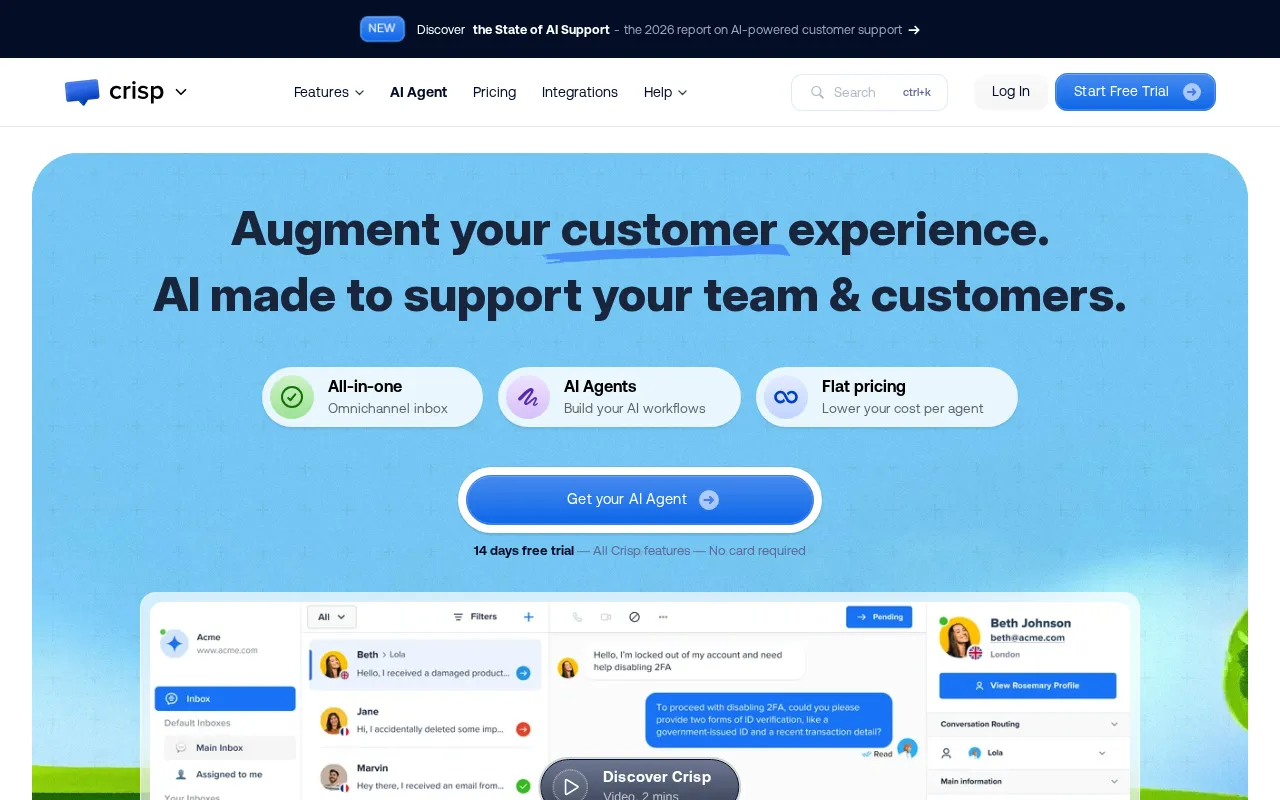
Crisp is a French customer support platform built around a website chat widget, with a shared inbox, many messaging channels and Hugo, its AI agent.
Crisp’s free plan gives a project 2 seats of website chat but no email inbox, so cloud customers who email you need Mini at $45 or above. Essentials, at $95 a month for 10 seats, adds a knowledge base and an MCP server your maintainers’ AI agents can use.
- Best for
- Small teams that start with free website chat and want WhatsApp, Instagram, SMS and phone in the same inbox later.
- How it bills
- Per workspace a month: Mini is $45 with 4 seats, Essentials $95 with 10 and Plus $295 with 20, including $5, $25 and $75 of AI credits (about 90, 450 and 1,350 Hugo conversations). Extra seats are $10 each, sold on Plus only, and Hugo past the credits runs on Pay-As-You-Go at about $0.05 to $0.10 a conversation.
- Free plan
- Yes: 2 seats, chat only, no AI
- 3 people, 300 AI replies
- $66 or more a month: Mini at $45 for 4 seats with about 90 Hugo conversations in its credits, plus about 210 more at about $0.10 each.
Pros
- One price per workspace, with 10 seats on Essentials for $95 a month.
- WhatsApp, Instagram, Messenger, SMS, Telegram and phone sit in the same inbox from Essentials.
- Its official MCP server can read, reply, add notes, resolve and write help center articles.
- Hugo can look up orders and refund through Shopify, WooCommerce, PrestaShop and Stripe, after a one-time code checks the customer.
Cons
- The free plan has no email inbox and no AI, and Mini has no help center, WhatsApp or MCP server.
- Hugo stops answering when the month’s credits run out unless you turn on Pay-As-You-Go, whose rates aren’t published.
- Stripe data in the inbox comes only with Plus at $295 a month.
- Crisp’s terms refund no fees, monthly or yearly.
Already on Crisp? See the best Crisp alternatives.
14. Zoho Desk
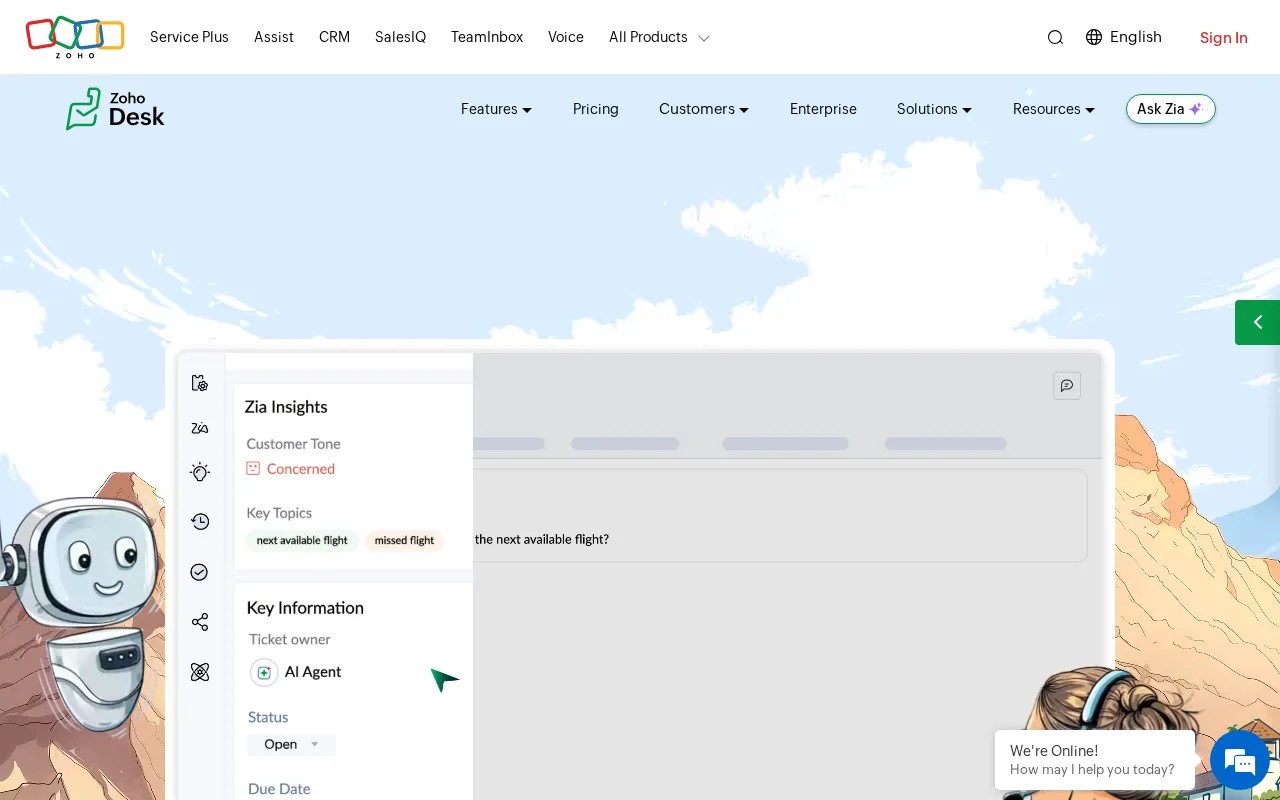
Zoho Desk is the help desk in Zoho’s suite of business apps, with tickets from email, social media, chat, WhatsApp and phone, a multilingual help center, and Zia, Zoho’s AI.
Zoho Desk’s free plan takes email for 3 users, and Professional publishes a help center in over 40 languages, useful when a project’s users write from everywhere. Zia’s full AI also waits for Professional.
- Best for
- Budget-minded teams that want a full ticketing suite with workflows and SLAs, especially if they already use other Zoho apps.
- How it bills
- Per user: Express is $7, Standard $14, Professional $23 and Enterprise $40 a month on annual billing ($9, $20, $35 and $50 monthly), and light agents are $6 each. Express allows up to 5 users; Standard and above have no user limit. AI agents include up to 30 million free tokens a month. Other generative features run on a key you bring from an AI provider, and Professional and Enterprise add Zia’s own.
- Free plan
- Yes: 3 users, email only
- 3 people, 300 AI replies
- $42 a month: 3 Standard users at $14 on annual billing, the first plan with live chat and Answer Bot, which answers customers from your help center. Zoho publishes no per-answer fee.
Pros
- Low seat prices: Express is $7 a user and Standard $14 on annual billing, with a free plan for 3 users.
- Standard adds live chat, WhatsApp, Telegram and other messaging apps, and Professional adds phone support.
- Workflows, SLAs and several departments, with a help center you can publish in over 40 languages on Professional.
- Zoho’s official MCP server is free and can read tickets, send replies and add comments.
Cons
- Express stops at 5 users, so a sixth teammate moves everyone to Standard at $14.
- Zia’s full AI needs Professional, and the agent that answers email tickets is open only to selected accounts.
- The MCP server has no tools for help center articles or saved replies, and every call uses daily API credits.
- Express has no live chat, and the free plan covers email only.
Already on Zoho Desk? See the best Zoho Desk alternatives.
15. Freshdesk
Freshdesk is Freshworks’ help desk: email ticketing with a customer portal and knowledge base, with Freshdesk Omni adding chat, phone and messaging. Its Freddy AI agent answers customers and is billed per session.
Freshdesk lets core contributors outside support pitch in cheaply: day passes start at $2, and Pro adds up to 5,000 external collaborators. Plans start at Growth, $19 an agent on annual billing, and Freddy AI sessions cost $49 per 100 after the first 500.
- Best for
- Teams that want a full ticketing help desk with SLAs, routing and a knowledge base, and chat and messaging for less per agent than Zendesk’s Suite Team.
- How it bills
- Per agent on annual billing: Growth is $19, Pro $55 and Enterprise $89 a month, or $29, $79 and $119 on Freshdesk Omni with chat and messaging. Freddy AI agent sessions cost $49 per 100 after 500 free ones, once per account. Voice is $15 to $69 more an agent, and MCP actions $15 per 1,000.
- Free plan
- No, 14-day trial
- 3 people, 300 AI replies
- $204 a month: 3 Growth agents at $19 on annual billing, plus 3 packs of 100 AI sessions at $49, on email only.
Pros
- SLA policies, custom dashboards, skill-based routing and audit logs come on its higher plans, with skill-based routing at $89 an agent where Zendesk asks $115.
- Freshdesk Omni adds chat, phone, WhatsApp, Messenger, Instagram and Line to the same tickets.
- Day passes from $2 let occasional helpers answer without a full seat.
- Its official MCP server can reply, add notes, update tickets and write knowledge base articles.
Cons
- List prices rose early in 2026, from $15 to $19 an agent on Growth, and the free plan is gone.
- Freddy AI agent costs 49 cents a session after the first 500, which never come back.
- Every MCP call counts as an action, and Growth includes only 1,200 a year.
- Fees are non-refundable, and a cancellation only takes effect at the end of your term.
Already on Freshdesk? See the best Freshdesk alternatives.
16. Zendesk
Zendesk is a customer service suite for email, messaging, live chat, social and voice, with AI agents that answer customers and are billed per automated resolution.
An early-stage open-source startup can get a 6-month trial of Zendesk Suite for up to 50 agents through its startup program. Data exports stay off until the account owner asks support, so check that before years of cloud customers’ history pile up there.
- Best for
- Growing and large teams that need voice, many channels, 1,800+ apps and integrations, and enterprise controls to grow into.
- How it bills
- Per agent: Support Team is $19, Suite Team $55 and Suite Professional $115 a month on annual billing ($25, $69 and $149 monthly). Each agent brings 5 automated resolutions a month (10 on Professional), then each costs $1.50 committed or $2.00 pay as you go. Copilot is $50 more an agent.
- Free plan
- No, 14-day trial
- 3 people, 300 AI replies
- $485 a month: 3 Support Team agents at $19 on annual billing, plus 285 automated resolutions at $1.50 committed beyond the 15 included, on email only.
Pros
- Email, messaging, live chat, WhatsApp, social and voice sit in one Suite, and AI agents can answer on email, messaging or voice.
- Its marketplace lists 1,800+ apps, partners and integrations.
- Agents refund and cancel Shopify orders inside a ticket, and an admin can connect Zendesk’s AI agents to Stripe’s MCP server.
- The 14-day trial opens every Suite Professional feature, Copilot included, and startups can get 6 months of Suite free for up to 50 agents.
Cons
- Every agent is a seat, and each automated resolution past the 5 per agent a plan includes costs $1.50 to $2.00.
- No official MCP server for outside AI tools yet: Zendesk announced one in May 2026 for early access and has published no tools for it.
- Data exports are off until the account owner asks support, and the export tools aren’t on Team plans.
- Zendesk gives no refunds or credits for unused seats or time.
Already on Zendesk? See the best Zendesk alternatives.
17. Jira Service Management
Jira Service Management is Atlassian’s service desk for IT, HR and other internal teams, sold in its Service Collection: requests by email, portal, widget, Slack and Microsoft Teams, with on-call schedules on every plan, assets on paid plans and change management from Premium, and an AI agent for customers billed per resolution.
If your project tracks work in Jira rather than GitHub Issues, its service desk takes requests by portal, email, Slack and Microsoft Teams, free for 3 agents, with a knowledge base on Confluence that needs no Confluence license.
- Best for
- IT and engineering teams already on Jira and Confluence that run incidents, changes, problems, assets and on-call in one place.
- How it bills
- Free for 3 agents. Up to 15 agents, Standard is $26.90 and Premium $61.60 an agent a month, or on annual billing Standard is $800 a year for 1 to 3 agents, $1,350 for 4 to 5 and $2,700 for 6 to 10. Enterprise is billed annually only, listed from 201 agents at $185,000 a year and bought through sales. The Customer Service AI Agent costs $1 per resolution from the first one, and Rovo credits past a plan’s allowance cost $0.01 each.
- Free plan
- Yes: 3 agents, no AI agent
- 3 people, 300 AI replies
- $367 a month: Standard for 1 to 3 agents at $800 a year on annual billing, plus 300 AI agent resolutions at $1.
Pros
- Incidents, problems, changes, assets and on-call sit next to Jira, where engineering already works.
- Free for 3 agents with unlimited customers, a portal, email, Slack and Microsoft Teams.
- The Customer Service AI Agent charges nothing when it fails to resolve a conversation.
- Its knowledge base runs on Confluence without buying Confluence.
Cons
- Live chat and the virtual service agent need Premium at $61.60 an agent.
- The Customer Service AI Agent bills $1 for every resolution, with none included.
- Extra Rovo credits and other usage are billed from December 3, 2026.
- There is no official Shopify app, and Stripe comes only through third-party Marketplace apps.
Already on Jira Service Management? See the best Jira Service Management alternatives.
18. Front
Front is a customer service platform built on shared inboxes, where support, sales and operations teams handle email, chat, SMS and social together. Autopilot, its AI agent, is billed by what it does in each conversation.
Front’s guest accounts let a maintainer who doesn’t do support comment on a cloud customer’s conversation without a paid seat. Starter allows one channel type and stops at 10 seats.
- Best for
- Teams that run many shared addresses, bring in colleagues outside support, and want people and AI agents working one queue.
- How it bills
- Starter is $25 a seat a month for up to 10 seats, Professional $65 for up to 50 and Enterprise $105, on annual billing ($35 and $85 monthly; Enterprise is annual only). Autopilot charges $0.39 to hand off and $0.89 to resolve a conversation, and Copilot is $20 a seat.
- Free plan
- No, 14-day trial
- 3 people, 300 AI replies
- $342 a month: 3 Starter seats at $25 on annual billing, plus 300 Autopilot resolutions at $0.89.
Pros
- Its official MCP server can search, draft, send, comment, assign, tag and archive, with sending behind its own permission.
- Guest accounts let colleagues outside support comment on a conversation without a paid seat.
- Autopilot answers on email, chat, SMS, WhatsApp and Slack, and its 30-day trial covers up to 1,000 resolutions.
- Outside AI agents built with Claude, OpenAI or Sierra can be assigned conversations like a teammate, on every plan.
Cons
- Starter stops at 10 seats and one channel type, so an 11th seat or a second channel means Professional at $65 a seat.
- Autopilot charges for handoffs too, not only for conversations it resolves.
- There is no export you can run yourself: Support makes one, and it leaves out contacts, templates, tags and individual inboxes.
- Monthly and annual payments are nonrefundable, even if you cancel early.
Already on Front? See the best Front alternatives.